2006 Nickel Error List with Pictures

One 2006-P nickel arrived at the press missing a straight section, then received its design off center. That two-error coin sold for $431.25 in September 2010.
The 2006 Jefferson Nickel errors below range from small raised lines to visibly misshapen coins. Estimated values span $5–$600.
This is the first year of Jefferson’s modern forward-facing portrait. Read on to compare that design, Monticello, and the edge without confusing normal features with mistakes.
1. 2006 Jefferson Nickel A Design Shifted on One Face
A narrow rim on one side and a wide rim on the other can suggest that a stamping tool moved. If the opposite design remains centered, the blank itself may have stayed in place.
This is a misaligned die; a die is the steel tool used to stamp one face. Year reports include this type without fixing one mint or direction.
The front and back must be compared together. A whole blank sitting off center creates a different relationship between the two faces.
Wear, impacts, and a tilted photograph can also change how even the border appears.
Estimated Value
For a visible original misalignment, estimate $5–$75. Tiny differences in rim width on a worn coin can add little to its ordinary value.
The estimate concerns a clear tool shift, rather than a verified auction result for one particular 2006 example. Surface condition and how easily both faces show the contrast influence buyer interest.
A damaged edge should not inherit the same range just because it looks uneven. Establish the relationship between the two designs before assigning a premium.
How to Identify
Lay the coin flat and compare Jefferson’s position with Monticello’s before judging the rim. A design shifted on one face beside a centered opposite face suggests movement of one stamping tool.
Use a 10× magnifier to trace both borders, checking whether a dent or worn rim is creating the apparent shift. Calipers and a scale should show an ordinary outline near 21.21 millimeters and 5 grams, with a plain edge.
Take straight-down photographs so a tilted camera does not exaggerate one side of the rim. If both designs shift together beside solid unused metal, compare the coin with an off-center strike instead of treating it as one displaced tool.
2. 2006 Jefferson Nickel Raised Facial Lines and Small Back Chips
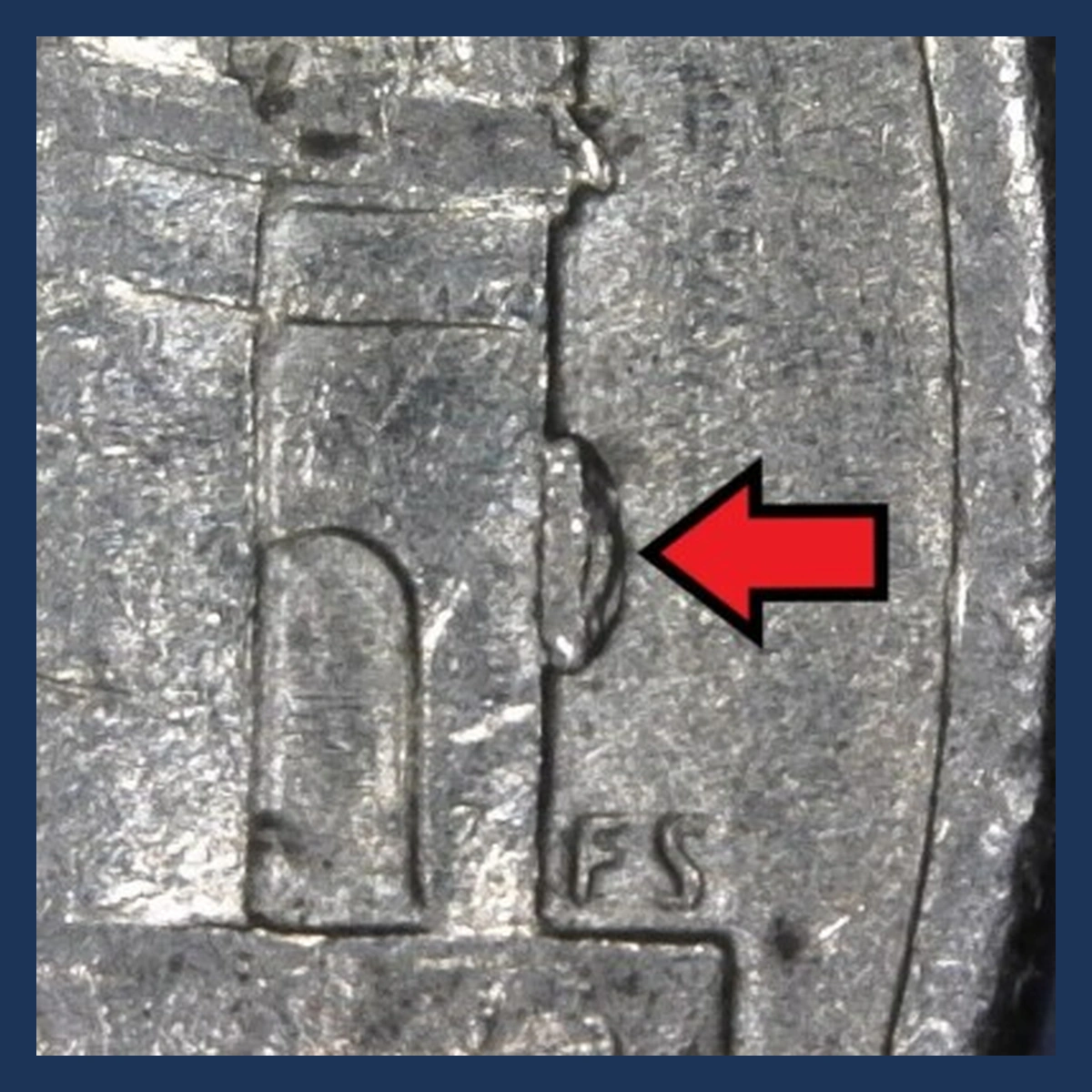
An extra line across Jefferson’s face may stand above the surface rather than cut into it. Denver reports for 2006 describe raised facial cracks.
A crack in the stamping tool lets coin metal enter the opening. The finished coin then carries a ridge where the tool had a gap.
Separate Philadelphia reports describe small raised lumps on the back. These can form where tiny pieces of the tool break away.
The reports do not establish one exact path or back location for every example. A raised facial line and a back lump should be compared as separate patterns.
Estimated Value
For minor genuine cracks and chips, estimate $5–$30, with stronger, attractive features around $30–$100. The extra metal should be clearly visible and original to the strike.
A tiny lump hidden among normal building details generally has less appeal than an easily photographed facial line. These ranges are estimates rather than individual 2006 auction records.
Do not add a complete coin value for every bump. Several small features on one nickel still belong to a single object.
How to Identify
Compare the suspect area with a normal 2006 nickel from the same mint. Ordinary facial contours and building details should not become imagined extra metal.
Use a 10× magnifier under low side lighting. Trace a line’s center to distinguish a raised ridge from a scratch with metal pushed along its sides.
For a lump, examine its texture and connection to the surrounding design. Leave possible dirt untouched instead of scraping the spot.
A loose coin should be near 5 grams and 21.21 millimeters on a scale and calipers. Inspect the plain edge and opposite face for a later hit.
Keep the specific front or back pattern with its mint letter in photographs. The separate reports do not require both features on one coin.
3. 2006 Jefferson Nickel Repeated Portrait and Doorway Details
An extra outline can appear beside part of Jefferson or at Monticello’s door. If the repetition was built into the stamping tool, collectors call it a doubled die.
The tool can reproduce that same small feature on many coins. The finished nickel does not need a second misplaced strike.
Reports for 2006 mention the earlobe, portrait, and lettering on the front, plus the central door frame on the back. Mint and catalog assignments must stay with the specific matching example.
Do not borrow one mint’s photograph to name another mint’s coin. Thick letters alone can have a different cause.
Estimated Value
For a clearly matched minor variety, estimate $10–$50, rising to $50–$150 for stronger, attractive examples. These figures assume genuine repeated tool detail rather than flat movement doubling.
The year reports do not supply one shared auction result for all the front and back patterns. Each needs its own identification before the range is useful.
A photograph showing an extra rounded outline is more persuasive than an enlarged blur. Scratches or wear can make a small variety much harder to recognize.
How to Identify
Choose the mint and finish first. Ordinary P and D coins need different comparisons from satin collector coins with a soft sheen or specially made S Proofs.
Under a 10× magnifier, keep the complete earlobe or doorway in view while tracing the extra line. The enlarged detail needs a clear position within the normal design.
Flat shelves beside letters can come from movement during striking. Shadows also change when you move the lamp, while a real raised outline stays part of the metal.
A scale and calipers should show about 5 grams and 21.21 millimeters on a loose coin, with a plain edge. The repeated shape must match the same mint and finish, rather than a catalog name borrowed from another example.
4. 2006 Jefferson Nickel Surface Color from Improper Annealing
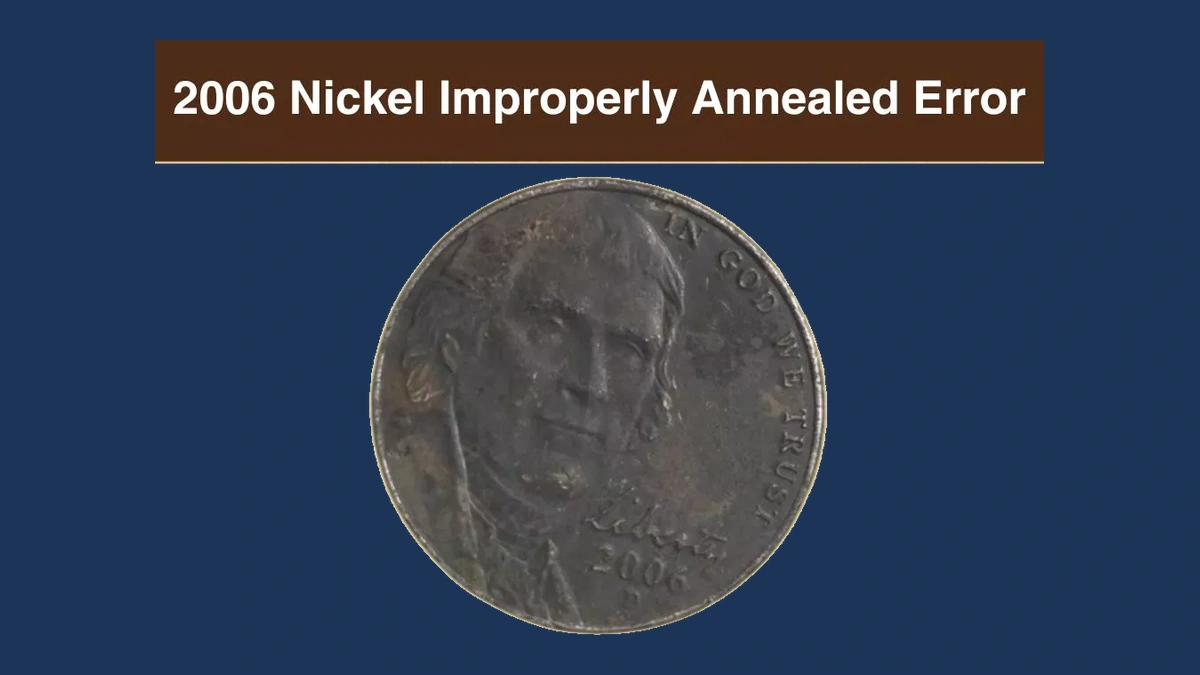
Heating prepares a blank for striking by making its metal easier to shape. This step is called annealing.
If conditions are wrong, the surface can develop an unusual color. Philadelphia reports describe this type for 2006, and a dealer list records a Denver example graded PCGS MS64.
The grade describes an unworn coin with marks; it does not identify a particular shade. Each example’s surface should be considered separately.
A normal nickel has copper and nickel mixed throughout, without a removable outer layer over a copper core. Later heating, chemicals, and burial can also change its color.
Estimated Value
Estimate $20–$200 for a properly identified Mint heating error. Strong original color and clean surfaces support the upper part of that range.
A historical Fred Weinberg price list offered the 2006-D PCGS MS64 example for $175. That was a dealer asking price, not a confirmed sale.
As a different-year sale comparison, a 2005-D example brought $119 in December 2022. Neither figure authenticates a newly found dark nickel; the original cause still needs to fit the surface.
How to Identify
If the coin is in a grading holder, read whether its label names improper annealing. A numerical grade describes condition, so it cannot establish the heating error by itself.
For a loose coin, check 5 grams and 21.21 millimeters with a scale and calipers before judging the surface. An unusually small or light piece needs a different investigation.
Use a 10× magnifier beside letters to look for paint, coatings, or corrosion. Compare both faces and the plain edge under neutral light.
Do not scratch or polish a test patch.
Keep the original surface for specialist examination, since even a uniform shade cannot distinguish Mint heating from all later treatments.
5. 2006 Jefferson Nickel Design Blocked by Foreign Material
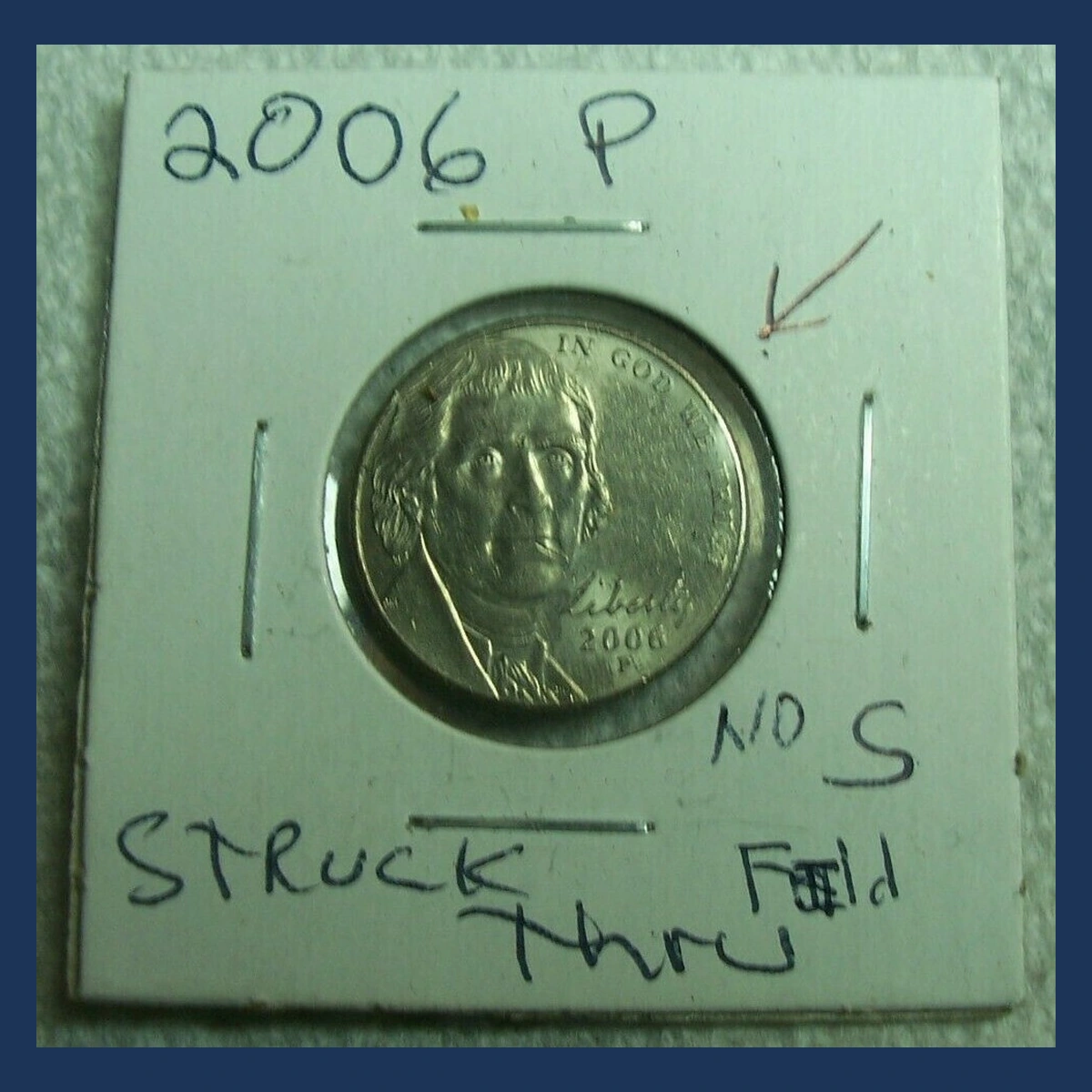
A small obstruction can keep the blank from receiving part of Jefferson’s design. The resulting area may be sunken or have less detail than the surrounding surface.
This is a strike-through. Material was caught between the blank and stamping tool when the press came together.
Philadelphia and Denver year reports describe this type without establishing one specific object or shared position. A narrow mark should not automatically be called wire, nor a textured patch cloth.
A new raised lump points toward a different explanation. Scraping, a weak strike, and ordinary wear can also remove detail from the portrait.
Estimated Value
For a clear original blocked area, estimate $10–$75, with a larger, distinctive impression around $75–$250. The date and nearby design should remain readable enough for comparison.
These are estimated ranges for the reported type, not prices attached to an identified 2006 object. The amount of interrupted design and overall preservation affect interest.
A later gouge does not qualify because it is deep or unusual. The impression must fit material present during striking rather than damage to a finished nickel.
How to Identify
Look beyond the mark before enlarging it. Compare Jefferson’s cheek and nearby lettering to see whether the whole coin is worn or only one local area lacks detail.
Use a 10× magnifier to follow the boundary between clear and interrupted design. A fresh trench with metal pushed aside can indicate later damage.
Turn the coin over and inspect the opposite face for an impact at the same position. Check the plain edge as well.
For a loose specimen, use a scale and calipers against 5 grams and 21.21 millimeters. Keep any material that remains attached in place.
Photograph the entire affected feature with sharp surrounding detail. Name the obstruction only when its actual shape or texture supports that identification.
6. 2006 Jefferson Nickel A Broadstrike with Complete Design
The border can spread beyond the normal width when the surrounding ring fails to contain the blank. That ring, called the collar, normally controls the coin’s edge.
Without its full restraint, the struck metal expands. A broadstrike still carries the whole design inside the new outline.
A Philadelphia example is listed by GreatCollections as NGC MS65 with six full steps. MS65 describes an unworn, well-preserved coin; the steps describe sharp Monticello detail.
Those steps are not another error. A normal plain edge is also not enough to identify a broadstrike, because ordinary nickels have plain edges too.
Estimated Value
Allow an estimated $30–$100 for moderate spreading and $100–$300 for an especially clear, attractive example. Shape and original surfaces matter together.
The NGC MS65 Philadelphia listing records a November 2018 auction, but its public page does not display the result. The starting bid is not a sale price.
A different-year 1999-P broadstrike brought $89 in March 2025, providing a modest comparison without assigning that price to the 2006 coin.
How to Identify
Check the outside words first: all should fit inside the enlarged border. Design lost beyond the edge instead suggests an off-center strike.
Use calipers across several spans against the normal 21.21 millimeters, rather than measuring only the widest point. A scale should remain near 5 grams because spreading alone does not remove metal.
Inspect the widened border with a 10× magnifier, watching for hammer marks, crushed lettering, or a squeezed portrait. Later flattening can enlarge a coin without making a genuine broadstrike.
Include both faces and the plain edge in photographs. Look for a complete, naturally spread design; sharply formed steps describe its quality rather than prove how the border expanded.
7. 2006 Jefferson Nickel Clipped Blanks, Including an Off-Center Strike
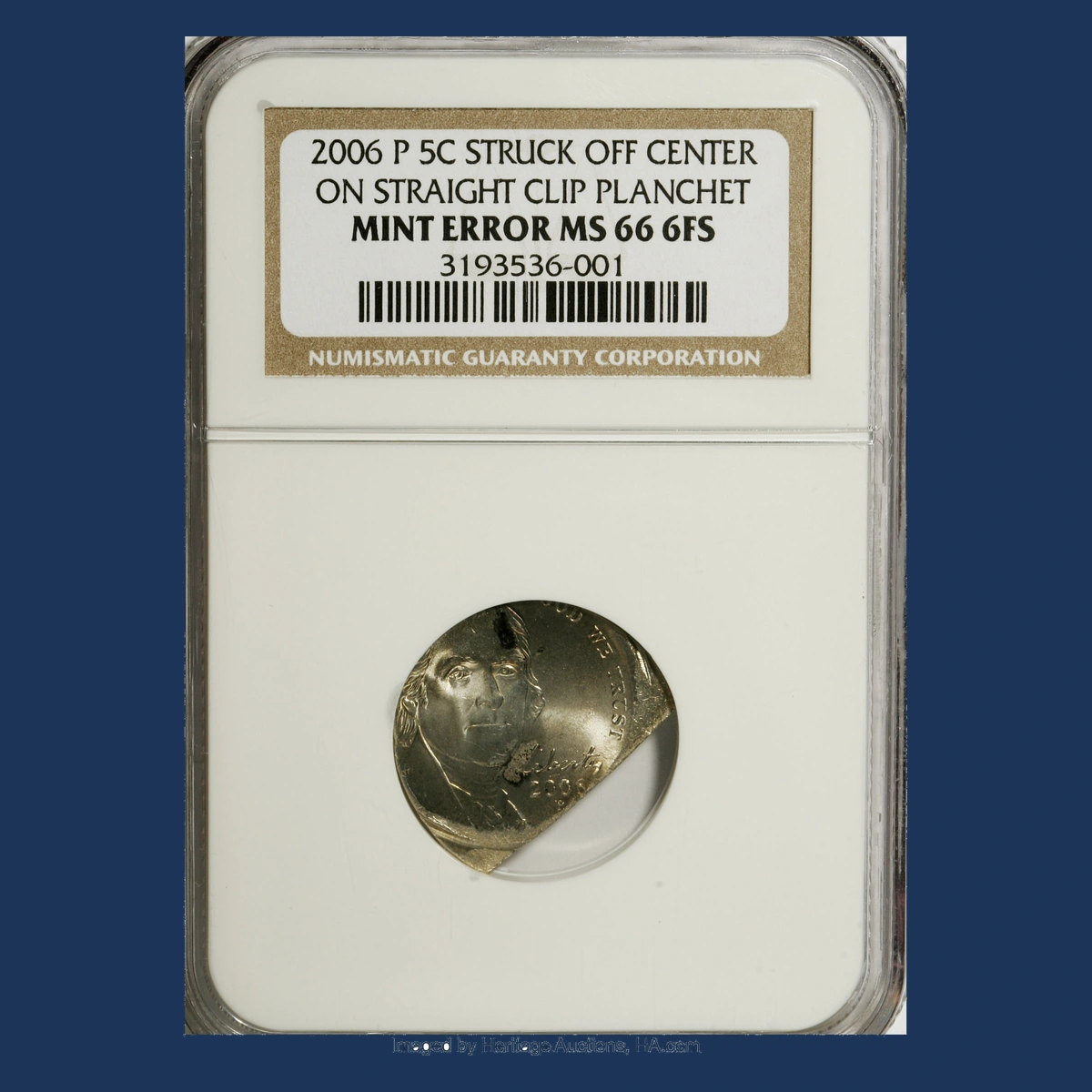
One 2006-P nickel combines two mistakes: a straight section was missing from the blank, then the remaining metal was struck off center. It weighs 3.7 grams.
NGC graded that coin MS66 with six full steps, indicating excellent unworn condition and sharp building detail. The clip and displaced design belong to the same piece.
A separate Philadelphia example has two clips and weighs 4.74 grams. Its ANACS MS63 label describes a different coin with more marks.
The second example should not inherit the first coin’s off-center strike. Neither record establishes one shared direction for the missing sections.
Estimated Value
The straight-clip, off-center nickel sold for $431.25 on September 26, 2010. That result prices its combined features as one coin.
Estimate $25–$200 for straightforward single or double clips and $150–$600 for an attractive clip combined with an off-center strike. The separate 4.74-gram double clip needs its own comparison.
Do not add two full prices for the first coin’s two errors. Its preservation, readable date, and visible combination are considered together.
How to Identify
The two recorded weights offer a starting point: 3.7 grams for the combined error and 4.74 grams for the double clip. Weigh a loose candidate on a scale against those readings and the normal 5 grams.
Use calipers on an intact span against 21.21 millimeters, without measuring across a gap as though it were the diameter.
Next separate actual missing metal from solid metal that received no design. The combined error has a straight missing section as well as the unused area from its off-center strike.
With a 10× magnifier, inspect the plain edge inside each opening for natural boundaries instead of saw or file marks. Verify each gap of the double clip separately; one genuine opening does not authenticate a second damaged spot.
Conclusion
The estimated $5–$600 range for these 2006 nickel errors includes affordable raised lines and a documented clipped, off-center coin. A small extra outline calls for a different check from missing metal or a widened border.
Keep the two recorded clipped coins separate when comparing weight and shape. Preserve the original surface, photograph both faces, and let the visible design guide the explanation before applying a price range.