1972 Nickel Error List with Pictures

A collector nickel can leave the press with overlapping portraits instead of one sharp design. One 1972-S Proof, a specially prepared collector coin, sold for $4,312.50 in January 2008 after receiving two displaced strikes.
The 1972 nickel errors below also include small extra letters, damaged stamping tools, and blanks meant for other countries. Estimated values stretch from $10 to $6,000.
Follow the pictures and checks to see how each mistake differs from a scratch, dent, or altered coin.
1. 1972 Jefferson Nickel Broadstrike
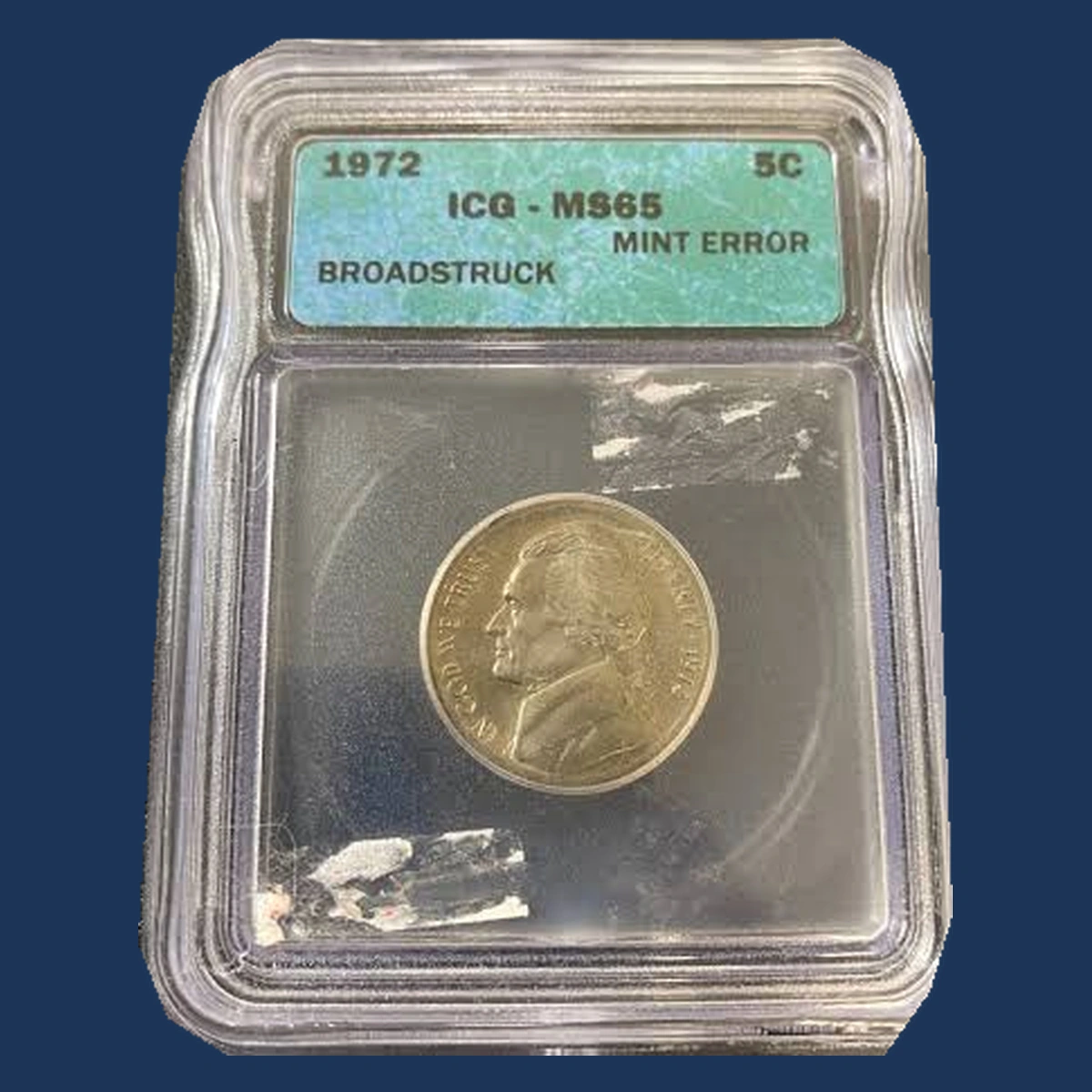
An unusually wide border can show that the blank spread without its normal restraint. The collar, a steel ring around the disk, normally limits this outward movement.
When it fails to contain the metal, the result is called a broadstrike. The design can remain complete within the expanded outline.
A documented no-letter 1972 example was graded MS62 by ANACS, meaning unworn with noticeable marks. It is an ordinary coin made for circulation, not a special Proof.
Flattening a normal nickel later can also make it wider, but changes its finished surfaces.
Estimated Value
Ordinary 1972 broadstrikes are estimated at $10–$200. A slight spread generally has less visual appeal than a wide border around a clear design.
The ANACS MS62 example sold for $57 in July 2021. An earlier MS65 example graded by ICG brought $10 in December 2008.
Those different outcomes show why a numerical grade does not set the price by itself. Shape, surface quality, and demand at the particular sale also matter.
How to Identify
A complete design inside an expanded border is the first feature to compare with a normal nickel. Look at both faces, because a shifted tool can make only one side appear off balance.
Measure a loose coin with calipers against the normal 21.21-millimeter diameter. Weigh it against 5 grams, then examine its plain edge under a 10× magnifier.
The wider metal should retain the texture of an original strike. Scraped surfaces, crushed letters, and a battered edge suggest that someone flattened the coin later.
If part of the design runs beyond the disk and a blank crescent remains opposite it, consider an off-center strike instead. An uneven border alone does not settle which event occurred.
2. 1972 Jefferson Nickel Doubled Dies
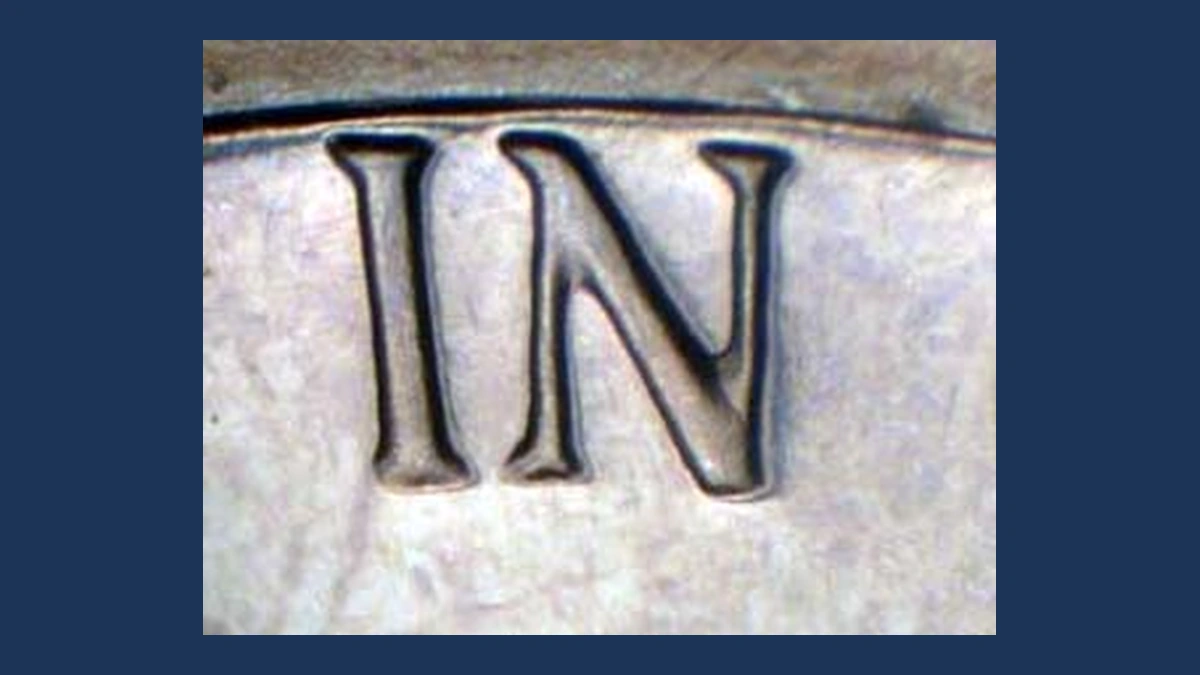
The last 2 in a Denver date can have a close extra outline. Other examples show spread in the back motto, AMERICA, or Monticello’s right side.
These are doubled dies: the steel tools that stamp coins already carried doubled details. The coin itself need not be struck twice.
S Proof examples have their own patterns. Front doubling can affect LIBERTY, the star, date, and small designer initials; back varieties affect the motto, country name, and parts of the building.
A Denver pattern should not be transferred to a shiny S Proof simply because both show doubling.
Estimated Value
For the minor doubled-die types described here, estimate $15–$100 on ordinary Denver examples and $25–$250 on S Proofs. Clear separation and attractive surfaces support the stronger prices.
These are working estimates for matched varieties, not auction records assigned to every catalog number. Faint extra lines can be hard to see on worn or marked coins.
Normal flat doubling caused by movement during striking does not receive the same price treatment as an original doubled tool.
How to Identify
Read the mint letter before enlarging a promising feature. Denver’s close extra 2 and the S Proof’s broader front patterns require different comparisons.
A 10× magnifier should show real extra outlines rather than a flat shelf shaving into a letter. On the back, compare the motto and building together instead of treating normal repeated columns as an error.
Matching small tool marks can help confirm a variety, but they are secondary clues. The doubled feature itself must agree with the photographed example.
For a loose coin, check 5 grams and 21.21 millimeters with a scale and calipers and inspect the plain edge. Then compare the same mint, face, and collector finish, retaining separate photographs when the front and back show different patterns.
3. 1972 Jefferson Nickel Repunched S Mint Mark
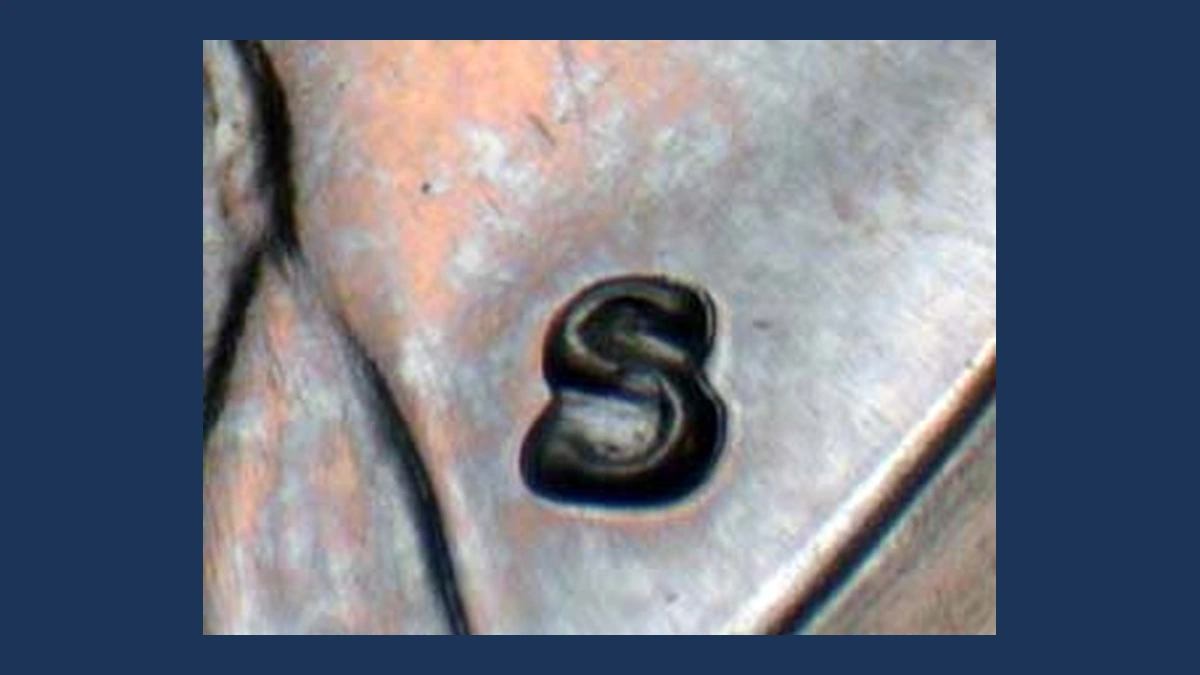
A small extra stroke above the S can be part of an earlier mint-letter impression. In 1972 the mint letter was punched into the stamping tool separately.
If the worker repeated that punch in a different position, traces of the first S could remain. The finished coins then repeated that shape.
Two cataloged S Proof varieties have an earlier impression toward the top. Another has a clockwise-turned impression.
These are repunched mint marks, often shortened to RPMs. A thick S or a dent beside it does not automatically represent a second punch.
Estimated Value
An estimated $20–$250 is a useful range for matched 1972-S repunched-mint-mark Proofs. The strongest examples combine a clearly visible earlier S with clean collector surfaces.
This estimate concerns the reported varieties rather than a confirmed auction result for each one. Closely placed outlines can need magnification, which generally limits their appeal compared with a dramatic wrong-blank error.
Keep the whole S visible in photographs; a cropped bright edge can make a minor feature look much stronger.
How to Identify
Locate the S below the date and photograph the whole letter straight on. Through a 10× magnifier, follow the extra curved stroke rather than judging one bright corner in isolation.
An earlier S above the main letter fits the north-shifted examples, while the turned impression needs its own comparison. Two varieties can share the same general direction without being the same tool.
For a loose Proof, use a scale and calipers to check 5 grams and 21.21 millimeters, and inspect the plain edge without touching its mirrored faces. Match the full earlier letter against a catalog photograph; a flat shelf from movement during striking or a nick beside the S is not another punched letter.
4. 1972 Jefferson Nickel Clipped Blank
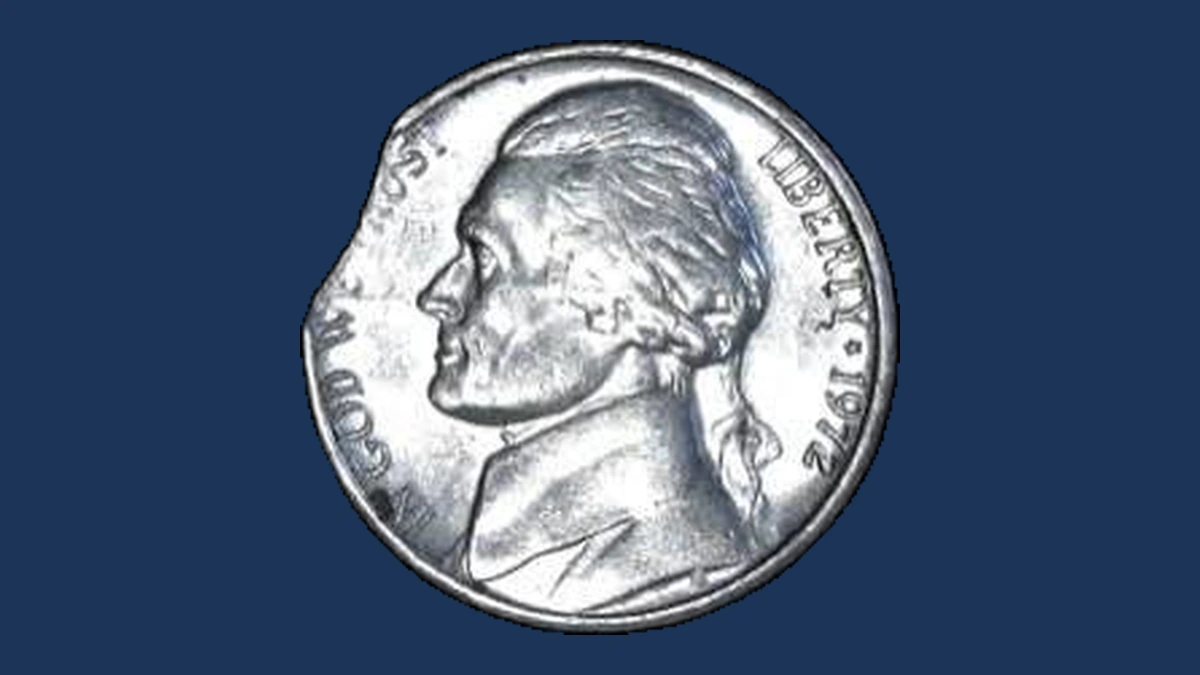
A clipped blank is incomplete before the coin receives its design. Its missing section may leave a curved gap or another shortened portion of the edge.
Year guides include this error for 1972 nickels. The general report does not establish one specific mint, collector finish, or gap shape for every example.
The important feature is how the metal near the missing part was struck. It should reflect a blank that was already incomplete, rather than a finished nickel cut afterward.
The amount of missing metal and the survival of the date affect collector interest.
Estimated Value
For a genuine 1972 clipped blank, estimate $20–$250. Small gaps belong near the lower end; larger, attractive pieces with a readable date can bring more.
A different-year 1997-P nickel with a 20% curved clip sold for $124 in March 2025. It offers a recent comparison for the mechanism, not proof of a particular 1972 specimen’s grade or price.
The range applies after distinguishing an original incomplete blank from a cut or ground coin.
How to Identify
Before calling a gap a clip, follow its two ends into the surrounding design. A later cut may slice through finished letters or leave tool marks across the edge.
Inspect those transitions with a 10× magnifier. Natural metal flow and sometimes a softened rim opposite the gap support a blank that was incomplete before striking.
A loose coin’s weight should reflect the amount of missing metal. Use a scale against the normal 5 grams and calipers across surviving full-width areas against 21.21 millimeters.
Photograph the plain edge along the gap, not just the attractive front view. Do not assign a curved or straight subtype, or an S Proof identity, until the actual shape and surviving mint details support it.
5. 1972 Jefferson Nickel Separated or Folded Surface Metal
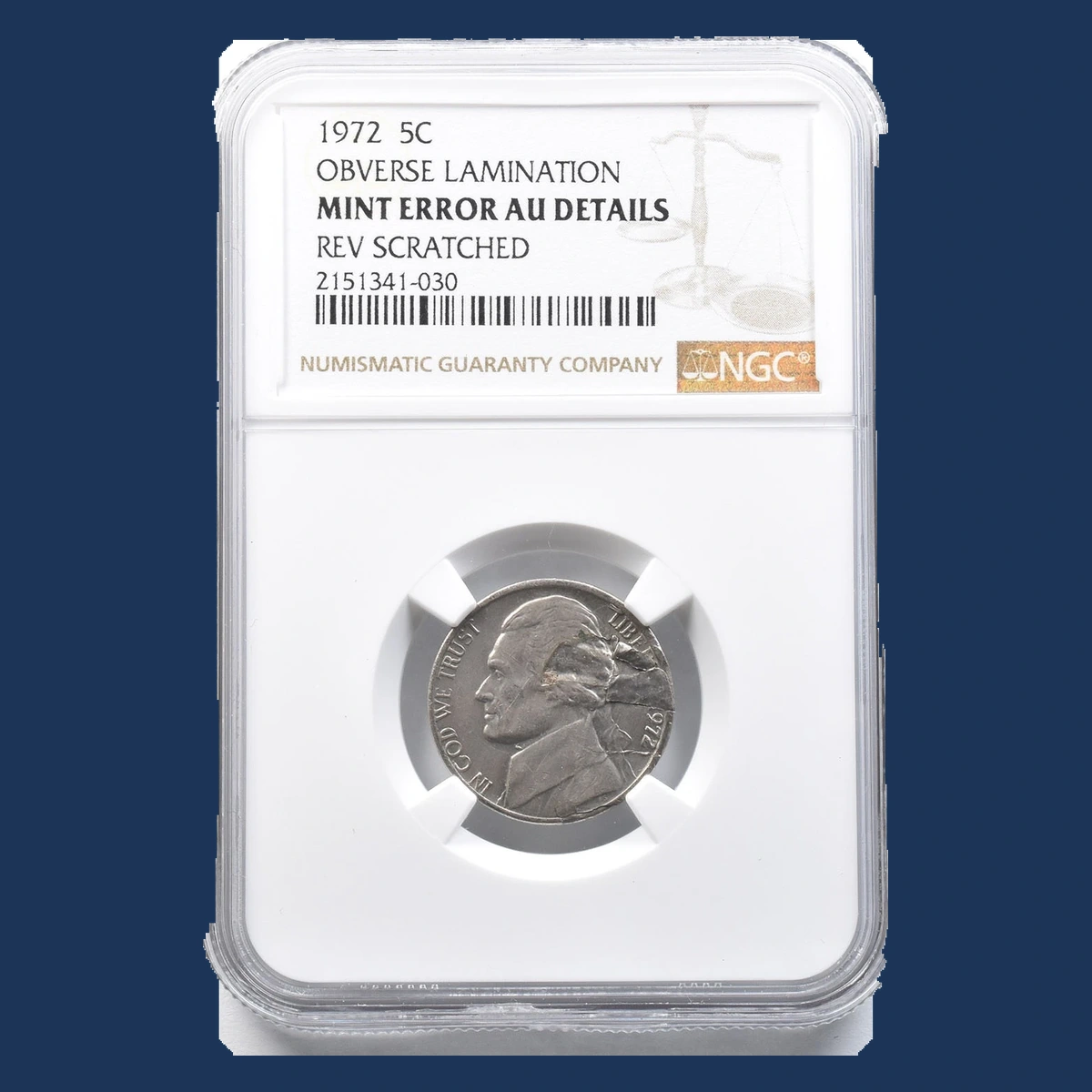
A flaw inside the alloy can let a thin layer separate from the blank. This is a lamination, even though a normal nickel has the same metal mixture throughout.
A no-letter 1972 example was recorded in its original Mint Set packaging. It was described as highly preserved but was not independently graded in that sale.
A separate Denver coin was struck through a folded piece of separated metal on its front. The flap interrupted the design as pressure pressed it down.
Peeling surface metal and a folded flap can look different while sharing the same original separation.
Estimated Value
Local laminations are estimated at $10–$100, with clear folded-flap examples at about $50–$300. The Denver coin graded MS62 sold for $79 in June 2023.
The no-letter lamination appeared in a ten-coin Mint Set lot that brought $24 in August 2011. That is the entire lot price, not an individual nickel sale.
An attached flap should remain in place. Removing it changes the error and can reduce the evidence collectors want to see.
How to Identify
If a flap remains attached, protect it from fingers and packaging pressure. Use a 10× magnifier to examine the break within the metal without lifting the edge.
On the folded Denver type, compare the weak design with the folded area. The relationship between the interrupted strike and the metal boundary matters more than simply finding a rough spot.
A normal nickel is 5 grams, 21.21 millimeters wide, and plain-edged. Weigh and measure only a loose coin with a scale and calipers; keep the packaged Mint Set example sealed.
A coating peeling above finished lettering is different from the nickel’s own alloy separating. Look for original design continuing onto or around the flap, rather than corrosion or a later gouge.
6. 1972 Jefferson Nickel Rolling Fold
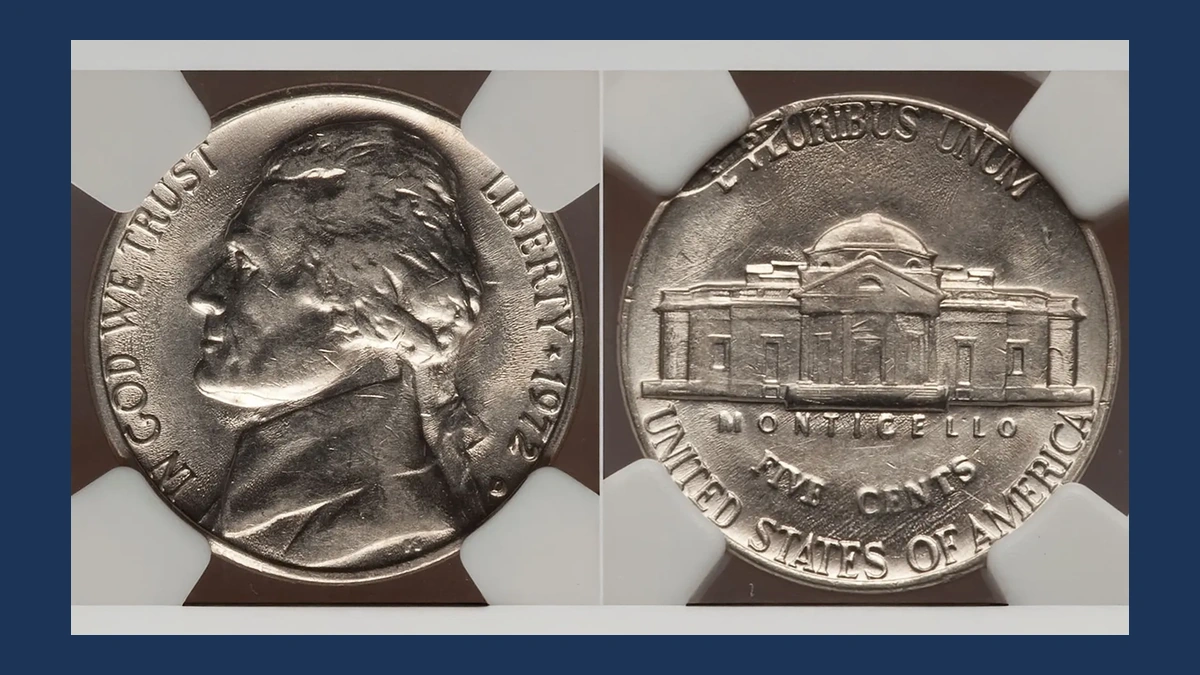
A broad tongue of metal lies almost level with the surrounding surface on one Denver nickel’s back. The letters E PLU were struck over it.
This feature began as a rough projection left when the blank was punched from metal strip. The projection folded inward before the design was struck.
Collectors call it a rolling fold. The documented 1972-D example has a short, fairly symmetrical tongue with a narrow split around it.
The adjacent outer edge remains undisturbed. That combination differs from a later blow that tears metal from the rim and pushes it inward.
Estimated Value
The recorded 1972-D rolling fold, graded AU55 for light wear, sold for $89 in August 2010. An estimated $50–$350 suits recognizable examples with similar original surfaces.
The E PLU lettering helps make this particular fold understandable to a collector. Larger size alone does not prove the same production fault.
A later gouge or bent rim should not receive this range merely because it leaves a flap pointing toward the center of the coin.
How to Identify
Inspect the plain outer edge beside E PLU before studying the folded tongue. The documented nickel leaves that adjacent edge undisturbed.
A 10× magnifier should then show a narrow split outlining a broad, short piece of metal that lies nearly level with the surrounding surface. Follow the letters across it: they were struck after the projection folded inward.
Do not lift the tongue.
If the coin is loose, record weight and width with a scale and calipers against 5 grams and 21.21 millimeters. The metal is folded rather than necessarily missing, so nearly normal weight would not rule it out.
A damaged edge feeding a long, pointed spur inward suggests a different event from this recorded rolling fold.
7. 1972 Jefferson Nickel Off-Center Strike
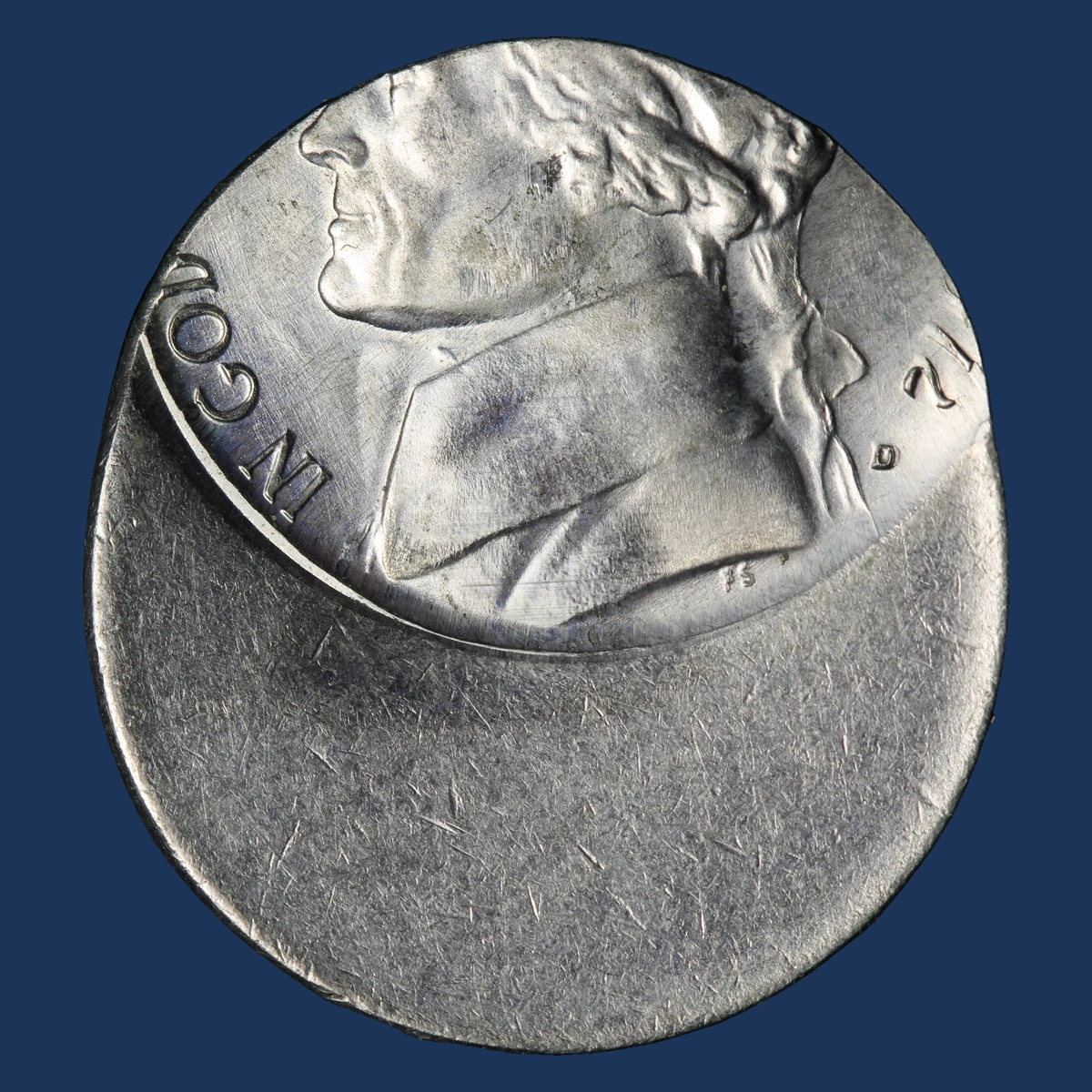
A disk caught partly outside the stamping tools receives only part of the normal design. The remaining crescent stays unstruck, producing an off-center coin.
The no-letter 1972 example is described as 75% off center toward eleven o’clock. A separate Denver example is 65% off center toward ten-thirty.
Both show substantial displacement, but their percentages and mint identities belong to different pieces. A surviving year helps identify the issue even when much of Jefferson is missing.
The blank area still contains metal, unlike a clip that removes part of the original disk.
Estimated Value
Readable ordinary 1972 off-center nickels are estimated at $25–$400. Surface quality and the surviving date can outweigh the stated percentage.
The no-letter 75% example sold for $99 in January 2022. The separate Denver 65% example also brought $99 at that sale.
Those matching prices do not make them the same error coin. Less dramatic examples brought $27 apiece in December 2008, showing that an off-center design can remain an affordable collecting type.
How to Identify
The first distinction is missing design versus missing metal. On a loose piece, compare its weight with 5 grams and record its widest dimensions against 21.21 millimeters using a scale and calipers.
Now align the surviving date upright and photograph both faces. The displaced designs should correspond to the disk’s position between the tools, rather than only one face having an uneven border.
Use a 10× magnifier on the blank crescent and plain edge to look for grinding or cuts. An original unstruck area need not resemble a surface polished smooth after minting.
Record the actual surviving date and mint letter before estimating direction. Eleven o’clock and ten-thirty describe the two cataloged examples, not a required position for every genuine coin.
8. 1972 Jefferson Nickel Broken Collar Along the Edge
An extra ridge on the side can come from a broken collar rather than a broken face-stamping tool. The collar is the surrounding ring that controls the coin’s edge.
One 1972-D example has a break described from seven o’clock to twelve. Its metal expanded into the missing part of that ring during striking.
The coin was included in a group with other Denver errors. Its Full Step label describes well-defined Monticello steps, not another minting mistake.
A face photograph may miss much of this defect, because the important expansion lies along the side.
Estimated Value
Estimate $75–$450 for a clear original example of this extended collar break. Visibility around the side and undamaged face rims help support the stronger prices.
The recorded specimen was part of a four-coin group that sold for $161 in August 2010. That total cannot be assigned to this one nickel.
For a different-year comparison, a 1976-D nickel with two collar breaks had a historical dealer asking price of $200, rather than a confirmed auction result.
How to Identify
A side-on photograph is essential. Keep the front’s top fixed while following the plain edge from seven o’clock toward twelve, so the position can be compared with the cataloged coin.
Under a 10× magnifier, inspect the expanded region and its joins. Added solder or an impact that crushes a face rim can imitate an edge bulge.
Use calipers on a loose piece across both affected and unaffected areas. Compare the undisturbed outline with 21.21 millimeters and check its weight against 5 grams on a scale.
A strong photograph should show how the edge defect meets each face, rather than hiding that junction. Well-defined building steps say nothing by themselves about whether a surrounding collar broke.
9. 1972 Jefferson Nickel Die Clashes
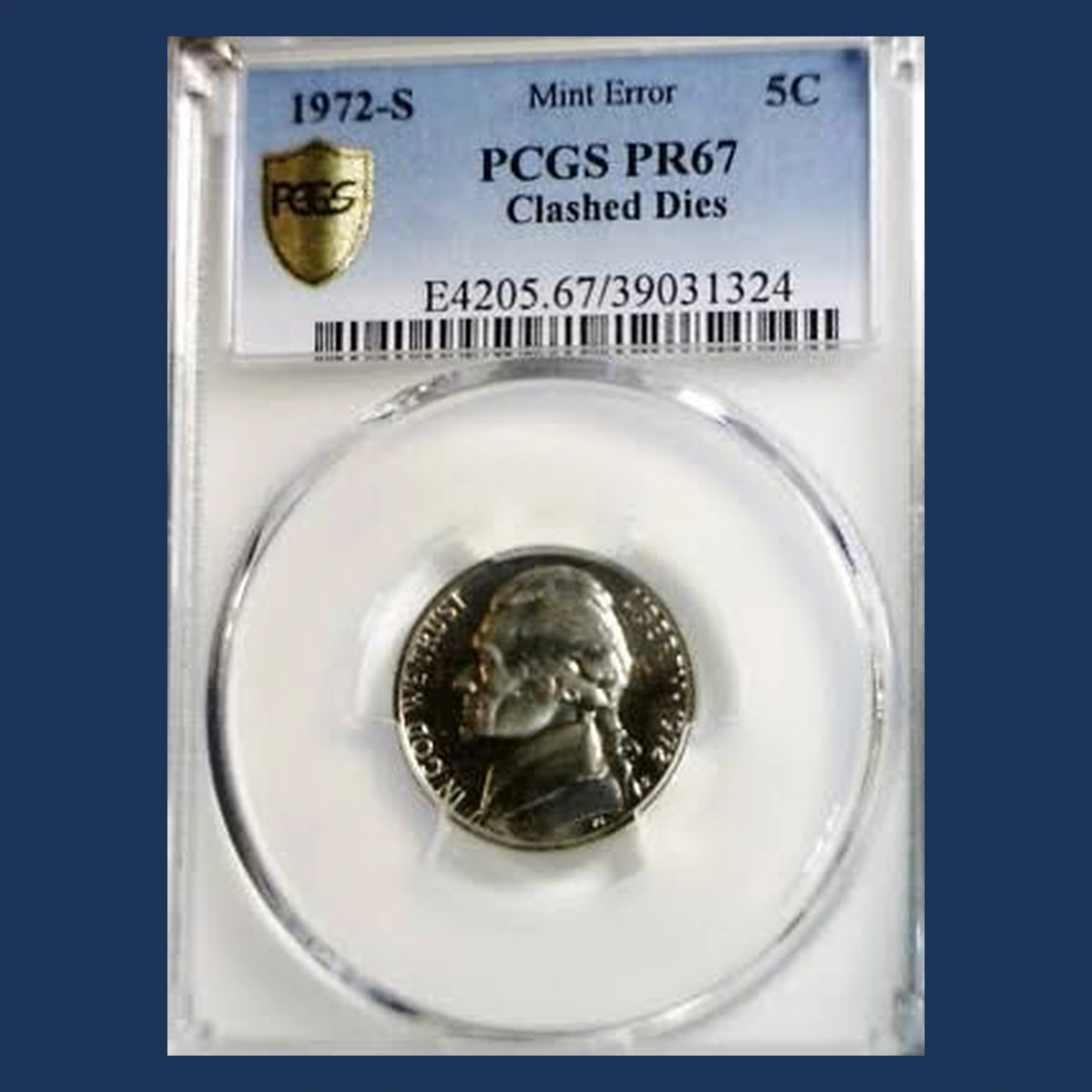
Faint parts of the opposite design can appear when the stamping tools hit each other without a blank between them. Those marks then transfer to later coins.
The effect is called a die clash. A 1972-S Proof example is documented, along with ordinary Denver reports.
One unusual Denver pattern includes sunken traces of MONTICELLO on the front. Much of that transferred lettering stops at the higher parts of Jefferson’s portrait.
Another Denver listing concerns ordinary clash traces. Its location should be matched separately rather than borrowing the unusual sunken-letter pattern from the first example.
Estimated Value
Clashed 1972 nickels are estimated at $20–$150 for faint ordinary examples and $75–$500 for especially clear or unusual patterns. An S Proof graded PR64 sold for $51 in December 2020.
That Proof result should not become an automatic price for the different Denver sunken-letter example. Its appeal depends on how much of the transferred lettering a collector can actually follow.
Random scratches or isolated dents do not justify the clash range without a recognizable design relationship.
How to Identify
Try matching the faint front marks to a photograph of Monticello and its lettering. Use a 10× magnifier to see whether several parts form a recognizable transferred design rather than unrelated scratches.
On the unusual Denver example, inspect the sunken MONTICELLO traces and where they stop beside the portrait. Do not reject them solely for being sunken or describe every other clash as the same pattern.
The ordinary Denver report and S Proof each need their own photographs. A loose coin can also be checked with a scale and calipers against 5 grams and 21.21 millimeters, including its plain edge.
Preserve faint traces under gentle lighting. Strong reflections from a Proof background can make a small mark look deeper or brighter than it is.
10. 1972 Jefferson Nickel Broken Dies and Cuds
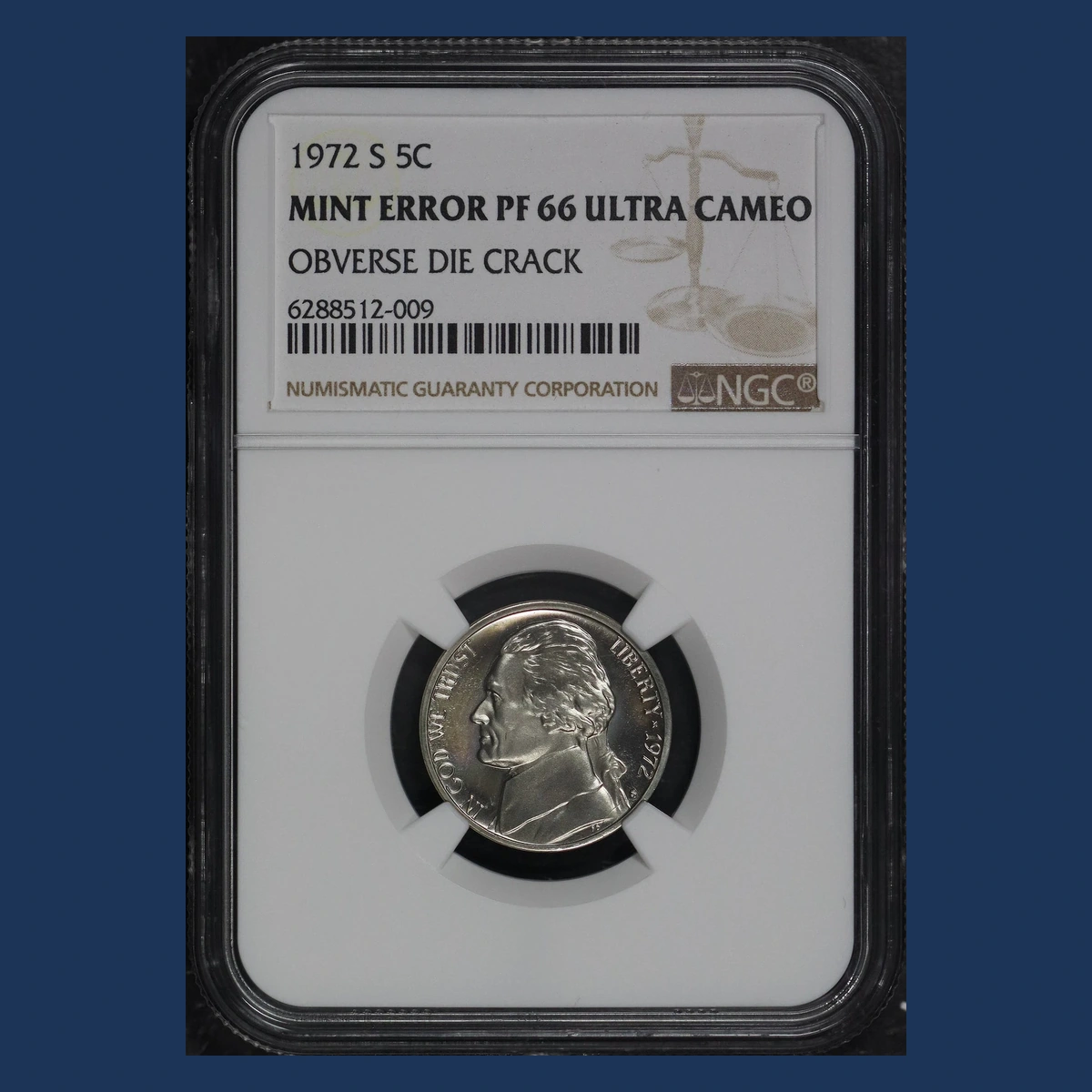
Raised metal can replace part of the design when a stamping die loses a piece beside its edge. The resulting rim-connected lump is called a cud.
Several Denver tools broke in different places and progressed through larger breaks. Their changing shapes can be followed across separate coins without treating each stage as a new mechanism.
An S Proof example has a front cud near five o’clock. Its collector finish distinguishes it from the ordinary Denver coins.
A famous six-coin progression includes one coin struck before the break developed, followed by five coins with cuds.
Estimated Value
Denver cuds are estimated at $30–$300 each, while the S Proof type is estimated at $250–$1,000. A Denver MS66 example sold for $94 in July 2021.
Sullivan Numismatics offered a PR65 S Proof at $450; that is a dealer asking price. The six-coin progression sold for $546.25 in August 2010 as a complete set.
Neither a set total nor a Proof asking price should be assigned automatically to an individual worn Denver coin.
How to Identify
A progression set offers a useful comparison: start with the intact coin and follow how the raised patch grows on later examples. Do not label that first normal coin as another cud.
For an individual piece, identify Denver or the S Proof finish before choosing a comparison photograph. The S Proof pattern is near five o’clock, while Denver’s different broken tools have their own shapes.
On a loose nickel, compare 5 grams and 21.21 millimeters with a scale and calipers. A 10× magnifier can then help trace the lump into the rim and inspect the adjoining plain edge for a crushed lip.
Look for solder or an outline cut around added metal. The shape should agree with original struck surfaces, not merely resemble a large bump.
11. 1972 Jefferson Nickel One-Sided Strike
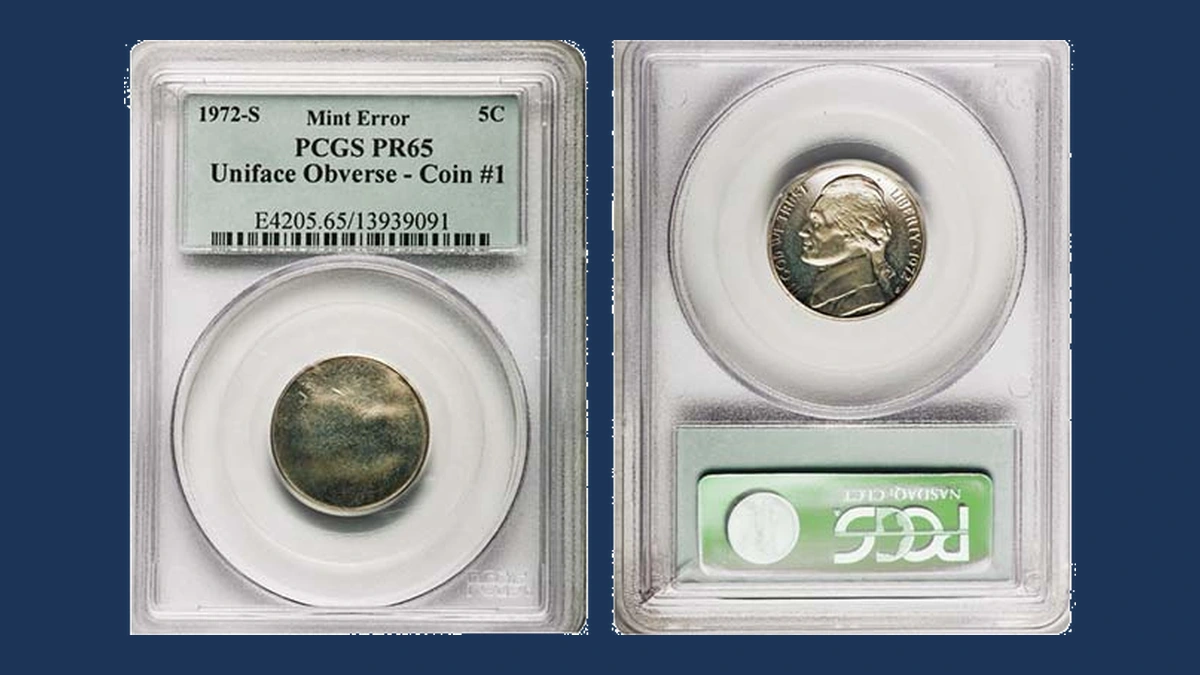
A coin can have normal design on one face and an unusually blank area on the other. If another blank blocked one stamping tool, that face could not receive its usual image.
Collectors call the result a uniface or one-sided strike. A year listing reports this type for 1972 but does not identify the blank face or a particular mint.
The report appears among several mint issues, so it does not establish an S Proof by itself. A polished-off design can also leave a blank-looking side on an ordinary nickel.
Estimated Value
For an authenticated ordinary 1972 one-sided strike, estimate $100–$1,000. This is a conditional range for the reported type, not a verified sale of one specifically pictured coin.
The amount of blank surface, remaining date, and evidence of original striking all matter. A small blocked area belongs nearer the lower end than a dramatic, well-preserved piece.
Grinding a finished face smooth creates an altered coin, which should not receive this estimate simply because one side looks empty.
How to Identify
A nearly blank face calls for a weight check before a price search. On a loose coin, compare 5 grams and 21.21 millimeters with a scale and calipers, recording thickness as well as width.
A ground-down face may reduce thickness and leave abrasion marks. Inspect the blank area and its boundary with a 10× magnifier, then look along the plain edge for disturbed metal.
The opposite face should be photographed clearly enough to establish the year and mint details. Do not call the piece an S Proof merely because a general year list appeared on a Proof page.
A specialist should compare the blocked surface with authenticated one-sided strikes, especially when smoothness has erased clues that would separate original pressure from later polishing.
12. 1972 Jefferson Nickel Struck on a Cent Blank
A copper-colored 1972 nickel may have started as a blank intended for a one-cent coin. That disk is smaller and lighter, so it cannot hold all the nickel’s outer design.
A Denver example weighs 3.1 grams and carries the nickel portrait and building. A separate no-letter specimen is also recorded on a cent blank.
These were unused blanks when they entered the nickel press. They need not show Lincoln or an earlier penny date beneath Jefferson.
Surface color alone cannot prove the error, because a normal nickel can be plated or discolored later.
Estimated Value
Use an estimated $200–$1,200 for authenticated 1972 nickels on copper cent blanks. Clear date and mint details, attractive color, and undamaged surfaces support the higher figures.
A Denver MS64 Red example sold for $552 in December 2023. A separate no-letter MS64 Red and Brown example brought $264 in September 2019.
MS64 means unworn with some visible marks. The color descriptions concern preservation of the copper surface, not a separate error to add to the price.
How to Identify
Compare the size before deciding from the copper color. A normal nickel is 21.21 millimeters wide and 5 grams, while a period cent blank starts at 19.05 millimeters and about 3.11 grams.
Use calipers and a scale on a loose coin, then inspect the cut-off outer design with a 10× magnifier. The portrait and Monticello should fit the smaller disk naturally rather than end at a filed boundary.
Examine the plain edge for copper throughout and signs of a thin added coating. The recorded Denver piece weighs 3.1 grams, but that measurement should not be copied onto the separate no-letter coin.
If recognizable Lincoln details survive underneath, investigate an already-struck cent instead of describing the object as an unused blank.
13. 1972 Jefferson Nickel Struck on a Dime Blank
Jefferson’s portrait can overfill a small silver-colored disk when a dime blank reaches the nickel press. The outer lettering is squeezed off the available space.
A Denver example was recorded at 2.22 grams. A separate no-letter coin weighs 2.24 grams.
Dime blanks have a copper core between outer copper-nickel layers. A normal nickel instead uses one consistent copper-nickel mixture through its body.
The edge and weight therefore provide useful clues even when the two metals look similar from above. Neither error requires an earlier Roosevelt design, because these disks were blank before the nickel strike.
Estimated Value
For the documented dime-blank type, estimate $250–$1,200. A readable date and attractive surfaces usually matter more than a tiny difference between recorded weights.
The 2.24-gram no-letter example sold for $345 in September 2010. The separate Denver 2.22-gram coin, graded AU58 for slight wear, brought $373.75 in January 2011.
Those results concern different coins. Keep the correct mint and condition with each comparison, especially when a new find has a partly missing date.
How to Identify
Start with the edge under a 10× magnifier. A visible copper core can support a dime blank, while filing marks may explain why an ordinary nickel was made smaller.
For a loose coin, measure weight and width with a scale and calipers. Compare the results with a dime blank’s standard 2.268 grams and 17.91 millimeters, allowing for the way striking spread the metal.
A normal nickel is 5 grams and 21.21 millimeters with a plain edge. Do not demand dime-style grooves: an unused dime blank has not necessarily passed through a dime collar to receive them.
Read the surviving nickel date and mint letter last, then match the correct example. The separate 2.22- and 2.24-gram records should not be blended into one coin.
14. 1972 Jefferson Nickel Struck on an Unidentified Copper Blank
The recorded 2.75-gram Denver example is copper-colored and smaller than a normal nickel. Its grading description identifies a copper blank but does not name its original country or denomination.
That missing name should not be filled in from appearance alone. A usual 1972 cent blank weighs about 3.11 grams, while other foreign blank errors have their own measured specifications.
The surviving design still identifies the coin as a 1972-D nickel strike. The unusual disk explains why the full nickel design does not fit normally around the outside.
Estimated Value
Estimate $400–$1,500 for a genuine example matching the recorded copper-blank type. The PCGS MS64 piece weighing 2.75 grams sold for $660 in October 2021.
That result does not depend on assigning the blank an invented foreign denomination. Its original surfaces, confirmed copper material, and unusual specifications already define the comparison.
A copper-plated normal nickel or a filed-down cent-blank error needs a different description, even if the resulting color and weight seem close.
How to Identify
A label that says copper blank does not necessarily name a denomination. Keep that description unless the coin’s measurements and material support something more specific.
On a loose piece, use a scale and calipers to record weight, width, and thickness. The recorded 2.75 grams falls below a period cent blank’s 3.11 grams and well below the nickel’s 5 grams.
Compare its width with a normal nickel’s 21.21 millimeters, then study the plain edge under a 10× magnifier. Filing, a clip, or an added coating can change measurements without creating the documented error.
Follow the outer nickel lettering into the disk’s boundary. An original strike fitted to the unusual copper blank matters more than choosing a foreign country from its color.
15. 1972 Jefferson Nickel Partial Counterbrockage
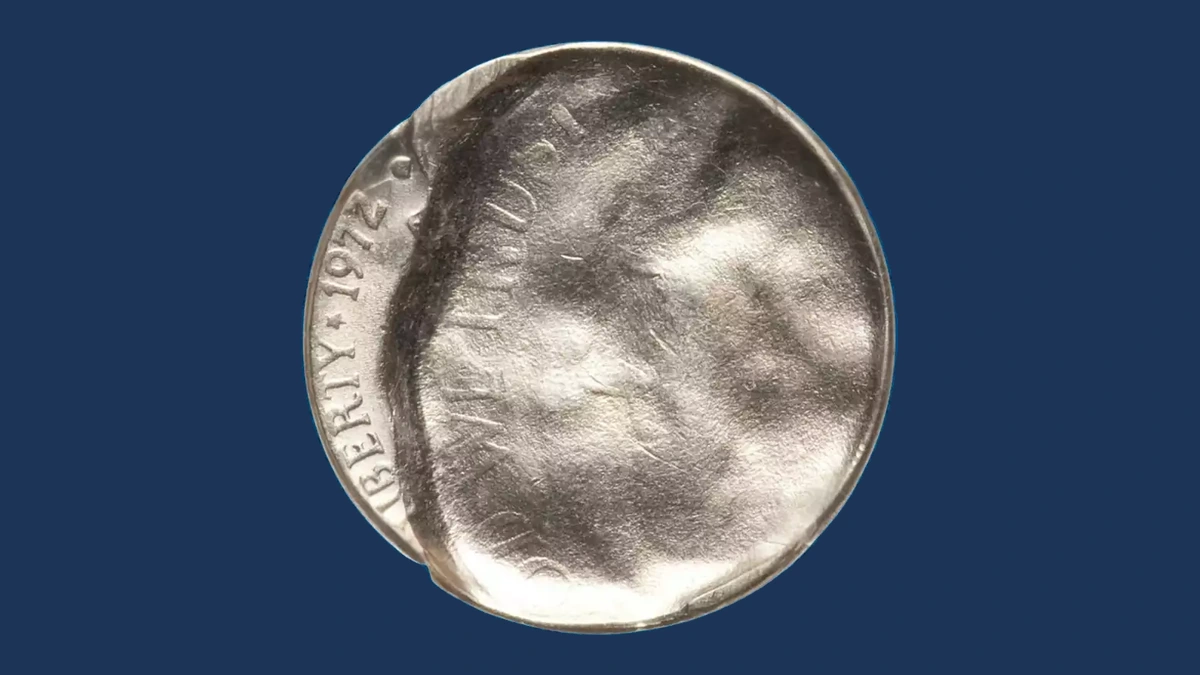
A distorted raised copy can form after a design transfers twice between coins. First, a struck coin presses its raised design into another piece, making a sunken mirror image.
That sunken image can then press a raised, normally facing copy onto a later coin. Collectors call this second transfer a counterbrockage.
A documented 1972-D example has the effect on part of its front. It was graded MS64 by NGC.
Its description does not establish one required clock position or percentage. Those details must come from the actual coin being compared.
Estimated Value
The recorded 1972-D partial counterbrockage sold for $517.50 in October 2010. An estimated $350–$1,500 covers similarly convincing examples, depending on size, clarity, and condition.
A recognizable transferred design makes the production sequence easier to understand than a vague extra bulge. That visibility helps explain differences in collector demand.
This is a separate comparison from a simple sunken mirror impression. Calling every brockage a counterbrockage would combine two different stages of the transfer process.
How to Identify
Determine whether the abnormal design rises or sinks before trying to read it. Side lighting and a 10× magnifier help reveal a raised transferred copy instead of the depressed mirror image of ordinary brockage.
Map where the unusual front area meets the normal design. Its distortion should support an indirect transfer, rather than merely showing flat movement doubling beside existing letters.
On a loose piece, use a scale and calipers against 5 grams and 21.21 millimeters. Photograph the plain edge and opposite face to check for pressure damage or an added piece.
Then compare the full pattern with the authenticated Denver example. A matching mechanism is more useful than guessing a clock position that the short catalog description never supplied.
16. 1972 Jefferson Nickel Struck on Bowtie-Shaped Scrap
A narrow piece of leftover strip can enter a press instead of a round blank. Its curved sides may resemble a bowtie because it came from metal between punched disks.
One 1972-D example weighs only 0.9 gram. Part of the nickel design, including enough date and mint detail to identify it, was struck onto that tiny scrap.
This differs from a broad round blank with one clipped edge. Most of the normal disk was never present.
A small piece cut from a finished nickel can imitate the outline without sharing its minting history.
Estimated Value
A working estimate is $600–$2,000 for this documented kind of dated bowtie scrap. The 0.9-gram NGC MS63 example sold for $822.50 in August 2013.
Collectors value a recognizable year and mint on such a small piece because many scrap strikes retain little identifying detail. Original edges are equally important.
The range should not be applied to any nickel fragment weighing less than a gram. A piece cut after striking does not become a Mint scrap error.
How to Identify
Photograph the entire outline before handling the small piece further. On a loose scrap, use a scale and calipers to record its weight, widest span, and thickness; the normal nickel comparison is 5 grams and 21.21 millimeters.
The recorded piece is only 0.9 gram, so its shape cannot be judged like a complete round coin. A 10× magnifier should show how the design meets its original curved boundaries.
Inspect the outer edge for fresh cutting, grinding, or burrs that sever finished detail. Compare with the normally plain nickel edge without expecting a full circular rim on scrap.
Finally read the actual surviving date and D. Those small features, together with original boundaries, distinguish the documented 1972-D strike from an unidentified fragment.
17. 1972 Jefferson Nickel Struck on Foreign Coin Blanks
Denver nickel designs appear on several blanks intended for other countries. The wrong disk can leave weak outer lettering or a design that does not fit.
Philippine examples include 25-sentimo blanks, a 2.4-gram five-sentimo blank, and a separate damaged five-sentimo blank weighing 2.5 grams. A ten-sentimo example weighs 2.0 grams.
A Liberian five-cent blank is another distinct type, recorded at 4.1 grams. Its front wheel mark is later damage, not the feature that identifies the blank.
Each weight belongs to its own coin; similar color does not make these denominations interchangeable.
Estimated Value
Estimate $200–$1,000 for Philippine 25-sentimo examples and $600–$3,000 for the other foreign-blank types here. The AU58 25-sentimo piece sold for $230 in February 2006.
A five-sentimo example brought $1,920 in March 2023; the separately damaged 2.5-gram blank brought $1,281 in June 2026. The ten-sentimo and Liberian pieces sold for $1,440 and $960 respectively in September 2019.
These prices retain each blank’s identity and the coin’s separate condition problems.
How to Identify
Weak building steps do not establish a foreign blank, so begin with the measurements recorded for that particular coin. Use a scale and calipers on a loose piece, comparing weight, width, and thickness with a normal 5-gram, 21.21-millimeter nickel.
Keep the five-sentimo examples’ 2.4 and 2.5 grams separate from the ten-sentimo piece’s 2.0 grams and the Liberian piece’s 4.1 grams. None supplies the missing measurement for the 25-sentimo coin.
Examine the outer lettering and edge under a 10× magnifier for filing, coatings, or other changes from the original strike. A normal nickel is plain-edged and uniform in alloy, but identifying a specific foreign disk requires a material-and-size comparison rather than a guess from its weak or cut-off design.
18. 1972 Jefferson Nickel Low-Pressure Indent and Partial Brockage
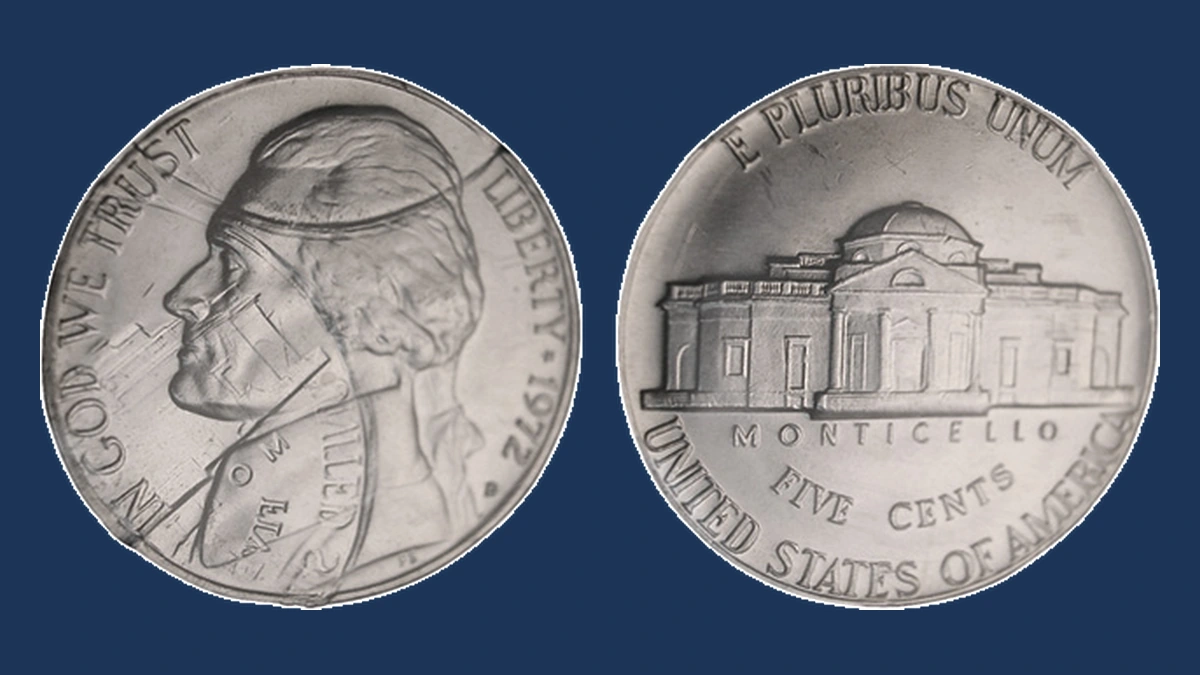
Two shallow impressions affect a Denver nickel whose first strike was normal. A later low-pressure blow left a 20% indentation at the top and a 40% partial brockage on the left.
An indentation is a hollow made by an overlapping object. A brockage contains a reversed, sunken coin design transferred from another struck coin.
The nickel did not rotate between blows and remained inside the collar. Beyond the two sunken areas, the second blow did not bring the stamping tools directly against either face.
The studied coin was still sealed in its Denver Mint Set pocket.
Estimated Value
For an authenticated coin matching this compound low-pressure event, estimate $300–$3,000. That range prices the whole object, including both sunken impressions and its preserved striking history.
A different 1972-D flipover double strike with later wheel marks sold for $408 in June 2023. It is a related repeated-strike comparison, not a sale of this packaged low-pressure coin.
Original packaging and clearly matched features strengthen the explanation; they do not supply a completed auction price by themselves.
How to Identify
Keep a packaged example sealed and tilt the plastic gently to reduce glare. Compare the top indentation and left-side mirror impression with the unaffected original design rather than expecting a second full portrait.
Under a 10× magnifier, the two sunken areas should show different evidence: an object-shaped hollow and a reversed design. Check that areas beyond them preserve the first strike without obvious direct contact from a second tool blow.
For an already loose candidate, use a scale and calipers against 5 grams and 21.21 millimeters and inspect the plain edge. Dents acquired in circulation can imitate low-pressure hollows.
The studied Denver coin stayed aligned between strikes, so rotation or a different face arrangement requires its own explanation.
19. 1972 Jefferson Nickel Double Strikes and Flipover Strikes
A second blow can add another portrait or move part of the design far outside the first impression. One 1972-S Proof received a 5% off-center strike followed by a 35% off-center strike.
Its curved back impression comes from the first strike’s rim. Another S Proof has a second strike 95% off center.
Ordinary Denver coins include a second strike 70% off center and a coin that flipped over before being struck again inside the collar. The latter puts traces of opposite-face designs together.
Normal repeated Proof strikes remain aligned and do not create these displaced patterns.
Estimated Value
Ordinary repeated strikes are estimated at $150–$1,200, with dramatic S Proofs at $1,000–$6,000. The Denver 70% second strike sold for $207 in August 2009.
The PR67 Proof with two off-center strikes brought $4,312.50 in January 2008. The separate PR66 Cameo Proof with a 95% second strike sold for $1,200 in April 2021.
These figures belong to different arrangements and surfaces, rather than a fixed price for each additional blow.
How to Identify
Map the old and new design before naming the event. On a flipover, remnants of Jefferson and Monticello can share a face; an ordinary displaced second strike need not reverse the coin.
A 10× magnifier helps trace overlap where the later blow flattened earlier detail. For a loose piece, document spreading with calipers against 21.21 millimeters and weigh it against 5 grams, inspecting the plain edge for later damage.
For the first S Proof, both strikes are described toward twelve o’clock relative to the disk, while the second lies toward six relative to the first. Those reference points differ.
Its curved back mark follows the first rim. Do not mistake that arc for a scratch, or transfer its directions to the separate 95% example.
Conclusion
Estimated values for these 1972 nickel errors range from $10–$6,000. Modest expanded strikes sit at the affordable end, while dramatic repeated Proof strikes can bring thousands.
The most useful clue is not always the largest mark. An earlier S outline, lettering crossing a folded metal flap, or a correctly identified foreign blank can explain the coin more clearly than its color alone.
Preserve original surfaces and keep combined features together when comparing prices.