1937 Nickel Error List with Pictures

The buffalo’s missing front leg is famous, but the marks under its belly are just as important. A genuine, exceptionally well-preserved 1937-D Three-Legged nickel sold for $99,875 at Legend in October 2021.
Other 1937 nickel errors include extra mintmark outlines, peeling metal, and copper blanks carrying the wrong design. Estimated prices across these types run from $15 to $100,000.
Explore the features below to see which clues separate mint mistakes from ordinary wear or later damage.
1. 1937 Buffalo Nickel Lamination
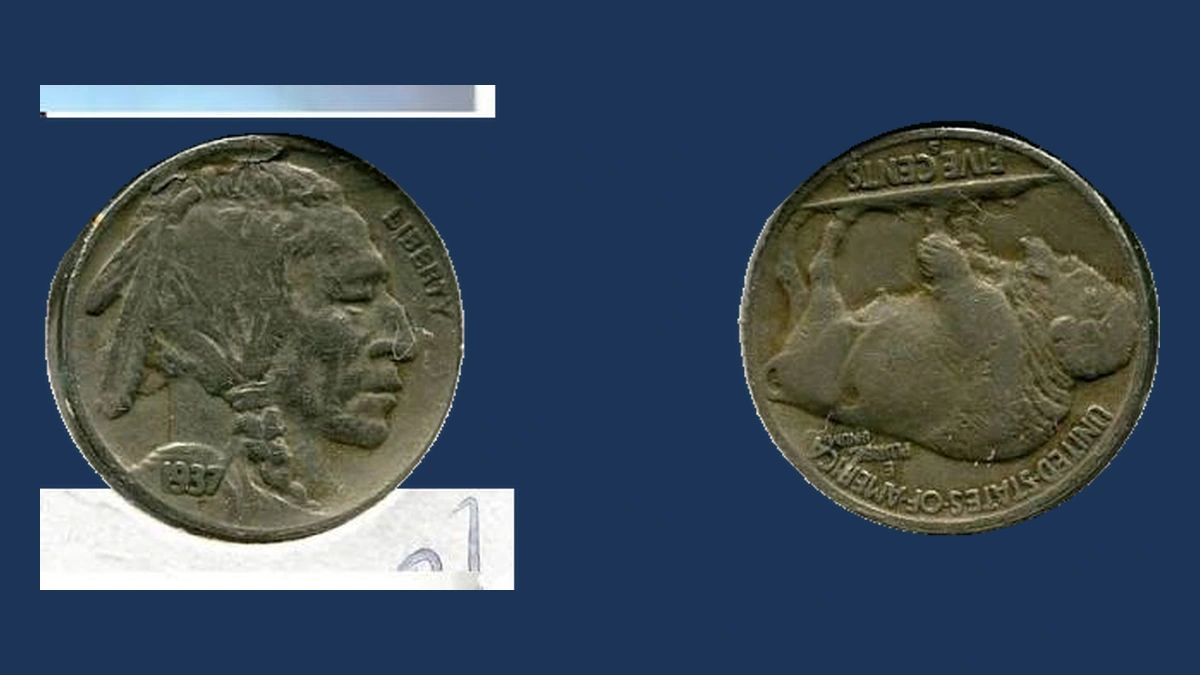
A patch of metal can peel away from a Buffalo nickel when the alloy contains a weak internal area. The surface may retain a flap or expose a rough patch where the flake has detached.
This is called a lamination. The normal coin is 75% copper and 25% nickel mixed together, rather than a copper core covered by a separate nickel layer.
The 1937 report does not establish a specific mint or affected spot. The actual peeling boundary must be examined, because a scraped portrait or corroded patch can look rough without being a mint error.
Estimated Value
A small genuine peel can fit an estimated $15–$175 range, with a larger visible separation on a better-preserved coin toward the upper end. The whole coin’s condition still matters.
A different-design nickel offers a modest comparison: a 1944-D Jefferson nickel with a back lamination sold for $27 in April 2008. Its wartime alloy also differs, so that historical sale illustrates affordability rather than setting an exact price for a 1937 Buffalo example.
How to Identify
Is the loose metal still attached, or has a patch disappeared completely? That distinction helps interpret a scale reading against the normal 5 grams, since an attached flap may leave almost all the original metal present.
For a loose coin, use calipers against 21.2 millimeters and inspect the plain edge without gripping the weak area. Under a 10× magnifier, compare the exposed boundary with smooth cuts or pushed-up metal from later scraping.
Check that the surviving portrait-side date actually reads 1937 before attaching the year to the error. Leave the flap unmoved and photograph the gap from the side; a damaged or worn Buffalo date cannot be reconstructed from a peeling surface alone.
2. 1937 Buffalo Nickel Doubled Dies
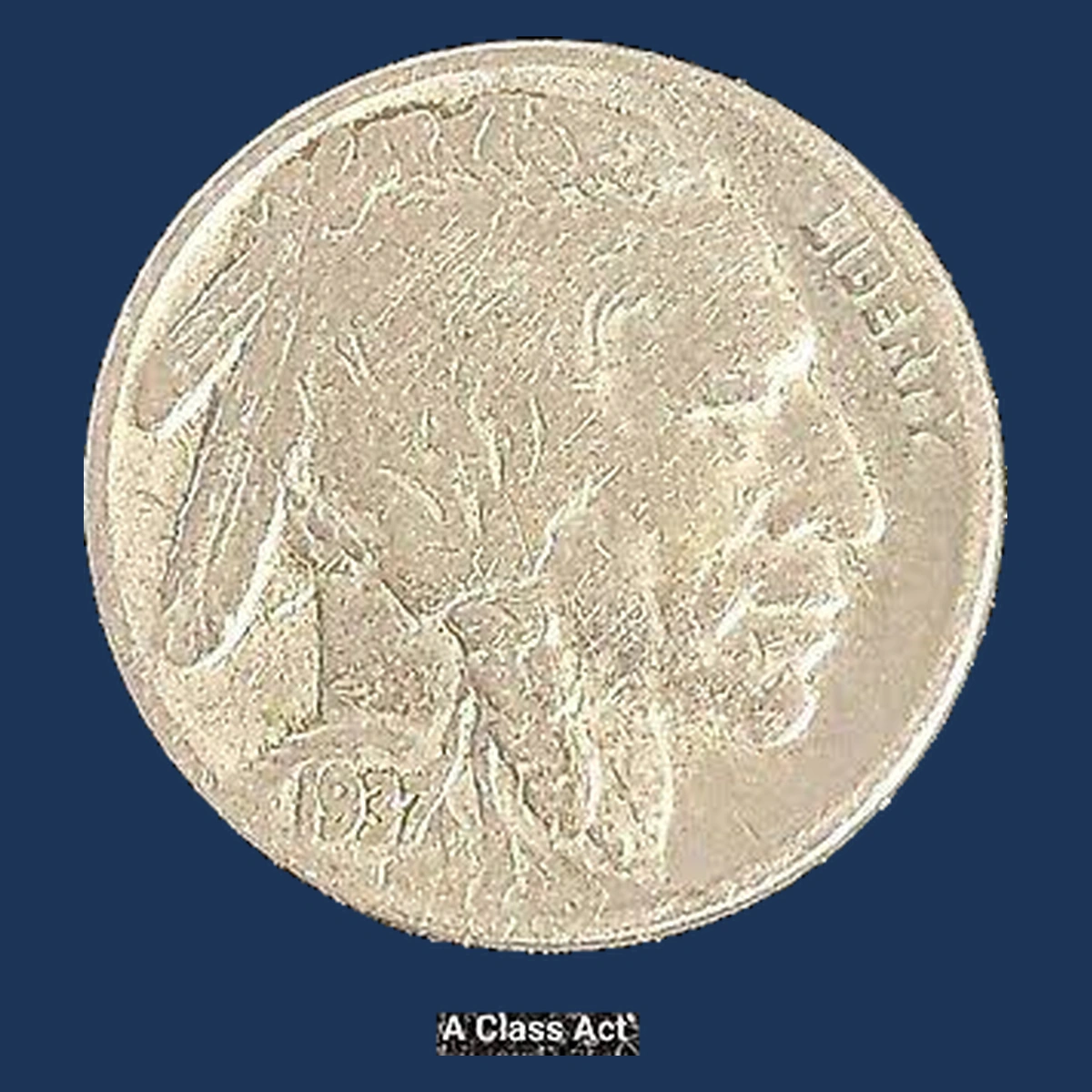
A doubled die is a steel stamping tool with repeated design details. It transfers those details to each coin it strikes, rather than giving the finished coin a second blow.
Philadelphia examples are reported on the front around the date and LIBERTY, and separately in back lettering. A collector also reports a San Francisco front variety on a coin that has a repunched mintmark.
That means the same S coin carries an extra mint-letter outline too. Its precise front pattern should be matched to the actual specimen, rather than borrowing the Philadelphia lettering locations.
Estimated Value
Estimated whole-coin values of $20–$250 suit the reported modest doubled designs, depending on clarity and condition. Tiny worn traces belong below a well-preserved, convincingly matched pattern.
The range is an estimate, not an auction record for each Philadelphia or San Francisco report. The S coin has both a doubled front and a repunched mintmark.
Those are two features of one specimen. Its value should be compared as a whole, without adding two full price ranges.
How to Identify
Check the mint letter beneath FIVE CENTS before selecting a comparison. Philadelphia has no letter there, while the reported combined front-and-mintmark example is from San Francisco.
Under a 10× magnifier, examine the Philadelphia date and LIBERTY or the back lettering appropriate to the suspected variety. The San Francisco front needs its own close photograph because its exact doubled locations are not established here.
Look for matching raised outlines rather than flat shelves beside letters. Those shelves can result from movement during striking and do not demonstrate a doubled stamping tool.
A loose normal nickel should be near 5 grams and 21.2 millimeters with a plain edge, checked by scale and calipers. Keep the two faces in your photographs so mint identity and the actual doubled pattern can be judged together.
3. 1937 Buffalo Nickel Repunched Mintmarks
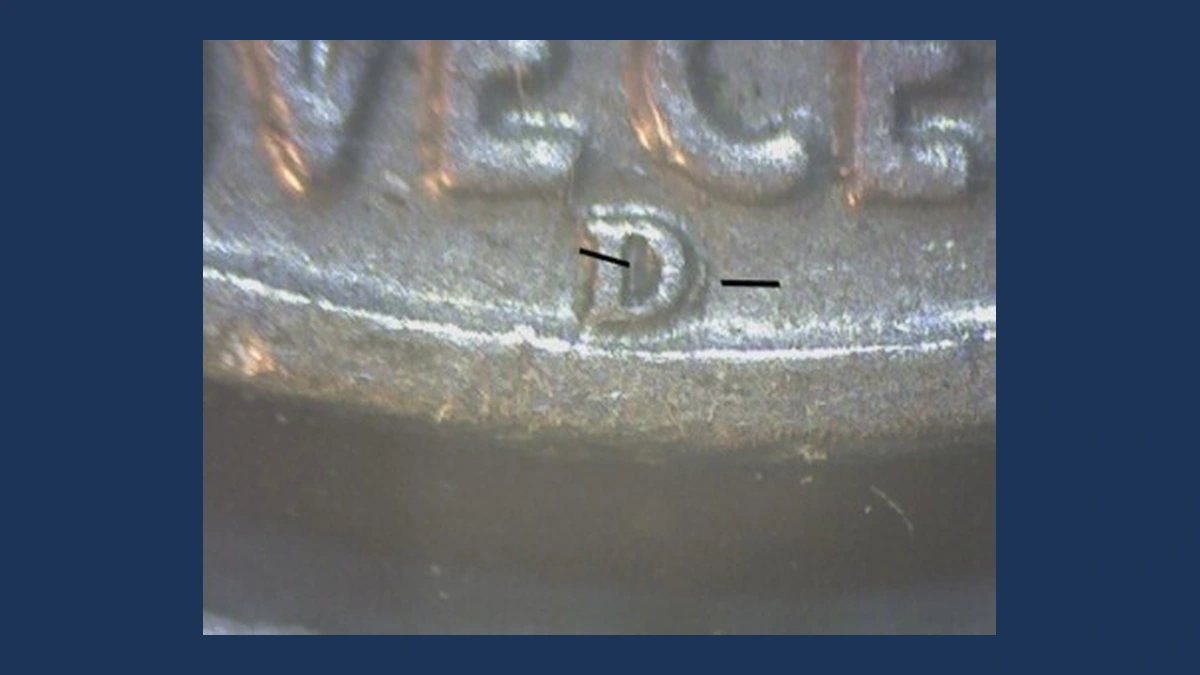
The letter beneath FIVE CENTS may contain a piece of another D or S. These mint letters were added to the stamping tool by hand, and a shifted repeat punch left an overlapping shape.
The result is called a repunched mintmark. Reported Denver varieties include rightward and upper-left spreads, plus a triple-punched D.
A separate Denver collector example is listed as a minor mintmark variety without a direction established here. San Francisco has a reported leftward S spread; none of these small mint-letter changes explains the missing leg on the famous Three-Legged variety.
Estimated Value
For the minor mintmark varieties, estimate $20–$250. A clear extra curve on an unworn coin can be more appealing than a thick-looking letter partly erased by circulation.
No separate auction record is assigned here to every reported punch shape. Direction helps identification, but it does not set the price by itself.
Condition and a complete, reliably matched outline matter most. Calling a small remnant a triple punch does not make it automatically more valuable.
How to Identify
Follow the inner opening of the D or the curves of the S with a 10× magnifier. The strongest clue is where another raised letter shape joins the main one, not simply how thick the mintmark appears.
Compare it with an example from the same mint. The reported rightward and upper-left Denver spreads are different shapes, and a triple-punched D needs evidence of more than one extra punch.
For a loose coin, compare weight with 5 grams and diameter with 21.2 millimeters using a scale and calipers. Check the plain edge for alteration.
Keep the mintmark upright in photographs and move the light. A damaged corner or changing reflection can imitate an extra line without preserving the curved structure of another letter.
4. 1937 Buffalo Nickel Struck Through Material
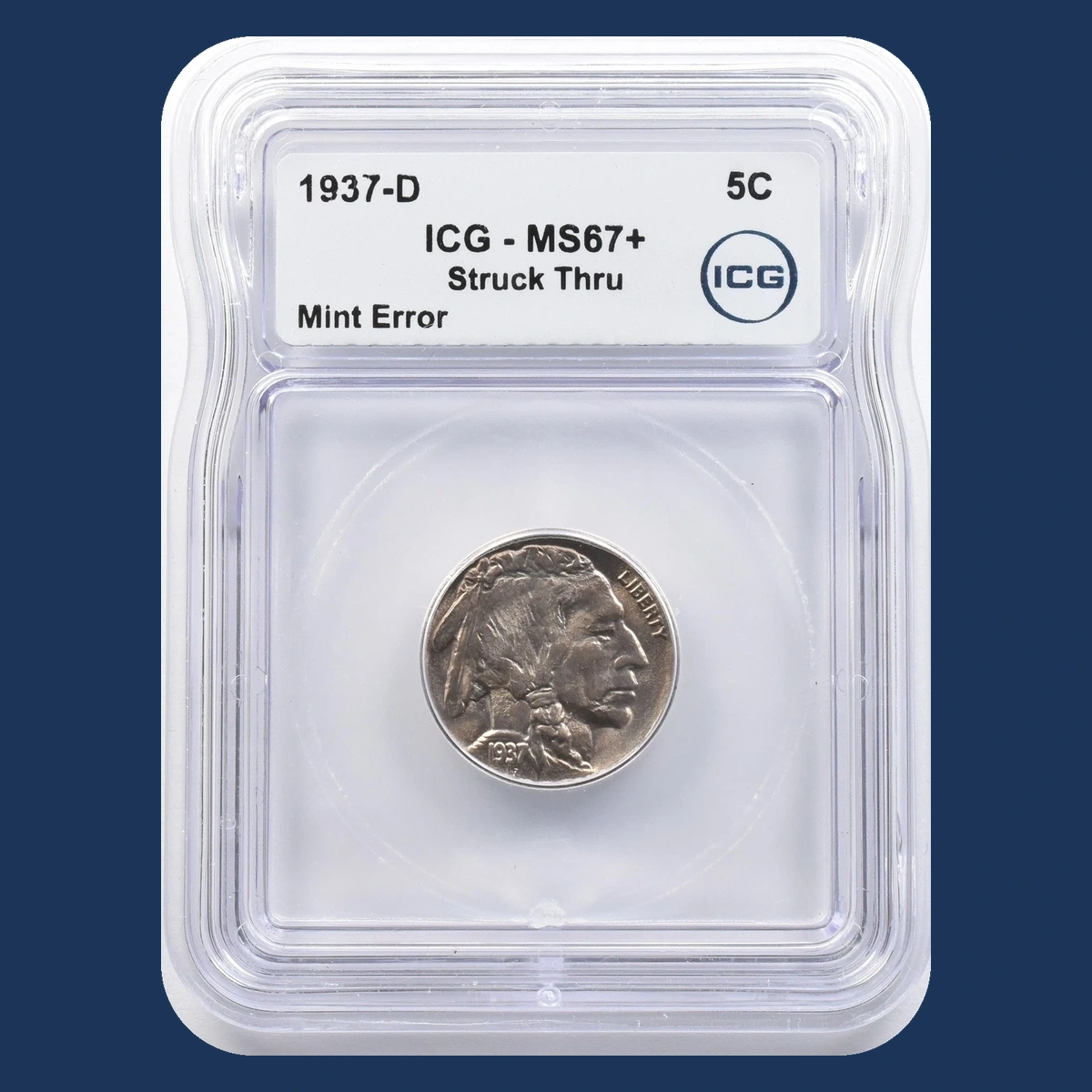
The design can stop short where something blocks the stamping tool. The blank receives the pressure through that material, leaving weak detail, a depression, or an unusual texture.
Collectors call this a strike-through. Its appearance depends on the obstruction, so a smooth weak patch and a sharply outlined impression need not have the same cause.
The 1937 type is reported without one fixed mint or known material. General examples involving grease or fibers should not be treated as proof that those particular substances occurred on a documented 1937 coin.
Estimated Value
Use an estimated $20–$250 for a confirmed strike-through, with distinct impressions generally above slight patches of missing detail. A recognizable shape can matter more than a large but vague weak area.
A later Jefferson nickel struck through material sold for $84 in February 2015. It provides a broad comparison from another design and year, not a sale of a 1937 Buffalo; ordinary wear, scraping, or corrosion cannot receive that error value simply because detail is missing.
How to Identify
Examine the surrounding portrait or buffalo before judging the weak patch. Wear tends to flatten exposed high points elsewhere, while a localized obstruction may leave sharp detail directly beside its impression.
Use a 10× magnifier at the boundary and look for texture, an object outline, or evidence of later scraping. Leave any retained material untouched.
The normal Buffalo nickel is about 5 grams and 21.2 millimeters, with a plain edge. A scale and calipers can check a loose candidate, but normal measurements do not identify what blocked the strike.
Photograph enough normal design around the patch to show the contrast. An isolated blank-looking close-up cannot establish either the year or whether the missing detail was created in the Mint.
5. 1937 Buffalo Nickel Clipped Blank
A clipped blank was incomplete before it entered the press. The coin’s design was then stamped onto the surviving metal rather than cut away from a finished coin.
The 1937 type is reported without a fixed mint, gap shape, or missing percentage. A curved gap can result when a blank punch overlaps an earlier opening in the metal strip, but that shape should not be assumed for every report.
The edges beside the missing portion carry useful clues about timing. A later saw cut or broken edge may reduce the coin just as much without being a mint error.
Estimated Value
An estimated $25–$350 covers genuine clipped 1937 Buffalo nickels, with larger clear errors on attractive coins nearer the upper end. A readable date helps connect the piece with the correct year.
A 1997 Philadelphia Jefferson nickel with a 20% clip sold for $124 in March 2025. It is a more recent comparison from a different design, rather than evidence that the reported 1937 gap has that size or deserves precisely the same price.
How to Identify
Ask whether the missing metal was absent when the design was struck. Under a 10× magnifier, inspect both ends of the gap for natural striking flow rather than severed detail and tool marks.
Look across the coin for a weak part of the rim, which can support some curved clips. It is not required on every shape, and the 1937 report does not establish a particular gap to copy.
Use a scale and calipers on a loose coin against the normal 5 grams and 21.2 millimeters. The remaining edge should be examined against the usual plain edge.
A low weight confirms less metal, not when it disappeared. Photograph the exposed boundary from the side, including any sawing, filing, or bending that might point to later damage.
6. 1937 Buffalo Nickel Broadstrike
An unusually wide Buffalo nickel can result when the collar fails to contain the metal. This collar is the surrounding ring that normally controls the coin’s diameter during striking.
Without full restraint, the blank spreads outward. A broadstrike keeps the design on the coin, unlike an off-center strike that loses part of the design beyond the metal.
The 1937 report does not establish a separate example for every mint. Its enlarged outline must be examined along with the full design, because hammering or squeezing a coin later can also make it wider.
Estimated Value
Estimated values of $75–$400 cover recognizable broadstrikes with different amounts of spread and wear. Clear expansion and attractive original surfaces can support a stronger price.
A 1999 Philadelphia Jefferson broadstrike brought $89 in March 2025. That is a later-design comparison, not a 1937 Buffalo sale.
A coin with missing outer design may instead be off-center. Later damage that merely flattens the rim does not support the same collecting range.
How to Identify
Measure a loose candidate at several angles with calipers before calling its outline unusually large. Compare with the normal 21.2-millimeter diameter, and use a scale against 5 grams to see whether the metal was mostly spread rather than removed.
Trace the entire outer inscription through a 10× magnifier. The design should remain on the blank despite the wider border; missing design beyond one side calls for an off-center comparison.
Inspect the plain edge and adjoining surfaces for later blows, filing, or squeezing. Those marks can explain a wide or flattened rim without a mint error.
Keep an overhead photograph alongside the edge view. The complete design and the outward metal flow need to support the same explanation.
7. 1937 Buffalo Nickel Off-Center Strike
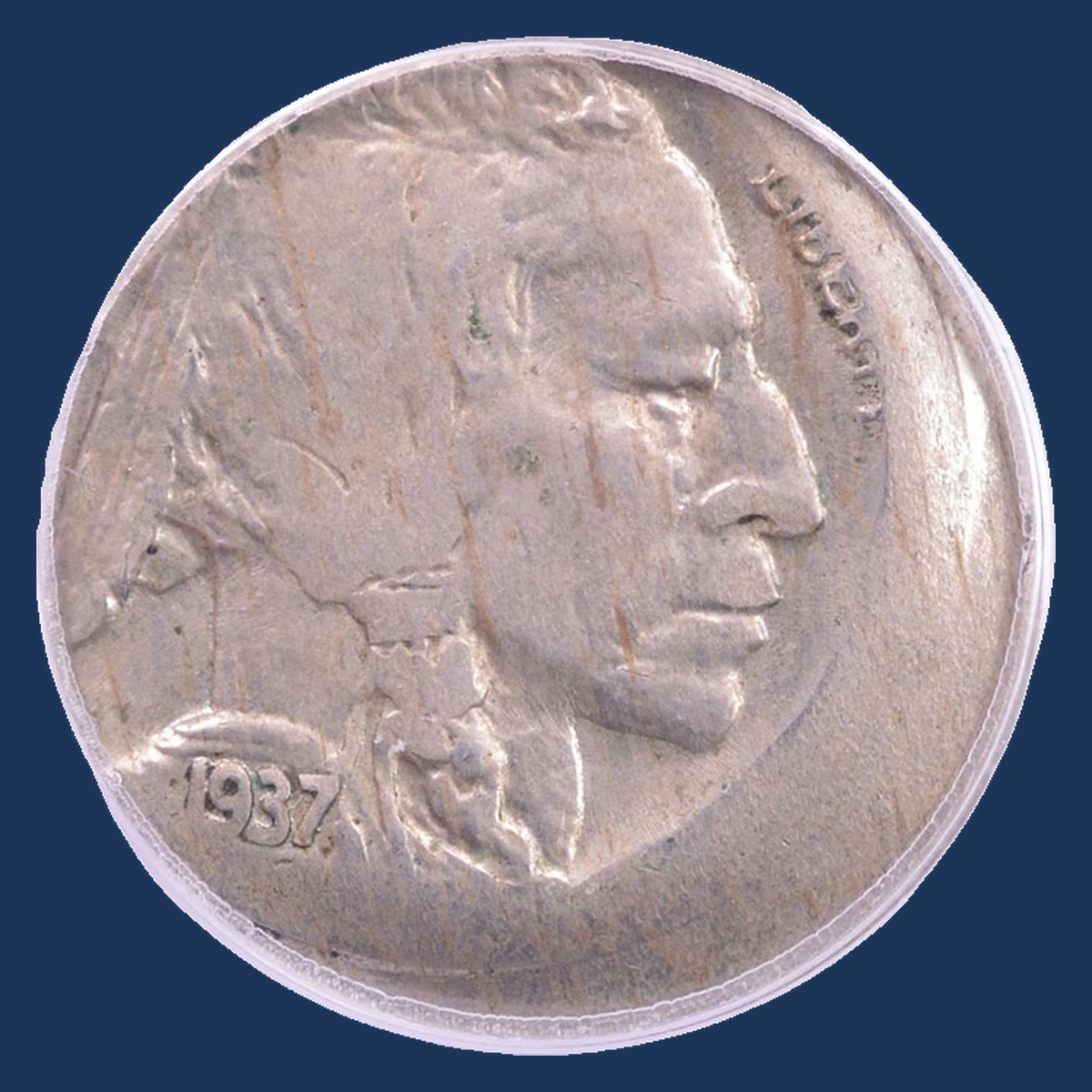
A collector’s Philadelphia example has a design displaced about 10% toward the bottom of the blank. It was recorded at MS64, meaning unworn with some marks.
The misplaced blank received only part of the intended design, leaving an unstruck area opposite the clipped-looking details. The missing design does not mean a piece of metal was necessarily removed.
On Buffalo nickels, keeping a readable date is especially helpful because wear can erase it. A separate coin with more blank space should not inherit this example’s stated percentage, direction, or condition without being measured and examined on its own.
Estimated Value
Allow an estimated $100–$1,500 for 1937 off-center examples, with modest shifts lower than dramatic, well-preserved coins retaining a readable date. The collector’s 10% piece has no auction result assigned here.
A nearby-year comparison is a 1940 Philadelphia Jefferson nickel struck 15% off-center, which sold for $218.50 in October 2010. It has a different design and degree of displacement, so that historical sale offers context rather than a direct price for the Buffalo specimen.
How to Identify
View both faces together and compare the untouched area with the opposite edge where design runs off the metal. This relationship identifies displacement more clearly than an uneven border around an otherwise complete design.
For a loose coin, use a scale and calipers against 5 grams and 21.2 millimeters, and inspect its plain edge through a 10× magnifier. Natural spreading differs from filing or cutting, which can remove both metal and design after striking.
Now read the portrait-side date and check beneath FIVE CENTS for a mint letter before matching the collector’s roughly 10% downward shift. If the mintmark area is absent, do not use that missing information as proof of Philadelphia origin.
8. 1937 Buffalo Nickel Copper Cent Blank
A brown copper coin can carry the Buffalo nickel design when a cent blank enters the wrong press. The smaller blank cannot hold the entire five-cent design, so outer details may be cut off.
A collector records a Denver example at MS64 Brown, meaning unworn with some marks and brown copper color. Its date and D must be identified on the same specimen.
This is a wrong blank rather than necessarily a nickel struck over an already finished cent. No Lincoln portrait is required, and the actual coin’s weight must be measured rather than borrowed from another copper error.
Estimated Value
An estimated $1,500–$7,500 is appropriate for a confirmed 1937 Buffalo nickel on a copper cent blank, depending on grade and retained design. This is an estimate, not a sale reported for the collector’s MS64 Brown coin.
For comparison, a 1940 Jefferson nickel on a cent blank sold for $990 in September 2019. Its different design and grade limit the comparison; the Buffalo estimate assumes a correctly identified example with the date and mint established.
How to Identify
Compare the candidate’s measurements with the two possible blanks before relying on its brown color. For a loose coin, use a scale and calipers against a cent’s roughly 3.11 grams and 19 millimeters, versus a nickel’s 5 grams and 21.2 millimeters.
These are normal blank standards, not recorded measurements of the collector’s example. With a 10× magnifier, inspect the plain edge for a coating seam, fresh cut, or filing that could explain a smaller copper-looking coin.
Then match the surviving 1937 date, Denver D, and cut-off nickel design on the same object. Keep its surface intact for a professional material check rather than scratching through the color or assuming every brown nickel is copper throughout.
9. 1937 Buffalo Nickel Three-Legged Buffalo
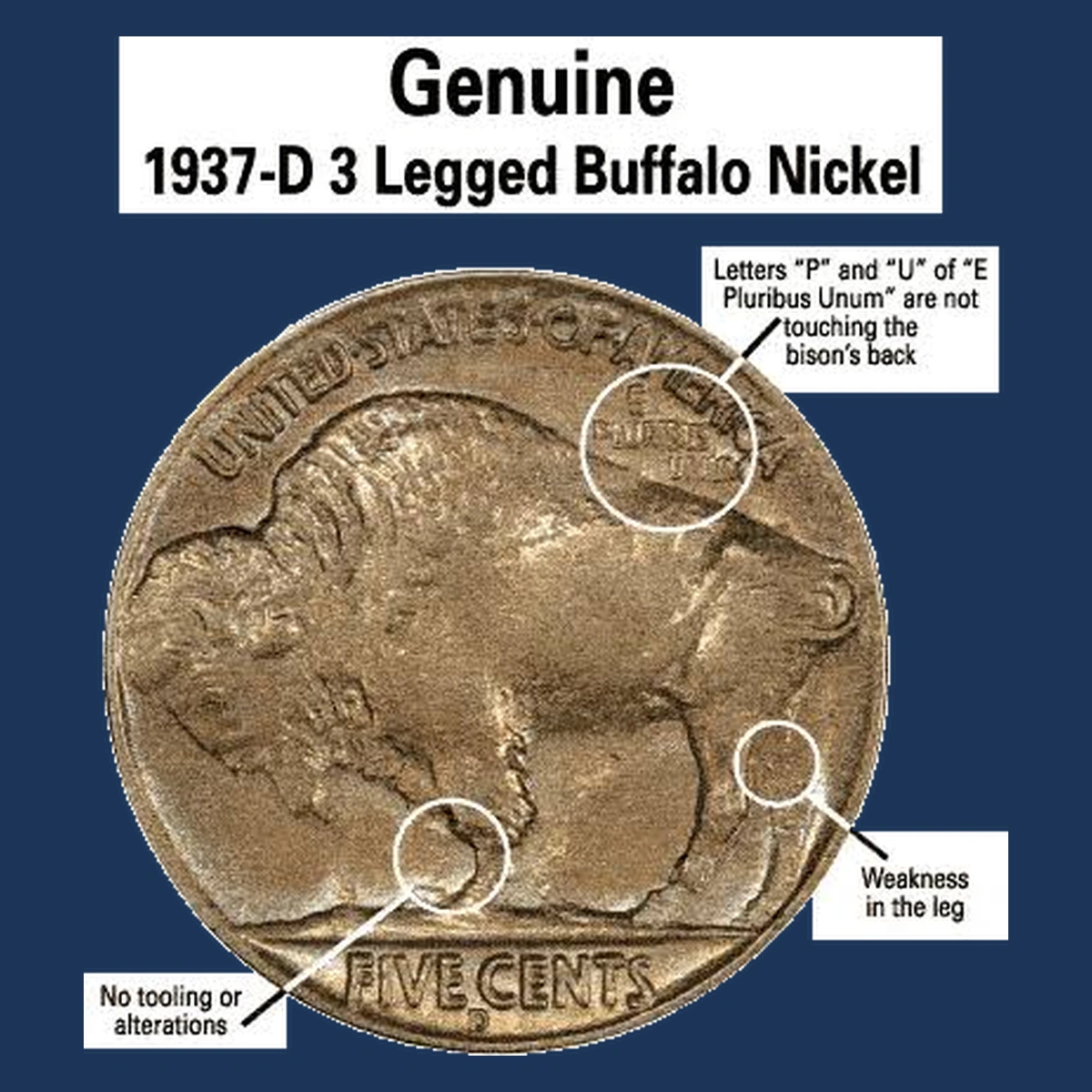
The famous Denver variety is missing most of the buffalo’s front right leg, but the hoof remains. Excessive polishing removed that part of the design from the die, the steel tool used to stamp the coin.
The same damaged tool also left a rough-looking rear leg and a raised trail beneath the belly. Those details help separate the genuine variety from a coin whose leg was removed later.
This is the 1937-D Three-Legged Buffalo. The different 1936-D “three-and-a-half-leg” variety should not be used as its date or diagnostic comparison.
Estimated Value
Genuine worn examples can fit roughly $400–$2,500, while desirable unworn coins may reach an estimated $3,000–$100,000. The top end is for exceptional preservation, not an average three-legged coin.
PCGS records $99,875 at Legend Rare Coin Auctions on October 28, 2021. That coin graded MS66+, meaning exceptionally well-preserved without circulation wear; the record should not be transferred to a worn, cleaned, or altered example.
How to Identify
Find the 1937 date and the small D beneath FIVE CENTS first. A different year or mint does not match this famous variety.
Under a 10× magnifier, inspect the front hoof that remains below the missing leg. Look for scraping or a hollowed surface where a normal leg might have been removed.
Compare the rough rear leg and raised trail under the belly with a genuine example. Their shapes connect the candidate to the damaged stamping tool, rather than to ordinary wear.
A loose coin should be near 5 grams and 21.2 millimeters on a scale and calipers, with a plain edge. Normal measurements alone cannot establish authenticity.
Have those surface features examined together before using the genuine Three-Legged price range.
Conclusion
Three visible legs are only the start of identifying the famous Denver variety. Its remaining hoof, rough rear leg, and marks under the belly need to agree.
The wider $15–$100,000 estimate also includes much smaller errors, from surface peeling to repunched mintmarks. Compare each coin with its own type and condition rather than the headline auction record.
Preserve the date, surface, and edge, and photograph the unusual feature without cleaning or altering the coin.