1910 Nickel Error List with Pictures

Liberty’s portrait and the large V on the back usually fit comfortably on a nickel. On a recorded 1910 cent-blank error, the smaller disk left some stars and part of AMERICA outside the metal.
That PCGS AU58 coin sold for $5,462.50 at Heritage in January 2006. The 1910 Liberty Nickel errors below have estimated whole-coin values of $10–$8,000.
Read on to distinguish an incorrectly sized blank from peeling metal, blocked details, and an off-center strike.
1. 1910 Liberty Nickel Design Blocked during Striking
A small area can fail to show the expected design even when nearby letters or hair remain clear. Material caught between the metal disk and the stamping tool can block the design from forming.
This is called a struck-through error. Soft material may leave weak detail, while a harder object can leave a more distinct impression.
The 1910 report does not identify a particular object or location. Grease, wire, and other obstructions explain possible shapes, but they should not be treated as separately confirmed examples from this year.
Estimated Value
For a genuine ordinary-strike example, estimate $10–$300. A faint blocked detail on a worn coin belongs below a clear impression on an attractive, unworn piece.
This range is an estimate based on the size and visibility of comparable nickel errors, not a recorded sale of a particular 1910 struck-through coin.
A missing letter alone does not establish the price. Original surface around the interruption matters, and later wear or polishing does not receive the same premium.
How to Identify
Compare the weak area with neighboring detail at the same height. If the whole portrait or word is equally flat, ordinary wear may explain what is missing.
Use a 10× magnifier and move a lamp from side to side. Look for design interrupted during striking rather than grooves, polished streaks, or metal pushed up by a later blow.
A loose normal Liberty Nickel weighs 5 g and measures about 21.2 mm, checked with a scale and calipers. Examine the plain edge for squeezing or other damage.
The strongest clue is a local interruption that fits the original surface around it. A blank-looking patch does not by itself establish which material caused the blockage.
2. 1910 Liberty Nickel Peeling Metal or Separation into Thin Pieces
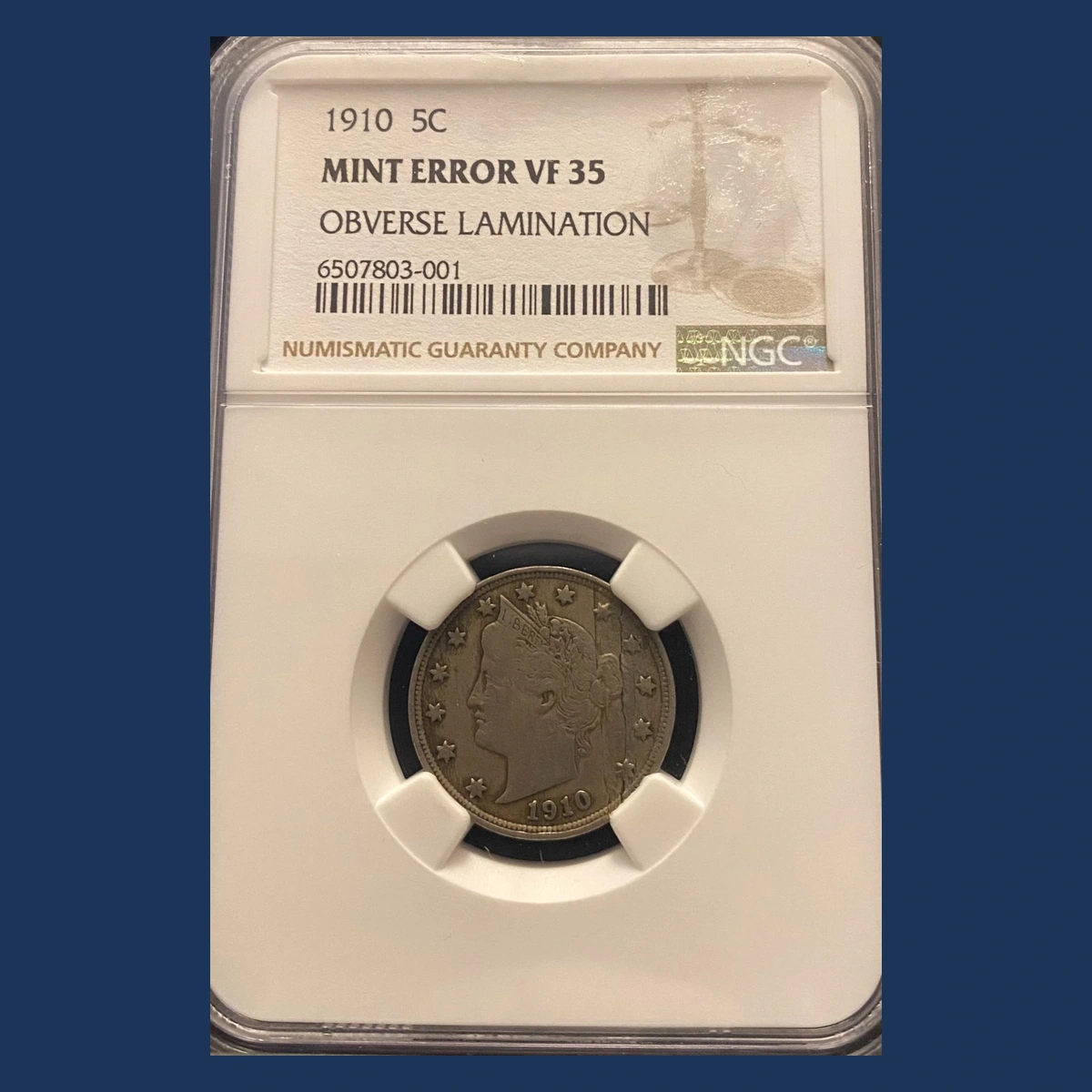
Metal can peel from a coin when a weak layer opens inside it. A small flap or shallow missing patch is called a lamination.
The weakness can also extend through much of the disk, allowing a struck coin to separate into thin pieces. A resulting piece may keep the design on its outside and expose a rough inner face.
Both forms are reported for 1910 Liberty Nickels. They involve the copper-nickel mixture itself, not a plated outer coating, and the report does not establish a surviving matching pair for this date.
Estimated Value
Estimate $15–$250 for a local lamination and about $100–$1,500 for a genuine thin piece separated after striking. A readable design and convincing natural separation are important.
For comparison, a 1917 Buffalo Nickel split pair, both pieces graded MS64, realized $1,260 in June 2023. NGC reports that price for both pieces together.
That different-year, different-design pair does not set an individual price for one 1910 fragment or a small surface peel.
How to Identify
Leave a flap in place. If you have a separate piece, support it without bending it or trying to attach it to another coin.
A scale can show reduced weight compared with the normal 5 g, while calipers record the outline against 21.2 mm. A thin split piece may keep nearly the full diameter.
Examine its rough inner face or the flap boundary with a 10× magnifier. Regular cutting lines and polished flat surfaces suggest machining rather than a natural split.
Inspect the surviving plain edge and the original struck face as well. A surface peel should connect naturally with the surrounding metal.
For a separated piece, a preserved outer design and rough inner boundary provide more useful evidence than reduced weight alone.
3. 1910 Liberty Nickel Off-Center Strike
An off-center strike leaves the design crowded toward one side, with an unused crescent on the other. The metal disk was not fully under the tools when they came together.
Parts of the outer stars or back lettering can fall outside the disk. The amount missing varies from coin to coin, and a complete readable date helps identify the year.
This error is reported for 1910 without a fixed percentage or direction. An uneven rim alone is different from a strike that actually loses part of its design.
Estimated Value
A reasonable estimated range is $100–$2,000 for a genuine dated 1910 off-center nickel, depending on displacement and condition. Small offsets generally sit below dramatic examples with a clear date.
A nearby-series comparison is a 1902 Liberty Nickel struck 20% off center, graded XF40, which sold for $561.20 in March 2026. XF40 indicates moderate wear with substantial detail remaining.
That is a different-year sale, not evidence that a particular 1910 coin has the same percentage or value.
How to Identify
Read 1910 first, then follow the outer stars and lettering around both faces. Identify where the design ends and where untouched metal begins.
Check that boundary under a 10× magnifier for natural spreading rather than grinding. A blank crescent should be part of the original disk, not a damaged area cut into a normal design.
Weigh a loose coin against the normal 5 g standard and use calipers against the usual 21.2 mm diameter. Spreading can change the outline without removing metal.
Inspect the plain edge for later cutting or flattening. Missing design beside an original unstamped crescent supports an off-center strike more clearly than a merely uneven rim.
4. 1910 Liberty Nickel Strike on a Cent Blank
A Liberty Nickel struck on a cent blank has more design than its smaller copper-rich disk can hold. Outer stars and letters can disappear beyond the edge, while the metal develops a brown color.
A recorded PCGS AU58 example was struck toward two-thirty. Some right-side stars and part of AMERICA lie outside the metal.
Its small scratch near the final star is later damage, not another mint error. The underlying wrong blank explains the crowded design, but neither color nor a scratch establishes the error on another coin.
Estimated Value
The recorded AU58 coin sold for $5,462.50 on January 7, 2006, at Heritage. AU58 indicates only slight wear, which helps explain the strength of its surviving design.
An estimated $2,000–$8,000 covers comparable authenticated 1910 cent-blank errors across different condition levels. The readable date and natural copper-rich metal are central to that comparison.
This range does not apply to a plated nickel or a normal coin deliberately cut down to cent size.
How to Identify
A cent of this period normally weighed 3.11 g and measured 19 mm before striking. Those are comparison standards, not a claimed measured weight for the auctioned coin.
Use a scale and calipers on a loose candidate, comparing it with a normal 5 g, 21.2 mm nickel. The smaller blank can spread when struck, so do not judge it by diameter alone.
Examine the plain edge through a 10× magnifier for cutting marks or a surface coating. A naturally crowded design should continue toward the boundary without signs of later trimming.
Confirm the date and obtain a non-damaging metal test if needed. The lighter copper-rich blank and original loss of outer design must agree, rather than relying on brown color alone.
Conclusion
The estimated $10–$8,000 range for 1910 Liberty Nickel errors starts with modest surface defects and reaches genuine cent-blank strikes. A smaller copper-rich disk requires different evidence from an ordinary nickel with missing detail.
Read the date, examine both faces, and keep loose metal untouched. Use the weight and outline to support what the design shows, while separating actual 1910 sales from comparisons involving other years.