1903 Nickel Error List with Pictures

Turn a 1903 Proof nickel over, and its back may be upside down. That surprising error shares this year with shifted designs and peeling metal.
A 65% off-center example brought $2,875 in a Heritage auction reported by Mint Error News. The 1903 nickel errors below have estimated values from $10 to $3,500, depending on the error and condition.
Read on to see which clues need magnification and which appear with a simple flip.
1. 1903 Liberty Nickel Repunched Date
Small raised pieces of numbers can hide beneath the date. They come from an earlier placement of the date punch, the tool used to add numbers to a steel die.
The die then stamped that overlapping date onto coins. This happened before the coins themselves were struck.
One published 1903 pattern has extra parts below the 1 and 9. Another shows traces left of the lower 1, 9, and 0.
NGC also lists a 1903/903 variety. Its label alone does not establish that it matches either of those two patterns.
Estimated Value
Estimated values are $10–$200 for circulated through moderately marked unworn examples. Clear extra digits and less wear place a coin higher within that range.
The Flynn and Van Note book listed historical guide values from $10 to about $110 for the two published patterns. Those figures were estimates, not auction results.
Heavy cleaning can reduce value even when the extra date outlines remain easy to see.
How to Identify
Set a clear photograph of the complete date beside your coin. With a 10× magnifier, compare the bottom of the 1 first, then follow the 9 and 0.
Below-the-number traces and left-side traces describe different patterns. Do not combine them into one imagined date; the published variety photographs show what to match.
A loose normal coin should weigh about 5 grams and measure 21.2 mm with a scale and calipers. Its edge is plain, and Philadelphia placed no mint letter on these nickels.
Check the extra strokes for raised, curved number shapes. Flat shelves beside many unrelated letters suggest a different kind of doubling, while cut grooves suggest alteration.
2. 1903 Liberty Nickel Lamination and Split Layers
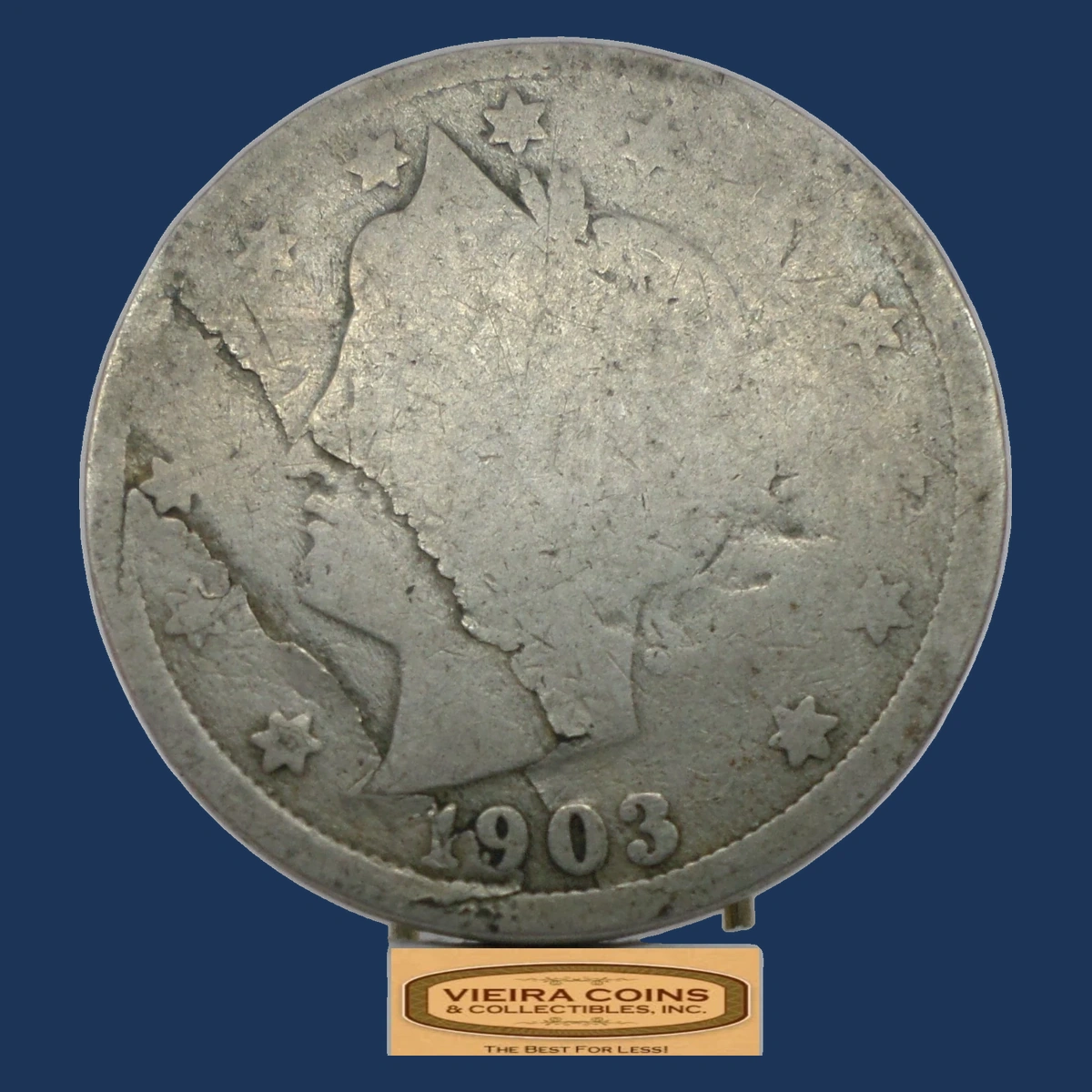
A peeling patch can expose metal below the finished front of a 1903 nickel. Collectors call this lamination: a weak layer separates within the coin’s metal.
The 1986 Harry Einstein auction catalog described a front-side example graded MS60, meaning unworn but noticeably marked. Such peeling need not cross the whole coin.
A collector also recalled seeing a 1903 nickel that split into two layers after striking, with both pieces sold together. That account describes a much larger separation, rather than another small surface flake.
Estimated Value
A small genuine surface peel has an estimated value of $10–$200. A 1911 Liberty nickel with front-side lamination sold for $51 in January 2023, providing a nearby-year comparison.
For a verified 1903 pair split after striking, estimate $300–$1,500 for both pieces together. That larger range reflects the complete separation and matching halves.
Missing pieces, repairs, or severe corrosion reduce the appeal; a two-piece price does not apply to one small flake.
How to Identify
Leave any attached flap alone. Lifting it can turn an intact error into a damaged coin with a lost piece.
Examine the opening under side lighting and a 10× magnifier. A thin ledge and rough exposed metal differ from a scratch with displaced metal pushed along its sides.
For an alleged split pair, compare both inner surfaces and the outer designs without pressing the pieces together. One outside should carry the front and the other the back.
Record loose-piece weights with a scale; together they should approach the normal 5 grams if little metal is missing. Calipers should show roughly 21.2 mm across, with portions of the original plain edge.
Matching separation surfaces matter more than two thin pieces merely sharing a diameter.
3. 1903 Liberty Nickel Proof with 180-Degree Rotation
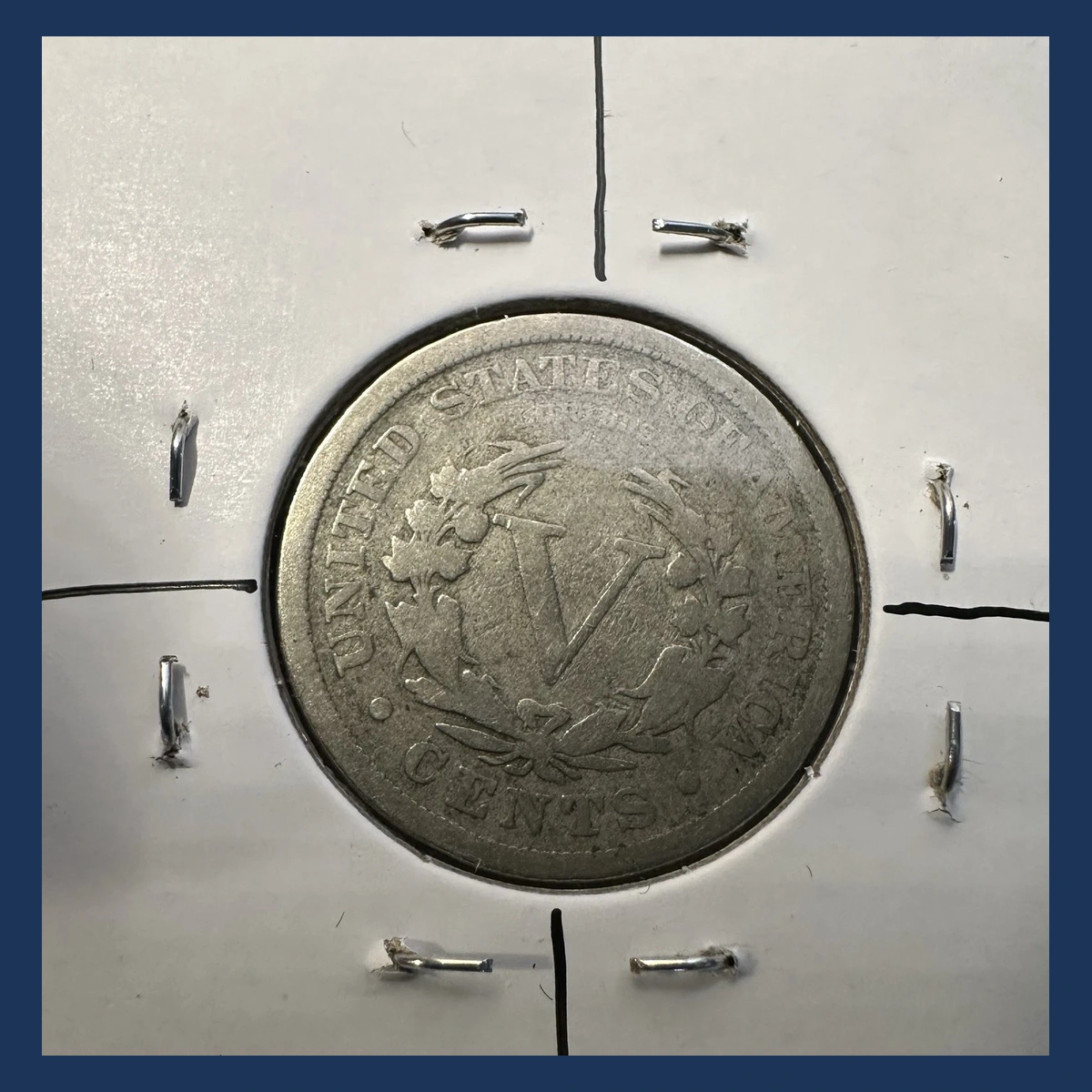
The portrait can look perfectly normal while the back points the wrong way. Some 1903 Proof nickels have this 180-degree rotation; Proofs are collector coins made with specially prepared tools and blanks.
Coin dealer David Bowers described discovering one while examining an album of Proof nickels. Changing the position of one side left the other upside down.
The two stamping dies faced the same direction instead of the normal opposing directions. This arrangement is called medal alignment, and it does not occur on every 1903 Proof nickel.
Estimated Value
For a genuine rotated 1903 Proof, an estimated range is $300–$2,000 across ordinary collectible grades. Scratches in the shiny background push prices toward the lower end.
A PCGS PR66 Cameo example sold for $1,380 in April 2006. That grade describes a well-preserved Proof with frosted details against a reflective background.
The price includes the whole Proof coin, not just the rotation, so surface quality remains a major part of its value.
How to Identify
Hold Liberty upright and turn the coin top-to-bottom, like flipping a page over its top edge. A normal United States nickel’s back will then stand upright.
The 180-degree error leaves the back upside down. Turning left-to-right changes the test, so keep the same motion when checking a normal comparison coin.
A short video of the turn is more useful than two separately rotated photographs. A sealed grading holder can be turned intact; there is no need to open it.
For a loose coin, check the normal 5-gram weight and 21.2-mm diameter with a scale and calipers. Inspect the plain edge with a 10× magnifier for a joining seam that might reveal two altered pieces.
4. 1903 Liberty Nickel Off-Center Strike
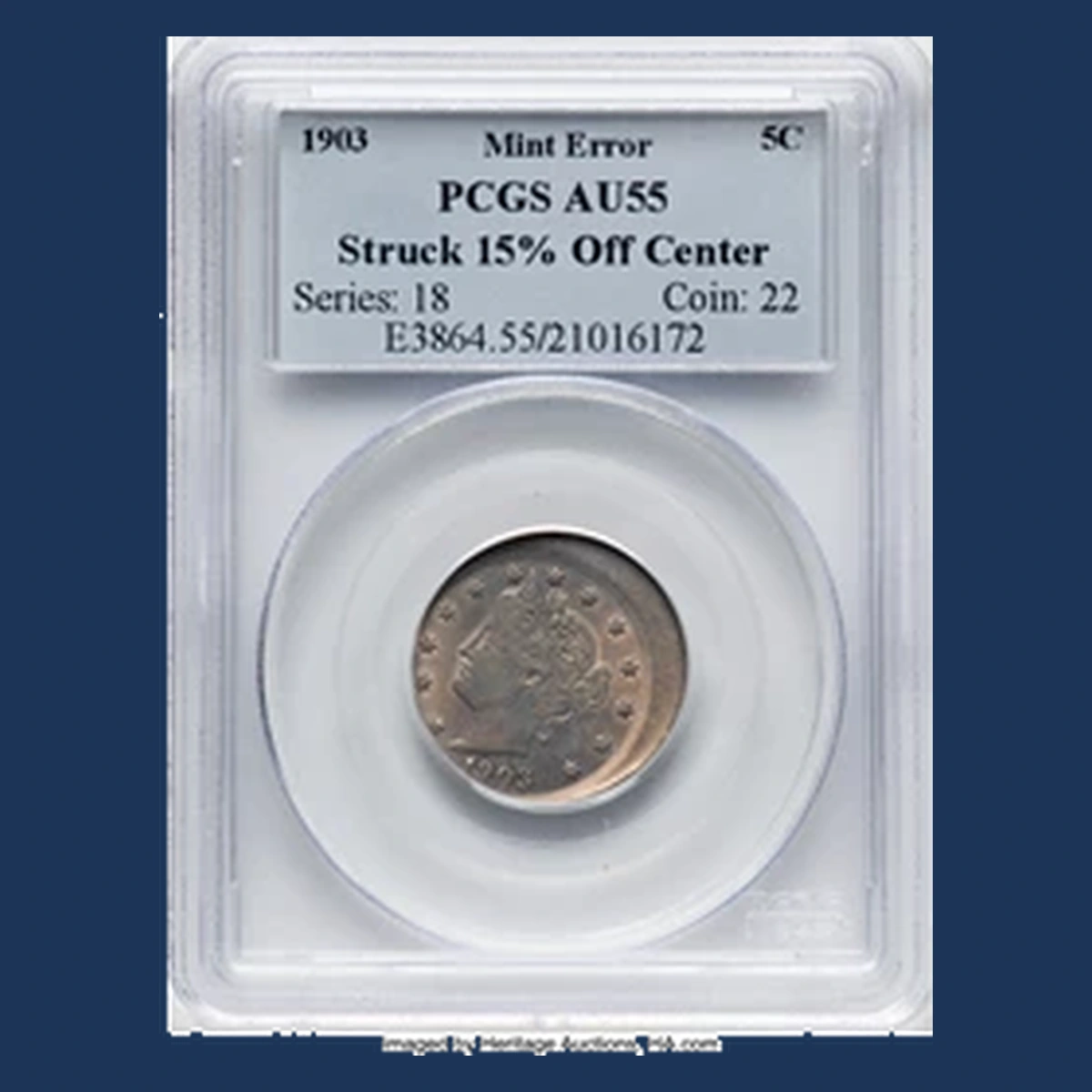
A large empty area beside Liberty makes this error easy to notice. The blank was not centered between the stamping tools, so part of the design missed the metal.
Two very different 1903 examples illustrate the spread. One is 15% off center and graded AU55 by PCGS, with light wear.
Another is 65% off center and graded MS64 by NGC, meaning unworn with some marks. The larger shift leaves much less design, but both belong to the same striking error rather than separate varieties.
Estimated Value
Budget an estimated $100–$3,500, with lightly shifted worn coins toward the lower end. A large blank area, readable date, and clean unworn surface bring stronger interest.
The 65% off-center MS64 coin realized $2,875, as reported in Mint Error News. That is a historical auction result for a dramatic example.
It should not set the price of a much smaller 15% shift simply because both coins bear 1903.
How to Identify
Read the surviving date before judging how dramatic the coin looks. A large shift may remove enough numbers to prevent a reliable year identification.
Trace the border between the struck design and the blank area on both sides. The design should run off the metal, rather than remain complete inside a broad rim.
An uneven front rim with a centered back calls for a different explanation. Use a 10× magnifier to check that the blank area is original metal, not a surface ground smooth.
A scale should put a loose complete nickel near 5 grams; calipers can record how striking changed its normal 21.2-mm outline. The edge normally has no grooves, so a plain edge alone proves nothing about the shift.
Conclusion
The estimated $10–$3,500 range covers tiny extra date strokes through dramatic off-center strikes. A repunched date rewards careful magnification, while the rotated Proof needs a controlled top-to-bottom turn.
Peeling metal deserves gentle handling, especially if part remains attached. For a split pair, inspect both pieces before treating them as one original coin.
Compare the size of the error and the coin’s condition together; the most eye-catching example is not the right price guide for every 1903 nickel.