1884 Nickel Error List with Pictures

The same repunched 1884 date can appear on a worn pocket coin or a Proof, a specially made collector coin. One exceptional Proof brought $8,812.50 at Heritage in June 2013.
This 1884 nickel error list also covers metal separating from both faces. Estimated whole-coin values run from $25–$9,000, with condition and special finish explaining much of the difference.
Compare the date strokes and broken surfaces below before deciding which kind of find you have.
1884 Liberty Nickel Lamination on Both Sides
The surface can lift or flake where the metal is weak beneath it. Collectors call this lamination, a separation within the alloy rather than a loss of nickel plating.
A seller describes an 1884 Liberty nickel with this flaw on both sides. The listing is for an ungraded coin and does not establish a particular certified condition.
Two affected faces do not mean the entire disk split into two pieces. The reported problem is surface separation, with its actual boundaries best understood from photographs.
Scraping and corrosion can also leave rough patches, but they need different explanations.
Estimated Value
The two-sided lamination listing is marked sold and displays $34.95. It also allowed Best Offer, so that display does not establish the final amount accepted.
Estimate $25–$250 for genuine 1884 surface laminations, depending on condition and the size of the visible separation. An original attached flap can show the flaw more clearly than a worn rough patch.
Having damage on two faces does not automatically double the value of the coin.
How to Identify
Keep any lifted flap in place. Do not pull it back to see underneath, because the original boundary is part of what you need to examine.
Use a 10× magnifier to compare both faces for a thin layer lifting or a naturally broken surface. Make separate photographs so marks on the front are not confused with marks on the back.
For a loose coin, weigh it against the normal 5.00 grams and measure its width against 21.21 millimeters with calipers. Missing metal can lower weight, while a retained flap may leave it close to normal.
Check the plain edge and rough areas for cuts or scattered corrosion pits. A visible separation within the metal gives stronger evidence than roughness alone.
1884 Liberty Nickel Repunched Date
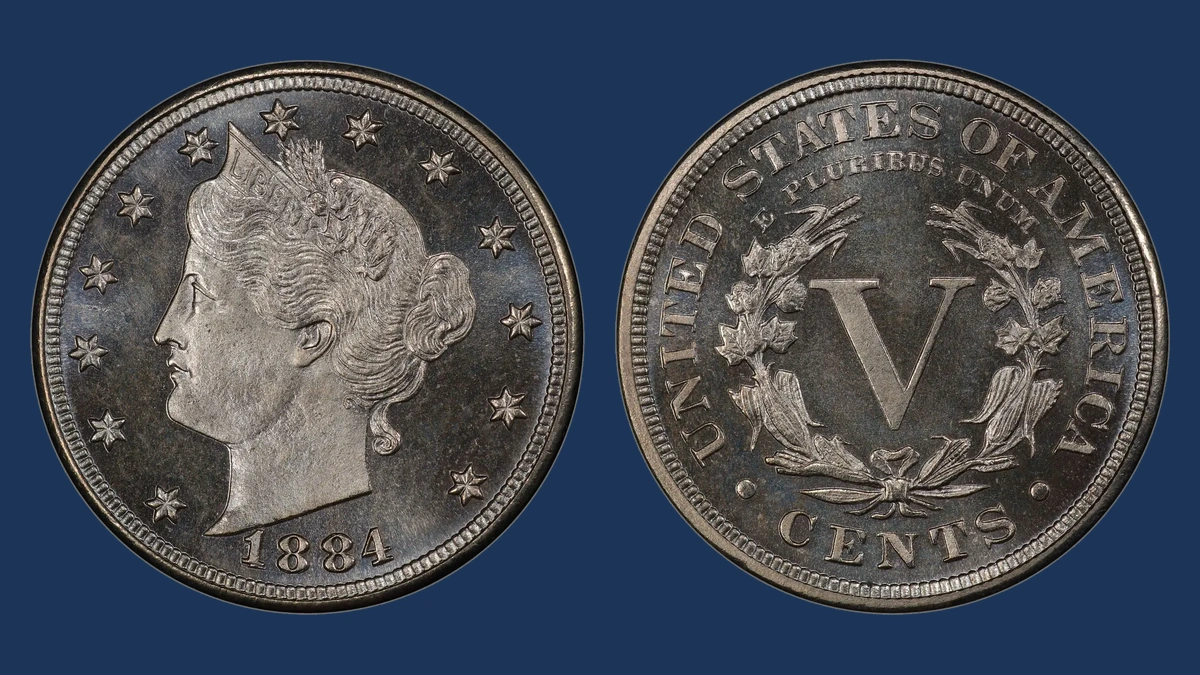
A second edge beside a date digit can preserve an earlier position of the date punch. Workers moved that punch while adding the year to a steel stamping tool, called a die.
The recognized FS-301 variety has extra date strokes and appears on both ordinary coins and Proofs. A Proof is a specially made collector coin.
GreatCollections describes remnants toward the upper left of the final digits. The same date pattern cannot, by itself, tell you how a coin was made.
A second punch position in the tool also differs from striking the finished nickel twice.
Estimated Value
Estimate $40–$800 for circulated through lower unworn repunched-date examples, and $300–$9,000 for Proofs across a wider quality range. These are whole-coin estimates, not amounts to add to ordinary nickel prices.
Heritage recorded $8,812.50 in June 2013 for an FS-301 graded PCGS PR66+ Deep Cameo. That describes an exceptionally preserved Proof with frosted raised designs against mirrorlike backgrounds.
Its special finish and preservation account for much of the high result.
How to Identify
Enlarge all four digits together with a 10× magnifier. On the cataloged FS-301 example, compare the earlier strokes toward the upper left with their matching numeral shapes.
A loose normal nickel should weigh near 5.00 grams on a scale and measure 21.21 millimeters with calipers. Those figures apply to both ordinary and Proof nickels, so they do not identify the finish.
Check for scratches cutting through the date or flat ledges beside the digits. Earlier punch details should repeat parts of a numeral rather than form random lumps.
Bright surfaces alone do not prove a Proof. Establish the collector-strike finish separately while using the matching extra numeral strokes to identify the repunched date.
Conclusion
The estimated $25–$9,000 spread reflects two very different kinds of 1884 nickel. A modest surface lamination and an exceptional Proof with a repunched date cannot be priced as equivalent discoveries.
Look for a real separation in the metal or a repeatable extra numeral shape. Preserve loose fragments, avoid cleaning the date, and compare the coin’s condition and finish before using an auction result.