1878 Nickel Error List with Pictures

A small flaw beside the shield appeared on an 1878 nickel once listed at $1,495. That was a dealer’s asking price for a Proof, a coin specially prepared for collectors.
Every genuine 1878 Shield nickel began as a Proof, even if it later became worn. This 1878 nickel error list covers estimated whole-coin values of $600–$3,500.
Read on to compare the small front flaw with a tiny extra stroke inside the date’s final 8.
1878 Shield Nickel Small Flaw beside the Shield
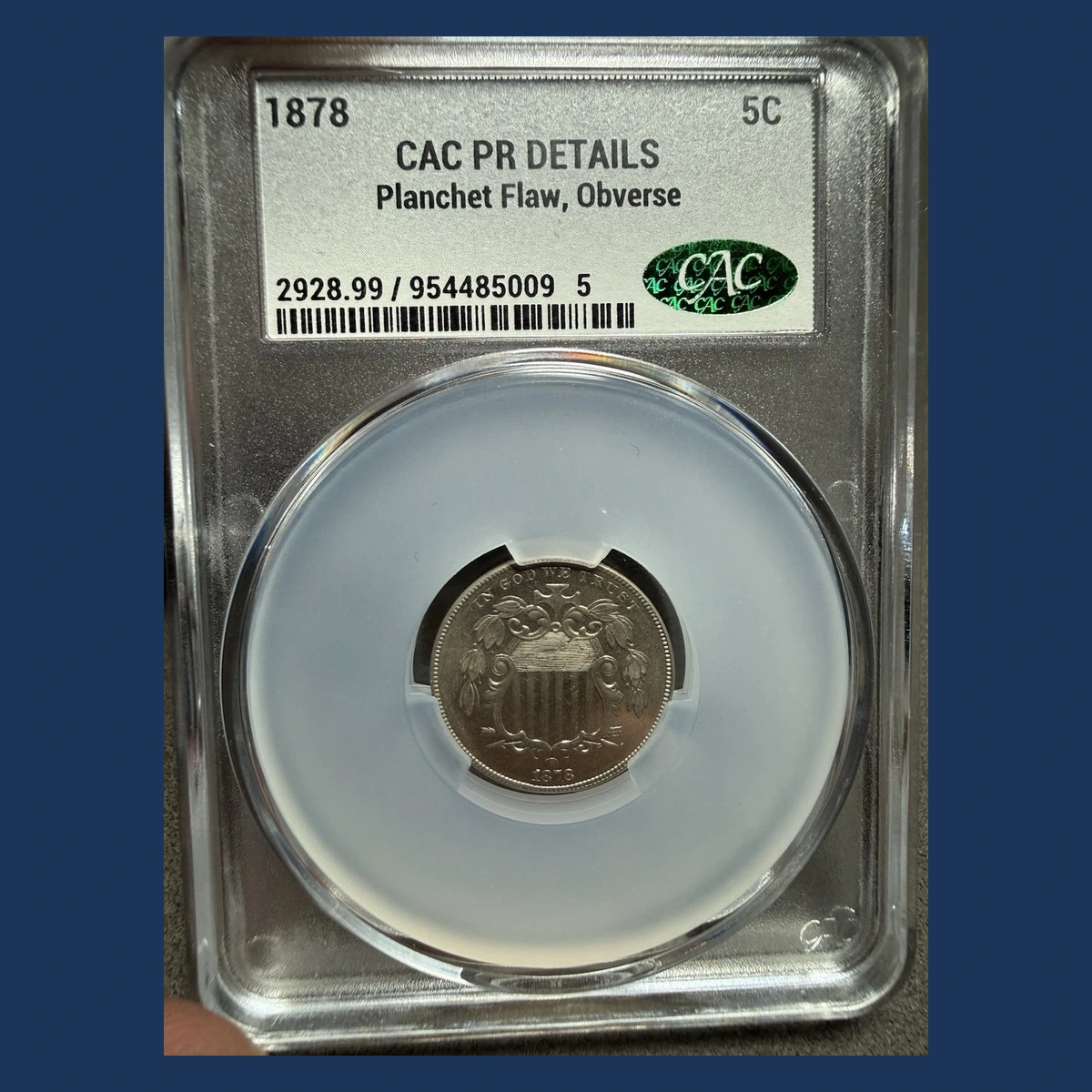
A small flaw to the left of the shield interrupts an otherwise carefully made collector coin. The dealer described this PCGS PR64 example as having a small defect in its blank, the metal disk used before striking.
PR64 indicates a Proof with some visible imperfections. Its golden color is separate from the reported flaw.
The description does not establish whether the metal peeled or failed in another way. The boundary beside the shield is the feature to compare, rather than a particular cause chosen solely from a rough or discolored patch.
Estimated Value
The dealer listed this Proof at $1,495; an out-of-stock notice does not confirm the final selling price. Estimate $1,000–$3,000 for a comparable, well-preserved 1878 Proof with a modest original blank flaw.
Much of that amount reflects the scarce collector coin itself. The small flaw may add interest without creating a large separate premium.
Clean reflective surfaces and sharp surrounding detail help the comparison. Scratches, polishing, or later damage can reduce appeal despite an authentic production flaw.
How to Identify
Keep a graded Proof inside its holder and find the affected area immediately left of the shield. A 10× magnifier and low side lighting can show how its boundary meets the nearby design.
Photograph the area from two light angles. Look for scraped finished detail or fresh tool grooves before assigning the roughness to the original blank.
Do not probe a loose edge or clean the patch. An intact boundary can preserve evidence that disappears if metal is lifted away.
For a loose coin, a scale and calipers can compare the normal 5 grams and 20.5 millimeters without touching the reflective faces. Inspect the plain edge, remembering that a small local flaw may cause no measurable weight change.
1878 Shield Nickel Repunched Final 8
The lower loop of the final 8 can contain a small extra trace from an earlier punch impression. The date punch entered the die, the steel stamping tool, again in a slightly shifted position.
The current Shield Nickel Varieties description calls this an 8 repunched toward the south. That means the relevant extra detail lies lower when the date is upright.
This is a repunched date on a Proof nickel, not evidence that the finished coin received two blows in different positions. The small trace also does not establish an 1878/7 overdate.
Estimated Value
For a matched repunched-date Proof, estimate $600–$3,500 across worn or impaired pieces and attractive examples. The coin’s preservation can matter much more than the size of the extra stroke.
The $1,495 dealer listing for the separate front-flaw Proof provides context for the underlying 1878 collector coin. It is not a transaction for this date variety.
A clear lower-loop trace helps identification. Fine surface scratches, cleaning, or wear can reduce appeal without making the repunched 8 an overdate.
How to Identify
Read the entire date before enlarging its final digit. An unclear 1873 can be misleading, so the last digit must actually support 1878.
With a 10× magnifier, inspect inside the final 8’s lower loop. Compare the small trace with the Shield Nickel Varieties description, keeping the date upright.
A scratch or reflection can imitate a short extra line. Change the lighting to check whether it remains part of the original raised digit.
For a loose Proof, check weight near 5 grams with a scale and diameter near 20.5 millimeters with calipers. Handle only the plain edge and protect the faces.
Match the lower-loop detail as a repunched 8 rather than filling in an imagined underlying 7.
Conclusion
The estimated $600–$3,500 range covers whole 1878 Proof nickels, with condition playing a large role. A small extra date trace and a small blank flaw need different close-up views.
Keep the full date in one photograph and the affected area in another. Protect the reflective surfaces, leave the flaw untouched, and compare the final 8’s actual outline before calling it an overdate.