1872 Nickel Error List with Pictures

A normal-looking date can hide a larger earlier set of numbers, while an upside-down back points to another mistake entirely. These are two ways to begin checking 1872 nickel errors.
For a price example, PCGS records a doubled-front coin sold on eBay for $685 in April 2024. Estimated values for the ordinary-strike pieces covered here run from $20–$3,000.
Use the separate checks below to read what the date, design, and metal are telling you.
1. 1872 Shield Nickel Die Cracks
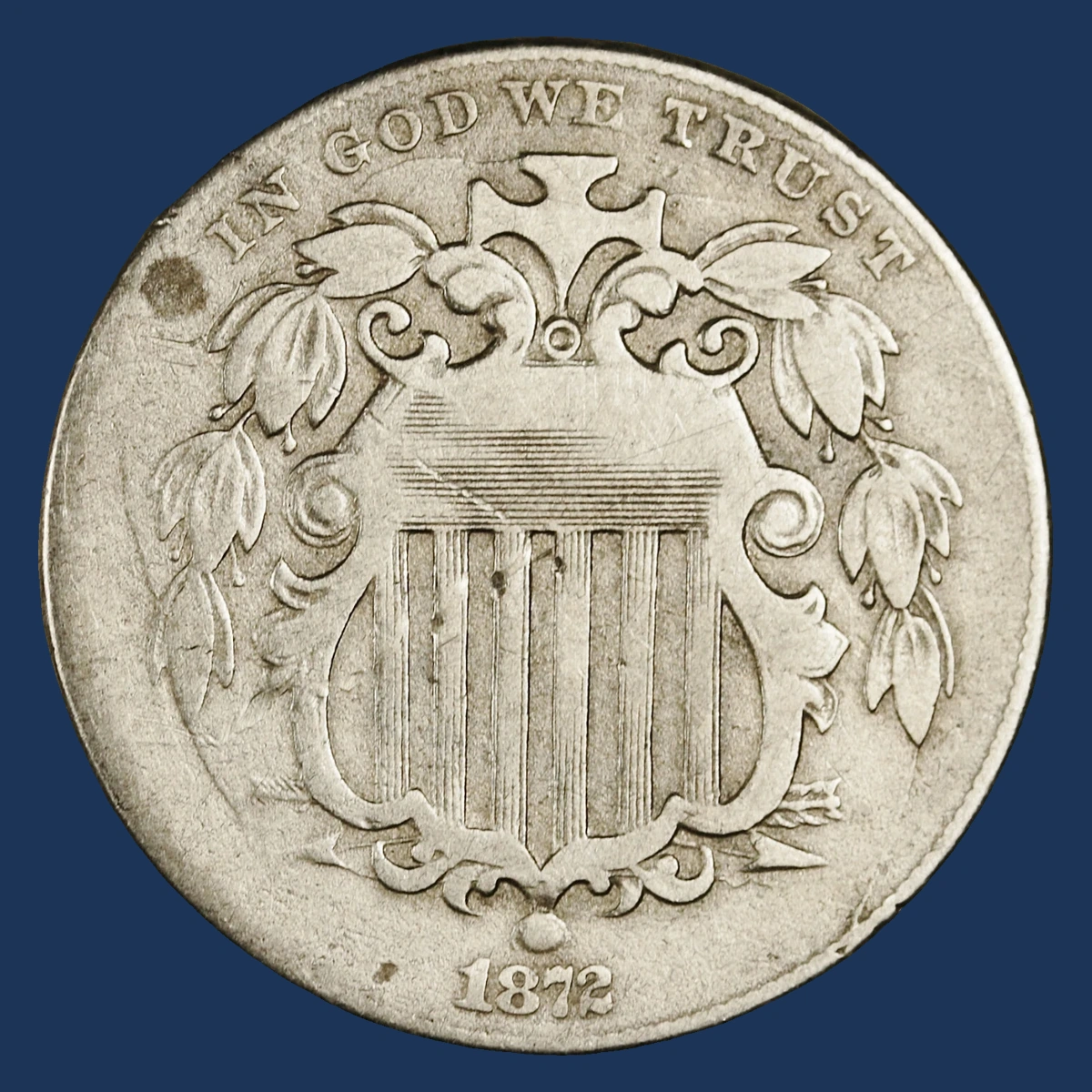
A raised thread of metal can run from the lower shield area toward the edge. It was formed when metal entered a crack in the die, the steel tool used to stamp the design.
Reported 1872 examples have cracks around the round lower ornament, the curved decoration, and lower leaf tips. Some lines continue outward toward the rim.
These paths reflect different cracked tools or stages of wear in a tool. A later coin may show a longer line, but that does not turn every added branch into a different kind of error.
Estimated Value
For worn through lightly worn nickels with visible cracks, an estimated $20–$300 is reasonable. The low end reflects a common date coin with only a small added feature.
A clear connected line may draw more interest than a faint crack lost among scratches. Attractive surfaces also make the original raised line easier to recognize.
Exceptional unworn condition can lift the price for other reasons, so a high-grade coin’s total value should not be treated as the value of its crack.
How to Identify
Examine the plain edge first for a hit beside the suspected crack, then follow the affected area inward. For a loose coin, use a scale and calipers to compare its weight and diameter with 5 grams and 20.5 mm.
Under a 10× magnifier, trace the line through the lower ornament, curved decoration, and nearby leaves. A tool crack leaves raised metal across the surface; a scratch usually cuts into it and may push metal up along its sides.
Change the light’s direction rather than judging from one bright photograph, because a shallow cut can look raised under misleading light. The useful distinction is the line’s height, not how far it extends or how many features it crosses.
2. 1872 Shield Nickel Large Reverse Lamination
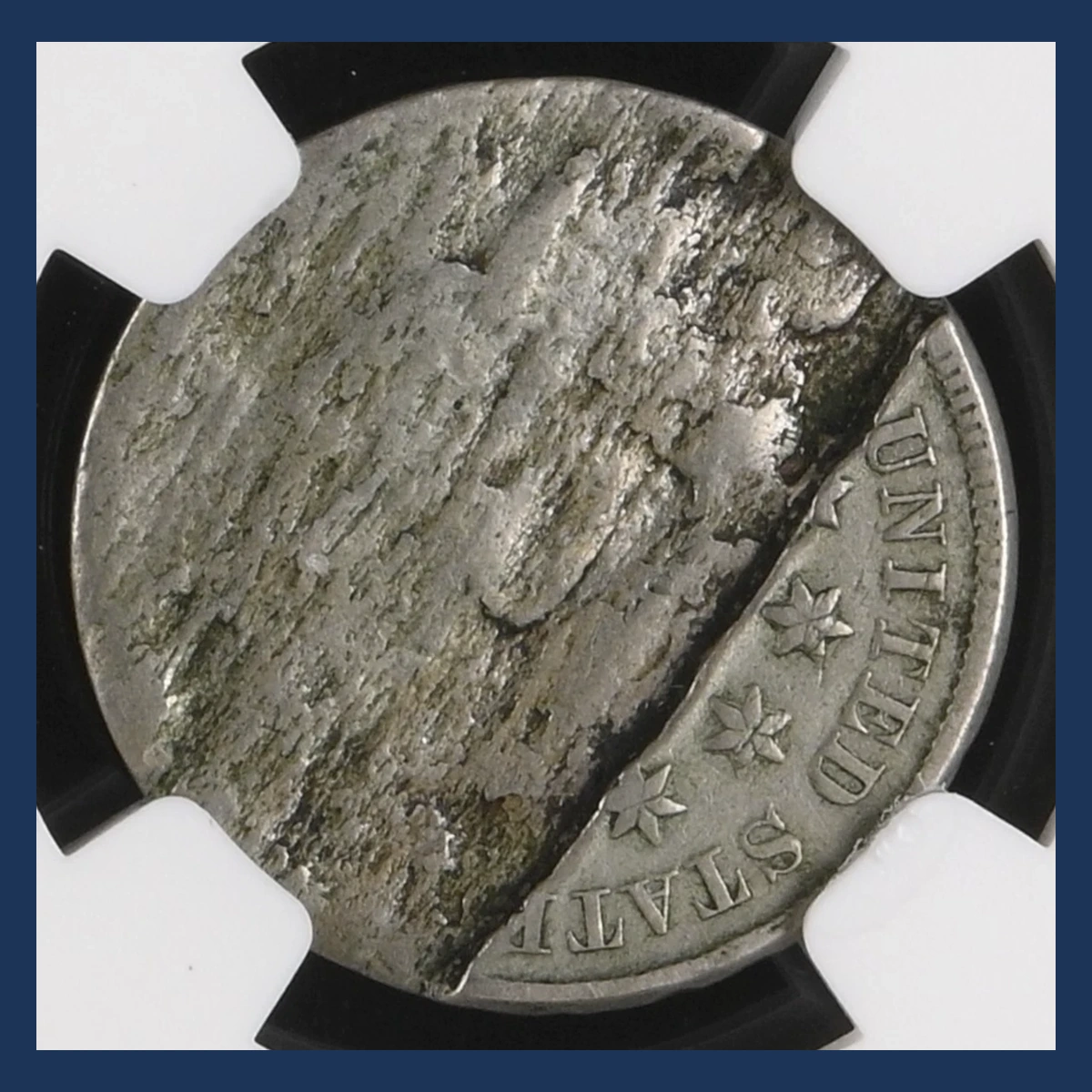
Much of the back can disappear when a layer of the original metal separates. The remaining coin shows a rough exposed area beside whatever design survived the split.
A 1978 catalog reprinted in Mint Error News describes an 1872 Shield nickel with about 80% of the back split off. That percentage describes the affected surface, not a measured loss of 80% of the coin’s weight.
This nickel is a uniform copper-nickel alloy. The separation comes from a weakness within that metal, rather than the loss of an outer layer on a modern clad coin.
Estimated Value
A large genuine surface separation fits an estimated $150–$1,000, depending on wear, remaining design, and later damage. The upper end calls for an unmistakable original split on a coin that still displays well.
An 1899 Liberty nickel consisting of one split front half sold for $109 in January 2023. That different design and more complete division offer only a broad comparison.
The 1872 description concerns one coin with extensive back-surface loss, not an offered pair of matching halves.
How to Identify
Protect any metal still attached around the split; do not pull at it.
Begin with a 10× view of the boundary between the surviving back design and the exposed inner surface. Rough layered texture can support a natural separation.
Smooth circular tracks, uniform thinning, or a sharply machined recess suggest metal removed after striking. Inspect the plain edge for related cutting.
For a loose piece, weigh it on a scale without assuming a target weight from the 80% description. An intact Shield nickel normally weighs 5 grams and measures 20.5 mm across with calipers.
Compare the exposed patch with the untouched back design. That boundary explains the missing layer more clearly than a photograph showing only a nearly blank face.
3. 1872 Shield Nickel Rotated Dies
The back may appear nearly upside down when you flip the coin from top to bottom. A normal United States coin should show both designs upright during that same motion.
This happens when the two stamping tools face the wrong direction relative to each other. The design on each face can remain otherwise normal.
The Shield Nickel Varieties catalog records an 1872 example with nearly 180 degrees of rotation. That is close to a half turn, not an exact angle to assign to every coin that looks slightly tilted.
Estimated Value
An estimated $100–$1,500 covers worn through attractive examples with a clearly demonstrated large rotation. Near-half-turn alignment is easier to appreciate than a small tilt of the back.
For another-year comparison, a Proof 1903 Liberty nickel with 180-degree rotation sold for $1,380 in April 2006. That specially prepared collector coin is a different product from this ordinary-strike Shield nickel.
Preservation still matters, and photographs must establish the relationship between both faces before a rotation premium can be judged.
How to Identify
Hold the shield upright, with the date at the bottom. Flip the coin over from top to bottom without turning it sideways; the back’s large 5 should normally finish upright.
Repeat the same motion with a normal United States coin to check your handling. For the reported near-half-turn error, the back finishes almost upside down instead.
Use a continuous video or fixed holder to preserve that relationship. Two separate photos can be rotated independently and cannot prove the angle.
A loose example should also be checked with a scale and calipers against 5 grams and 20.5 mm. Inspect its plain edge with a 10× magnifier for a seam that might reveal joined pieces, then repeat the flip without moving the coin inside its support.
4. 1872 Shield Nickel Doubled Dies
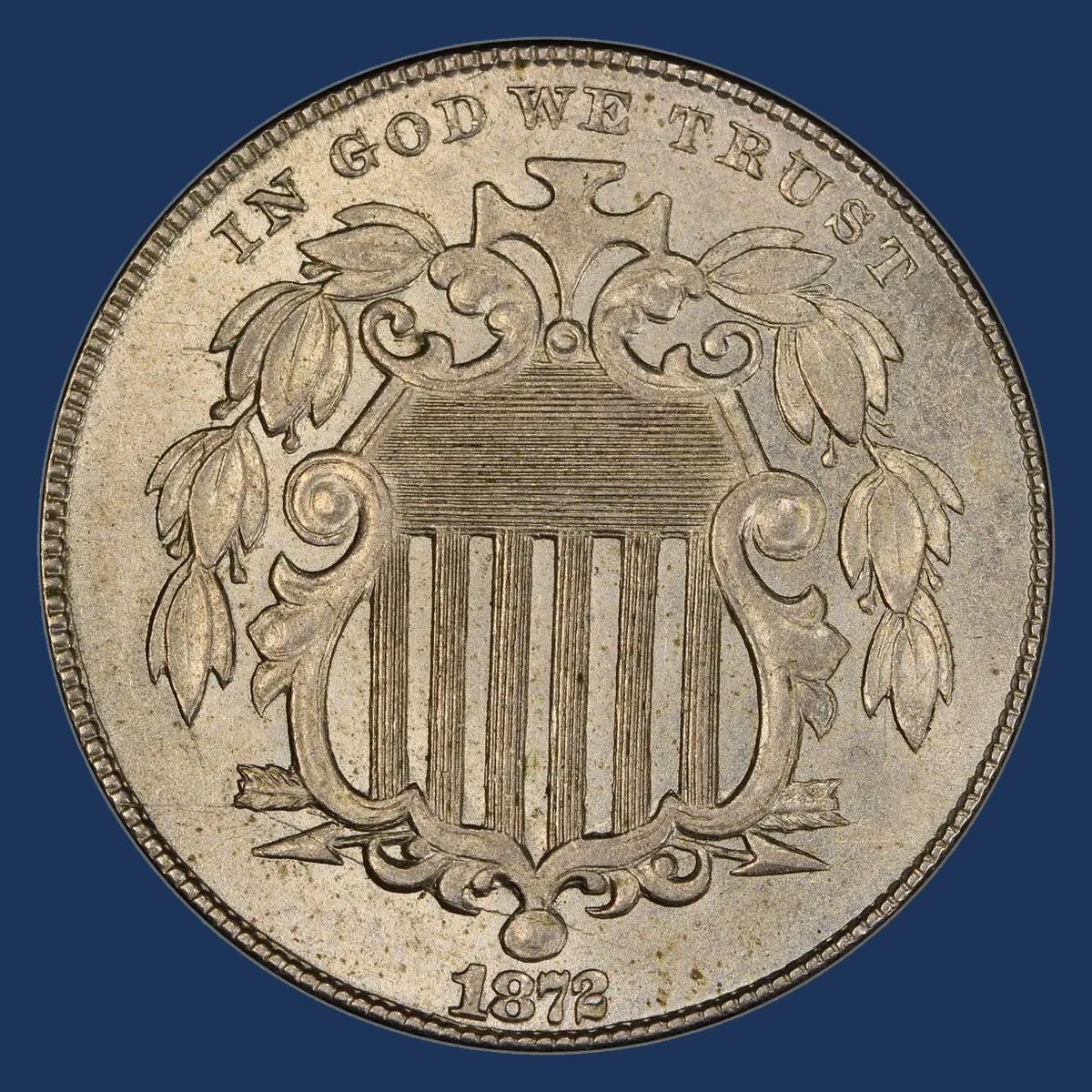
Extra raised outlines can repeat parts of the shield, the small round ornaments, the cross, or the curved decoration. Other 1872 examples show doubling at stars on the back.
The repeated design was already present in a stamping tool before the coin was made. One strike can therefore produce doubled details without the coin moving for a second blow.
Front and back examples do not all share one pattern. A back with doubled stars can also accompany a repunched 2 in the date, but the date feature needs its own close inspection.
Estimated Value
PCGS records a doubled-front example at $685 on eBay in April 2024. It was graded MS62, meaning unworn with noticeable marks.
An estimated $100–$2,500 allows for worn examples through stronger, better-preserved doubled varieties. The size of the separation and the specific pattern matter alongside condition.
That recorded price belongs to the front variety called FS-103. It should not be presented as a sale of a doubled-star back or every other doubled 1872 design.
How to Identify
Choose a comparison photograph showing the same side and pattern as your coin. A doubled shield and a doubled star need different close-ups.
For a loose nickel, check the normal 5-gram weight, 20.5-mm diameter, and plain edge using a scale and calipers. These measurements do not establish doubling, but they help confirm the basic coin.
With a 10× magnifier, trace rounded extra contours on the shield, cross, ornaments, or the back’s stars. A flattened shelf beside a feature can result from movement during striking instead.
When the stars match a doubled-back example, inspect the date separately for the reported extra trace below 2. Finding that trace is useful, but it cannot replace the need to match the star outlines themselves.
5. 1872 Shield Nickel Repunched and Misplaced Dates
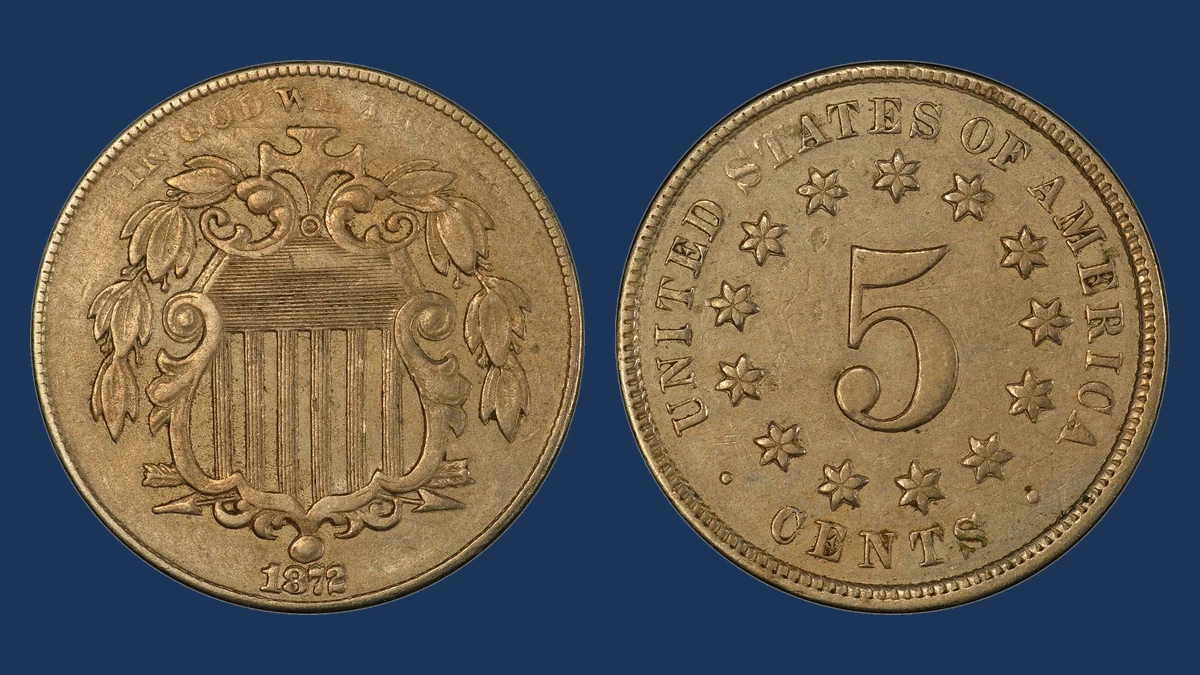
Traces of an earlier date can remain beside the final 1872 numbers. In one variety, a large date punch intended for a dime was used on the nickel’s stamping tool, then corrected.
Parts of those larger numbers remain around the normal date. This is a wrong-tool mistake; it does not mean the nickel was struck on a dime blank.
Other reported date-punch errors include a misplaced curved top of a 2 beside the round ornament above the date. Another example has a misplaced 2 below the 7.
Estimated Value
The range is broad because a small repeated stroke and a clear large-date correction are different finds. Estimate $75–$3,000 for identifiable worn examples through attractive unworn pieces.
The same-year $685 doubled-front sale is a general condition-and-variety comparison, not a sale of the large-date correction. More obvious surviving digit shapes can attract stronger interest.
When several date remnants appear on one coin, judge the complete pattern and condition. Do not add a separate price for every extra digit or curve.
How to Identify
A wrong date punch does not change the metal blank. Check a loose coin against the normal 5 grams and 20.5 mm with a scale and calipers, and inspect its plain edge.
Next, enlarge the whole date with a 10× magnifier rather than cropping to one number. For the large-date correction, look around the normal digits for portions of the wider earlier numbers.
The misplaced-digit examples require a different search. Inspect the area just right of the round ornament above the date, then the space below 7.
A curved mark should fit the shape and position of the reported 2, not merely resemble part of a number. Compare a clear photograph of the particular pattern before treating a small bump or scratch as a misplaced digit.
Conclusion
Begin with the feature you can actually see: a raised line, missing surface, extra outline, displaced digit, or wrong-facing back. Each calls for a different check.
The estimated $20–$3,000 range covers these ordinary-strike examples in differing conditions. Compare the same kind of mistake before using a sale price, and keep a nickel made with the wrong date punch separate from one struck on the wrong metal blank.