2023 Half Dollar Error List with Pictures

A 2023-P doubled-front half graded NGC MS65, meaning unworn with some marks, sold for $230.62 in November 2025. Its catalog name, VP-001, gives collectors a specific example to compare.
Clad halves have outer metal layers bonded over copper.
The 2023 half dollar errors below have estimated values from $3 to $600. Reports also cover missing metal, expanded coins, and a separate back-side doubling find.
Read on to learn where to look. A thick letter, brown surface, or odd rim needs more than a catchy name to show what happened.
1. 2023 Half Dollar Reported Die Cracks and Chips (Estimated Up to $25)
A line or lump can appear when a stamping tool begins to break. A narrow crack fills with coin metal during striking and leaves a ridge.
A small missing piece of the tool can leave a raised patch instead. That tool is called a die, and the patch is a die chip.
The 2023 reports suggest checking the portrait, date, and eagle. They do not give one exact crack path on a named example.
Compare those areas with a normal coin. Feathers already have many lines, and a scratch or contact mark can look unusual without adding a Mint-made feature.
Estimated Value
Estimate $3–$25 for minor genuine cracks and chips on ordinary clad halves. This is the usual modest comparison for small modern Kennedy tool flaws.
It is not a recorded 2023 auction price. A clear raised feature on a clean coin is easier to appreciate than a faint line among scratches.
Surface condition and visibility help choose a price within the range. A larger-looking mark is not automatically more valuable if later damage explains it.
How to Identify
Compare the suspect portrait, date, or eagle detail with a normal half first. A 10× magnifier helps show whether the line adds metal above the design or cuts down into it.
Change the light to separate a reflection from a real ridge. Do not scrape or press the mark.
An ordinary clad coin should weigh about 11.34 grams and measure 30.61 millimeters. Check with a scale and calipers, then inspect the edge ridges for squeezing or impact damage.
A folded piece of metal can look raised too. The first clue is an extra ridge or chip absent from the normal design, without a cut or crushed area beside it.
2. 2023-P Half Dollar Reported Doubled Die Reverse (Estimated Up to $75)
A collector’s 2026 roll-searching report identifies a 2023-P with extra back-side design. The collector matched it to a doubled-reverse variety listing.
That is separate from the recognized VP-001 front variety. A doubled reverse concerns the tool that stamps the eagle side.
The account is a collector’s identification, not the grading-service record for the front-side example. It does not provide enough detail here to name particular doubled letters or feather tips.
A candidate needs a clear repeated raised shape that matches the reported tool. A shadow beside an ordinary feather or general thickness does not establish the same variety.
Estimated Value
A clearly identified minor reverse variety has an estimated range of $10–$75. The comparison is with other small modern Kennedy doubled-die features.
It does not borrow the VP-001 front-side sale as a back-side transaction. They are different claims with different supporting records.
Clear extra outlines and a matching tool pattern can support the higher estimate. Thick-looking design or flat ledges from striking movement should not receive the same added value merely because a collector used a variety name.
How to Identify
Confirm the 2023 date and P mintmark before comparing the eagle side with the original report’s pictures. Use a 10× magnifier to follow the claimed extra outline.
Move the light so an ordinary feather’s shadow is not mistaken for added metal. A flat ledge that reduces the original design suggests movement during striking instead.
Use a scale and calipers against the normal clad 11.34 grams and 30.61 millimeters. Inspect the edge ridges for signs of later alteration.
Those measurements cannot prove doubling. The deciding first match is the same raised extra shape in the same back-side location as the reported variety, not the front variety’s name.
3. 2023 Half Dollar Reported Clipped Planchet (Estimated Up to $150)
A clip leaves part of the blank missing before the coin receives its design. The gap can be curved or straight.
A curved shortage may form when the cutting punch overlaps an earlier hole in the metal strip. A strip end can leave a straighter edge.
The 2023 list includes clips without identifying the exact shape, mint, or position of a particular example. Those details belong to the actual coin.
The nearby rim and design should show that the gap existed during striking. A rounded bite cut afterward can imitate the outline but interrupts details that had already formed.
Estimated Value
Estimate $30–$150 for genuine small or moderate clips on ordinary clad coins. A specialist dealer offers a 1971-D ten-percent clip graded PCGS MS64 for $90.
That is a different-year asking price, not a 2023 sale. A readable date, original gap borders, and attractive remaining detail support the comparison.
A cut or filed edge does not qualify. The shape of the missing piece alone cannot give later damage the value of a Mint-made clip.
How to Identify
Weigh the coin against the normal clad standard of 11.34 grams. Use calipers across an intact part to compare with the usual 30.61-millimeter outline.
Under a 10× magnifier, inspect both ends of the missing section and the nearby design. A saw groove, filed wall, or sharp cut through a finished letter points to later removal.
Follow the remaining edge ridges around to the opposite rim. Weakness there can support a clip but varies among genuine examples.
A light coin alone is not enough. Original rim and letters formed around the gap at both ends are the quickest useful evidence that the metal was missing before striking.
4. 2023-P Half Dollar Reverse Surface-Anomaly Candidate (Estimated Up to $150)
A collector reported a disturbed patch between the ribbon behind the eagle and the arrow bundle on a 2023-P. The question was whether it came from an obstruction or a separating layer.
Those explanations need different clues. A strike-through can leave a shape pressed into the surface, while lamination means a layer of metal has separated.
A lifted edge or a natural hollow would help tell them apart. Later damage can imitate either in one photograph.
The report remains one candidate, not two confirmed errors. Inspect the local metal before choosing either explanation or assigning a value to the mark.
Estimated Value
Estimate $20–$150 only if the patch proves to be a genuine minor strike-through or local layer separation. A dealer asks $125 for an undated PCGS AU58 Kennedy with strike-throughs on both sides.
That is another coin and an asking price, not a sale of the reported 2023-P. AU58 means very little circulation wear.
The range concerns an original manufacturing feature. An ordinary scrape or contact mark does not receive the same added error value.
How to Identify
Light the space between ribbon and arrows from opposite directions. A 10× magnifier may reveal a lifted edge if a layer is separating.
If it is an impression, inspect how the hollow meets nearby design. Scrape trails and pushed-up metal can show that something damaged the coin later.
Do not probe a possible flap. Photograph the area as it is, with enough surrounding design to keep its location clear.
Check 11.34 grams and 30.61 millimeters with a scale and calipers, and inspect the edge ridges for related damage. A lifted layer border favors separation; a naturally struck hollow without later cuts favors an obstruction.
5. 2023 Half Dollar Reported Broadstrike (Estimated Up to $250)
Complete designs can remain on a blank that spreads wider than normal during striking. That is the appearance reported for 2023 broadstrikes on ordinary clad coins.
The collar is the ring that usually holds the blank’s edge and forms its ridges. Without proper restraint, the border can spread outward.
Both the center and outer lettering may stay on the coin. An off-center strike instead can lose part of the design beyond the blank.
The report gives no measured specimen for every mint. A wide-looking border from camera angle or later flattening should not be treated as proof of a broadstrike.
Estimated Value
Estimate $60–$250 for comparable clad Kennedy broadstrikes. Specialist offers include $165 for a 1990-P NGC MS65 and $175 for a 1983-P MS65.
Both are different-year asking prices, not completed 2023 transactions. The range allows for smaller expansions below those offers and clearer, attractive examples above them.
Compare condition and edge shape before selecting a value. A recent date by itself does not establish rarity or add a special premium to a wide-looking coin.
How to Identify
Check every complete outer word on both sides before measuring the wider border. All intended design should remain on a broadstrike.
Calipers can record spread beyond the normal 30.61 millimeters. A scale near 11.34 grams supports metal spreading rather than being removed.
Use a 10× magnifier around the edge and outer design. Look for missing collar-made ridges and compare any wide area with pressure marks or crushed details from later flattening.
Bare metal beside incomplete designs would suggest an off-center strike instead. A widened original border holding complete, uncrushed designs on both faces is the first broadstrike clue to confirm.
6. 2023 Half Dollar Reported Off-Center Strike (Estimated Up to $350)
A reported Philadelphia off-center half has bare metal beside its shifted design. That part of the blank lay outside the stamping tools when they struck.
The broader year discussion mentions both P and D circulation coins. The more specific example identifies Philadelphia, so it should not be relabeled Denver.
The offset describes where the design landed. It does not mean that the same percentage of metal is missing.
Read the date and mintmark, then compare the other face. Those details tie a coin to the report and help distinguish a blank struck in the wrong position from a clipped blank.
Estimated Value
A readable-date ordinary example has an estimated range of $75–$350. Dealer comparisons include a 1983-P ten-percent NGC MS64 at $225 and a 1976 ten-percent PCGS MS65 at $350.
Those are asking prices for other years. They do not establish completed 2023 sales.
Grade, visible offset, and the amount of readable lettering explain the range. The specific Philadelphia report also does not prove an equivalent Denver example or a special Proof error.
How to Identify
Read the date and mintmark before assigning the coin to 2023. A 10× magnifier also helps inspect the bare area beside the strike.
Compare both faces for the same shift against the outline. One shifted side with a centered opposite side can mean a misaligned tool.
Record weight and size with a scale and calipers against 11.34 grams and 30.61 millimeters. Off-centering does not automatically make the coin lighter because it removes no metal.
Inspect remaining edge ridges and watch for later trimming through finished letters. Matching displaced designs on both sides next to untouched bare metal are the fastest useful evidence of an off-center strike.
7. 2023-P Half Dollar Doubled Die Obverse VP-001 (Estimated Up to $400)
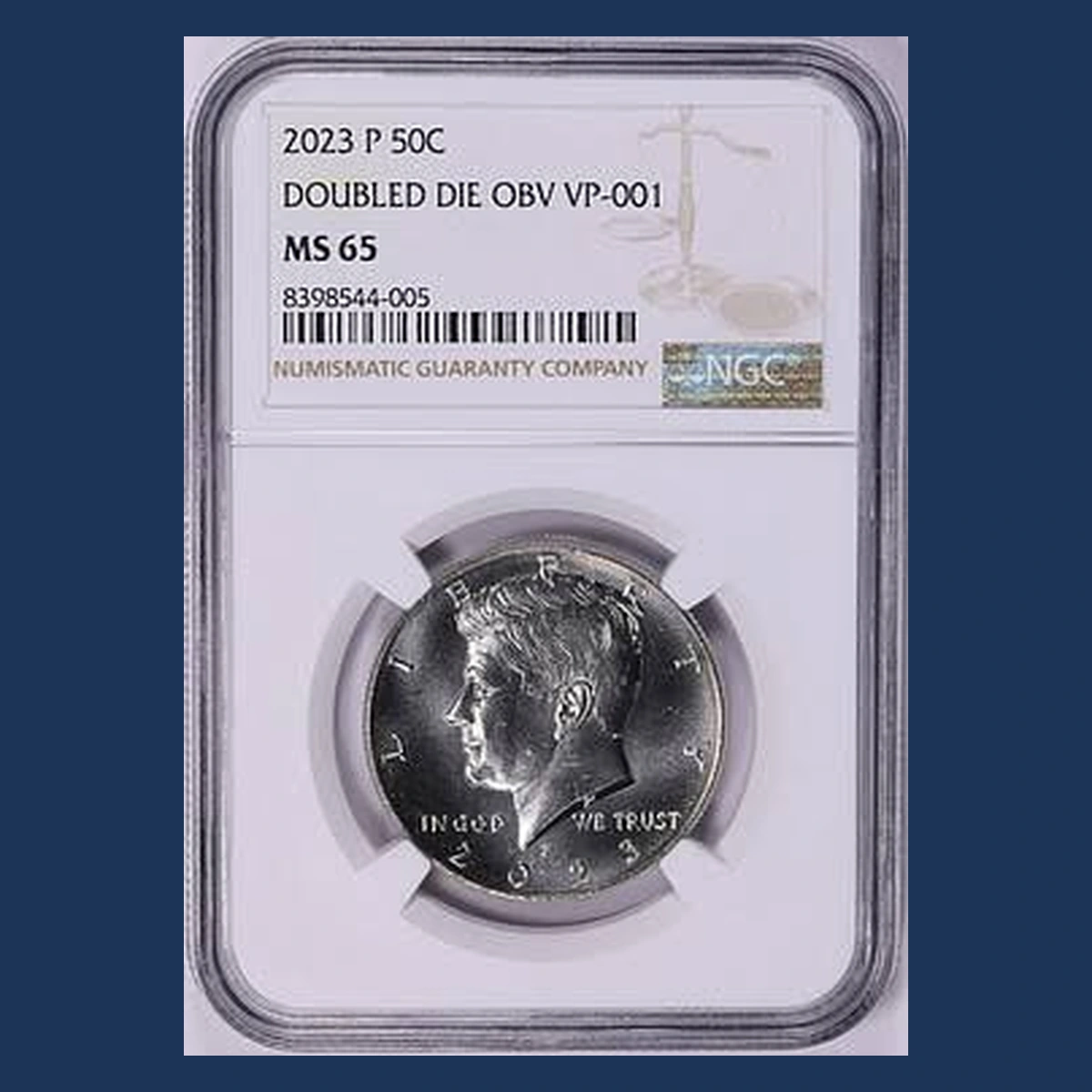
VP-001 names a specific 2023-P doubled-front variety. GreatCollections offered an NGC MS65 example under that name, giving collectors a certified coin to compare.
Extra design outlines were present in the stamping tool and repeated on coins it made. The coin itself did not need an extra strike to create them.
Year guides suggest looking at the motto, LIBERTY, and the date. Those general areas do not replace the exact pattern on VP-001.
A thick letter elsewhere cannot borrow the name. Match the actual added shape on the certified example rather than expecting every letter or date digit to look doubled.
Estimated Value
The GreatCollections archive records $230.62 for the NGC MS65 sold in November 2025. Estimate $100–$400 for attractive examples securely identified as VP-001.
Condition and how clearly the extra outlines remain visible affect the comparison. The sale belongs to a particular Philadelphia coin.
It is not a universal price for every 2023 half with thick lettering. A candidate should match the named variety before the estimate is applied.
How to Identify
Use a clear image of the certified VP-001 before judging the candidate. With a 10× magnifier, match its actual added outlines rather than overall thick lettering.
The motto, LIBERTY, and date are suggested search areas, not a promise that every position has extra lines. Change the light to keep shadows out of the comparison.
Confirm the P mintmark and inspect the edge ridges for squeezing. A scale and calipers should be compared with the usual clad 11.34 grams and 30.61 millimeters.
Flat ledges that reduce normal detail can come from movement during striking. The same raised extra pattern as the certified VP-001 is the deciding first match.
8. 2023 Half Dollar Reported Missing Clad Layer (Estimated Up to $600)
A missing outer layer can expose the copper center on one face of a clad half. The other face may keep its pale copper-nickel layer.
Clad means bonded metal layers. If a layer is lost before striking, the exposed center can receive the design directly.
The 2023 reports do not give a measured specimen with a known mint or affected face. A candidate needs its own edge and surface checks.
The normal silver Proof is a specially made collector coin containing 99.9 percent silver. Its silver appearance and higher weight come from a different construction, not a missing clad layer.
Estimated Value
Estimate $100–$600 for genuine missing-layer examples, depending on the amount lost and condition. A dealer offers a related 1967 MS63 missing-layer coin for $250.
That older coin uses forty-percent silver clad construction, so its metal differs from an ordinary 2023 half. It is a retail comparison, not an exact substitute.
The upper estimate requires a clear, correctly identified error. A brown-toned full-weight coin does not qualify, and no specific 2023 sale is claimed here.
How to Identify
Inspect the edge layers before deciding what a copper-colored face means. A 10× magnifier should show an actual missing layer and original design in the exposed metal.
Scraping, chemical roughness, or plating can create misleading colors. Check the opposite face to see which outer layer remains.
Weigh against the normal clad 11.34 grams and measure against 30.61 millimeters with calipers. Inspect the edge ridges for filing that could also reduce weight.
A normal 2023-S silver Proof weighs 12.685 grams and contains 99.9 percent silver, so use its separate standard. A missing outer-layer border, exposed copper with struck detail, and a matching weight loss are the first clues to compare.
Conclusion
Estimated values for these 2023 errors run from $3 to $600. The certified VP-001 sale provides a specific front-side comparison, while the reported reverse doubling needs its own match.
Check the ribbon-to-arrow disturbance for a real lifted layer or impressed shape before giving it a name. For larger errors, compare both faces and the edge.
Original surfaces, measured weight, and a clear date make the price comparison more useful.