2018 Half Dollar Error List with Pictures

A 2018-S Light Finish half graded NGC PF70 sold for $200 in 2018. PF70 is the top condition grade.
Another PF70 brought $76.15 in June 2026.
This variety is a silver reverse Proof, a collector coin with special frosted surfaces. Its unusually low contrast differs from the missing metal and shifted pictures among other 2018 half dollar errors.
Estimated values below range from $50 to $700. Read on to compare each visible feature with the right finish and metal.
1. 2018-S Kennedy Half Dollar Silver Reverse Proof Light Finish (Estimated Up to $150)
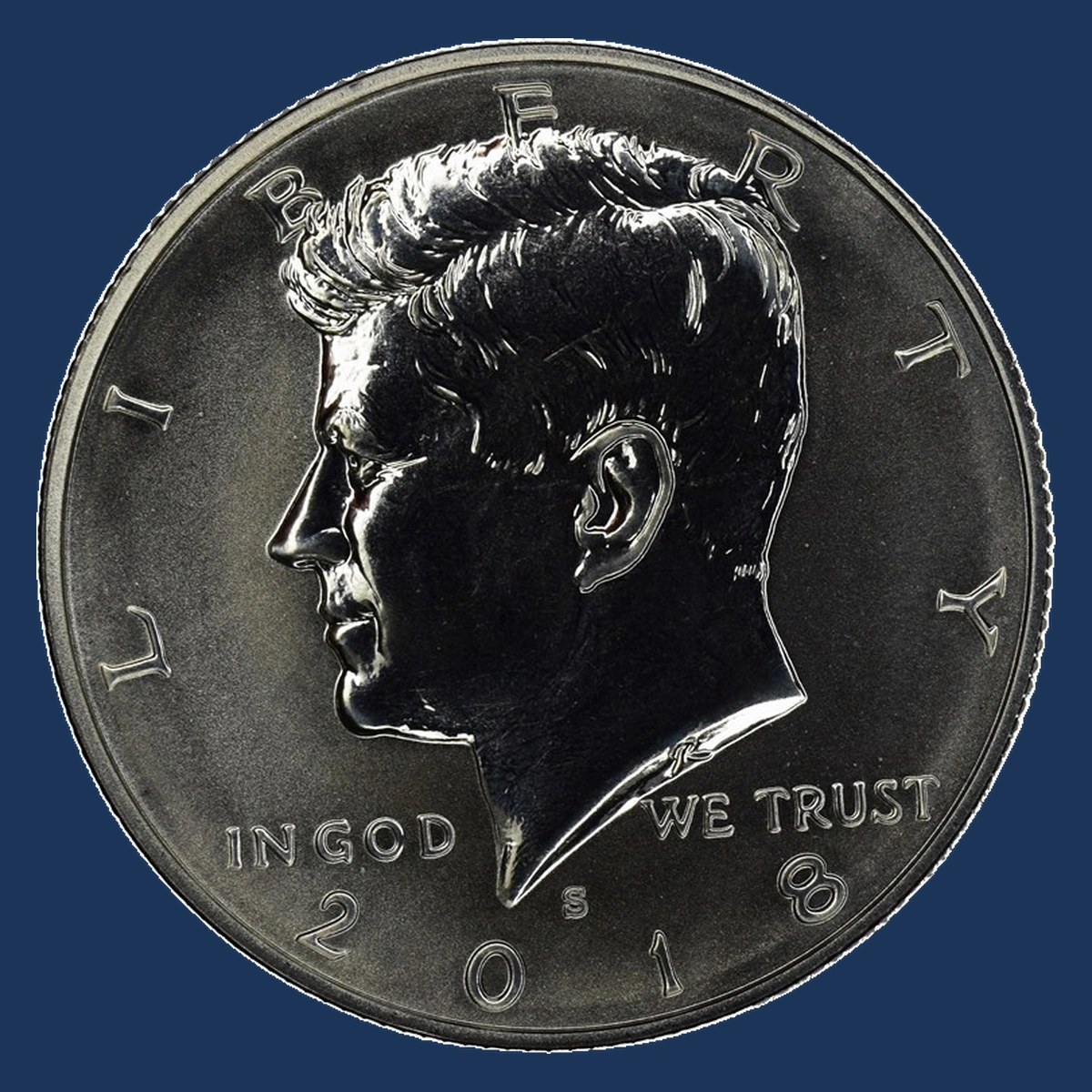
The area around Kennedy looks less strongly contrasted on Light Finish coins. NGC recognized the variety in September 2018 on the silver reverse-Proof issue.
Its first explanation suggested incomplete preparation of the die, the steel tool that stamps the coin. That was a proposed cause, not a final finding.
A later Mint explanation describes different strengths of laser frosting used across the normal half dollar. The normal surface treatment is intentional.
Compare appearance rather than assuming one proven cause. Light Finish means reduced contrast on the front, especially in the broad areas beside Kennedy.
Estimated Value
An NGC PF70 Light Finish sold for $76.15 in June 2026. Estimate $50–$150 for attractive, recognized examples in high Proof grades.
An earlier NGC PF70 sale was recorded at $200 in 2018. That historical result is not a guaranteed current price.
Compare the grade, label, and original surface together. A lightly contrasted photograph alone does not show that a coin belongs to the recognized variety.
How to Identify
Place a normal 2018-S silver reverse Proof beside the candidate under the same soft light. A conventional Proof has a different normal surface treatment and is not the right comparison.
Keep sealed grading holders closed. For a safely accessible coin, use a scale and calipers against 12.50 grams and about 30.6 millimeters; the 90% silver coin has edge grooves.
Through a 10× magnifier, check for haze, fine scratches, or wear that might dull the contrast. Verify any Light Finish label matches the coin.
Move both coins together as you change the viewing angle. Compare the broad areas around Kennedy for consistently reduced front-side contrast, rather than a single dull reflection.
2. 2018-D Kennedy Half Dollar Reported Rim Cud (Estimated Up to $200)
A raised patch touching the rim can come from a broken stamping tool. Part of its edge broke away, leaving room for the coin’s metal to rise.
The resulting patch is called a cud. It replaces detail that the missing part of the tool could no longer stamp.
The year-by-year error list reports a noticeable cud on a 2018-D. It does not state the affected face or clock position.
A bent rim can also look raised. The actual coin must show a continuous rim connection and missing design that fit a broken tool, rather than a later blow.
Estimated Value
Estimate $50–$200 for a confirmed visible cud on an unworn 2018-D. A small border break fits nearer the lower end.
A larger patch reaching into the picture can support more interest. The comparison uses modern Kennedy guide values, not a sale of the reported coin.
A 2008 guide puts substantial breaks around $50–$150 and above. That helps set the estimate without establishing the size or condition of a 2018 example.
How to Identify
Does the raised patch actually reach the rim? Follow it through a 10× magnifier before judging how large it looks.
Check for a folded edge, solder seam, or loose attachment. A solid raised area from minting should meet the border as part of the coin itself.
A Denver half normally weighs 11.34 grams and measures about 30.6 millimeters. Use a scale and calipers when safely accessible, and inspect the edge grooves and opposite face for impact damage.
Take a photograph showing the whole affected face as well as the close-up. Look for raised metal joined to the rim in place of intended picture detail, without a bent-over edge.
3. 2018 Kennedy Half Dollar Reported Doubled Dies (Estimated Up to $350)
Extra outlines around the date can be a starting point on a Philadelphia candidate. The reports mention the 8, LIBERTY, and IN GOD WE TRUST.
They also mention doubling on the back without identifying an exact letter or eagle feature. No named certified variety is established by those descriptions.
Denver’s listing separately mentions doubled dies. It does not prove that the same Philadelphia pattern appears there.
A doubled design in the stamping tool can repeat on many coins. A moving reflection or a flat shelf caused during one strike does not show the same cause.
Estimated Value
Estimate $50–$350 for clear, matched doubling on an unworn 2018 half. The year guide’s roughly $50–$200 range supplies the starting point.
The upper estimate needs especially visible detail and a reliable matching pattern. A grade alone cannot show the strength of the doubling.
The guide mentions an unworn MS69 front-and-back doubling example without enough identifying information to use a sale. This estimate does not turn that report into an auction result.
How to Identify
On a Philadelphia candidate, begin with the date’s 8 under a 10× magnifier. Move the lamp and compare the nearby digits with a normal 2018 coin.
A reflection changes with the light. A flat ledge along a digit can come from movement during striking instead of a doubled tool.
Check an accessible ordinary coin with a scale and calipers against 11.34 grams and about 30.6 millimeters. Inspect the edge grooves and record the mintmark.
Keep Denver and back-side claims separate until their own photographs show the match. Look for the identical raised extra outline on another matching coin, in the same position and with the same shape.
4. 2018 Kennedy Half Dollar Reported Broadstrike (Estimated Up to $500)
A coin can become wider while keeping its full picture. That is the basic appearance of a broadstrike.
The collar, a ring that controls width during stamping, failed to hold the blank. Metal spread outward instead of staying inside the normal outline.
The 2018 reference page reports this error without a specific mintmark or measurement. It does not identify one coin as Philadelphia, Denver, or San Francisco.
An off-center strike loses some outer design, whereas a broadstrike keeps it. Flattening a finished coin can also make it wider, so the condition of the picture and edge matters.
Estimated Value
Estimate $100–$500 for a confirmed unworn 2018 broadstrike with obvious spreading and original surfaces. Complete, readable pictures help its appeal.
A 1998-P NGC MS65 broadstrike sold for $106 in January 2010. It also used a Type 1 blank, before the usual rim-preparation step.
That older coin combines blank preparation and striking errors. Its sale offers a comparison, not a 2018 result or proof of a particular grade for the general report.
How to Identify
Follow the date and outer letters around both faces. The full intended picture should stay inside the wider outline.
Use calipers across several directions, comparing with the normal width of about 30.6 millimeters. A scale should be compared with 11.34 grams for ordinary layered metal or 12.50 grams for a silver Proof.
Check the edge through a 10× magnifier. Normal grooves may be absent or incomplete where the ring failed to hold the metal.
A later flattening blow can crush the picture and leave pressure marks. Look for complete, uncrushed details surrounded by metal that spread during stamping, with an edge that supports that same explanation.
5. 2018 Kennedy Half Dollar Reported Clipped Planchet (Estimated Up to $550)
A 2018-S Proof graded PR66 is reported with a clip. It is described as clad, meaning layered metal, rather than the separate silver Proof issue.
Philadelphia and Denver listings also report clips. The descriptions do not establish the shape of the Proof coin’s gap.
A clip begins before stamping, when the blank metal disc is already incomplete. The later design forms beside that missing section.
A curved gap may come from the punch overlapping an earlier hole. A straight gap can follow the strip edge, but neither shape can be assigned to this Proof without its photograph.
Estimated Value
Estimate $75–$550 for genuine clips in collectible condition. A clearly identified Proof with an attractive original gap may fit toward the top.
The guide’s similar range is not a verified sale of that Proof. For comparison, a 1998-D PCGS MS63 ten-percent triple clip brought $99 in March 2025.
A separate NGC MS66 forty-five-percent curved clip realized $240 in July 2021. Both are regular circulation issues, so their finishes differ from the S Proof.
How to Identify
Confirm the S Proof is the layered-metal version before comparing weight. It normally starts at 11.34 grams and about 30.6 millimeters across, with edge grooves.
Philadelphia and Denver regular coins share these measurements, but have different surfaces. Use a scale and calipers when safely accessible to compare the missing section with the remaining metal.
Under a 10× magnifier, inspect how the picture approaches the gap. Filing marks, a sharp burr, or a cut through finished details suggest later damage.
Weakness on the opposite rim can help but need not be obvious. Look beside the gap for original details formed around an already missing piece, rather than sliced away afterward.
6. 2018-S Kennedy Half Dollar Reported Proof Strike-Through (Estimated Up to $600)
A seller lists a 2018-S silver half with an impression on the front, graded PF69 Ultra Cameo. Ultra Cameo describes strong contrast between frosted pictures and shiny surrounding areas.
This is a conventional Proof. A separate ASG inventory lists a reverse Proof with an abbreviated front-side strike notation.
The two descriptions do not establish one shared coin. Neither gives the exact location or names the material that blocked the stamping tool.
A strike-through affects a local area. The overall lower contrast of Light Finish is a different feature and does not by itself show an object impression.
Estimated Value
Estimate $75–$600 for a clear mint-made impression on a preserved silver Proof. Attractive shiny areas and an easily understood mark can support the upper end.
The seller’s PF69 Ultra Cameo description is a grade report, not a sale price. A 1992-D NGC MS64 struck through an edge-groove fragment sold for $336 in July 2021.
That different-year circulation coin provides an object-impression comparison. Its finish is not the same as either silver Proof.
How to Identify
Check the holder or original packaging to separate conventional and reverse Proofs. Both silver versions contain 90% silver and normally weigh 12.50 grams.
They measure about 30.6 millimeters and have edge grooves. Use a scale and calipers only when safely accessible; do not open a sealed grading holder.
Now look for a local hollow or interrupted piece of the picture through a 10× magnifier. An overall change in shine is not enough.
Move the light around the mark’s edges and check for raised lips or torn silver from a later impact. Look for original design interrupted inside a small depression; this local mark differs from Light Finish.
7. 2018 Kennedy Half Dollar Reported Off-Center Strike (Estimated Up to $650)
A shifted picture leaves some metal untouched and some intended design missing. The blank lay partly outside the correct position during stamping.
The 2018 guide discusses displacement around fifteen to thirty percent. That is general guidance, not a measurement of a named certified example.
It also does not establish a mintmark or direction for one specific coin. Those details must be read from the actual piece.
Both faces should show a matching shift. An uneven border on only one face may come from a shifted stamping tool.
A complete picture on wider metal may instead point to a broadstrike.
Estimated Value
A 1999-D NGC MS66 described as 65% off-center sold for $552 in March 2023. Its displacement is greater than the 2018 guide’s general range.
Estimate $100–$650 for a confirmed collectible 2018 example. The older sale is a comparison, not a 2018 result.
A readable date and clear untouched crescent help its appeal. A slight offset or an unreadable year does not automatically qualify for the upper figure.
How to Identify
Keep both photographs aligned to the same physical edge. Read the surviving 2018 date before estimating how far the picture moved.
Use a 10× magnifier on the blank-looking area. Scraping or smoothing can erase a previous picture and imitate an untouched crescent.
An ordinary layered-metal blank starts at 11.34 grams and about 30.6 millimeters across. Use a scale and calipers when safely accessible, recording the actual outline and any remaining edge grooves.
A strike that moves the picture does not inherently remove metal. Look for matching incomplete pictures on both faces beside truly unstamped metal, without abrasion marks showing that someone removed the design later.
8. 2018 Kennedy Half Dollar Reported Missing Clad Layer (Estimated Up to $700)
An unworn 2018-D graded MS65 is reported with a missing layer. The Philadelphia listing also names this error, without naming the face or weight.
Ordinary P and D halves have copper-nickel outer layers bonded to a copper middle. Losing some outer metal changes the structure, not just the color.
A small patch and loss across most of one face are different amounts of the same failure. Any surviving layer boundary can help show what happened.
The 90% silver Proof does not use this copper-core construction. Its unusual color or surface should not be explained by a missing clad layer.
Estimated Value
Estimate $125–$700 for confirmed layer loss on an unworn example. Larger original exposure with readable pictures can fit toward the upper end.
A 1998-P NGC MS63 with defective front cladding sold for $149 in March 2023. That different-year result helps compare a modest example.
No auction price is given here for the reported 2018-D MS65. Its actual missing area and original surfaces must support the price, rather than the grade or copper color alone.
How to Identify
A copper band between the outer layers at the edge is normal. Do not treat that stripe alone as evidence that a face layer is missing.
For a copper-colored face, use a 10× magnifier and low light to inspect its boundary with any remaining silver-colored metal. Look for a real step, not just a stain.
When safely accessible, compare scale weight with 11.34 grams and caliper width with about 30.6 millimeters. Inspect the edge grooves and both faces for stripping, chemical damage, or plating.
A small weight difference does not settle the cause. Look for missing outer metal beside an original struck surface, with an actual layer boundary explaining the copper patch.
Conclusion
On a 2018 half dollar, compare the finish before deciding that a dull area is an error. Light Finish changes the front’s contrast, while a strike-through interrupts one local part of the picture.
The estimated ranges run from $50 to $700. Keep silver and layered-metal coins separate when checking weight.
Compare the actual missing metal or shifted design before choosing a price from another example.