2012 Half Dollar Error List with Pictures

A 1967 Kennedy half struck on a quarter’s metal disc sold for $840 in 2019. It provides a different-year comparison for the reported 2012 half dollar errors below, whose estimates span $10–$3,000.
First identify the normal coin: clad halves have bonded metal layers and weigh 11.34 grams, while the 2012-S silver Proof weighs 12.50 grams. A Proof is a specially made collector coin.
Read on to compare raised lines, missing metal, and shifted designs.
1. 2012 Kennedy Half Dollar Reported Die Crack (Estimated Up to $30)
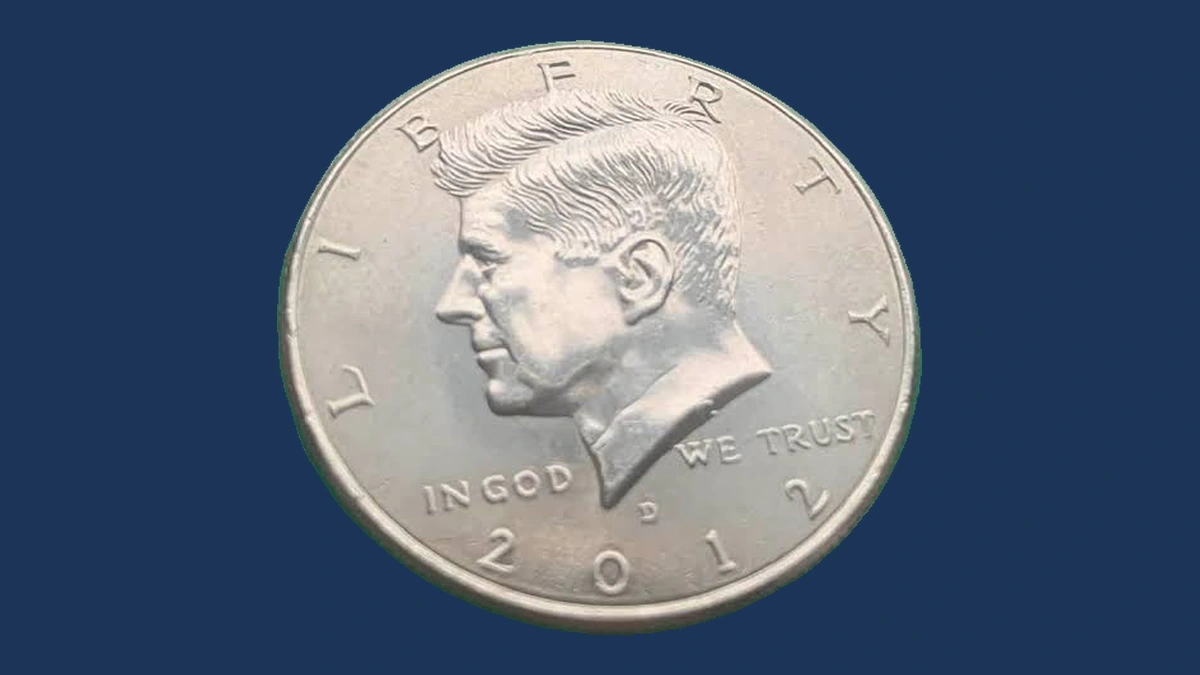
A thin raised line can cross the surface without cutting into Kennedy or the nearby letters. It may come from a crack in the die, the steel stamping tool.
During striking, metal enters the crack and forms a small ridge. A scratch made later usually cuts down into the finished coin.
The 2012 report gives no particular mint or known route for the line. Do not assume it must pass through the hair or eagle.
A narrow ridge differs from a broad raised lump. The latter can involve a larger piece of broken steel.
Estimated Value
A minor visible crack on an ordinary clad half has an estimated value of $10–$30. This follows the year discussions and is a guide estimate, not a recorded auction sale.
Clad means the coin has outer metal layers around a copper center. A clear ridge on an attractive surface is easier to appreciate than a faint line among scratches.
The range does not give a small hairline crack the value of a large broken-tool lump.
How to Identify
Tilt the suspected line under low light and inspect it with a 10× magnifier. Look for a raised ridge instead of a recessed cut with pushed-up edges.
Read the mintmark before choosing a comparison picture. The year report does not identify one specific mint.
Use a scale and calipers to compare a clad coin with 11.34 grams and 30.61 millimeters. Inspect the grooves around the edge; the 2012-S silver Proof instead normally weighs 12.50 grams.
Those measurements do not prove a crack. For the quickest check, follow a continuous line that rises above the surface without cutting through the design.
2. 2012-D Kennedy Half Dollar Reported Clipped Planchet (Estimated Up to $150)
A missing piece can leave an irregular outline when the coin began as an incomplete blank, or metal disc. The design was struck after that metal was already absent.
Pressure during striking can soften details beside the gap or weaken the rim opposite it. These clues help explain when the loss occurred.
CoinTrackers reports clipped blanks for 2012-D, identifying Denver as the mint. It does not establish a curved or straight shape, position, or missing percentage.
Those details need to come from the actual coin. A generic clip picture cannot supply them.
Estimated Value
A genuine clip has an estimated value of $40–$150, based on the guide’s comparison across Kennedy halves. No specific 2012-D sale sets this range.
A 1971-D with a ten-percent clip and PCGS MS64 grade is offered for $90. That is a dealer asking price for an unworn coin, not a completed sale.
Both dates normally use clad metal discs. Clearer missing sections and better surfaces can place a 2012 coin differently within the estimate.
How to Identify
Confirm the D below Kennedy’s neck, then inspect the gap with a 10× magnifier. Follow how the design meets the missing boundary instead of judging only its shape.
Check the opposite rim for weakness, a helpful clue that is not equally visible on every clip. Look around the remaining edge grooves for filing or cuts.
Measure an intact span with calipers against 30.61 millimeters. Compare the scale reading with 11.34 grams and consider whether the missing area explains the lower weight.
For a quick distinction from later cutting, look for naturally struck edges and softened neighboring detail rather than file tracks at the gap.
3. 2012 Kennedy Half Dollar Reported Broadstrike (Estimated Up to $200)
A broadstruck coin spreads wider than normal while keeping its complete design. The collar, a ring that normally limits the coin’s width, did not restrain it during striking.
Metal could flow outward beyond the usual border. The new rim may be wider on one side than the other.
The year guide reports broadstrikes on ordinary 2012-P and 2012-D halves. These differ from off-center coins that lose part of the design.
An enlarged shape alone proves little. A coin flattened later can also become wider, but its finished details usually show crushing or pressure marks.
Estimated Value
An estimated $60–$200 covers the reported 2012 broadstrike category. Dealer offers of $165 for a 1990-P and $175 for a 1983-P provide different-year comparisons.
Both offered coins are graded MS65, indicating attractive unworn condition. These figures are asking prices, not 2012 auction records.
The year guide’s narrower $60–$80 discussion concerns lower MS62 examples. Clear expansion and cleaner surfaces support a higher estimate, while damage from later flattening does not.
How to Identify
Weigh and measure before judging the wide rim. A scale reading near the normal 11.34 grams with a diameter beyond 30.61 millimeters can show expansion without missing metal.
Use calipers in several directions, then account for the complete design on both sides. Letters can move outward without being cut off.
With a 10× magnifier, look for natural outward flow near the border. Inspect the edge for missing or incomplete grooves where the retaining ring failed to act.
Later flattening can crush finished details. To check a broadstrike quickly, confirm that complete, naturally struck designs remain on the expanded disc rather than flattened designs on a hammered coin.
4. 2012-D Kennedy Half Dollar Reported Doubled Die (Estimated Up to $200)
A small extra outline can repeat on coins made from the same doubled die. The die is the steel stamping tool that carries the design.
This doubling already exists on the tool, rather than coming from movement of one coin during striking. Modern tool preparation can create it without the older repeated hand-guided process.
The 2012-D listing gives no confirmed variety number or affected side. No exact doubled letter can be named from that report.
Inspecting the date or LIBERTY is only a starting search. A matching extra outline still needs confirmation.
Estimated Value
A confirmed minor doubled example has an estimated value of $30–$200. The range comes from a modern Kennedy comparison, not a recorded sale of a named 2012-D variety.
The upper end assumes clear extra detail that matches a particular stamping tool and attractive surfaces. Thick-looking letters alone are not enough.
Glare or a flat shelf left by movement during striking does not receive the same allowance. The visible feature must support the claimed doubling.
How to Identify
Move the light before deciding that a bright edge is doubled. Reflections can disappear, while a real extra outline remains part of the surface.
Use a 10× magnifier to look for rounded additional detail. A low shelf trimming the main letter suggests movement during striking instead.
Confirm the D mintmark and inspect the edge grooves. A scale and calipers should be compared with the normal clad standards of 11.34 grams and 30.61 millimeters.
The report does not establish which side is affected. For the fastest firm check, match the extra outline and its exact location to a confirmed example made by the same stamping tool.
5. 2012 Kennedy Half Dollar Reported Off-Center Strike (Estimated Up to $350)
The coin shows a blank area beside a design that runs off the opposite edge. Its metal disc was partly outside the stamping tools when they struck.
Both sides should record that same misplaced disc. This is an off-center strike, rather than one tool shifting sideways by itself.
The 2012-P and 2012-D reports concern ordinary coins, not specially made Proofs. A Proof error from another year does not establish a 2012-S example.
No single percentage applies to all such coins. The surviving date and amount of lost design need to be read from each piece.
Estimated Value
For roughly ten- to twenty-percent displacement with a readable date, the estimate is $75–$350. The year guide discusses $75–$150 at MS62–MS64, which are unworn grades.
Sullivan Numismatics asks $350 for a 1976 Kennedy struck ten percent off center and graded PCGS MS65. That different-year retail offer helps support the upper allowance.
It is not a $350 auction result for 2012. The range also does not price a Proof error.
How to Identify
Place the coin beside a normal half and compare both faces. If only one design shifts while the other stays centered, consider a misaligned stamping tool instead.
Under a 10× magnifier, inspect the blank crescent for an unstruck surface. The opposite edge should lose part of the intended design.
Compare a scale reading with 11.34 grams and use calipers to record the outline against the usual 30.61 millimeters. Check the edge grooves for partial formation or later trimming.
A readable date helps identify the year. For a quick off-center check, find matching displacement on both sides with untouched blank metal beside their incomplete designs.
6. 2012 Kennedy Half Dollar Reported Struck-Through Error (Estimated Up to $350)
A shallow impression or patch of missing detail can form when something blocks the strike. Material between the steel tool and the disc prevents the normal design from reaching the metal.
A solid piece may leave a shaped depression. Grease or packed debris can instead stop a small letter or other feature from forming fully.
The 2012 discussion names no specific object, mintmark, or finish. A wire, thread, or cloth pattern cannot be assumed.
Wear and scraping remove detail by different processes. The boundary between the unusual patch and normal surface helps distinguish them.
Estimated Value
Local impressions on ordinary clad halves have an estimated value of $30–$350. Subtle grease-related weakness belongs near the lower end.
A dealer offers an undated Kennedy with impressions on both sides for $125. It is graded PCGS AU58, meaning it has very little wear.
That asking price provides a comparison, not a 2012 sale. Larger, recognizable impressions and better surfaces support the upper estimate, but the offer does not identify the material involved in a different coin.
How to Identify
Inspect the transition from normal design to the affected patch with a 10× magnifier. Look for an impression formed with the strike rather than gouges across finished details.
Compare the opposite side and nearby high points to separate a local blockage from general wear or weak striking. Check the edge grooves for an impact that might explain a later dent.
Use calipers against 30.61 millimeters and a scale against 11.34 grams for clad coins. A normal 2012-S silver Proof instead weighs 12.50 grams.
For the fastest useful check, follow the local interruption into untouched neighboring design without finding scraping or pushed-up damage.
7. 2012-D Kennedy Half Dollar Reported Missing Clad Layer (Estimated Up to $1,900)
Reddish copper can cover part or all of a face when an outer metal layer is missing. A normal clad half has copper-nickel outer layers around a copper center.
A partial loss leaves a boundary between exposed copper and the surviving outer layer. Losing the full layer changes nearly the whole side.
The 2012-D report does not identify the affected face or how much is absent. Those details require the actual coin.
A brown stain is not proof. The 2012-S silver Proof also uses a different, uniform alloy and is not an example of missing clad metal.
Estimated Value
Confirmed examples have an estimated value of $200–$1,900, based on modern Kennedy missing-layer comparisons. Partial exposure on an ordinary coin belongs nearer the lower end.
Extensive loss with clear evidence and attractive surfaces can support a higher value. The range is an estimate across the series, not a 2012-D auction record.
Collectors are buying a manufacturing failure, not simply an unusual color. A stained half with all its layers intact does not fit this range.
How to Identify
Compare the two faces before relying on a brown color. With a 10× magnifier, look for a surviving layer boundary or detail struck directly into exposed copper.
Weigh the coin on a digital scale. Missing metal should reduce the normal 11.34 grams by an amount consistent with the visible loss.
Use calipers against 30.61 millimeters and inspect the edge grooves for layer joins or scraping. A coating over finished details is different from a missing outer layer.
A normal 12.50-gram silver Proof is a separate issue. To check quickly, match exposed copper and a natural layer boundary with the corresponding lower weight.
8. 2012 Kennedy Half Dollar Wrong-Planchet Candidate (Estimated Up to $3,000)
A genuine wrong-disc strike would put Kennedy’s design on metal intended for another coin. A smaller disc can lose the outer parts of the half-dollar design.
Its weight, size, and metal can help identify what the disc was meant to become. Collectors also call this a wrong-planchet error.
The 2012 guide raises the possibility using other Kennedy dates, without identifying a confirmed 2012 example. It remains a candidate requiring physical evidence.
A normal silver Proof is not this error. Nor does finding the wrong coin in a collector package prove the wrong disc entered the press.
Estimated Value
A confirmed strike on a smaller-denomination disc has a comparison-based estimate of $600–$3,000. A 1967 Special Mint Set Kennedy struck on a quarter disc sold for $840 in 2019.
That Heritage result proves the mechanism on another date and finish. It is not a record of a 2012 discovery.
The actual disc identity would determine the useful comparison. Ordinary silver Proofs and speculative rare-silver prices are excluded from this estimate.
How to Identify
Identify the normal product first. Clad P, D, and S coins weigh 11.34 grams; the 2012-S silver Proof weighs 12.50 grams and uses 90-percent silver.
All normally measure about 30.61 millimeters and have edge grooves. Use a scale, calipers, and a 10× magnifier to record the suspect coin’s weight, width, layers, and missing outer design.
A quarter disc starts near 5.67 grams and 24.3 millimeters; a nickel disc near 5 grams and 21.21 millimeters. Striking may enlarge either disc.
Metal testing helps distinguish alloys from altered surfaces. For a firm check, match the measured metal, weight, and size to another coin’s disc and confirm the Kennedy strike.
Conclusion
The estimated $10–$3,000 range covers small raised cracks through a possible wrong-disc strike requiring confirmation. Check the feature first, then use the price range for the stated condition and comparison.
Keep the ordinary clad coins separate from the normal 2012-S silver Proof. Weight, edge construction, and the way the design meets the metal are more useful than color alone when deciding what happened to the coin.