2006 Half Dollar Error List with Pictures

A narrow sunken track and a peeling surface need different explanations on a Kennedy half dollar. Even a normal 2006-D can be valuable: an exceptional MS68 example sold for $2,585 at Heritage in 2017.
That was a condition record, not an error sale. The 2006 half dollar errors below have estimated ranges from $15 to $2,500.
Read on to check the missing metal, extra outlines, and shifted designs, while keeping each mint and finish with the right comparison.
1. 2006-P Kennedy Half Dollar Clipped Planchet Error (Estimated Up to $200)
A clipped half dollar has an incomplete outline before Kennedy’s portrait is stamped onto it. Part of the metal blank was missing, so the design formed around the gap.
Collectors call the prepared blank a planchet. A clip differs from cutting a section out of a finished coin.
The 2006-P guide reports examples without identifying one shape or finish. The actual boundary must supply those details.
Look at the struck border near the missing section. Its natural flow toward the gap can help distinguish an original incomplete blank from fresh cutting, filing, or other later damage.
Estimated Value
Estimate $25–$200 for an authenticated 2006-P clip. A 1993-D ANACS MS64 curved clip totaled $34.74 with fees in August 2025, a different-year comparison.
Greater visibility and undamaged surfaces can support a higher estimate. Small clips generally sit nearer the lower end.
Identify the finish too. Some 2006 collector-set coins have a soft matte appearance called satin, while regular coins have a different surface; the finish itself is not an error.
How to Identify
Follow the rim into both ends of the gap through a 10× magnifier. Fresh saw lines or a sharply filed wall suggest metal removed after striking.
Check the opposite rim for supporting weakness, called the Blakesley effect. Not every tiny clip shows it clearly, so it is not a single pass-or-fail test.
The normal clad coin, made from bonded metal layers, weighs 11.34 grams. A scale checks for consistent metal loss, while calipers may still show 30.61 millimeters across an intact direction.
Inspect the remaining edge ridges too. Natural struck detail flowing toward the gap, supported by the opposite rim, is the most useful first check.
2. 2006-P Kennedy Half Dollar Doubled Die Obverse Error (Estimated Up to $250)
Extra outlines in LIBERTY, the motto, or the eye area are the places named in the 2006-P guide. The report does not mean all three areas must show equally strong duplication.
A doubled die has repeated detail in the steel stamping tool before it makes a coin. The coin then copies that pattern.
It does not need two strikes. A slipping tool during one strike can instead leave a low flat ledge beside the original design.
Obverse means the front. Checking the actual shape in the reported areas is more useful than assuming any doubled-looking edge has the same cause.
Estimated Value
The estimated range is $25–$250 for minor through more visible authenticated examples. The year guide places minor doubling around $25–$75 and stronger examples above $200.
Those are guide estimates, not a specific auction result. Clear detail and a correct variety match are needed before applying the premium.
Flat ledges from movement during striking are a different effect. Extreme enlargement does not make them valuable doubled-die features.
How to Identify
Choose a normal 2006-P with the same finish. Compare LIBERTY at equal image size, then inspect the motto and eye area through a 10× magnifier.
Move the light without changing the coin’s position. Real extra detail should stay in the same place, while a reflection may change or vanish.
The clad half normally weighs 11.34 grams and measures 30.61 millimeters, checked with a scale and calipers. Its edge has ridges.
Regular and satin coins need separate variety comparisons; a dull surface alone does not prove satin production. Matching rounded extra outlines to an identified example of the same finish is the decisive first test.
3. 2006 Kennedy Half Dollar Satin Finish Clad Separation Error (Estimated Up to $250)
A flap or peeling patch can interrupt the soft surface of a satin-finish coin. Reports for 2006-P and 2006-D collector-set halves describe layers separating in their clad metal blanks.
Clad coins contain bonded layers. If that bond fails locally, part of the outer layer can lift or come away.
A small attached flap differs in severity from an entirely missing outer layer. The amount of metal still present helps explain the visible result.
Satin texture alone is normal. A dark or pale patch may be toning rather than separation, so the surface must show a physical change, not just color.
Estimated Value
Use a whole-coin estimate of $45–$250 for authenticated satin examples with modest to prominent local separation. The guide suggests about $40–$120 in error premium for smaller examples, with larger peeling defects above that.
This range includes a modest normal-coin allowance. It does not add the price of an exceptional top-grade collector coin.
Clear original boundaries and intact nearby surfaces strengthen the comparison. The size of a discolored patch alone does not establish missing metal.
How to Identify
View the patch from a shallow angle through a 10× magnifier. Real separation has depth or an attached layer; a stain may change only color.
Leave any flap untouched. Prying marks or scratches can show that someone lifted the surface after the coin was made.
Use a scale against the intact clad weight of 11.34 grams and calipers near 30.61 millimeters. Inspect the edge ridges and how the remaining layers meet.
Confirm satin production from reliable set history or an identified holder. A silver Proof, a specially made collector coin, is a different issue; an original layered break beside intact satin texture is the useful first confirmation here.
4. 2006 Kennedy Half Dollar Struck-Through Error (Estimated Up to $300)
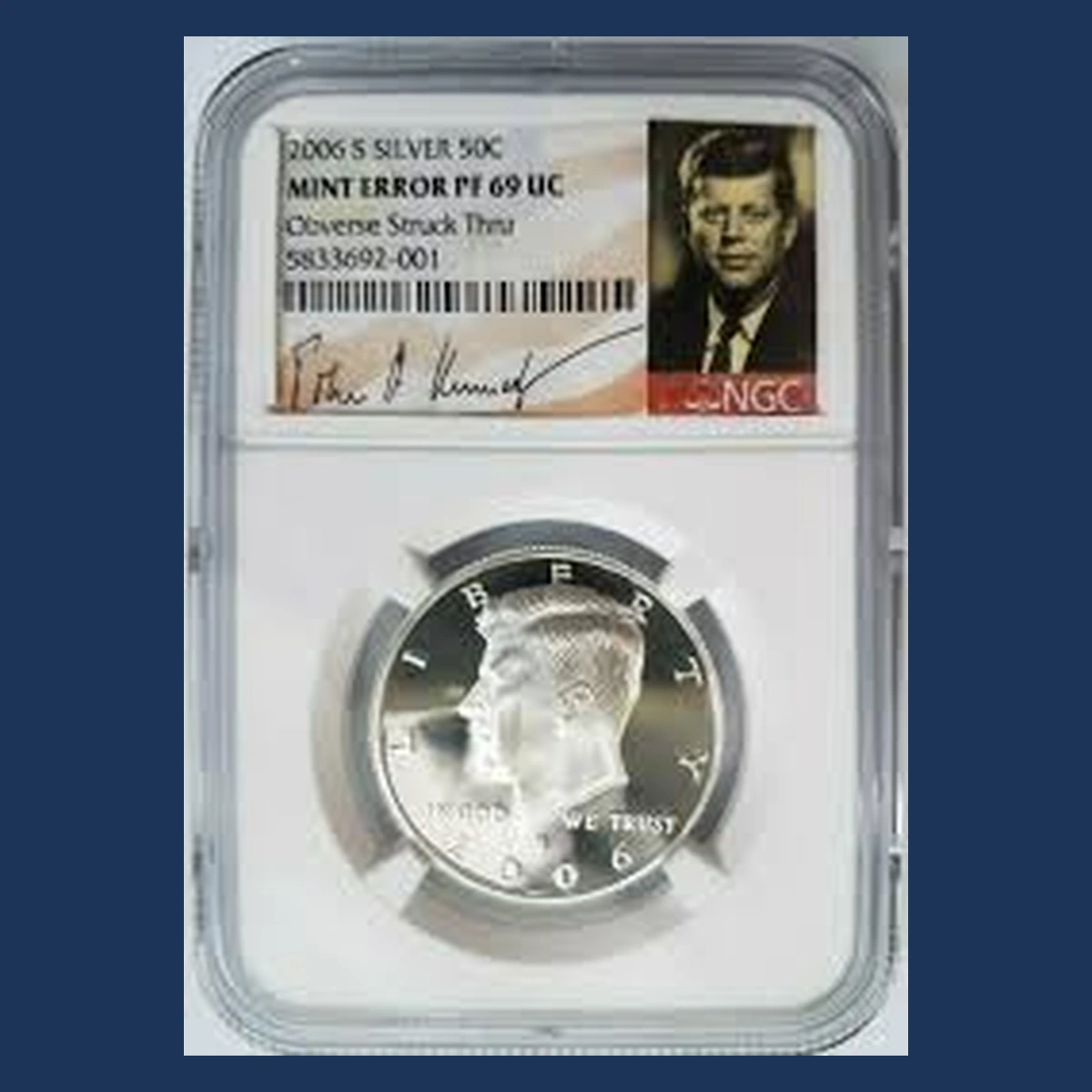
A sunken line on a collector’s 2006-P was described as an impression from cord or insulated wire. The discussion does not establish exactly what the object was made of.
Material between the stamping tool and blank can block the design and press its shape into the coin. This is called a struck-through error.
A separate guide report concerns 2006-S Proofs. Those specially made collector coins have a different finish from the reported Philadelphia piece.
Keep the examples separate. They share the basic idea of something interfering with the strike, but one groove cannot establish the other coin’s object or appearance.
Estimated Value
Estimate $30–$300 for modest through clearly visible authenticated strike-throughs in these finishes. The guide lists Proof estimates around $30–$80 for small interruptions and above $150 for stronger marks.
The 2006-P collector example shows appearance, not a transaction. No sale price is assigned to its groove.
Length, visibility, original surfaces, and secure identification affect the comparison. The guide’s figures do not establish the precise material that caused an impression.
How to Identify
Trace the whole sunken track with a 10× magnifier. Where it crosses design, look for blocked detail rather than a cut through already formed letters or design details.
Later scratches often push metal beside the groove. Move the lamp to confirm that the dark line is actually a depression.
Compare the reported P coin with its own photographs and an S Proof with matching Proof images. Calipers should show roughly 30.61 millimeters; a scale separates 11.34-gram clad from 12.50-gram silver Proofs.
The edge normally has ridges. A continuous object-shaped depression with locally interrupted design is the quickest check, though it need not identify the object’s exact material.
5. 2006 Kennedy Half Dollar Off-Center Strike Error (Estimated Up to $350)
A blank crescent and missing design on the opposite side should tell the same story. The blank sat partly outside the stamping tools, so some metal remained untouched while part of the design missed it.
The 2006 reports cover Philadelphia and Denver coins. They do not assign one displacement percentage to every example.
A readable date and mintmark connect an off-center piece to the right year and mint. A dramatic blank area cannot supply missing identifying digits.
An uneven rim alone can have another cause. Both faces need examination before calling the whole blank out of position.
Estimated Value
The estimated range is $15–$350, from small shifts to conspicuous examples with readable dates. The year guide places modest errors in the low tens and stronger pieces around $100–$300.
These are estimates based on visibility, not sale results for one identified 2006 specimen. No particular percentage is assigned here.
A clear year and mintmark improve the comparison. Damage or missing date digits can reduce appeal even when the off-center shape is dramatic.
How to Identify
Compare Kennedy and the eagle against the same remaining blank area. A genuine off-center strike should explain both designs, rather than one unusually wide rim on one face.
Use a 10× magnifier to inspect the crescent for original surface texture. Grinding away existing design leaves different marks, while a cut removes metal altogether.
A scale should stay near 11.34 grams for the clad issue because displacement normally removes no metal. Calipers record the outline against the normal 30.61 millimeters; inspect surviving edge ridges too.
Keep the date, mintmark, and complete outline in photographs. Shared displacement beside genuine unstamped metal is the quickest distinction from a one-sided alignment problem.
6. 2006 Kennedy Half Dollar Wrong-Planchet Strike Error (Estimated Up to $2,500)
The outer design can be missing because the blank itself was too small. The 2006 guide reports half dollars struck on quarter blanks, which never had enough metal to hold the full design.
This differs from an ordinary half-dollar blank sitting off-center. The wrong kind of blank entered the press.
Size alone cannot identify it. Weight, metal composition, edge texture, and the way the design was struck must agree.
A trimmed half dollar can also look small. The report does not establish one mint for every candidate, and a cut-down finished coin is not a wrong-planchet error.
Estimated Value
An authenticated quarter-blank strike has an estimated range of $500–$2,500, using the guide’s modern Kennedy comparisons. This is not a recorded 2006 auction sale.
The readable date, recognizable half-dollar design, and confirmation of the smaller blank matter together. A small diameter alone does not support the value.
A machined-down coin does not qualify. Likewise, an authorized silver Proof has its own normal composition and should not receive a wrong-metal premium merely for differing from clad.
How to Identify
Weigh first. A clad quarter blank starts near 5.67 grams, far below a normal clad half’s 11.34 grams.
A strike may spread the smaller blank beyond a quarter’s usual 24.30-millimeter diameter. Use calipers to record the actual outline against that size and the half dollar’s normal 30.61 millimeters.
Inspect the edge through a 10× magnifier for filing, machining, or a newly cut circumference. The missing outer design should fit naturally on the remaining metal.
A normal 2006-S silver Proof weighs 12.50 grams, so identify the issue before applying a standard. Agreement between weight, original edge, and the cramped half-dollar design is the strongest preliminary check.
Conclusion
Estimated values run from $15 to $2,500 across the 2006 features described. A clipped blank, peeling layer, sunken impression, or shifted design each needs a different check.
Identify the mint, metal, and finish before choosing a comparison. Regular, satin, clad Proof, and silver Proof coins have legitimate differences, so preserve the surfaces and match the actual abnormal feature instead of treating every unusual appearance as an error.