1991 Half Dollar Error List with Pictures

Two overlapping designs helped a 1991-P half dollar bring $1,092.50 in the 2009 FUN auction results. A separate 1991-D was struck fifty percent off center and sold for $546.25.
The 1991 half dollar errors below have estimated values from $20 to $1,200. Read on to compare those striking mistakes with a small missing edge, an interrupted design, missing designer’s initials, and an unusually wide coin.
1. 1991-D Kennedy Half Dollar Rim Clip (Estimated Up to $75)
A shallow piece missing from the edge identifies the reported 1991-D rim clip. GreatCollections offered the ANACS AU58 example from the Rippere collection in January 2025.
AU58 means very little wear. Its small clip does not remove a large part of Kennedy’s portrait or the eagle.
A clip begins with an incomplete blank, the round metal disc used to make a coin. The design is stamped onto the remaining metal, unlike filing or an edge blow after minting, which damages a coin that already has its design.
Estimated Value
Estimated value is $20–$75 for a modest genuine rim clip in similar worn condition. The 1991-D AU58 listing identifies the coin but does not show a publicly visible final price.
A regular-metal 1976-D clip graded ANACS MS64 sold for $89 at Heritage in March 2025. That older, unworn coin provides a higher-condition comparison rather than the price of the 1991 example, whose smaller feature needs its own assessment.
How to Identify
Weigh the coin before judging a small missing section. A clip may lower the normal 11.34 grams only slightly, while calipers across an intact part should remain close to 30.61 millimeters.
Compare the shallow opening with the AU58 reference under a magnifier. Include the nearby border so its curve and the transition into the missing area remain clear.
Look for weakness in the opposite rim, but do not require a dramatic flat spot on a tiny clip. Verify the D and date and follow the remaining edge grooves for filing or fresh burrs.
The original boundary of the shallow rim interruption is the primary identifying feature.
2. 1991 Kennedy Half Dollar Missing FG Initials (Comparative Estimate Up to $150)
The small letters FG normally sit beside the eagle’s leg and tail feathers. They stand for Frank Gasparro, who designed the back.
The 1991 year guide raises missing initials as something to examine, rather than identifying a certified example of a major named variety. Faint letters are not the same as completely missing letters.
Heavy polishing of a steel stamping tool can remove the tiny recessed letters that would make FG appear on a coin. Wear, dirt, or scraping after minting can hide the initials too, so an empty-looking spot needs closer examination.
Estimated Value
A genuine, independently identified 1991 example with both initials lost through the stamping tool has a comparative estimate of $20–$150. This is not a recorded sale for a recognized 1991 variety.
Established 1982-P No FG coins provide the comparison, including NGC MS66 examples sold for $84 in early 2022. Those were well-preserved unworn coins, and their known variety identity cannot simply be transferred to a 1991 half dollar with faint letters.
How to Identify
Find FG on a normal Kennedy half dollar before examining the same spot on your coin. A magnifier of at least 5× helps reveal tiny remaining pieces of either letter.
Check for dirt, scratches, or smoothing, then compare nearby detail with the overall amount of wear. If an F or G outline survives, describe the letters as weak rather than absent.
Read the mintmark on the front and inspect the grooves around the edge. A scale and calipers can compare the regular 11.34 grams and 30.61 millimeters.
An undisturbed surface with both initials completely absent is the essential first observation before seeking a specific 1991 identification.
3. 1991-D Kennedy Half Dollar Obverse Strike-Through (Estimated Up to $200)
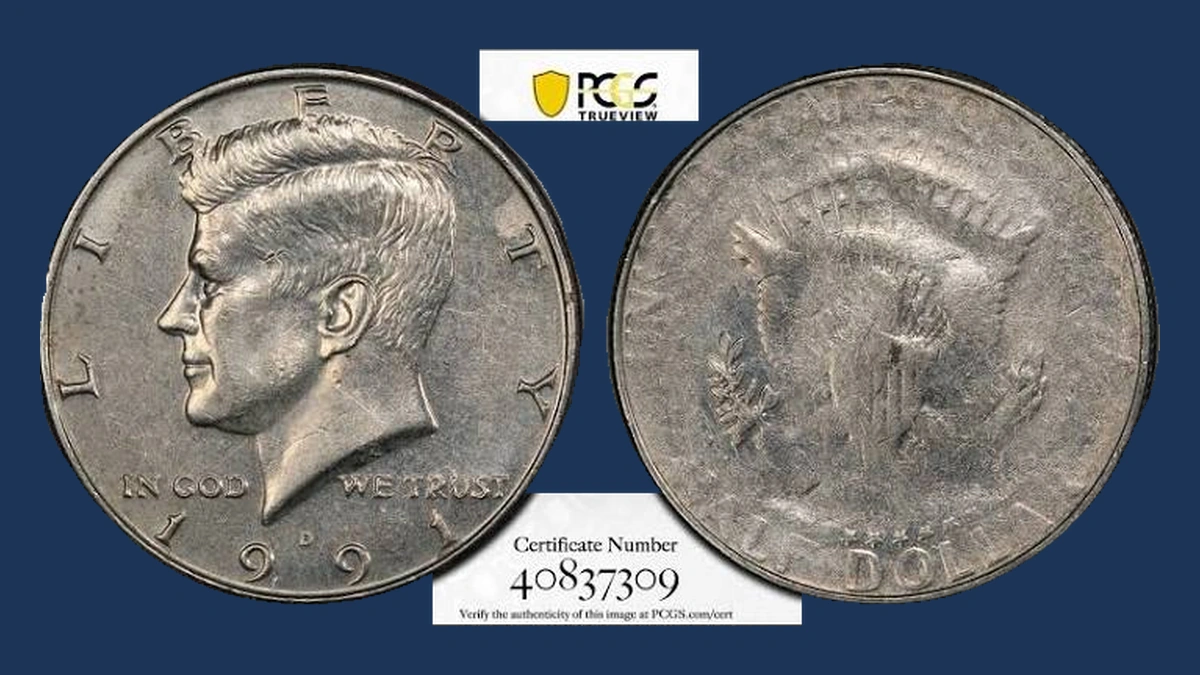
An area on the front of a 1991-D did not receive its normal design, according to a collector’s 2021 post after grading. The report calls it a strike-through without identifying the material involved.
A strike-through occurs when something gets between the stamping tool and the metal disc during striking. It can leave a dent-like shape or prevent nearby detail from forming properly.
A later scrape can also remove detail, but it cuts a surface that was already finished. The boundary and surrounding design therefore matter more than guessing what substance caused the mark.
Estimated Value
Estimated value is $50–$200 for a genuine visible front strike-through of this general kind. The collector’s 1991 report provides no completed sale price.
A regular-metal 1976-D with strike-through effects on both sides sold for $114 in March 2025. That different-year example offers a broad comparison, while the area affected, how easily the error can be seen, and the coin’s condition determine how closely another piece fits the estimate.
How to Identify
Use the collector’s example to locate the affected area on the front. Keep the whole portrait in one photograph and take a separate sharp close view of it.
Confirm the D and date, then inspect the edge grooves for alteration. A scale and calipers can compare 11.34 grams and 30.61 millimeters, but those measurements alone cannot establish a strike-through.
Follow the mark’s boundary with a magnifier, looking for cuts, scrape tracks, or metal pushed up by a later blow. A boundary showing that the design was interrupted as it formed is the immediate distinction from damage to an already completed coin.
4. 1991 Kennedy Half Dollar Broadstrike (Comparative Estimate Up to $300)
A half dollar can spread wider than normal while keeping its complete design. Collectors call that a broadstrike.
A metal ring normally surrounds the disc during striking, limiting its size and forming the edge grooves. If the ring fails to contain the metal, pressure can force metal farther outward.
The 1991 guide discusses this possibility without identifying a separate certified example. A wide-looking rim alone is not enough, since a shifted stamping tool or later damage can make one edge appear broader without the metal actually spreading during the strike.
Estimated Value
Use a comparative estimate of $50–$300 for a genuine identified 1991 broadstrike. No specific 1991 transaction is established here.
A large 1977-D broadstrike graded PCGS MS65 brought $456 in December 2025. It had dramatic spread and attractive unworn surfaces.
A slightly widened or worn 1991 would make a weaker comparison. The estimate for those less obvious pieces therefore stays below that older coin’s result.
How to Identify
Place a normal half dollar beside the candidate and measure several widths with calipers. Actual widening beyond the usual 30.61 millimeters matters more than one broad-looking rim.
A scale should still read near 11.34 grams because spreading does not remove metal. Then compare both sides to check that the lettering and central design both remain complete.
Examine the edge under a magnifier for missing or uneven grooves. Dents, hammer marks, and flattened edges can indicate damage after minting.
A complete design inside a genuinely wider outline, supported by an edge formed without normal restraint, gives the most direct broadstrike test.
5. 1991-D Kennedy Half Dollar Off-Center Strike (Estimated Up to $650)
A large part of the disc remains blank on the PCGS MS62 1991-D pictured in Mint Error News. Its holder identifies a fifty-percent off-center strike.
The round metal disc entered the press too far to one side. Only the part beneath the stamping tools received the design, while the rest stayed outside their reach.
This is not simply a weak strike. The untouched area and the missing part of the picture fit together, showing where the design moved beyond the available metal, and the coin’s surviving details identify it as a 1991-D.
Estimated Value
The PCGS MS62 example sold for $546.25 in the published 2009 FUN results. MS62 describes an unworn coin with noticeable marks.
That exact-year sale supports an estimated $150–$650 for dramatic examples that remain identifiable. Smaller shifts can fall around $20–$100.
The surviving date, surface condition, and appearance also matter. Another fifty-percent off-center coin does not automatically receive the historical example’s price.
How to Identify
Compare both sides with the illustrated PCGS MS62 Denver example, keeping the entire outer outline visible. Match the large blank area with the part of the design missing at the opposite edge.
Use a magnifier at the boundary between stamped and untouched metal. One uneven rim alone can come from a shifted tool rather than the whole disc moving.
Record the actual outline with calipers against the normal 30.61 millimeters, and weigh it against 11.34 grams. Inspect the edge for damage after striking.
The large original blank area paired with corresponding design displacement on both sides is the defining first comparison.
6. 1991-P Kennedy Half Dollar Double Strike (Estimated Up to $1,200)
Two versions of the design overlap in different positions on the pictured 1991-P. The coin received another blow after its first design had already formed.
ANACS graded it MS64 PL. MS64 means no wear but some marks, while PL means prooflike, describing its reflective appearance.
That reflection does not make it a specially produced proof coin. This is a Philadelphia coin made for ordinary use.
The overlapping pictures came from two strikes, unlike small repeated shapes already present in a stamping tool. Following where one image crosses the other helps show what happened without guessing an unreported direction of movement.
Estimated Value
The published 2009 FUN results give $1,092.50 for the ANACS MS64 PL double strike. It is the highest specific error-coin sale discussed here.
Estimated value is $300–$1,200 for identifiable double strikes, from less dramatic pieces to examples approaching that coin’s appearance. Separation of the pictures, surviving date, and condition affect value.
Reflective surfaces are another characteristic. They do not prove that the coin was specially made as a Proof.
How to Identify
Start by locating a piece of the first picture that continues beneath the second. Both sides should show how the two positions relate, rather than just one thick-looking letter.
Compare the whole coin with the published ANACS example. Confirm the P and 1991 date, then inspect the edge grooves and any spreading for later damage.
Use a scale and calipers to compare the usual 11.34 grams and 30.61 millimeters. A magnifier will help trace exactly where one original impression crosses the other.
Two independently positioned designs that visibly overlap establish the double strike more directly than small doubled outlines or reflective surfaces.
Conclusion
The estimated $20–$1,200 range covers several different causes. The Denver off-center coin missed part of one strike, while the Philadelphia double strike received a second overlapping design.
Keep their $546.25 and $1,092.50 historical results attached to those particular coins. Smaller clips and strike-through marks need their own comparisons, while missing-initials and broadstrike candidates require the physical evidence described here before receiving those names and estimated values.