1994 Half Dollar Error List with Pictures

A doubled-reverse Kennedy half from 1965 sold for $408 in March 2024. That different-year collector issue offers a price comparison; it is not a sale of a 1994 coin.
In this 1994 Kennedy half dollar error list, two silver-Proof varieties have cataloged extra outlines around the back’s star ring. Proofs are specially made collector coins; clad coins have outer metal layers bonded over copper.
Estimated values run from $10 to $600. Read on to compare those varieties and the other reported errors without confusing missing detail with later damage.
1. 1994 Kennedy Half Dollar Clashed Dies Error (Estimated Up to $100)
An eagle-like outline reported on Kennedy’s side may be a clash mark. It resembles part of a design that normally belongs on the back.
Clashes begin when the dies, the steel stamping tools, hit each other without a blank between them. The contact can mark a tool, which passes the extra shape to later coins.
The 1994 report gives no exact mint, finish, or location for an identified example. Compare the actual outline with the opposite design.
Pressing two finished coins together later can also leave misleading impressions. An eagle shape alone does not prove that the Mint’s tools clashed.
Estimated Value
Estimate $20–$100 for a light but clearly identified clash on an ordinary clad example. A recognizable opposite-side shape is more useful than vague lines suggesting an eagle.
A 1973-S Proof with a strong clash, graded PCGS PR68 Deep Cameo, sold for $720 in October 2022. Deep Cameo describes strong contrast between frosted design and shiny background.
That different-year Proof belongs to another price level. It does not set the value of a faint reported 1994 clash.
How to Identify
Compare photographs of both faces to see which part of the eagle could match the extra front-side shape. A 10× magnifier helps trace the outline beyond one short line.
Its size and position must fit contact between the tools. Random scratches do not become clashes just because they suggest a bird.
Inspect the edge ridges for crushing or a seam from later alteration. A normal clad coin weighs 11.34 grams, while an S silver Proof weighs 12.50 grams.
Use a scale and calipers against the shared 30.61-millimeter diameter. A recognizable opposite-side shape in the right place, with original surrounding surfaces, is the first useful clash test.
2. 1994 Kennedy Half Dollar Portrait Strike-Through Error (Estimated Up to $150)
A weak patch in Kennedy’s portrait may form when material blocks part of the stamping tool. Nearby details can remain sharp because they were not blocked.
The year report describes filled-tool or strike-through effects without identifying an object still present. Both terms concern something preventing normal detail from forming.
The affected patch’s border can be more useful than its center. Compare how the normal design changes as it reaches the weak area.
The report gives no particular mint or solid object. Ordinary wear can also flatten the portrait, so weak detail alone does not show that anything interrupted the strike.
Estimated Value
Estimate $10–$150 for genuine local weakness caused by an obstruction on an ordinary clad half. Very faint softness may add little to normal collector value.
A 1976-D clad Kennedy struck through on both sides sold for $114 at Heritage in March 2025. It provides a recent comparison from another year.
That coin had a two-sided error. A vague 1994 patch does not automatically inherit its identity or sale price without matching evidence.
How to Identify
Check nearby high points for wear before enlarging the weak patch. Broad rubbing across raised details suggests circulation rather than one blocked area.
A 10× magnifier can show scrape lines or an original border between weak and sharp design. Make sure a mark on the holder is not being mistaken for a mark on the coin.
Record the mint and finish. Use a scale against 11.34 grams for clad or 12.50 grams for an S silver Proof, and calipers against 30.61 millimeters.
Inspect the edge ridges for damage too. A local patch of missing detail beside sharp, undamaged design is a stronger first clue than general portrait softness.
3. 1994 Kennedy Half Dollar Clipped Planchet Error (Estimated Up to $250)
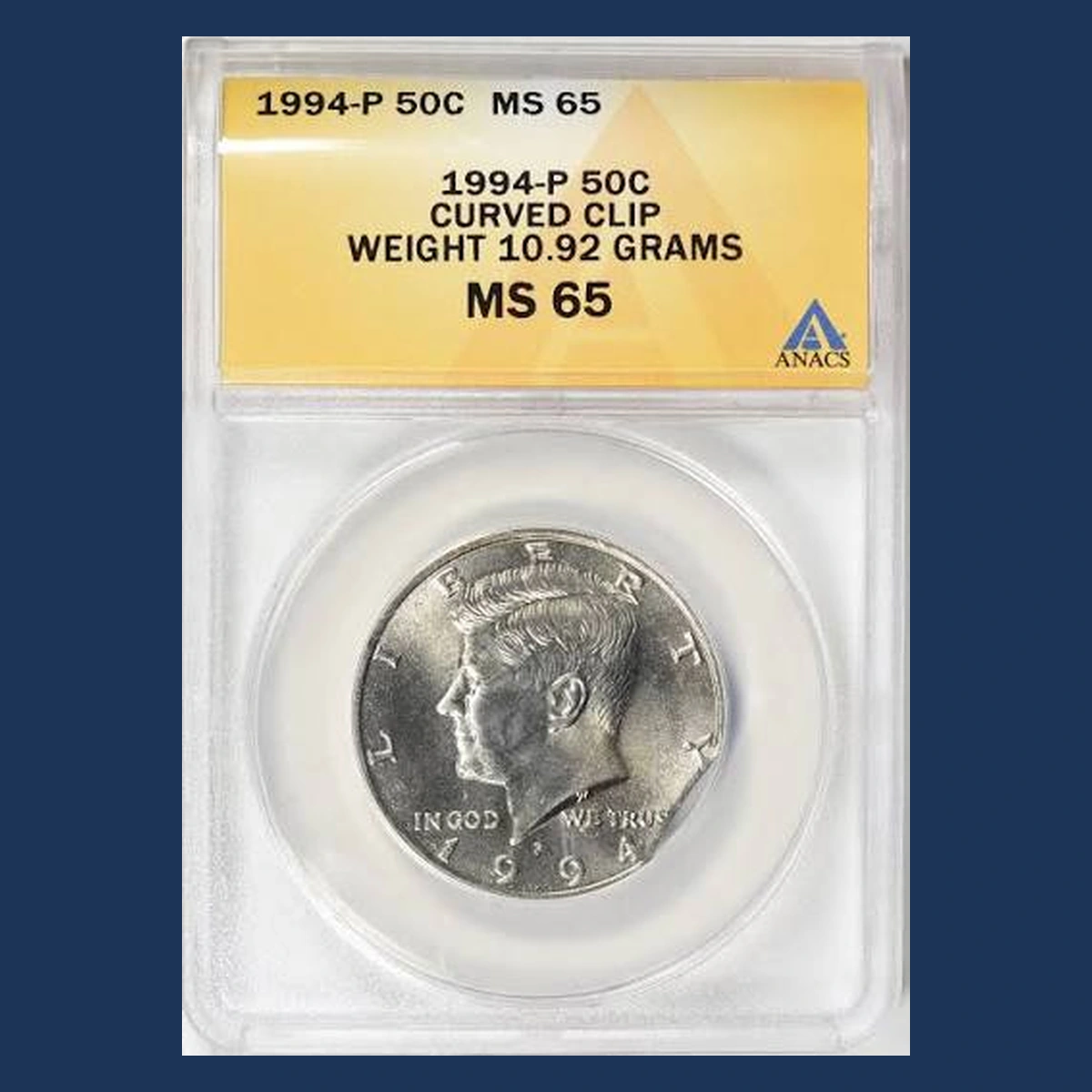
A curved gap and a straight missing section can both begin before a coin receives its design. Each leaves an incomplete blank for the stamping tools.
The 1994 circulation-coin report mentions these forms without naming a specific mint, missing percentage, or position. Those details must come from the coin.
Nearby letters and rim metal can show how the design formed around the gap. The opposite rim may also be weak.
A saw or file can imitate the outline after minting. The gap’s sidewall and the way it meets details are therefore more useful than its curved or straight shape alone.
Estimated Value
Genuine clips on ordinary 1994-P or D halves have an estimated range of $25–$250. The gap’s size, original surfaces, and condition affect where a coin fits.
A 1993-D curved clip graded ANACS MS64 sold for $34.74 including the buyer’s fee in August 2025. MS64 means unworn with some marks; this nearby-year sale offers a modest comparison.
It is not a 1994 sale. It also does not mean every curved clip is worth more than every straight one.
How to Identify
With a 10× magnifier, follow the gap from one end at the rim to the other. Inspect the exposed copper center and pale outer layers as well.
Fresh tool marks or a sharp cut through completed lettering suggest later removal. A genuine clip was already there when those details formed.
Calipers across intact parts should be near 30.61 millimeters. A scale can show a loss from the normal 11.34 grams, allowing for wear as well as missing metal.
Inspect the surviving edge ridges and look opposite the gap for possible rim weakness. Original struck borders at both ends of the missing section are the quickest useful distinction from trimming.
4. 1994 Kennedy Half Dollar Reported Doubled Die Obverse (Estimated Up to $300)
The Denver report points to extra outlines at the nose, ear, and chin. Broader Philadelphia and Denver reports also mention front lettering and date details.
Those descriptions do not mean both mints used one tool or that every feature appears on one coin. Each example needs its own comparison.
A doubled die has repeated details built into the stamping tool. Movement during striking can instead flatten a letter’s edge into a ledge.
The year sources mix those two explanations. Look at the actual raised shapes before accepting the label, rather than calling every thick-looking portrait or letter a doubled-die variety.
Estimated Value
Estimate $25–$300 for clearly identified minor front-side doubling on ordinary collectible examples. Flat ledges from striking movement or damaged outlines do not receive the same variety premium.
A 1974-D FS-101 graded ANACS MS64 sold for $49 in May 2026. That provides a recent comparison with a recognized Kennedy variety.
Its catalog number belongs to the earlier coin. It should not be borrowed to fill the missing identification behind a reported 1994 example.
How to Identify
On a Denver coin, compare the nose, ear, and chin with a normal D-mint portrait under a 10× magnifier. Consider any lettering claim separately.
For a Philadelphia coin, choose a P-mint comparison instead of importing Denver’s reported shape. Look for rounded extra outlines or separated corners.
A flat shelf that reduces a letter’s width can come from movement during striking. Photograph several affected details with consistent light to see whether they form a repeated pattern.
Both ordinary versions have edge ridges and should approach 11.34 grams and 30.61 millimeters on a scale and calipers. The same added shapes on a verified same-mint example give the strongest starting match.
5. 1994 Kennedy Half Dollar Missing FG Initials Examination (Estimated Up to $400)
FG is the designer Frank Gasparro’s initials near the eagle’s tail. A suggestion to search 1994 halves for missing initials appears alongside examples from other years, especially 1982-P.
That does not establish a 1994 No FG coin. A candidate needs genuinely absent letters and original surrounding surfaces.
Wear, blocked detail, or changes to the stamping tool can make the initials faint. Overbright photographs may hide them too.
A locally polished finished coin is different from a coin struck by a changed tool. Look at the nearby design and smooth background together before deciding that the Mint omitted anything.
Estimated Value
A confirmed Mint-made omission on an ordinary clad 1994 could fit an estimated $40–$400. This is a comparison range, not a claim that an identified 1994 No FG has sold.
The recognized 1982-P polished-tool No FG variety, graded PCGS MS66+, brought $384 at Heritage in May 2024. That supports the general price scale.
Its established collector demand does not automatically apply to another date. Weak or hidden letters need to be distinguished from true absence.
How to Identify
Find FG beside the eagle’s tail on a normal half first. That comparison keeps you in the correct spot on the candidate.
Use a 10× magnifier under several light angles to check for any remaining part of F or G. One bright photograph can hide faint letters.
Inspect nearby sharp details and the smooth background for rubbing, fine scratches, or residue. Those can explain why the initials are hard to see.
Check the edge ridges and measure with a scale and calipers: clad 11.34 grams, S silver Proof 12.50 grams, and 30.61 millimeters across. Truly absent letters beside original undamaged surfaces are the first requirement for a No FG candidate.
6. 1994 Kennedy Half Dollar Silver Proof Doubled Die Reverse (Estimated Up to $450)
Extra outlines around the upper part of the star ring identify the cataloged 1994-S silver-Proof doubled reverses. Lighter repeated detail also appears among stars and rays.
CONECA lists DDR-001 and DDR-002 separately. Those numbers refer to different stamping tools even though their effects look broadly similar.
An early DDR-001 also has a small raised mark near the rim, to the left of H in HALF. It came from a gouge in the tool.
These varieties belong to silver Proofs. The same-year clad Proofs should not receive those names without matching the correct composition, repeated pattern, and other identifying marks.
Estimated Value
Estimate $75–$450 for correctly identified silver-Proof examples in ordinary collectible grades. Clear extra lines and undamaged shiny surfaces help their appeal.
A 1965 SMS doubled reverse graded ANACS MS66 sold for $408 in March 2024. SMS was a special collector-set finish, and that coin contained forty-percent silver.
It is a different-year, different-finish comparison, not a 1994-S transaction. The result does not establish that DDR-001 and DDR-002 have equal rarity or value.
How to Identify
Identify the silver Proof before naming its variety. It normally weighs 12.50 grams, compared with 11.34 grams for the clad Proof; both measure 30.61 millimeters.
Use a scale and calipers for a loose coin, or the grading label for a sealed example. Inspect the edge ridges as well.
Through a 10× magnifier, compare the upper star ring, stars, and rays with the CONECA photographs. DDR-002 needs its own matching images.
For early DDR-001, look just left of H in HALF for the small raised mark from a tool gouge. The correct extra star-ring lines plus that matching mark provide the quickest useful identification.
7. 1994 Kennedy Half Dollar Broadstrike Error (Estimated Up to $500)
A broad border around complete designs can form when a blank spreads outward during striking. The collar, a ring around the blank, normally limits that spread.
Without proper restraint, the coin can become wider. Its edge may lack the usual ridges where it did not meet the collar.
The 1994 list reports broadstrikes for Philadelphia and Denver circulation coins. It gives no measured original specimen to compare directly.
Record the actual width, mintmark, and edge. A normal half flattened after minting can also grow wider, but pressure usually damages its existing design rather than leaving an original expanded strike.
Estimated Value
An estimated $100–$500 covers comparable genuine 1994 broadstrikes. Recent Kennedy results help set the scale.
A 1990-P ANACS MS61 sold for $192 in March 2025, while a separate 1990-P ANACS MS65 brought $119 in January 2023. Both are earlier-year examples.
The higher grade did not bring the higher price in those sales. Appearance and buyer interest matter too, and no specific 1994 sale or measured width is established by these comparisons.
How to Identify
Use calipers in several directions to check for spread beyond 30.61 millimeters. A scale should stay near 11.34 grams because spreading does not remove metal.
Examine both designs with a 10× magnifier. They should remain complete even though the border is wider.
Check where the edge lacks normal ridges and follow the design into the expanded margin. Later flattening often crushes details and leaves pressure marks.
An off-center strike can lose outer design instead of keeping it all. Complete original designs, natural outward spread, and an edge that fits the same strike are the useful first combination, rather than size alone.
8. 1994 Kennedy Half Dollar Off-Center Strike Error (Estimated Up to $550)
An off-center blank receives only part of the intended design. Some metal stays bare, while part of the lettering or portrait falls beyond the blank.
Both faces should show the same shift against the coin’s outline. One uneven rim alone is not enough.
The 1994 report includes Philadelphia and Denver coins but gives no certified example’s percentage or direction. Those measurements cannot be borrowed from another year’s photograph.
A readable date helps place the coin in a 1994 collection. An undated off-center coin can still have value, but identifying its error and identifying its year are two different tasks.
Estimated Value
Estimate $50–$550 for modest through obvious off-center strikes on ordinary 1994 clad coins. A readable date, clear shift, and original surfaces matter alongside the amount of offset.
A 1990-P ten-percent example graded NGC MS66 sold for $198 in September 2025. A 1991-D fifty-percent example graded PCGS MS62 brought $546.25 in 2009.
Those different-year sales show a broad price scale. They do not create a confirmed 1994 specimen or a 1994 auction result.
How to Identify
Read the date and mintmark directly, then compare the design boundaries on both sides. A 10× magnifier should show original bare metal beside the incomplete design.
Inspect the surviving edge ridges and any section that escaped the collar. Calipers can record the outline against the usual 30.61 millimeters.
The scale should generally stay near 11.34 grams if no metal is missing. Off-centering changes where the design lands, not how much blank metal remains.
If one side stays centered, one tool may have been misaligned instead. Matching incomplete designs beside untouched blank metal on both faces identify the error first; the readable date then establishes the year.
9. 1994 Kennedy Half Dollar Missing Clad Layer Error (Estimated Up to $600)
A clad half has copper-nickel outer layers bonded to a copper center. If a layer separates before striking, the tools can stamp the design directly into exposed copper.
The reports for 1994 concern Philadelphia or Denver circulation coins. They do not identify which face is affected on a particular example.
A red front or back therefore needs its own inspection. Color is not enough to assign a missing layer to the year report.
The silver Proof uses a different alloy. Its edge lacks the usual copper stripe because it is a silver coin, not because a clad layer is missing.
Estimated Value
Estimate $150–$600 for an authenticated missing outer layer on a collectible clad half. Original design on exposed copper and a clear layer border support the comparison.
A 1974-D NGC MS64 missing its front clad layer sold for $432 in March 2023. It weighed 9.34 grams.
That is a different-year example with a measured weight and known affected face. Neither detail should be assigned to an undocumented 1994 coin simply because it has a similar color.
How to Identify
Weigh a loose P or D coin against the normal 11.34 grams. Use calipers to check its outline against about 30.61 millimeters, since layer loss affects weight more directly than width.
With a 10× magnifier, inspect the edge ridges and where the remaining outer layer meets exposed copper. The colored face should still show believable original struck texture.
Grinding leaves cuts, while chemicals can roughen the surface. Plating can change color without removing any layer at all.
Later stripping may reduce weight too, so low weight alone cannot prove a Mint error. A genuine layer border together with original design on the exposed metal is the first useful match.
Conclusion
Estimated values for these 1994 errors run from $10 to $600. The silver-Proof star-ring varieties have specific catalog comparisons, while the other reports need their visible features checked on each coin.
Confirm the mint and finish first. The S appears on both clad and silver Proofs, which have different weights.
Then compare the original surfaces, design, and edge rather than borrowing a familiar variety name or price from another year.