1984 Half Dollar Error List with Pictures

A 1984-S proof with two front pictures almost a quarter-turn apart sold for $5,462.50 in January 2007. Proofs are specially made collector coins.
The front stamping tool had turned between blows while the back tool stayed still.
This 1984 Kennedy half dollar error list has estimated values from $20 to $10,000. Other examples include a repeated mintmark, rim breaks, and a half-dollar design on a smaller quarter blank.
Read on to compare each visible feature and the prices for similar coins.
1. 1984 Kennedy Half Dollar Repunched Mintmark RPM-001 (Estimated Up to $125)
Extra strokes toward the upper right of D help identify this repunched mintmark. CONECA calls the 1984-D variety RPM-001 and describes the direction as northeast.
The mintmark was punched more than once into the die, the steel tool used to stamp coins. Part of the earlier D remained beside the final letter.
Coins made with that tool received the extra shape. A flat shelf or random bump beside D can have another cause.
The variety is reported in mint sets, but the packaging does not prove the error. The letter itself must match the catalog photograph.
Estimated Value
A matching example has an estimated value of $20–$125. Clear upper-right remnants and attractive original surfaces support the stronger end.
The catalog identifies the variety but does not set one selling price. For comparison, a guide gives $15–$60 for minor ungraded 1986-D repunched mintmarks.
That is a different-year guide range, not a completed auction. A better-preserved 1984 RPM-001 can justify more interest, but the actual extra strokes need to remain visible.
How to Identify
Focus a magnifier on the upper-right side of D and compare it with the RPM-001 photograph. Include the whole letter rather than one enlarged bump.
Look for a clearly visible rounded remnant shaped like part of D. Check whether corrosion or an impact interrupts the outline.
A loose normal coin should weigh near 11.34 g on a scale and measure 30.61 mm with calipers. Inspect its edge grooves for unrelated alteration.
Keep the mintmark untouched; polishing can erase the small strokes needed for comparison. Match the northeast D outline first, regardless of whether the coin is still in mint-set packaging.
2. 1984 Kennedy Half Dollar Double Clipped Planchet Error (Estimated Up to $350)
Two missing areas can indicate a double clip. Both gaps must have existed in the blank, the round metal disc, before the design was stamped.
This differs from a finished coin cut twice after minting. Each opening needs evidence of original striking around its edge.
The 1984 report gives no individual coin’s mintmark, gap shapes, locations, or percentages. Those details must be checked on an actual example.
Weakness opposite a gap can support a clip, but does not prove it alone. One genuine opening also cannot guarantee that a second notch has the same origin.
Estimated Value
The estimated range is $30–$350, depending on both gaps’ size, position, and original appearance. An attractive pair can be more appealing than a barely visible single clip.
A 1993-D single curved clip sold for $34.74 including the buyer’s fee in August 2025. ANACS graded it MS64, meaning unworn with some marks.
That different-year sale supports modest clip prices. The extra gap and the 1984 coin’s condition must justify a higher comparison.
How to Identify
Photograph the full coin with both gaps visible before inspecting either one. Then use a magnifier to follow each boundary into the remaining rim.
Look for original detail weakening toward the openings. Check the surviving edge grooves for cutting, file marks, or sharp burrs.
A scale can compare the lost weight with the normal 11.34 g. Calipers across intact opposite edges should be compared with 30.61 mm.
Inspect any weak rim opposite each gap, but do not use that clue by itself. For the quickest check, test both openings separately for original strike-shaped boundaries rather than accepting the second because the first looks genuine.
3. 1984 Kennedy Half Dollar Doubled Die Varieties (Estimated Up to $350)
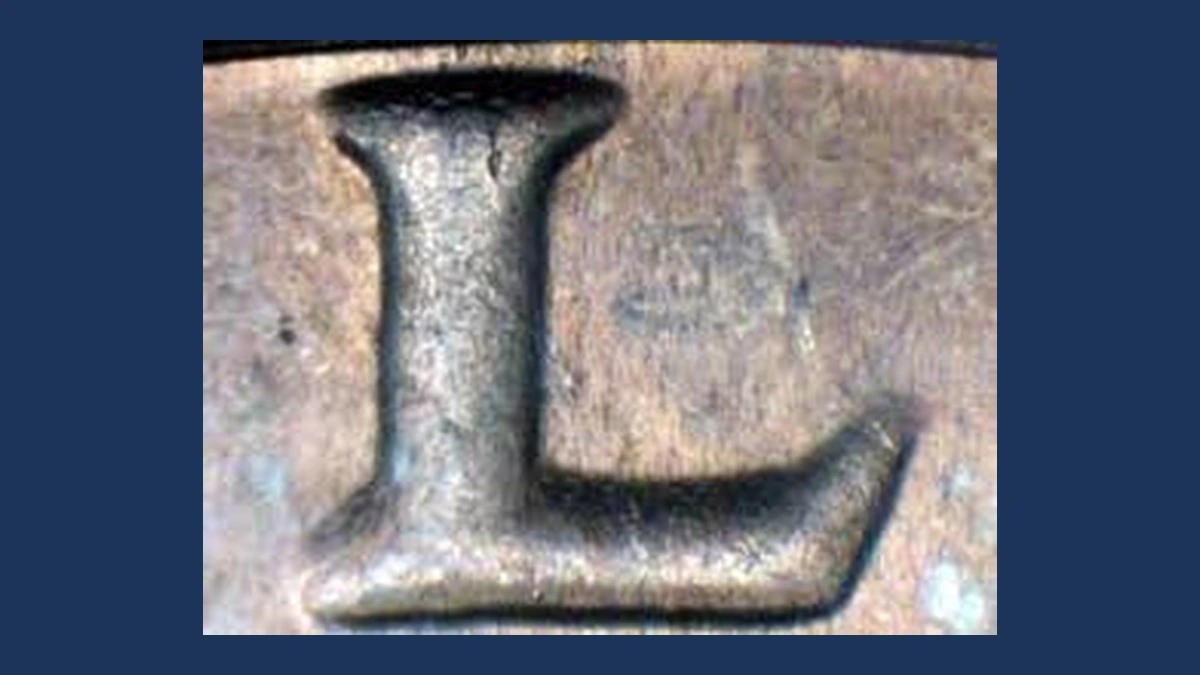
The known Philadelphia front variety shows separation in LIBERTY and extra thickness extending inward in other details. Catalogs call it WDDO-001 or DDO-001, two names for the same variety.
A thin vertical raised line left of the chin and a short raised mark left of the date’s upper 1 help identify it. These came from marks in the stamping tool.
True doubled design does not always have two clean outlines everywhere. Some parts appear thickened instead.
Back doubling is separately reported without an established matching variety. It cannot borrow the front’s small marks or catalog number.
Estimated Value
A confirmed doubled die has an estimated value of $25–$350. The known Philadelphia front provides the clearest matching example, with preserved extra detail supporting more interest.
A 1974-D doubled die graded ANACS MS64 sold for $49 in May 2026. That is a different-year unworn coin with some marks.
Higher estimates depend on condition and collector demand. An unnumbered back-doubling report does not automatically deserve the same price as a correctly identified front variety.
How to Identify
Compare LIBERTY under a magnifier, then examine thickening in the motto, upper hair, and date. Use a confirmed photograph rather than expecting every letter to have a clean twin outline.
Look left of the chin for the thin vertical line and beside the upper 1 for the short raised mark. They help support the front identification.
Keep any back-doubling claim separate and inspect the edge grooves for alteration. On a loose coin, check roughly 11.34 g with a scale and 30.61 mm with calipers.
Start with LIBERTY’s matching separation, then confirm the small chin and date marks; do not judge the variety from thick lettering alone.
4. 1984 Kennedy Half Dollar Missing FG Initials Report (Estimated Up to $400)
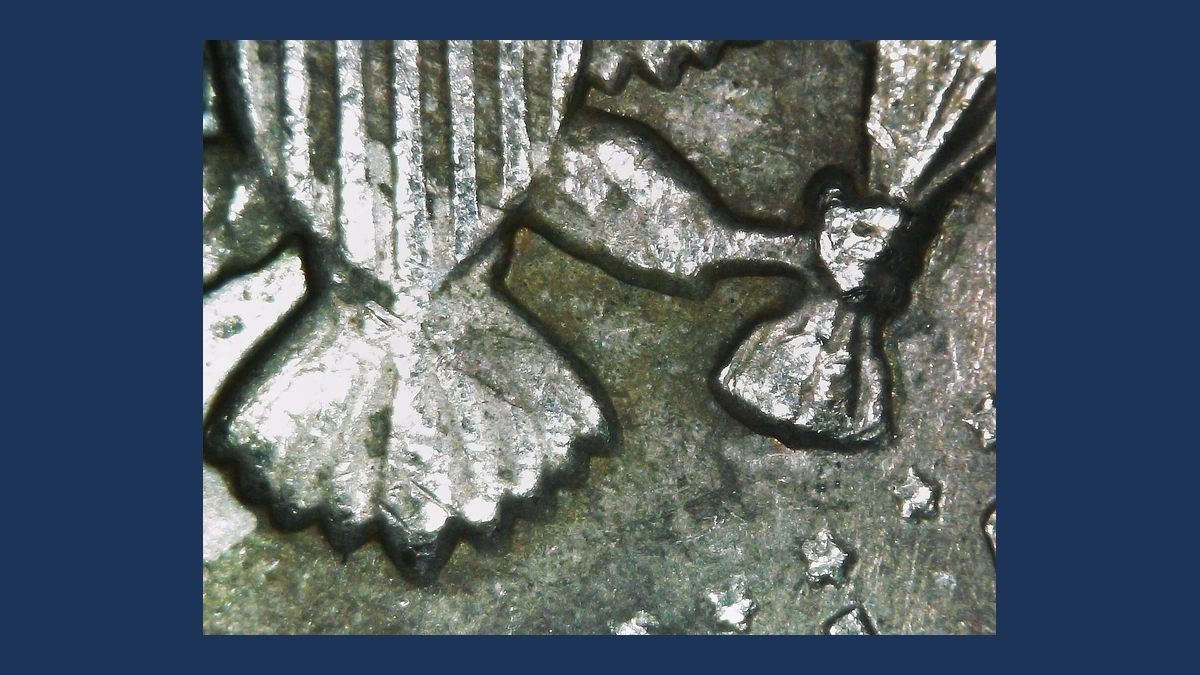
The small FG initials sit between the eagle’s leg and tail feathers. They name back designer Frank Gasparro.
A collector reported a 1984-P with apparently missing initials, but a clear confirmed example is not established here. The area needs sharp photographs under more than one light angle.
Faint remaining strokes are different from complete absence. Wear, a weak strike, trapped material, or deliberate smoothing can also make the letters hard to see.
Nearby detail helps explain the blank-looking spot. The candidate should not automatically be described as a recognized variety made by polishing the stamping tool.
Estimated Value
A genuinely absent, correctly identified FG feature has an estimated value of $20–$400. Modest examples belong nearer the lower end.
An established 1982-P No FG graded PCGS MS66+ sold for $384 in May 2024. That was a highly preserved unworn coin from a different year.
It offers context for the upper estimate, not a sale of the 1984 candidate. A blurred photo, rubbed patch, or faint surviving letters cannot justify borrowing its full premium.
How to Identify
Locate FG on a normal back first, then examine the same spot with a magnifier under several light angles. Search for any surviving portion of either letter.
Compare nearby feathers and flat areas for wear, weak detail, or rubbing. Keep those surrounding features in the close-up so an empty-looking patch is not misleading.
Do not clean the coin. Check the edge grooves and use a scale against 11.34 g and calipers against 30.61 mm on a loose example.
The original candidate still needs clear surface evidence. For the first screening step, look for a remaining F or G stroke; either means weak initials rather than complete absence.
5. 1984 Kennedy Half Dollar Broadstrike Error (Estimated Up to $400)
A widened border can remain visible even after a coin is cleaned or worn. Two 1984-P auction records describe broadstrikes in different conditions.
One is graded ICG AU58, meaning only slight wear. The other is described as unworn but improperly cleaned, so it lacks a normal numerical grade.
A broadstrike forms when the retaining ring fails to limit outward spreading during striking. The complete designs can remain inside the enlarged outline.
Cleaning can reduce appeal without causing or erasing that original error. The edge and spreading still need to be examined separately from later surface damage.
Estimated Value
The lightly worn ICG AU58 brought $23 in August 2009. The cleaned unworn example brought $31 in February 2009.
These are separate historical results with different condition descriptions. An estimated $25–$400 allows more interest for clean, strongly expanded examples.
For newer context, a 1990-P broadstrike graded ANACS MS61 sold for $192 in March 2025. That different-year sale does not turn the cleaned 1984 coin into an undamaged example.
How to Identify
Follow the outer lettering on both faces with a magnifier to see whether the complete design survives. Check the edge grooves and spreading, rather than relying on a wide border alone.
Use calipers in several directions against 30.61 mm and a scale against 11.34 g. Later flattening can widen a coin while crushing details already present.
Inspect fine scratches and disturbed surface shine as a separate cleaning question. A genuine mint error can still have later damage.
Keep full photographs of both faces and the edge. First match a complete original design inside a naturally expanded outline; judge the cleaning only after identifying that relationship.
6. 1984 Kennedy Half Dollar Obverse Cud Error (Estimated Up to $450)
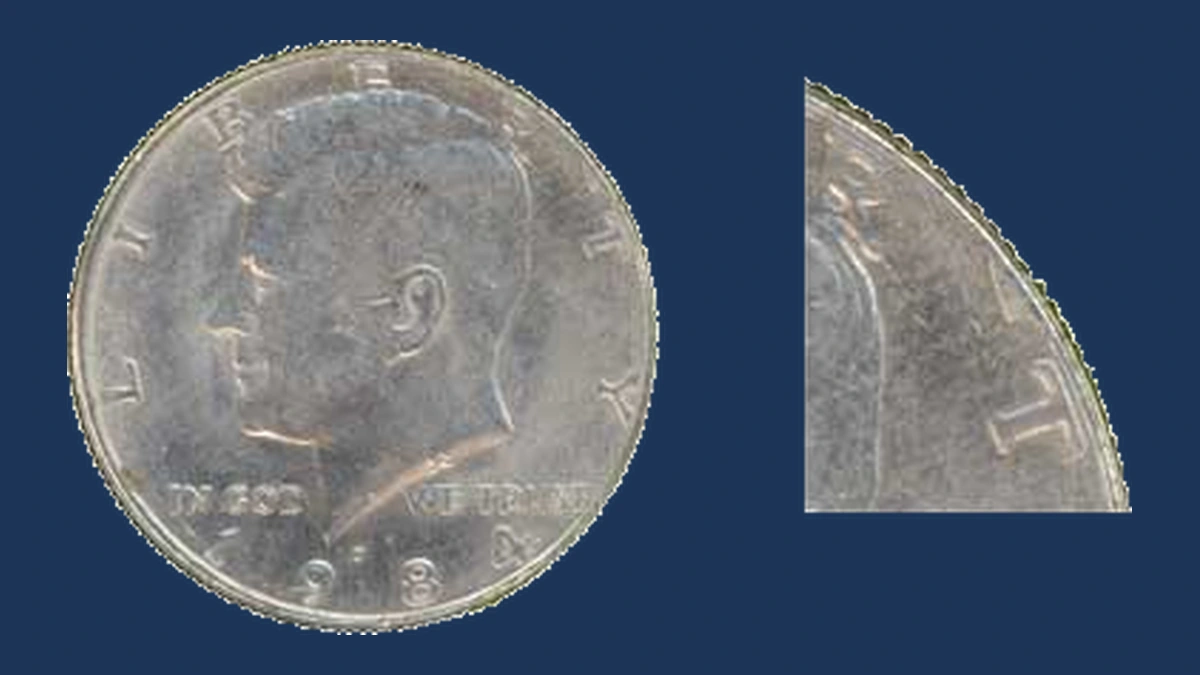
A small raised rim feature near 1:45 identifies this 1984-P front cud. Its catalog description compares the shape with an arrowhead split lengthwise.
Cud-001, 84P-1, and UVC 262 are names for the same entry. They do not describe three separate kinds of error.
A cud forms when the edge of a stamping tool breaks away. Coin metal fills the missing space and leaves a raised patch, rather than a hole.
The catalog gives approximate depth and width percentages for the feature. Those numbers do not mean that the same percentages of coin metal are missing.
Estimated Value
A matching original example has an estimated value of $25–$450. A clear outline and attractive surfaces support stronger prices, while wear and damage reduce appeal.
A 1976-D with a back die break graded NGC MS65 sold for $256 in June 2026. That was an attractive unworn coin from a different year.
The sale provides a comparison within the same broad type of tool failure. The actual 1984 feature’s size and condition still determine its value.
How to Identify
Keep Kennedy upright and find the rim near 1:45. Use a magnifier to compare the raised patch with the pictured half-arrowhead shape.
Confirm P and 1984 in the same full view. Inspect the connection to the edge grooves for original striking rather than solder, corrosion, or a rim folded by impact.
A normal loose coin should be near 11.34 g on a scale and 30.61 mm with calipers. Do not convert the catalog’s rough percentages into invented exact dimensions.
Include nearby design in the photograph. Match the raised rim-connected half-arrowhead outline first; the different catalog names all refer to that same feature.
7. 1984 Kennedy Half Dollar Obverse Struck Through Error (Estimated Up to $500)
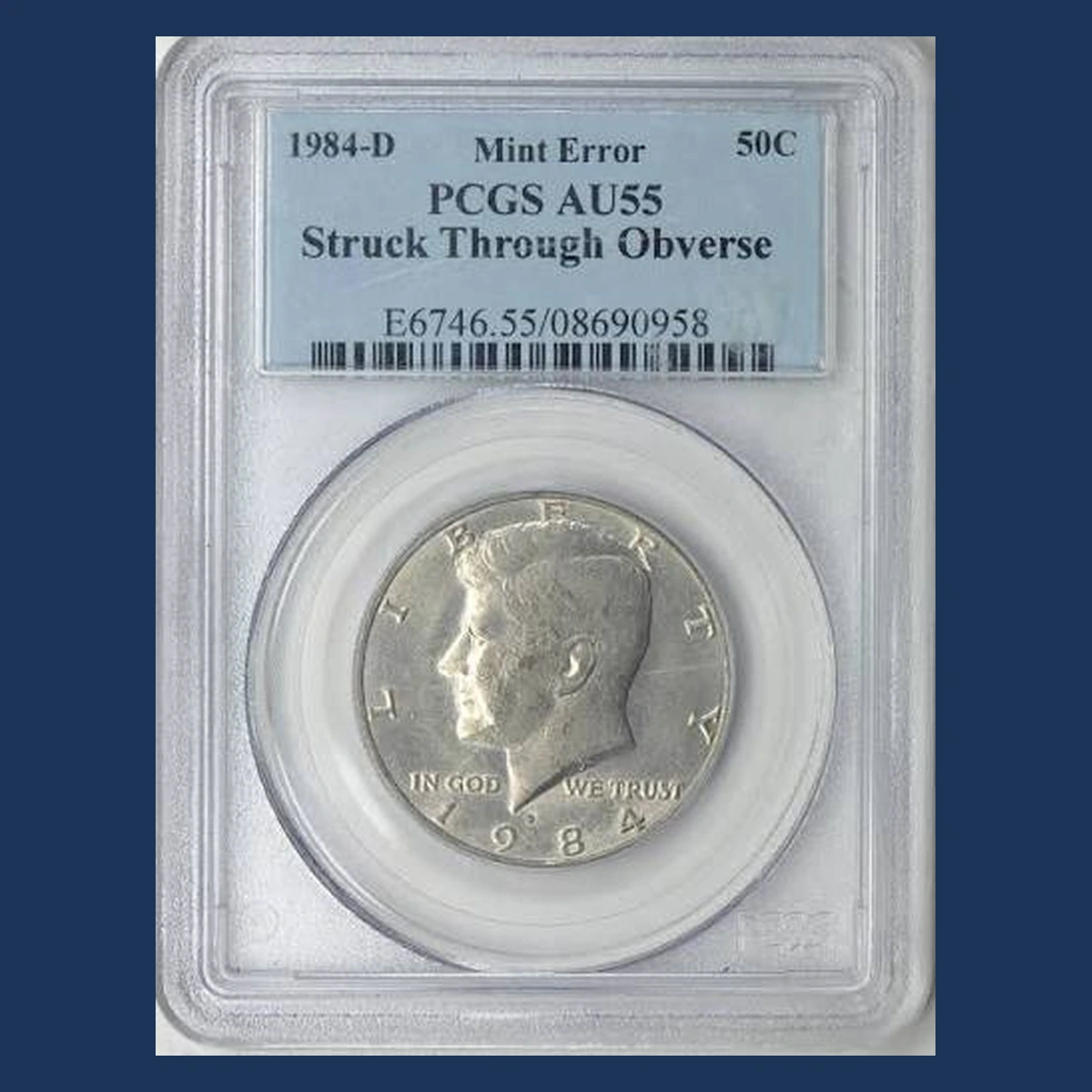
Part of the front design was interrupted on a 1984-D half listed by GreatCollections. PCGS graded it AU55, meaning a coin with only light wear.
The recorded error is a strike-through. Material between the stamping tool and the coin prevented normal contact in one area.
The text gives no exact location or shape, and does not name the trapped material. Grease, wire, cloth, or a retained object should not be assumed.
The actual boundary needs comparison with normal detail. Wear and later dents can also change the surface, but have a different cause from an obstructed strike.
Estimated Value
Estimate $25–$500, from minor interruptions to clear, visually prominent impressions. The listing identifies the 1984-D example, but its starting bid is not a realized sale price.
A 1988-D front strike-through graded NGC MS67 sold for $59 in July 2021. A 1976-D struck through material on both sides brought $114 in March 2025.
These are different-year comparisons. Their condition and affected areas must not be copied onto the lightly worn 1984-D coin.
How to Identify
Find the affected patch on the actual front before naming any trapped material. Use a magnifier to inspect how sharp nearby detail meets the interruption.
Check whether a later impact crushed existing design or pushed up a damage lip. Photograph both complete faces as well as the patch.
Inspect the edge grooves and nearby flat areas for alteration. On a loose ordinary coin, compare a scale reading with 11.34 g and calipers with 30.61 mm.
Leave any material in place, since cleaning could destroy useful evidence. Start with the patch’s boundary: original design interrupted during striking should look different from metal torn or pushed aside afterward.
8. 1984 Kennedy Half Dollar Misaligned Die Clash Error (Estimated Up to $650)
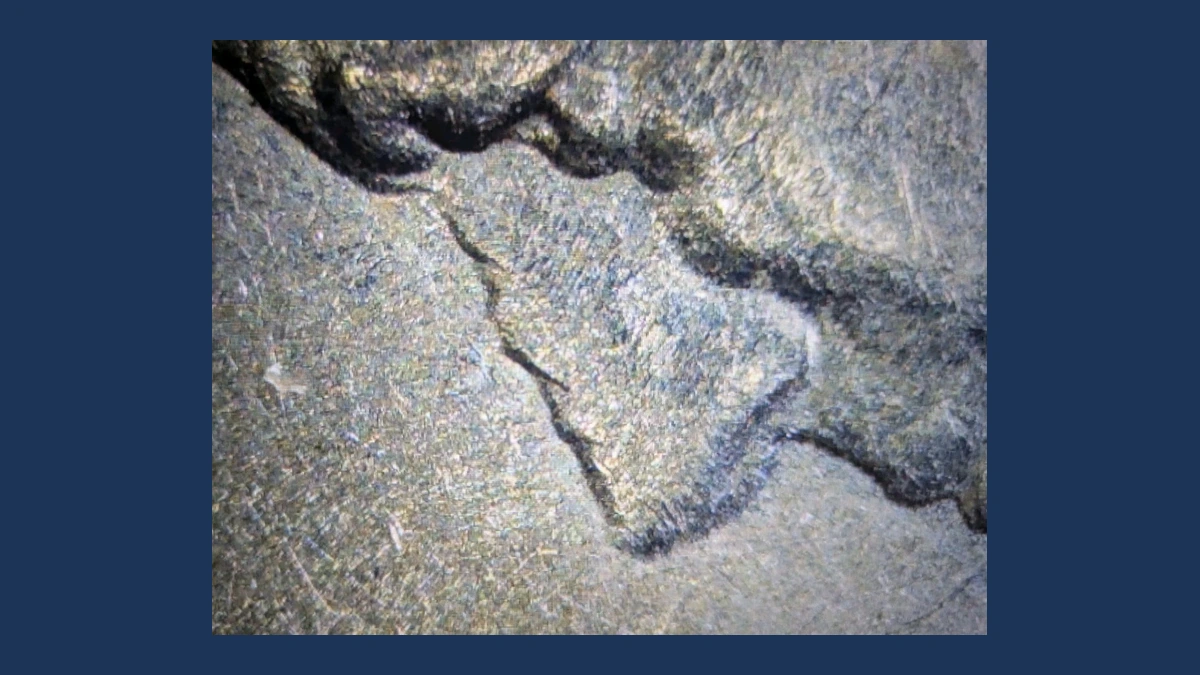
Extra lines in front of and behind Kennedy’s head form part of this cataloged 1984-P clash. Part of a facial outline also appears on the back.
A clash occurs when stamping tools meet without a metal disc between them. Their contact leaves unwanted marks that later appear on coins.
The catalog calls this example ADC-50c-1984P-01. Some traces fit a more centered contact, while others suggest shifting, turning, and tilting.
Those visible relationships can be compared with photographs. The exact order of contacts and suggested later polishing remain explanations of the evidence, rather than witnessed events.
Estimated Value
A clearly matching complex clash has an estimated value of $50–$650. Several readable transferred shapes can attract more interest than faint or worn lines.
A strong-clash 1973-S proof sold for $720 in October 2022. PCGS graded it PR68 Deep Cameo, indicating excellent preservation and contrast between frosted detail and reflective surfaces.
That different-year collector proof has a different finish and market. It offers context for strong clashes without giving an ordinary 1984-P the same premium automatically.
How to Identify
Compare the marks in front of Kennedy’s face, behind his head, and on the back as separate areas. Keep their positions visible rather than making them into one supposed outline.
Use a magnifier and photographs aligned at the same size to compare each trace with the opposite design. Scratches or polishing lines need another explanation.
Check the grooved edge for damage and use a scale against 11.34 g and calipers against 30.61 mm. Those measurements do not prove a sequence of clashes.
Record what you can see before ordering the events. First match the front and back trace positions to the catalog photographs, without assuming every proposed step occurred.
9. 1984 Kennedy Half Dollar Off-Center Strike Error (Estimated Up to $800)
A 1984-P auction record identifies a half struck off center and graded ANACS MS63. That means an unworn coin with noticeable marks.
Its description gives no percentage or direction for the displacement. A general guide’s illustrative percentage must not be assigned to this coin.
An off-center strike starts with the disc partly outside the stamping tools. It receives an incomplete picture beside an area of untouched metal.
Both faces help reveal the shift. A readable date and mintmark keep the coin’s identity clear when other lettering has been lost.
Estimated Value
The indexed Heritage record gives $45 in July 2006 for the 1984-P ANACS MS63 off-center coin. The estimated range is $50–$800 for present comparisons.
A dramatic example with a readable date and attractive surfaces can support more interest. A 1990-P struck ten percent off center sold for $198 in September 2025.
NGC graded that different-year coin MS66. Its percentage and better-preserved grade do not describe the 1984 example.
How to Identify
Compare both faces for an untouched crescent and matching missing outer design. One face with an uneven border while the other is complete may indicate a shifted stamping tool instead.
Use a magnifier to read 1984 and P on the same coin. Inspect the transition from plain metal to struck detail for grinding or cutting.
Weigh a loose example against the ordinary 11.34 g and measure its outline with calipers against 30.61 mm. Record any spreading caused by the strike.
Check remaining edge grooves before estimating a percentage from a straight-on photograph. First confirm the same displacement on both sides beside genuine untouched metal.
10. 1984 Kennedy Half Dollar Rotated Dies Errors (Estimated Up to $1,000)
A tilted eagle after a controlled flip can indicate a rotated stamping tool. The reported 1984 cases include Denver at 180 degrees and San Francisco proofs at 90 degrees clockwise or 180 degrees.
These specialist-table reports still await confirmation. They do not establish completed sales or fully checked specimens.
A proof is a specially made collector coin. Its finish does not by itself prove unusual alignment.
The angle concerns the final relationship between the two sides. It differs from the separate proof error with two overlapping front pictures, made when the tool moved between strikes.
Estimated Value
Estimate $40–$300 for a confirmed ordinary-coin rotation and $150–$1,000 for a substantial proof rotation. Angle, finish, and preservation affect the price.
A 2000-P rotated seventy-five degrees clockwise sold for $79 in March 2025. Two 1988-P examples with matching upright-side alignment brought $288 together in July 2021.
Those are different-year comparisons for ordinary coins. The paired sale is not a per-coin price, and neither result confirms one of the reported 1984 angles.
How to Identify
Hold Kennedy upright and turn the coin top to bottom without twisting sideways. Normally, the eagle should finish upright.
A 180-degree change leaves it upside down, while ninety degrees leaves it sideways. Repeat the flip and record the mintmark and finish for the example being tested.
Use a magnifier on the edge grooves to look for seams or machining. All normal 1984 halves, including S proofs, use layered metal and weigh 11.34 g.
Check that weight with a scale and about 30.61 mm with calipers. The quickest test is repeated controlled flips showing the eagle at the same wrong angle, rather than independently turned photographs.
11. 1984 Kennedy Half Dollar Wrong Quarter Blank Error (Estimated Up to $1,800)
The half-dollar picture does not fit the smaller disc on this 1984-P error. NGC graded the coin MS63 and its recorded weight is 5.6 grams.
The disc was intended for a quarter and was described as damaged before the strike. That differs from an already minted quarter carrying Washington’s picture.
No older quarter design is described beneath Kennedy. MS63 means unworn with noticeable marks.
Matching descriptions appear in 2022 and 2025 sales. Without matching coin identities, those appearances do not prove whether the same piece returned to auction or two separate examples were sold.
Estimated Value
The damaged-quarter-blank description appears at $690 in January 2022 and $720 in March 2025. Both records describe an NGC MS63 coin.
An estimated $500–$1,800 allows for differences in readable design, remaining date, and original blank condition. The two records are not automatically counted as two known specimens.
Damage already present on the disc must be considered separately from later damage to the finished coin. Both can influence what a buyer pays.
How to Identify
Use a scale to compare with the reported 5.6 g. A normal quarter disc weighs 5.67 g, far below a half dollar’s 11.34 g.
Calipers can compare the smaller outline with a quarter’s 24.26 mm and a half’s 30.61 mm, allowing for spreading. Use a magnifier where the oversized picture ends at the edge.
Inspect the edge layers and grooves for trimming or grinding. Also compare the original disc damage with the design stamped over it.
Look for any surviving earlier design before claiming the disc was a finished quarter. Start with near-quarter weight and original half-dollar detail ending naturally at the smaller boundary, rather than a filed-down edge.
12. 1984 Kennedy Half Dollar Proof Double Strike with Die Rotation (Estimated Up to $10,000)
Two greatly separated front pictures appear on this unusual 1984-S proof. The front stamping tool turned almost ninety degrees counterclockwise between blows, while the back tool stayed in place.
Proofs normally receive repeated blows, but those impressions line up. This tool movement made the collector coin an error.
The original retaining ring kept the coin in place during the strikes. The result differs from a coin with one picture on each side simply facing the wrong direction.
A loose front tool is a proposed explanation. The visible evidence is the overlapping fronts and unchanged back alignment.
Estimated Value
The PCGS PR62 example sold for $5,462.50 on January 6, 2007. PR62 describes a proof with noticeable surface marks.
An estimated $3,500–$10,000 reflects the dramatic movement and that historical sale. The amount belongs to this overlapping proof error.
It does not price an ordinary 1984-S or a separate report of final side-to-side rotation. Condition still matters, but the unusually clear movement attracts interest beyond the numerical grade alone.
How to Identify
Trace both front pictures with a magnifier and compare their almost quarter-circle separation. Then inspect the back to see that its design did not rotate in the same way.
Confirm S and the specially made proof finish. Ordinary repeated proof blows remain aligned and cannot explain this arrangement.
The normal 1984 host uses layered copper-nickel metal. Check a loose coin near 11.34 g on a scale and 30.61 mm with calipers, and inspect its edge grooves.
Keep both faces in complete photographs and look for later manipulation. Start with two separated front pictures paired with one aligned back; that comparison reveals movement between the proof strikes most directly.
Conclusion
Estimated values for these 1984 errors range from $20 to $10,000. The strongest comparisons match the exact feature, finish, and condition.
A turned proof tool between strikes differs from two sides ending at the wrong angle. Likewise, an extra D stroke, a rim cud, and a smaller quarter blank each need their own checks.
Preserve both faces and the edge in photographs, then compare the actual coin before applying a sale price.