1973 Half Dollar Error List with Pictures

A 1973-S half dollar with a small copper disc embedded in its front sold for $16,200 in May 2025. It is a Proof, a specially made collector coin.
The 1973 half dollar errors below have estimated values of $25–$25,000, from modest features to exceptional coins struck on the wrong metal disc. Read on to compare extra outlines, missing pieces, shifted designs, and material trapped during striking.
1. 1973-D Kennedy Half Dollar Double Clip (Estimated Up to $300)
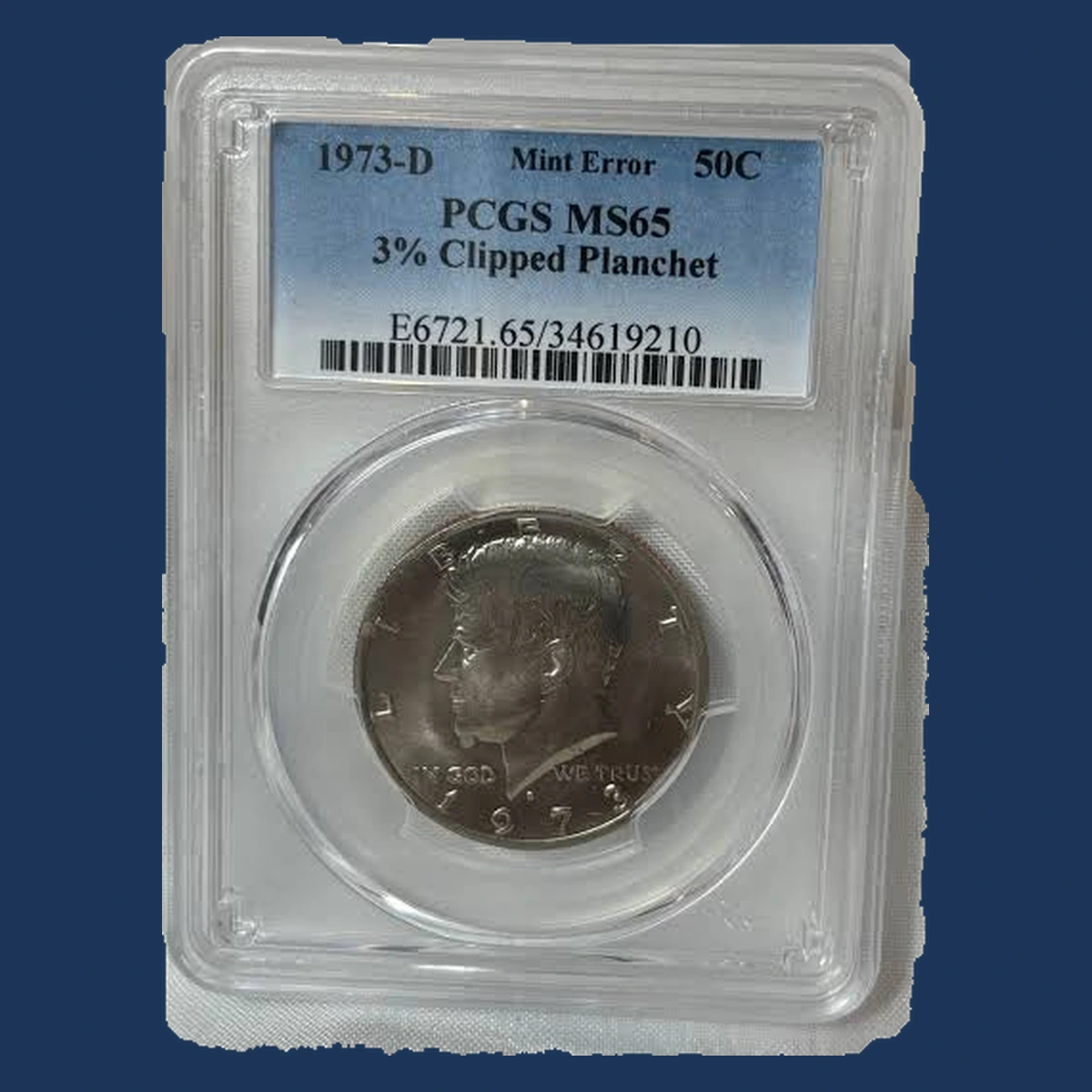
Two curved gaps interrupt the outline of the reported 1973-D double clip. A seller lists an example graded ICG MS62, indicating an unworn coin with noticeable marks.
The blank, or metal disc, was incomplete before the design was struck. A cutting punch can overlap areas where earlier discs have already been removed.
The resulting missing arcs remain through the later minting steps. Their nearby rims may form differently under pressure.
Check each gap separately. Damage to a genuine clipped coin can add a false second notch, and the report gives no exact positions or percentages.
Estimated Value
A confirmed double clip with a readable date has an estimated value of $50–$300. The ICG MS62 listing provides a reported example, not an auction price used here.
A different 1998-D triple clip graded PCGS MS63 sold for $99 in March 2025. That coin has three gaps and a later date.
Its result helps compare modest clip values without directly pricing the 1973-D. More gaps do not automatically make a coin a major rarity.
How to Identify
Weigh the coin against the normal 11.34 grams before inspecting the gaps. Both missing areas should help explain the lower weight.
Use calipers to record the surviving shape against the usual 30.6-millimeter diameter. Then inspect each gap separately through a 10× magnifier.
Compare its surface with nearby design and edge grooves. Smooth cutting marks or sharp pushed-up lips suggest later damage.
A weak rim opposite a gap can support a genuine clip, though it is not a guarantee. Photograph both boundaries separately.
Both missing edges need natural striking at their boundaries; one genuine gap does not authenticate the second notch beside it.
2. 1973-D Kennedy Half Dollar Doubled Die Obverse (Estimated Up to $500)
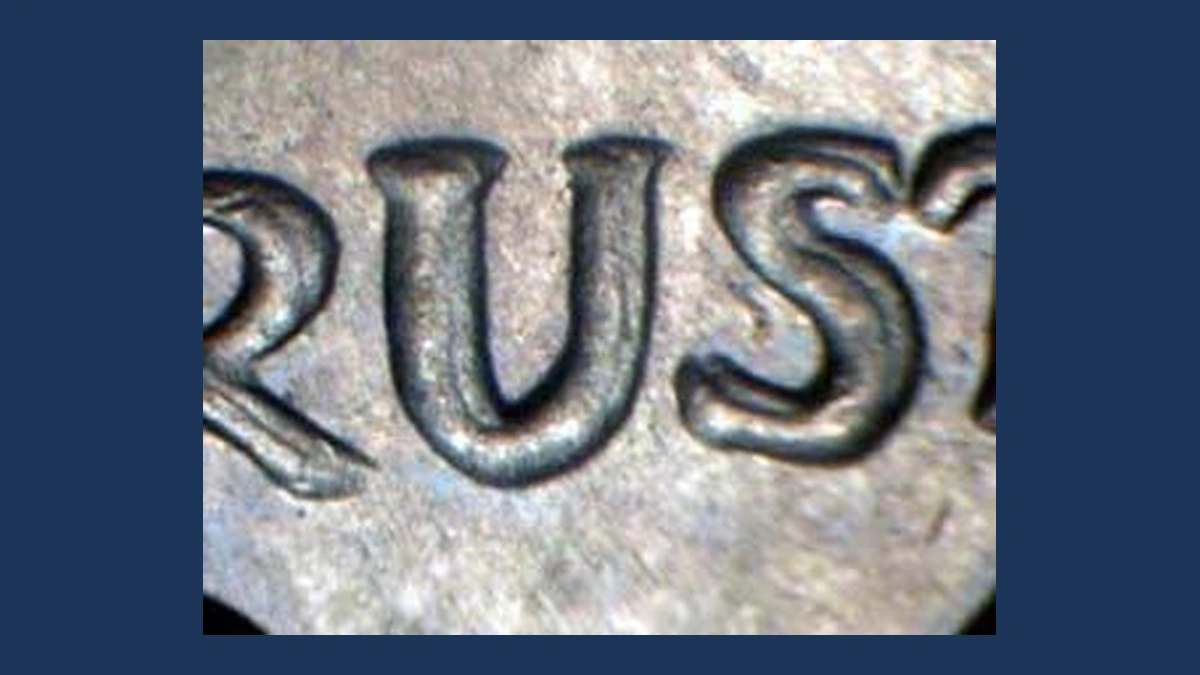
Extra rounded outlines and split letter corners identify the 1973-D FS-101 front-doubling variety. Useful areas include LIBERTY, IN GOD WE TRUST, and the date.
The steel stamping tool carried the repeated detail before it made the coin. Collectors call that tool a doubled die.
A listed ANACS AU58 example also has clash marks from the two tools hitting each other. Those marks are separate from the lettering’s doubling.
Look for the correct repeated pattern. A low, flat shelf beside one letter can come from movement during striking and does not establish FS-101.
Estimated Value
PCGS records $167 for an AU55 FS-101 in January 2020. That lightly worn coin helps support an estimated $75–$500 range for collectible, confirmed examples.
Clear extra outlines and better condition can support higher prices. The separate ANACS AU58 with clash marks provides identification evidence, not another sale price used here.
Its clash does not add a fixed amount to every FS-101. Examine each coin’s surfaces and actual features.
How to Identify
Find the D below Kennedy’s neck and compare the date, motto, and LIBERTY with confirmed FS-101 pictures. A 10× magnifier helps reveal small split corners.
Tilt the light: glare can create an outline that disappears, while true extra detail remains. A flat shelf that cuts into the main letter is a different striking effect.
For an unsealed coin, use a scale against 11.34 grams and calipers against roughly 30.6 millimeters. Inspect the edge grooves for damage.
Those normal measurements do not identify the doubled variety. Matching extra outlines across several FS-101 letters or date digits identify the variety more securely than one thick-looking letter.
3. 1973 Kennedy Half Dollar Die Clash, Including S Proof (Estimated Up to $1,000)
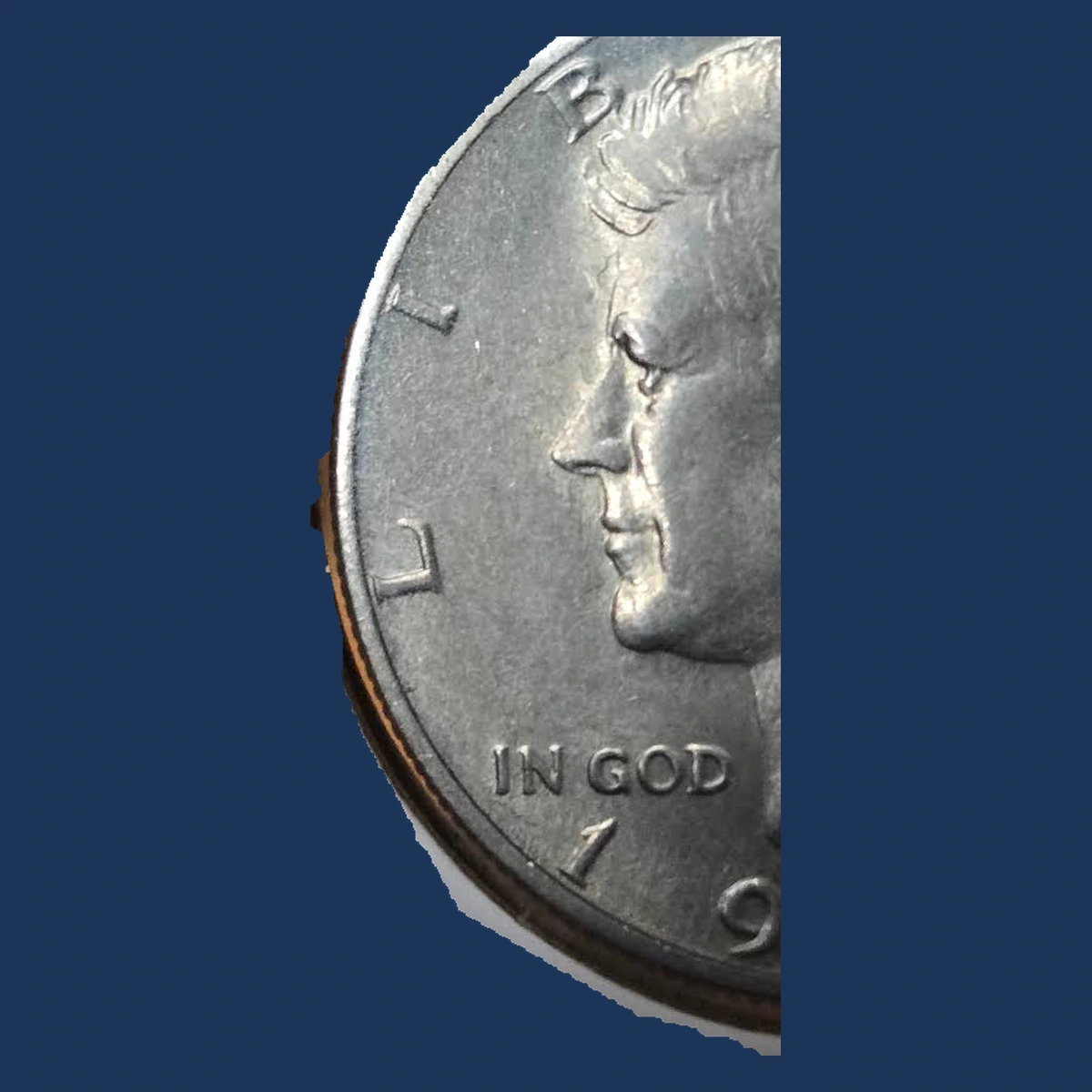
Faint pieces of the eagle design can appear around Kennedy after the stamping tools collide without a disc between them. Later coins receive traces left on the damaged tools.
This is a die clash. The extra shapes need not form a complete second design.
Examples exist on 1973-S Proofs, and a listed 1973-D FS-101 also carries a clash description. Their marks must be checked on their own coins.
A Denver coin should not inherit the Proof’s exact pattern by assumption. The useful clue is a shape that matches part of the opposite design in the correct position.
Estimated Value
Two PCGS PR68 Deep Cameo Proofs with strong clashes sold for $660 and $720 in October 2022. Comparable Proofs have an estimated value of $200–$1,000.
Deep Cameo describes strong contrast between frosted designs and mirrorlike backgrounds. Condition and clarity of the transferred marks affect value.
For ordinary strikes, estimate $25–$150 for the clash contribution before separately assessing any doubled variety. The Proof prices do not automatically apply to the Denver AU58 combination.
How to Identify
Put correctly oriented pictures of the front and back beside each other. Find whether an extra shape matches a recognizable part of the opposite design.
Use a 10× magnifier to check its height. A mirror image pressed below the surface can come from contact with another finished coin instead.
Normal 1973 ordinary coins and Proofs are clad, with outer copper-nickel layers bonded around a copper center. They normally weigh 11.34 grams and measure roughly 30.6 millimeters, with edge grooves.
Use a scale and calipers on an unsealed example. Match the stray shape to its opposite-side source and confirm that it remains visible under changing light.
4. 1973-S Kennedy Half Dollar Rotated Dies (Estimated Up to $2,000)
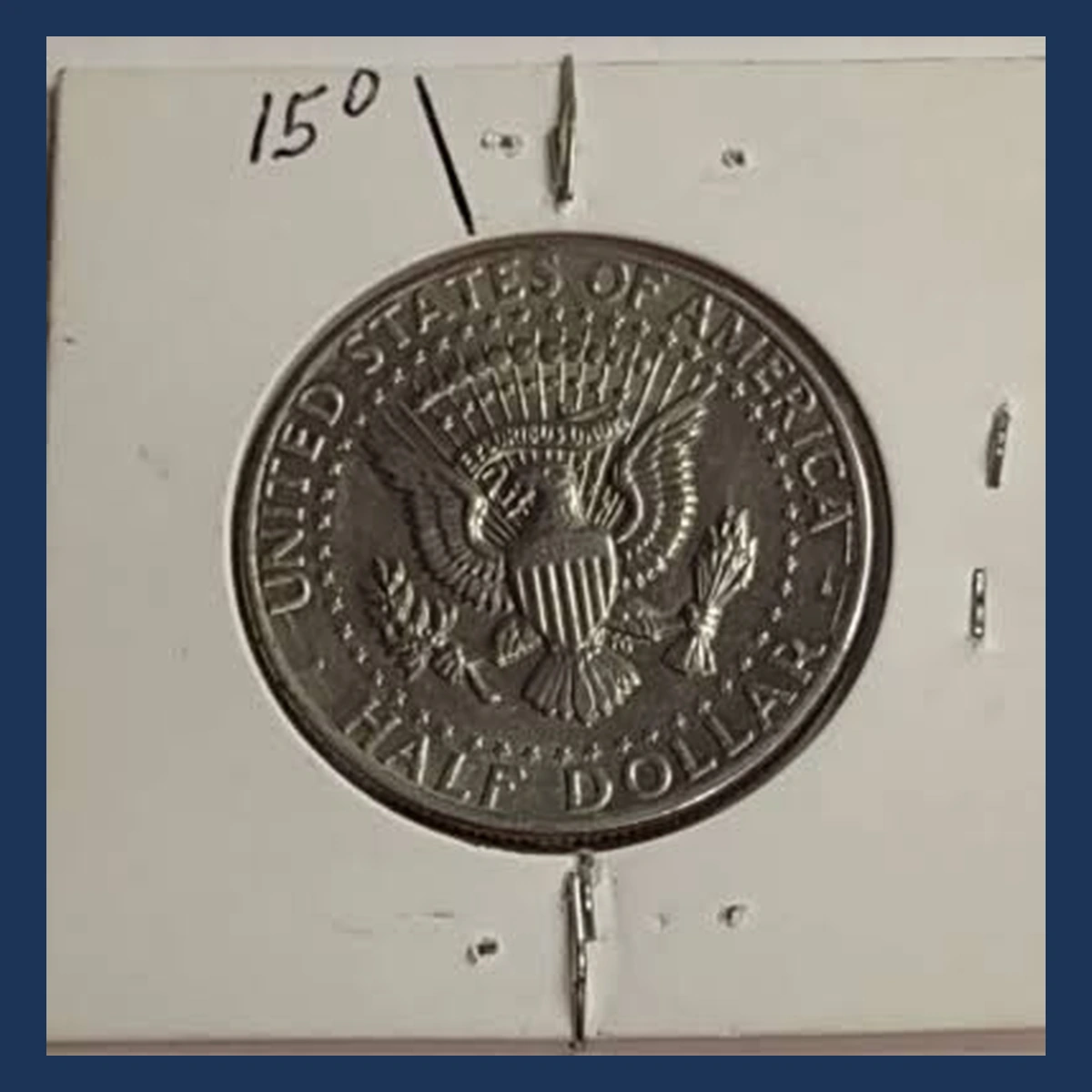
The eagle sits at an unusual angle relative to Kennedy on the cataloged 1973-S rotated Proof. It was graded NGC PR67 Cameo.
Cameo describes contrast between frosted design details and reflective backgrounds. The rotation concerns the direction of the two faces, not doubled details within either design.
Normally, flipping upright Kennedy straight from top to bottom leaves an upright eagle. A repeatable tilt shows that the tools were angled differently.
The auction does not give a measured angle for this coin. A half-turn or other specific amount should not be added to its description.
Estimated Value
The NGC PR67 Cameo rotated Proof sold for $1,560 in July 2021. Confirmed Proof examples have an estimated value of $300–$2,000.
The measured tilt, original surfaces, and appearance affect the comparison. A slight angle does not automatically justify a four-figure price.
Small rotations and a complete half-turn are different degrees of the same problem. The recorded sale proves the example’s market result but cannot supply an angle that its description does not state.
How to Identify
Hold Kennedy upright and flip the coin straight from top to bottom without adding a twist. Judge the eagle by its shield and surrounding letters.
Repeat against a fixed upright line, then measure any consistent tilt. The coin’s angle inside a plastic holder alone does not establish the relationship.
Use a 10× magnifier to inspect edge grooves and look for overlapping older details. A shift between successive blows is different from rotation between the two complete faces.
For an unsealed clad Proof, compare a scale and calipers with 11.34 grams and roughly 30.6 millimeters. A consistent eagle tilt after each controlled flip establishes the two faces’ unusual alignment.
5. 1973-S Kennedy Half Dollar Off-Center Strike (Estimated Up to $2,500)
A crescent of blank metal remains beside the design on the recorded ten-percent-off-center 1973-S Proof. The metal disc sat partly outside the correct position when struck.
Heritage lists it as PCGS PR66 Deep Cameo. Its shiny backgrounds and frosted details can make the boundary of the strike easy to see.
Part of each design falls beyond the available metal. The two faces should therefore be examined together.
A shifted second impression on a double-struck coin is a different event. The earlier blow may already have covered the area that looks blank in a single-strike error.
Estimated Value
A confirmed 1973-S Proof with clear displacement and a readable date has an estimated value of $1,000–$2,500. The cataloged ten-percent PR66 Deep Cameo establishes the relevant example.
A different PR66 Cameo, struck twice with its second blow 25 percent off center, sold for $2,880 in March 2023. That additional strike makes it more complex.
Its price is a comparison above the estimate, not the sale result for the ten-percent single strike.
How to Identify
Start at the untouched crescent and inspect it with a 10× magnifier. Follow where the design ends on both faces and check that the blank surface was not scraped.
Compare the interrupted designs: an uneven border on just one side may come from a shifted tool. Read the surviving date and S together.
A scale should be compared with 11.34 grams, since missing design does not necessarily mean missing metal. Use calipers to record the outline against roughly 30.6 millimeters and inspect surviving edge grooves.
Matching design loss on both faces beside original blank metal establishes off-centering; a complete design surrounded by extra width does not.
6. 1973-S Kennedy Half Dollar Rim Cud (Estimated Up to $3,000)
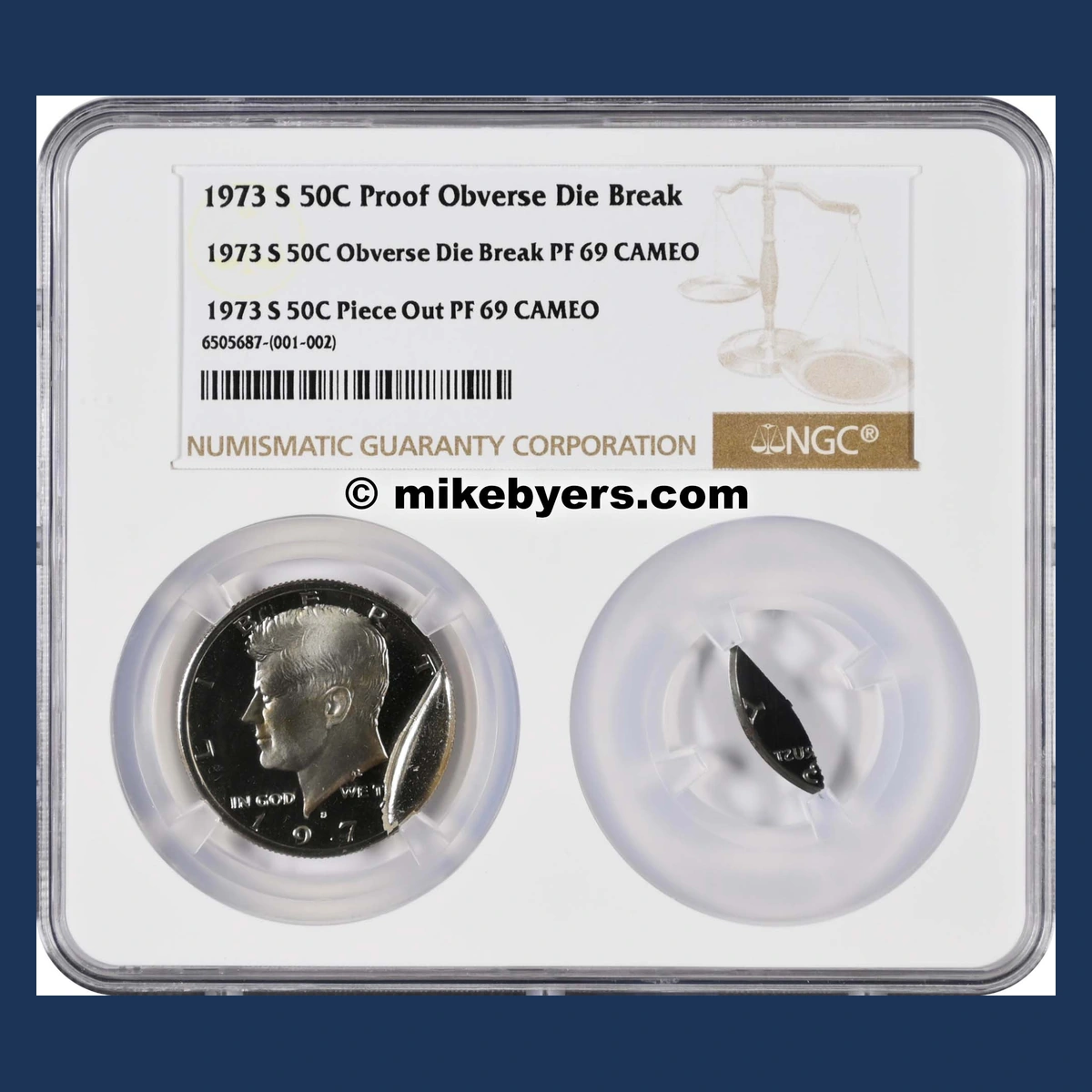
A large raised lump covers the Y in LIBERTY and much of the final 3 on one 1973-S Proof. It reaches the right rim from about two-thirty to five o’clock.
Part of the steel stamping tool broke away, allowing metal to fill the empty space. Collectors call this rim-connected lump a cud.
The NGC PR67 Cameo also has weak, unstruck-looking detail opposite the lump on the back. Lost support on the front helps explain that weakness.
This is larger than a thin crack or small internal chip. An intact tool would have formed the now-missing details.
Estimated Value
The NGC PR67 Cameo sold for $2,040 in March 2022. Comparable Proofs with this substantial rim break have an estimated value of $1,000–$3,000.
The size of the affected area and condition of the remaining mirrored surfaces matter. The recorded coin also shows matching weakness on the back.
A minor raised line or small chip belongs in another price range. The broad phrase die break in an advertisement does not make every example comparable.
How to Identify
Locate the Y in LIBERTY and final 3 before examining the raised area. A 10× magnifier should show how the lump joins the right rim.
Turn the coin over and compare the weak region directly opposite. That pairing is more useful than one picture of a lump.
Side lighting can expose an added-metal seam, crushed rim, or later impact. Do not scrape the surface to test it.
Use a scale and calipers on an unsealed coin against 11.34 grams and about 30.6 millimeters. Inspect the surviving edge grooves.
The rim lump over Y and 3 should pair with the corresponding weak back-side area on this documented example.
7. 1973-S Kennedy Half Dollar Broadstrike (Estimated Up to $4,000)
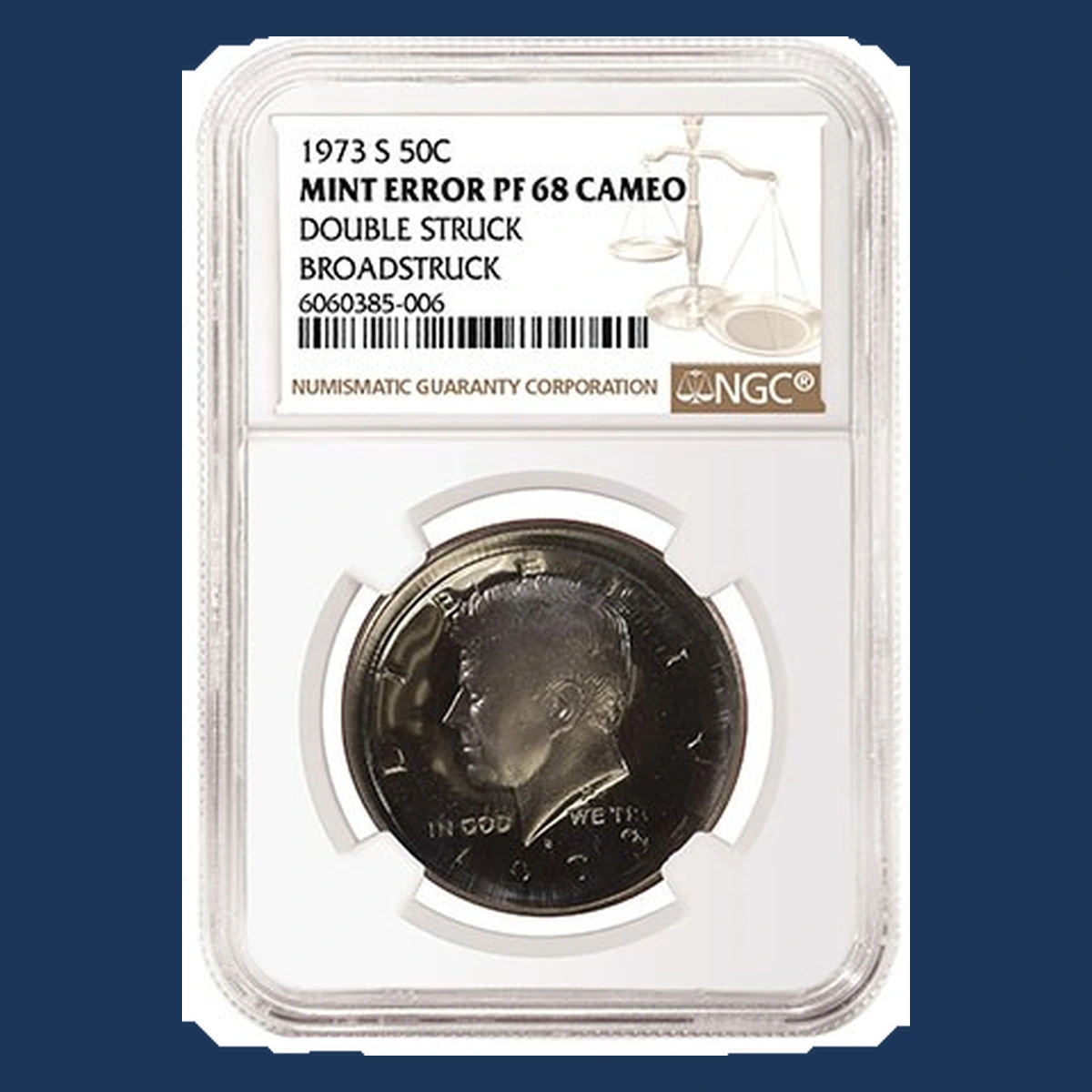
The illustrated 1973-S Proof is wider than normal, with its complete design still present. Metal spread outward when the collar, the ring that limits coin width, failed to restrain it.
NGC graded the coin PF68 Cameo and also notes a second impression. Slight overlapping details show that another blow accompanied the expansion.
Those features can occur together, but they explain different things. The width concerns restraint around the disc; the repeated details concern another strike.
Both faces need a complete design for a broadstrike. Design running off the metal instead points to an off-center component.
Estimated Value
A 1973-S PR68 Cameo combining a broadstrike and double strike sold for $2,400 in August 2021. Similar Proof combinations have an estimated value of $1,200–$4,000.
The price covers the expanded coin and its second impression together. It cannot be divided into independent prices for each feature.
Simpler expansion and dramatic combined errors may attract different bids. Similar numerical grades do not make their visible striking histories or market values identical.
How to Identify
Measure the width in several directions with calipers, comparing it with the usual 30.6 millimeters. A scale checks whether the coin retains its normal 11.34 grams of metal.
Now account for every part of both complete face designs. Extra width can surround a complete design; it need not mean anything was cut off.
A 10× magnifier shows overlapping details on the NGC illustrated Proof. Inspect the edge grooves as well, since an earlier blow may leave grooves before a later blow allows expansion.
Complete designs on naturally expanded metal support broadstriking; crushed designs and pressure marks instead suggest later flattening.
8. 1973-S Kennedy Half Dollar Double and Multiple Strikes (Estimated Up to $6,000)
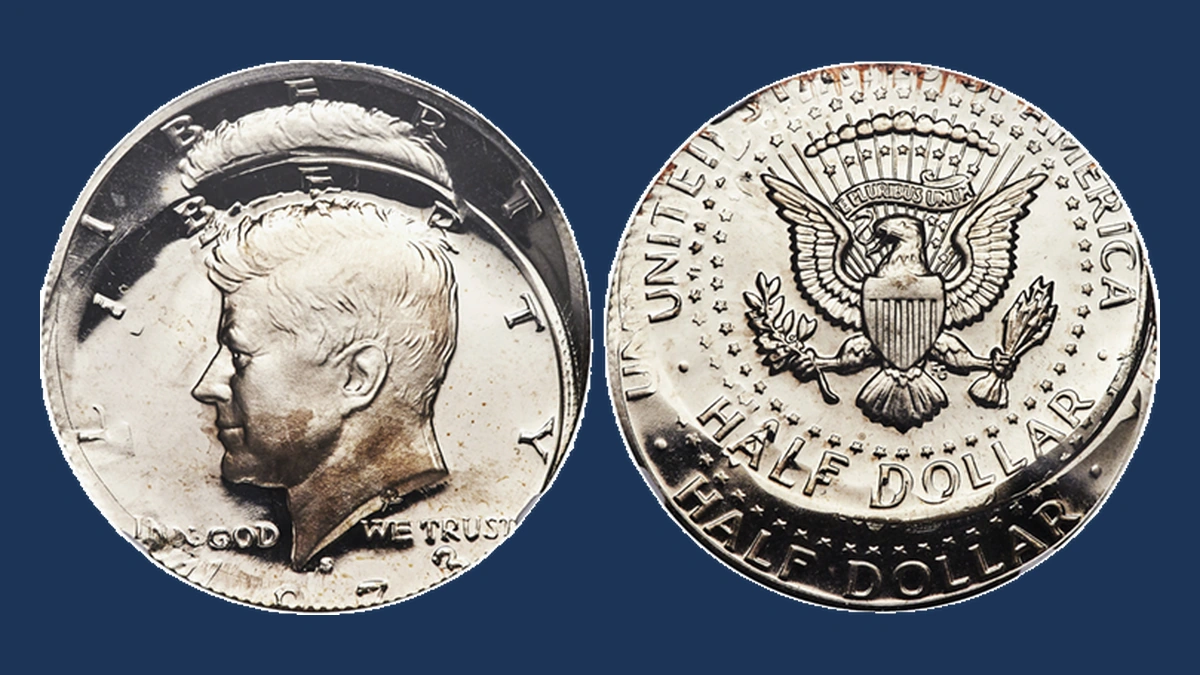
Two or more shifted designs can overlap on a multiple-struck Proof. The PR66 Cameo example’s second impression sits 25 percent off center toward nine-thirty.
A separate PR64 Cameo has three visible impressions on each face. Its date and S survive in the final strike.
Other examples include a flip between blows, rotation, and five impressions. These involve movement, unlike the aligned repeated blows normally used to make Proofs.
The crossings show the order. A later design can flatten earlier details, while flipping can put parts of Liberty and the eagle on the same side.
Estimated Value
The shifted second-strike PR66 Cameo sold for $2,880 in March 2023. The triple-struck PR64 Cameo brought $4,680 in April 2020.
These results support an estimated $2,000–$6,000 range for the Proof combinations discussed. More impressions do not multiply the price automatically.
Readable overlapping designs, a surviving date, and attractive surfaces matter. The reported five-strike coin has no sale price assigned here merely because another multiple-struck Proof has a published result.
How to Identify
Follow one date or portrait through the overlapping designs with a 10× magnifier. Look for separate positions rather than assuming normal repeated Proof blows created an error.
Compare the crossings under different light directions. A turned second strike may leave earlier letters, while a flip can mix parts of opposite designs on one face.
Record weight with a scale against 11.34 grams and shape with calipers against roughly 30.6 millimeters. Inspect the edge grooves for contact during the different blows.
The decisive visible evidence is separate raised impressions whose intersections show the later strike flattening earlier detail, with natural metal flow around the crossings.
9. 1973 Kennedy Half Dollar Reported 40%-Silver Planchet (Estimated Up to $6,000)
An earlier 40-percent-silver disc could look nearly the same size as a normal 1973 half. A value guide discusses that possibility without identifying a certified 1973 example.
Normal 1973 halves, including San Francisco Proofs, have bonded copper-nickel outer layers around a copper center. This layered metal is called clad.
Silver Eisenhower dollars from the period do not establish a silver half-dollar issue. They are different coins.
The proposed error therefore depends on identifying the actual alloy and layers. A pale edge or a slightly unusual weight does not show that an old silver disc entered the half-dollar press.
Estimated Value
A professionally confirmed 1973 on an older 40-percent-silver disc has a conditional estimate of $1,500–$6,000. This is not a sale result for an identified 1973 silver example.
A different 1973-S Proof on a Philippine twenty-five-sentimos disc sold for $2,640 in August 2020. It was graded NGC PR67.
That recorded wrong-material error helps compare the market. Its price and certification do not establish the guide’s claim about an older silver disc.
How to Identify
Calibrate the scale before judging a reading near 11.50 grams. That is close to the normal clad weight of 11.34 grams and cannot prove silver by itself.
Use a 10× magnifier to inspect surfaces for plating. Non-destructive metal testing needs to be interpreted with the coin’s layered construction.
Calipers should show roughly 30.6 millimeters for either proposed half-dollar disc. Both normally have edge grooves, so a pale grooved edge does not settle the alloy.
Keep the actual mint and finish attached to the examination. A genuine 1973 strike must match original silver-clad construction and professional material testing before the silver-disc claim is established.
10. 1973 Kennedy Half Dollar Struck Over a Quarter (Estimated Up to $7,000)
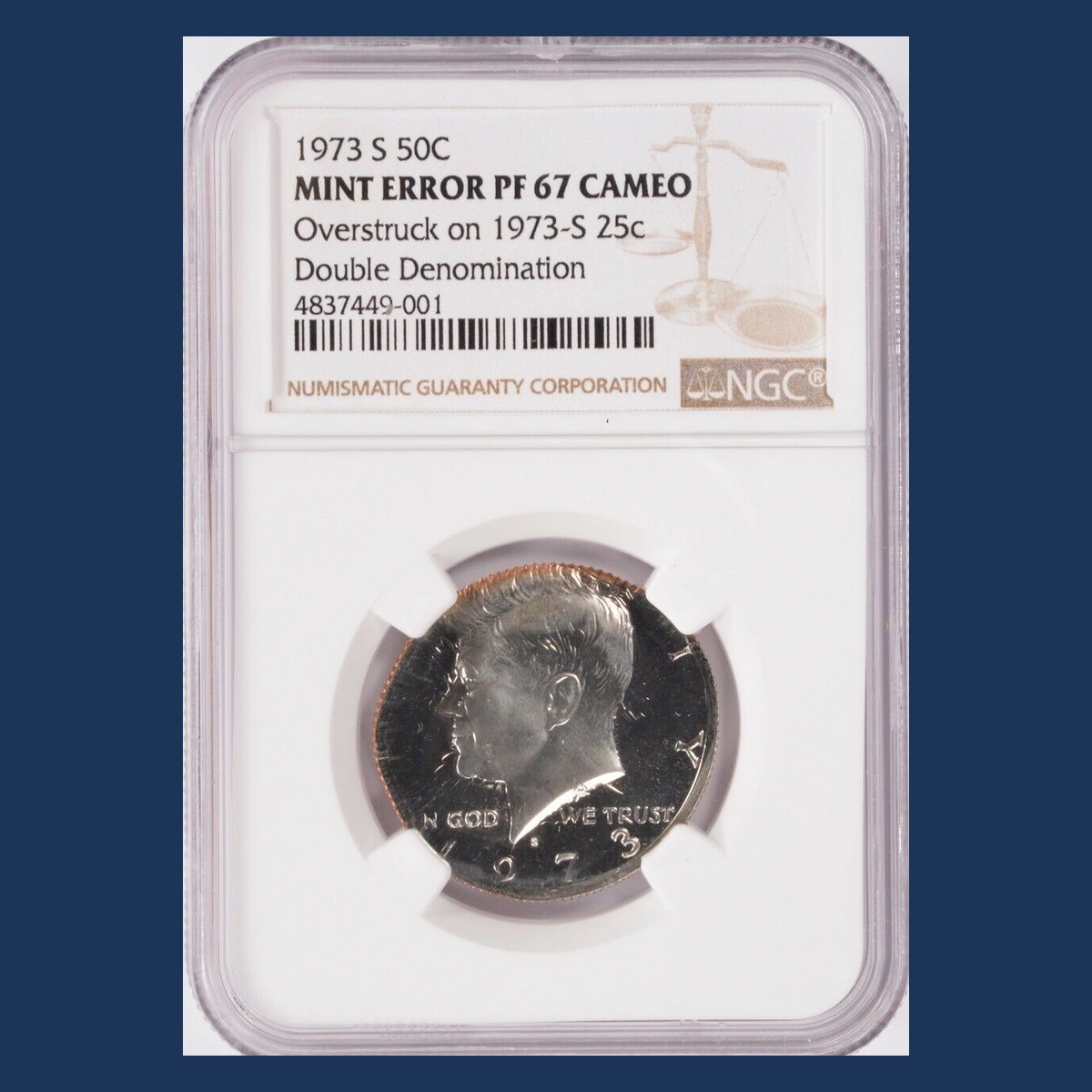
Earlier quarter details can remain under Kennedy’s design when a finished quarter enters the half-dollar press. This is called a double denomination because two different coin designs were struck on the same piece.
One 1973-S PR67 Cameo preserves parts of the quarter’s date and S near the new design. A separate PR68 Cameo lost the visible quarter design but retained earlier edge grooves.
Those grooves helped support its identification. A plain quarter-sized disc is a different case.
A 1973-D over a 1972-D quarter is also reported. Each example needs evidence of the earlier finished coin.
Estimated Value
The NGC PR68 Cameo double-denomination Proof sold for $4,560 in May 2023. Comparable confirmed Proofs have an estimated value of $3,000–$7,000.
The separate PR67 Cameo offered in April 2021 did not sell. Its description provides identification details, not a completed transaction.
Ordinary Denver strikes need their own condition comparison. The Proof range does not automatically price every Kennedy struck over a quarter, especially when the earlier coin’s evidence differs.
How to Identify
On the PR67 Cameo, look for the quarter’s surviving 973 near the half-dollar’s 73. Its earlier S lies near the Y in LIBERTY.
Use a 10× magnifier to trace those older details. The separate PR68 relies instead on its surviving earlier edge grooves and certified identification.
A normal quarter starts near 5.67 grams and 24.3 millimeters, versus 11.34 grams and 30.6 millimeters for a half. Record the changed shape with calipers and the retained weight with a scale.
Earlier struck letters or other convincing quarter features distinguish a finished coin under the Kennedy design from a half struck on an unmarked quarter disc.
11. 1973-S Kennedy Half Dollar with a Retained Copper Planchet (Estimated Up to $20,000)
A small copper disc is embedded in the front of this 1973-S Proof. It is additional material, not the disc from which the whole half dollar was made.
The reported 1.6 grams refers to that small copper piece. Its weight does not identify it as a standard United States cent disc.
NGC graded the complete coin PF67, and its back appears normal. The joined boundary shows where the two pieces were pressed together.
Dealer Mike Byers describes deliberate placement before striking. That account is separate from the visible evidence distinguishing the assembly from a glued-on decoration.
Estimated Value
The complete Proof realized $16,200 at Heritage in May 2025. An earlier appearance brought $10,800 in December 2022.
Those recorded results support an estimated $10,000–$20,000 range for the exceptional retained assembly. The appraisal concerns the whole coin with its embedded copper disc.
It does not price a loose 1.6-gram copper piece or an ordinary half with a copper-colored stain. The surviving joined structure is essential to the comparison.
How to Identify
Leave the copper attached. Prying it away would destroy the boundary that explains how the pieces were joined.
Use a 10× magnifier and side lighting around the junction. Look for struck detail and metal flow across it rather than glue, solder, or a later attachment.
The normal half-dollar disc weighs 11.34 grams and measures roughly 30.6 millimeters, with edge grooves. The copper piece’s reported 1.6 grams is additional material, not the entire object’s weight.
Use a scale and gentle caliper measurements only when safely accessible. A joined boundary matching the certified PF67, with both metals shaped by the strike, supports the retained-disc identification.
12. 1973 Kennedy Half Dollar on a Wrong-Denomination Planchet (Estimated Up to $25,000)
A half-dollar design can land on a disc meant for a smaller or larger denomination. The wrong metal and size change how the finished 1973 coin looks.
Proof examples use quarter, five-cent, and Philippine twenty-five-sentimos discs. A 1973-D MS61 is identified as struck on a Taiwan one-yuan disc.
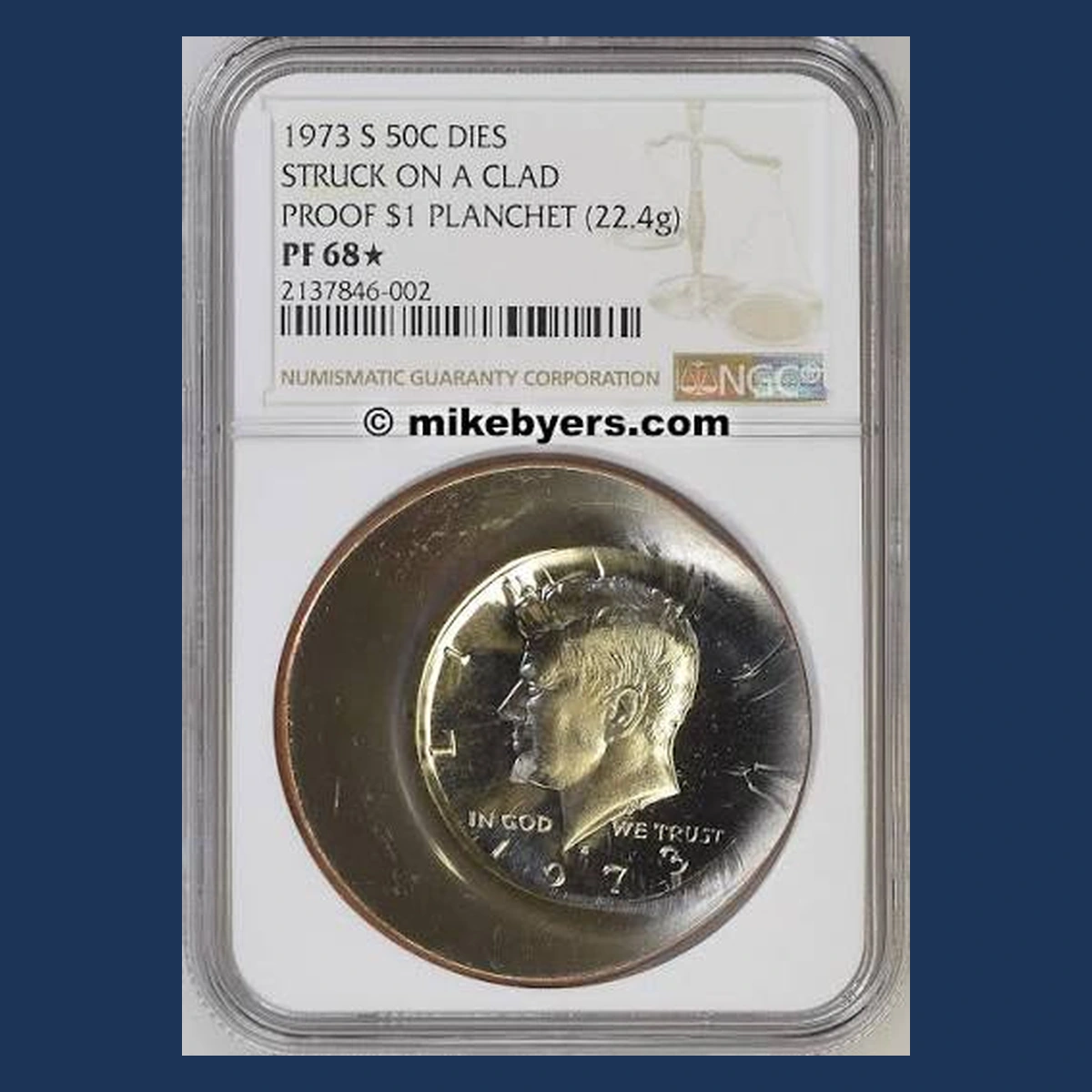
The PF68 Star clad-dollar-disc Proof is much larger and cup-shaped. Its dealer describes deliberate production.
The cup shape alone does not show that it stuck to a stamping tool. Each piece needs its own disc identification rather than a guess based on being too small or large.
Estimated Value
Estimated values span $600–$25,000, with the unusual oversized dollar-disc piece at the upper estimate. Recorded results include $690 for the Taiwan MS61 in January 2008 and $2,640 for the Philippine PR67 in August 2020.
A quarter-disc PR67 Cameo sold for $2,880 in August 2021. These are different coins.
The dollar-disc listing says sold without giving a price. The $25,000 upper figure is an estimate, not that coin’s disclosed sale amount.
How to Identify
Record weight and size with a scale and calipers before naming the disc. Normal halves start at 11.34 grams and roughly 30.6 millimeters, with edge grooves.
Quarter discs start near 5.67 grams and 24.3 millimeters; nickel discs near 5 grams and 21.2 millimeters. A nickel disc initially has a plain edge.
The reported Taiwan piece weighs 6.1 grams, the Philippine piece 4 grams, and the dollar piece 22.4 grams. Striking can enlarge the outline.
Inspect original edges with a 10× magnifier for trimming or an added ring. Matching the metal, weight, and struck shape to the specific certified disc provides the useful identification.
Conclusion
The estimated $25–$25,000 range covers modest 1973 features and exceptional wrong-disc Proofs. Identify what entered the press: a normal blank, another denomination’s disc, a finished quarter, or two pieces together.
Then match condition, finish, measurements, and the visible design sequence to the right example. A doubled letter, shifted strike, and retained copper piece have different causes, so their prices should not be transferred simply because all are called errors.