1982 Half Dollar Error List with Pictures

Two missing designer’s initials helped identify an exceptional 1982-P half dollar that sold for $2,820 in 2016. Most examples of the No FG variety cost much less.
These 1982 half dollar errors have ordinary estimated ranges beginning at $20, with the exceptional sale reaching $2,820. Other clues include a missing edge, an expanded outline, and wire trapped during striking.
Read on to compare each feature with the normal design and the right kind of price.
1. 1982 Kennedy Half Dollar Clipped Planchet (Estimated Up to $100)
A clipped half starts as a metal blank with a piece already missing. A punch can overlap an earlier hole in the strip or reach beyond its edge.
The resulting gap may be curved or straight. The incomplete blank can still enter the press and receive the coin design.
The year guide reports Philadelphia and Denver examples. A recorded Denver coin has a 15% curved clip and an NGC MS64 grade, meaning no circulation wear and few marks.
Cutting a finished coin can imitate the outline. Its boundary, however, will not show the same way metal flowed during the strike.
Estimated Value
Estimate $20–$100 for ordinary genuine clipped examples. Larger, clearly original gaps generally fall toward the upper end of this modest range.
A 1982-D with a 15% curved clip, graded NGC MS64, sold for $94 in March 2018. It gives a historical comparison for a fairly large clip.
The guide’s $20–$75 range covers typical pieces, not every possible size. Surviving design quality and absence of later damage still affect the complete coin’s value.
How to Identify
Examine where the original faces meet the missing section with a 10× magnifier. Saw marks, filed surfaces, or pushed-up burrs suggest a cut made after striking.
Look across the coin for a weak section of rim opposite the gap. This can support a genuine clip, but it is not equally strong on every example.
A scale can compare the coin with the normal 11.34 g; a substantial missing section should reduce weight. Calipers across an intact span can be compared with 30.61 mm.
Inspect remaining edge grooves and photograph both faces. The best starting combination is a natural clip boundary, consistent metal loss, and rim formation that fits a blank already missing that section.
2. 1982 Kennedy Half Dollar Doubled Die Reverse (Estimated Up to $150)
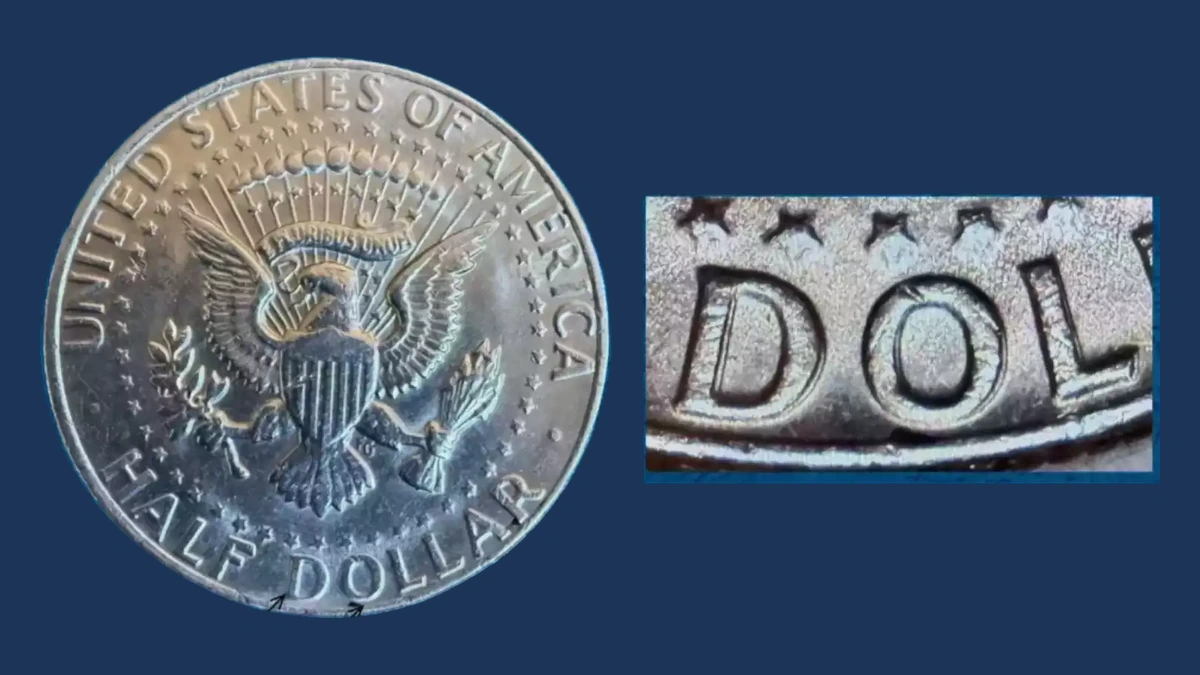
Extra outlines in UNITED STATES OF AMERICA, HALF DOLLAR, or eagle details are the places suggested by the year guide. Its report concerns ordinary Philadelphia and Denver strikes.
A doubled die is a stamping tool with a repeated part of its design. It can copy the same close double outline onto many coins.
The finished coins do not need two strikes to receive it. Matching shapes on the correct variety are therefore important.
Movement during striking can also flatten a letter edge into a shelf. Worn tools may make letters broad without creating a genuine second design outline.
Estimated Value
Use an estimated $20–$150 for genuine examples with clearly matched back doubling. This follows the year guide’s range, not a specific certified auction result.
The higher portion assumes stronger, easily photographed separation on a well-preserved coin. A faint or heavily worn feature makes a weaker comparison.
Thick letters, flat shelves, or an unrelated mark on the front do not qualify for the same price. The mint and the actual repeated back pattern need to agree.
How to Identify
Use a 10× magnifier on several back letters, then compare the relevant eagle details with the same known variety. Do not combine unrelated marks into one supposed pattern.
The extra outlines should have matching shapes and spacing. A flat shelf or general thickening around a letter can have a different cause.
Photograph P or D and 1982 on the front. A scale and calipers should be compared with 11.34 g and 30.61 mm for a loose example.
These coins have bonded metal layers around a copper core, often visible along the grooved edge. The direct check is the same rounded extra contours in the same back details as the matching variety.
3. 1982 Kennedy Half Dollar Broadstrike (Estimated Up to $200)
A broadstrike spreads wider while keeping the complete design. The collar, a metal ring around the blank, failed to hold the metal to its normal width.
The stamping tools still impressed the faces, but silver-colored metal flowed farther outward. The collar normally also makes the grooves around the edge.
Philadelphia and Denver broadstrikes are reported in the 1982 guide. Their altered rims may lack normal grooves or show unusual edge formation.
A wide-looking border on one face alone does not establish the error. The actual outline must expand, and the relationship between complete design and edge must support that explanation.
Estimated Value
The guide supports an estimated $50–$200 for 1982 broadstrikes. This is a range based on appearance and condition, not a stated sale for one authenticated specimen.
Clear expansion, a full date, and appealing surfaces favor the stronger end. Slight spread, numerous contact marks, or later edge damage make a weaker example.
A very high numerical grade needs its own market comparison. It does not automatically produce another large premium simply because the coin is also broadstruck.
How to Identify
Trace the complete designs on both faces before judging how wide the border looks. A shifted impression on one side can create an uneven rim without expanding the blank.
Use calipers along several directions against the normal 30.61 mm diameter. A scale should be compared with 11.34 g, since spreading metal does not remove it.
Under a 10× magnifier, inspect the transition into the wider rim and the missing or abnormal edge grooves. Later hammering can flatten grooves, but commonly leaves impact marks and crushed detail.
For a sealed coin, use existing measurements and clear edge views. The clear combination is complete design, actual extra width, and edge formation consistent with missing ring support.
4. 1982-P Kennedy Half Dollar Struck Through Foreign Material (Estimated Up to $250)
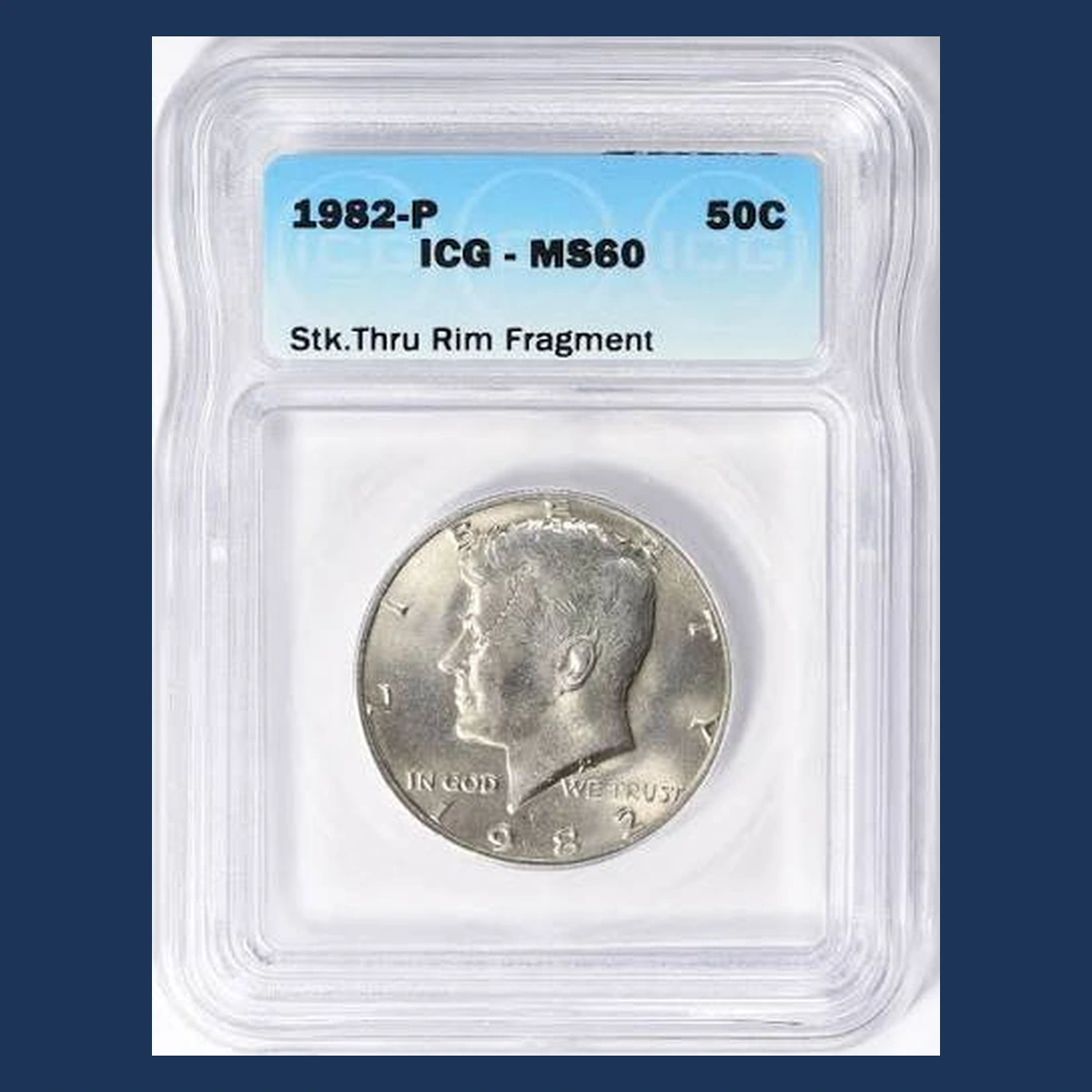
A rim fragment or wire can block part of a strike. One 1982-P listing describes a coin struck through a rim fragment; another records wire still attached.
The fragment example is ICG MS60, while the wire coin is ANACS MS64. Both grades indicate no circulation wear, with more marks allowed at MS60.
The wire coin also lacks the FG initials, a separate feature of its back stamping tool. The trapped wire concerns the striking step.
An object may fall away after leaving a hollow or remain embedded. Its edges and contact with nearby design help explain what happened.
Estimated Value
Heritage’s No FG example with retained wire sold for $132 in December 2020. It was one coin with two features, not two separate prices to add.
Estimate $100–$250 for comparable recognizable strike-throughs. The object’s shape, clear impression, and the coin’s condition affect value.
The separate rim-fragment listing documents another example but supplies no price used here. It should not inherit the wire coin’s result simply because both involve trapped material.
How to Identify
Choose the right comparison: an angular fragment impression and attached wire need different close views. The rim-fragment listing supplies one specific example.
Use a 10× magnifier along the hollow’s boundary and interrupted design. Where material remains, inspect how struck metal meets it without trying to remove the object.
A scale and calipers can compare the coin with 11.34 g and 30.61 mm, allowing for any attached material’s weight. Inspect the bonded-layer edge and remaining grooves for alteration.
Later contact marks or glued objects do not show the same relationship. Begin with an impression or attached object that interrupts the original struck design and is fitted into its surrounding metal.
5. 1982 Kennedy Half Dollar Off-Center Strike (Estimated Up to $350)
An off-center strike places part of the intended design beyond the metal. Opposite that missing detail, a crescent of the blank remains untouched.
The blank sat too far to one side between the stamping tools. Both faces should reflect the same misplaced strike.
The 1982 guide reports Philadelphia and Denver examples with different amounts of shift. A readable date can preserve the year even when part of Kennedy or the eagle is missing.
A small hollow caused by a trapped fragment is different. It blocks a local area without necessarily moving the whole design relative to the coin’s outline.
Estimated Value
Estimate $20–$50 for mild, clearly identified examples and $100–$350 for more dramatic pieces with visible dates. These follow the year guide’s comparisons, not a particular certified 1982 auction sale.
A larger shift is not the only factor. The readable year, an attractive blank crescent, and undamaged remaining design all help.
An extreme example with its date missing may be less useful to a year collector. Compare condition and surviving details together with the amount of displacement.
How to Identify
Photograph both sides without cropping the outline. Find design cut off at one side and original blank metal opposite it, then compare the back.
A shift on only one face may indicate a moved stamping tool. A complete design inside a wider outline instead suggests a broadstrike.
Use a 10× magnifier where the design meets untouched metal. Weigh a loose coin against 11.34 g on a scale, and record its outline with calipers against the normal 30.61 mm.
Inspect both grooved and unstruck edge areas for damage. The essential combination is original blank crescents with corresponding design loss on both faces and a readable 1982 date.
6. 1982-P Kennedy Half Dollar No FG (Auction Record $2,820)
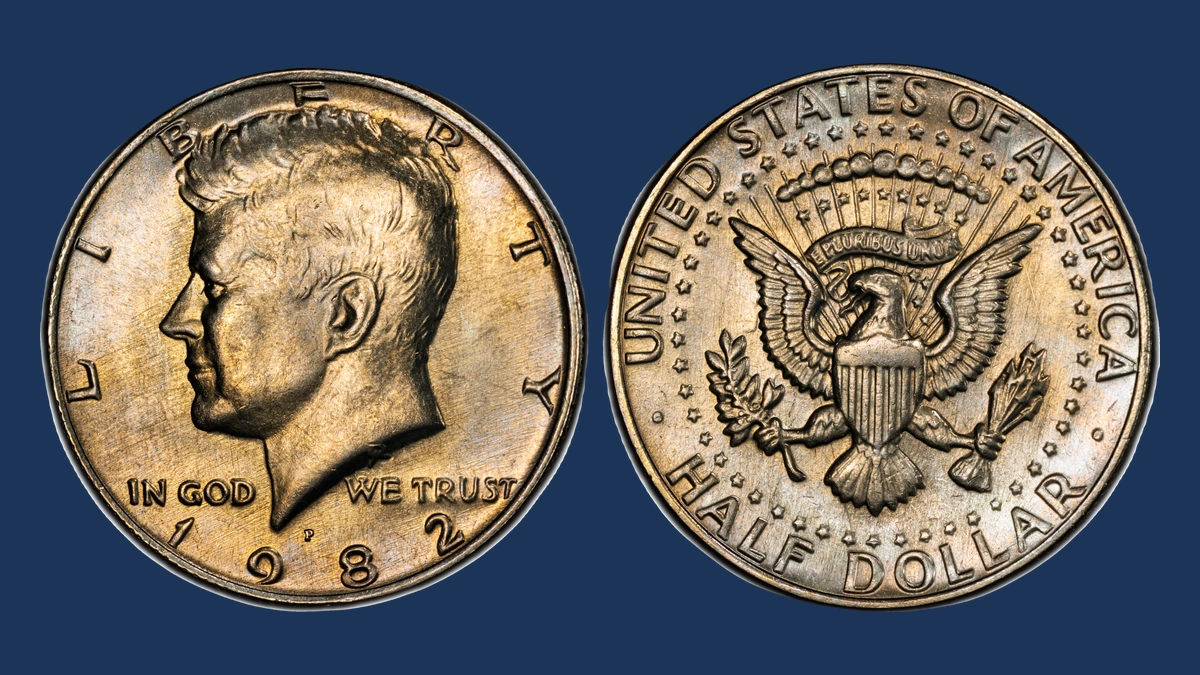
Frank Gasparro’s tiny FG initials normally sit near the eagle’s leg and tail feathers. On the recognized 1982-P No FG variety, both letters are absent.
Polishing removed the detail from the back stamping tool. Coins made with it therefore never received the initials.
This is a bonded-layer Kennedy half with a copper core and copper-nickel outer surfaces. Missing FG does not change its metal or mean a mint letter is missing.
Weak initials are different. Any surviving part of F or G fails the complete-absence test, while wear, residue, or scraping can also make the area difficult to read.
Estimated Value
Estimate $20–$150 for ordinary matching examples from circulated through more accessible unworn grades. NGC MS66 No FG coins sold for $84 in early 2022.
MS66 means no circulation wear and few marks. Those sales show how far typical prices can sit below the MS67 record of $2,820 in 2016.
The record belongs to an outstanding certified coin. It is not the automatic value of any Philadelphia half whose small initials are hard to see.
How to Identify
Look below the eagle’s leg on your right, above and beside the tail feathers. Compare that small area with a normal back using a magnifier of at least 5×.
Neither F nor G should leave an outline. Move the light to check for residue, scratches, or deliberate removal, and compare wear on the neighboring feathers.
Confirm P and the complete 1982 date on the front. Calipers and a scale should match about 30.61 mm and 11.34 g for a normal loose coin.
The edge should show the usual bonded layers and grooves. The immediate test is complete absence of both initials in an undamaged area, matching the recognized Philadelphia variety.
Conclusion
Ordinary estimates here begin at $20, while the exceptional No FG sale reached $2,820. Most matching No FG coins belong in the much lower $20–$150 range.
The edge helps separate missing metal, expanded metal, and displaced striking. For smaller details, compare the actual design carefully, and remember that the retained-wire No FG coin had one sale price for both features together.