1980 Half Dollar Error List with Pictures

One coin carries parts of a 1979-P Anthony dollar beneath a 1980-P half-dollar design. It sold for $22,325 in January 2016.
This 1980 Kennedy half dollar error list has estimated values from $5 to $30,000. Some coins used the wrong metal disc, while that expensive example began as an already finished dollar.
Read on to compare the surviving pictures, weights, and edge features that separate these mistakes.
1. 1980 Kennedy Half Dollar Filled P Mintmark Feature (Estimated Up to $75)
A P with a solid-looking center may have extra raised metal filling its opening. That can happen when a small piece breaks from the steel stamping tool.
The tool is called a die. Metal enters the damaged space during striking and fills the letter’s center on the coin.
A weak or partly missing P is a different appearance. Dirt, damage, and lighting can also hide the opening below Kennedy’s neck.
The year guide reports a filled P without establishing one numbered variety. Check what is actually raised or missing before deciding how the feature formed.
Estimated Value
A clearly mint-made filled center has an estimated value of $5–$75. Small ordinary examples belong nearer the bottom.
A much larger back die break on a 1976-D sold for $256 in June 2026. NGC graded that different-year coin MS65, meaning attractive and unworn.
That comparison shows the market for a more obvious tool failure. Its price should not be transferred directly to a tiny mintmark feature, especially one without a clear original surface.
How to Identify
Light the P from opposite sides and examine its center with a magnifier. Decide whether the center is raised, the letter is weak, or dirt blocks the opening.
Look for original struck texture across any raised area. Scraping, corrosion, or an attached substance can imitate a solid center without the same mint cause.
Inspect the edge grooves and check a loose coin with a scale against 11.34 g and calipers against 30.61 mm. These measurements identify the ordinary layered-metal coin, not the cause of the mark.
For the first useful distinction, look inside P: extra raised metal and missing letter detail need different explanations.
2. 1980 Kennedy Half Dollar Collar Clash Error (Estimated Up to $100)
A row of tooth-like marks along the face’s rim can show a collar clash. This differs from faint eagle or portrait outlines transferred between the two stamping tools.
The collar is the ring that surrounds a coin during striking and forms its edge grooves. Its ridges can hit and damage the rim area of a stamping tool.
Later coins receive that repeated pattern. Error-Ref shows it on a 1980-P from about seven to eleven o’clock.
The marks are on the face’s rim. A stepped edge from a partly seated coin is another kind of error.
Estimated Value
Estimate $10–$100 for collectible examples, depending on how clear and extensive the repeated marks are. A visible sequence is more useful than one ambiguous rim line.
A seller offers an ungraded 1983-P with misalignment and collar-clash claims for $9.50. The seller calls it AU55, or lightly worn.
That different-year asking price is neither a sale nor an independent grade. It supports a modest comparison for small collar marks, not a fixed 1980 value.
How to Identify
Compare the rim sector from seven to eleven o’clock with the pictured 1980-P example. Use a magnifier to follow the spacing of several marks.
Random nicks usually do not repeat like the ring’s regular ridges. Change the light so reflections do not create an apparent pattern.
Turn the coin sideways to inspect the edge grooves. A step along the edge is different from marks reproduced on the face’s rim.
Check a loose coin near 11.34 g with a scale and 30.61 mm with calipers. Start by matching several evenly spaced rim marks to the pictured sequence, rather than judging one tooth-like projection.
3. 1980 Kennedy Half Dollar Doubled Die Varieties (Estimated Up to $300)
The known Philadelphia front variety shows extra edges pointing inward on LIBERTY, especially T and Y. It is listed as DDO-001 and WDDO-001, two names for the same stamping tool.
A later stage also has a crack above T. Earlier coins need not show that crack.
The doubled design was already on the tool before it struck the coin. This differs from receiving a second strike.
Back doubling is separately reported without a specific matching variety established here. That claim cannot borrow the front variety’s number or assume the eagle side has the same pattern.
Estimated Value
A confirmed variety has an estimated value of $20–$300. The known Philadelphia front pattern provides the clearest identification, with sharp extra outlines and clean surfaces supporting stronger prices.
A 1974-D doubled die graded ANACS MS64 sold for $49 in May 2026. That is a different-year unworn coin with some marks.
The comparison supports a modest starting level. A broad back-doubling report alone does not establish an equally valuable recognized variety.
How to Identify
Keep LIBERTY upright and examine T and Y with a magnifier. Compare their inward extra edges with a confirmed DDO-001 photograph.
Look above T for the optional later crack, but do not reject an earlier example just because that line is absent. The repeated lettering is the main feature.
Check any proposed back doubling separately. A flat shelf or changing reflection does not replace a match to a real repeated design.
Use a scale and calipers for about 11.34 g and 30.61 mm, and inspect the edge grooves for alteration. Match the inward T and Y outlines first, keeping the P mintmark visible in the full-coin photograph.
4. 1980 Kennedy Half Dollar Cud and Rim Break Errors (Estimated Up to $450)
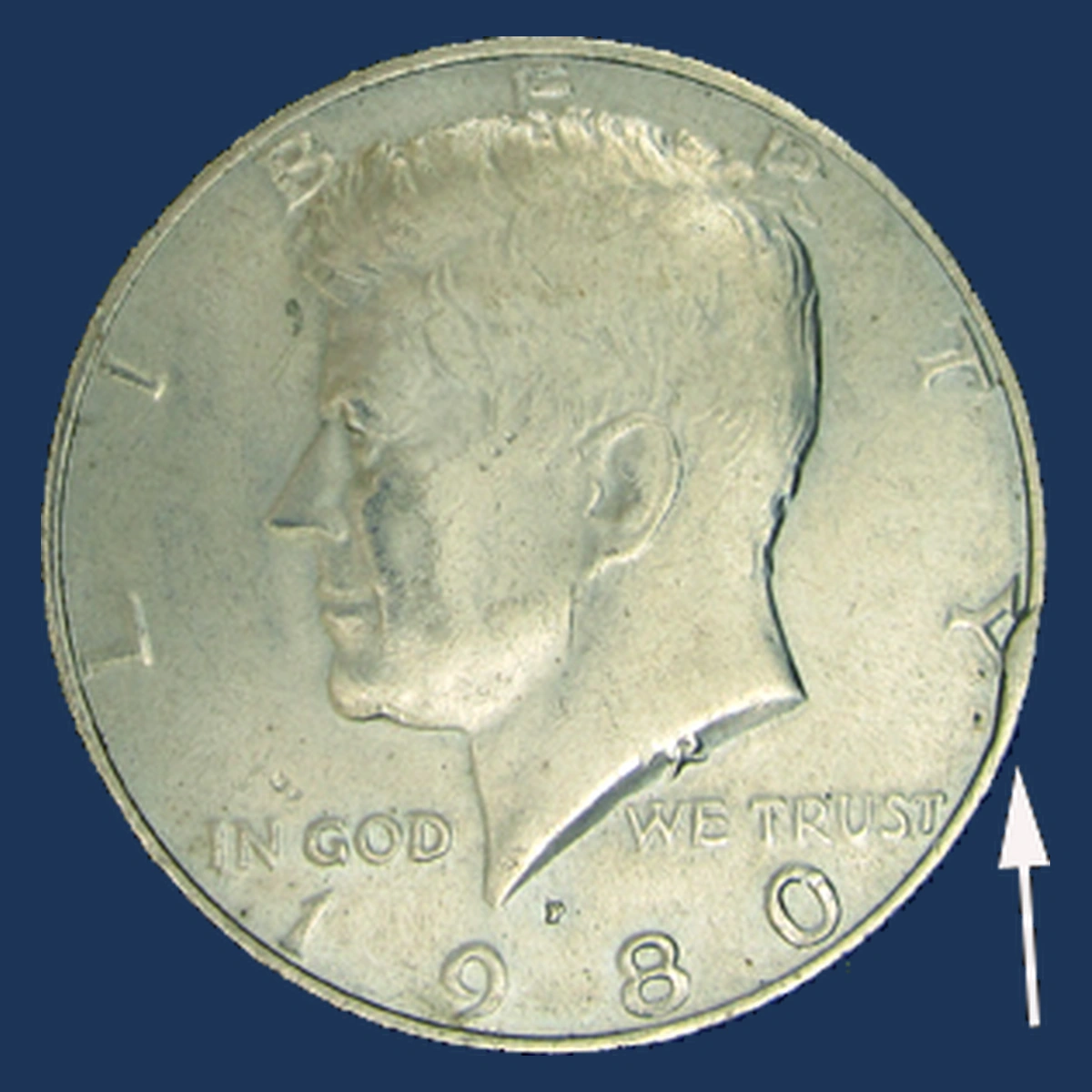
Raised metal touching the rim can record a broken edge on the steel stamping tool. Metal fills the unwanted opening instead of receiving the normal contour.
Cuds on Coins lists two Philadelphia and two Denver examples for 1980. Their catalog numbers end P-01, P-02, D-02, and D-03.
They show different examples of the same kind of tool failure. Each coin needs its own photograph and mintmark kept together.
A rim cud need not cover a huge part of the design. Its exact size, affected face, and position must be matched to the individual example.
Estimated Value
Confirmed examples have an estimated range of $20–$450. A small rim failure usually attracts less interest than a larger raised break interrupting the design.
A 1976-D with a back die break graded NGC MS65 sold for $256 in June 2026. That was an attractive unworn example from a different year.
It provides a comparison for larger tool failures. A catalog number alone does not give every 1980 coin the same size, condition, or price.
How to Identify
Choose the catalog photograph for the correct mintmark before comparing the raised outline. A Philadelphia example should not be matched to a Denver photograph simply because both touch the rim.
Use a magnifier at the edge connection. Look for original struck metal rather than solder, glue, or a fragment folded over by an impact.
Inspect the edge grooves for damage and compare the adjacent design. A nick removes or pushes existing metal, while the broken tool changes the shape formed during striking.
Check roughly 11.34 g with a scale and 30.61 mm with calipers. First match the precise raised rim outline on a coin from the same mint.
5. 1980 Kennedy Half Dollar Broadstrike Error (Estimated Up to $500)
Extra metal around a complete design can indicate a broadstrike. The coin spread because the retaining ring failed to hold it within its usual diameter.
The whole picture should still fit on the metal. A shifted strike that misses part of the design is different.
Broadstrikes are reported for 1980 without one particular graded coin or measured diameter established here. An unusual outline needs its own examination.
A smooth edge alone cannot establish the error. Grinding, wear, or pressure after minting can change a normal border without the original spreading of a genuine broadstrike.
Estimated Value
Estimate $80–$500 for modest through strongly spread examples with attractive original surfaces. Expansion and an undamaged outline both affect the price.
A 1990-P broadstrike graded ANACS MS61 sold for $192 in March 2025. A 1983-P graded NGC MS65 has a $175 dealer asking price.
Both grades describe unworn coins, with MS65 generally allowing fewer marks. These different-year figures provide a sale and an offer, not a recorded transaction for 1980.
How to Identify
Measure the outline in several directions with calipers against the usual 30.61 mm. Then weigh it against 11.34 g, since spreading should not itself remove metal.
Use a magnifier to follow the outer letters around both faces. The complete design should remain inside the expanded edge, even if it looks unevenly centered.
Inspect changes to the normal edge grooves and look for natural outward spreading. Crushed detail or scraped surfaces suggest later work.
Missing picture beside a plain crescent calls for an off-center check instead. Pair a complete original design with the widened edge first; those two features tell more than unusual diameter alone.
6. 1980 Kennedy Half Dollar Obverse Indent Error (Estimated Up to $600)
A smooth hollow interrupts the front design on the listed 1980-P example. Heritage offered the coin, graded ANACS MS60, in October 2022.
The error is called an indent. Another metal disc can overlap the coin during striking and block direct contact with part of the stamping tool.
That leaves a clearly outlined hollow instead of normal design. MS60 means unworn but with many noticeable marks.
The description gives no percentage or clock position. A hollow containing recognizable reversed lettering would be a different feature, called a brockage, made through contact with an already struck coin.
Estimated Value
The Heritage sale record reports $77 on October 10, 2022 for the ANACS MS60 example. The estimated range is $60–$600 for modest through stronger, attractive indentations.
A clear boundary and untouched surface can make an indent easier to appreciate. A shallow feature hidden among heavy marks generally attracts less interest.
The upper estimate allows for greater size and clarity. It is not an automatic multiplication of the recorded coin’s price simply because an error is present.
How to Identify
Place a magnifier over the boundary between the normal front design and the hollow. Look for an interrupted strike rather than a later hit that crushed a finished picture.
Search inside the recess for reversed letters or recognizable design. A plain indent should not be confused with a mirror-image brockage.
Check the edge grooves and nearby flat areas for impact marks. A scale near 11.34 g and calipers near 30.61 mm provide normal references, with local distortion considered separately.
Do not scrape the hollow. Start with a smooth bounded interruption of the design, then check that it lacks the reversed picture expected from a brockage.
7. 1980 Kennedy Half Dollar Off-Center Strike Error (Estimated Up to $800)
The reported 1980-P example is fifteen percent off center toward two o’clock. Its auction index description also notes spreading and calls it brilliant uncirculated, an unworn appearance rather than a numbered grade.
The disc sat partly outside the stamping tools. Only part of it received the picture, leaving plain metal beside incomplete outer details.
A readable date is essential for placing such a coin in 1980. An undated half cannot gain a year simply from a listing’s heading.
The direction and percentage belong to this reported example. Other coins may have different amounts or directions of movement.
Estimated Value
Estimate $75–$800 for off-center coins that can be identified by date. More dramatic movement and clean surviving detail can support the upper portion.
A 1990-P struck ten percent off center, graded NGC MS66, sold for $198 in September 2025. That was a well-preserved unworn coin.
The different-year sale gives a comparison for a moderate shift. Compare the reported fifteen-percent 1980 example with similar coins before applying the highest estimates.
How to Identify
Confirm 1980 and P on the coin itself with a magnifier. For the reported example, compare the picture’s movement with two o’clock, without applying that direction to every candidate.
Study both faces where stamped detail ends and plain metal begins. Their missing outer designs should fit the same shifted position.
Use a scale against 11.34 g and calipers against 30.61 mm to record any spreading. Inspect the remaining edge grooves and smooth areas for original texture rather than filing.
An uneven rim on one face can have another cause. Check first for matching displacement on both sides beside genuinely untouched metal.
8. 1980 Kennedy Half Dollar Wrong Planchet Stock Error (Estimated Up to $1,500)
This coin has a nearly normal half-dollar outline but thinner metal. Heritage identifies it as a 1980-P made from metal strip intended for Susan B. Anthony dollars.
The recorded weight is 168 grains, or about 10.89 grams. PCGS graded the coin MS63, meaning unworn with noticeable marks.
Its weight is roughly four percent below a normal half. That is a much smaller difference than using a complete 8.1-gram Anthony-dollar disc.
The mistake concerns the strip chosen before discs were cut. It is not the same as pressing a half-dollar design onto a smaller dollar-size blank.
Estimated Value
The wrong-stock example sold for $373.75 in June 2006. Estimate $350–$1,500 for confirmed examples with original surfaces and convincing measurements.
A separate 1980-P struck on a complete 8.1-gram Anthony-dollar blank brought about $1,281 in June 2026. PCGS also graded that coin MS63.
The smaller-blank error is visibly different. Its recent price is related context, not a direct substitute for the thinner-stock coin’s value or weight.
How to Identify
Compare the coin’s diameter and thickness with a normal half using calipers. Wrong stock can keep the roughly 30.61 mm outline while making the metal uniformly thinner.
Use an accurate scale to check the recorded example’s 10.89 g against the ordinary 11.34 g. Low weight alone cannot identify the original metal strip.
Inspect both faces and the edge grooves with a magnifier. Grinding, chemical attack, or missing layers can make a finished coin lighter too.
Check whether full original designs fit the outline. Start with near-normal diameter, thinner undamaged metal, and the recorded lower weight, rather than looking for the missing outer letters of a smaller blank.
9. 1980 Kennedy Half Dollar Associated Split-Off Clad Layer Strike (Estimated Up to $1,800)
A thin detached layer of coin metal can enter the press and receive a design of its own. The pictured example is struck thirty-five percent off center and graded PCGS MS62.
Its holder says No Date. It is an undated comparison associated with the 1980 discussion, not a confirmed coin dated 1980.
The material is the separated outer layer itself. This differs from a mostly intact half dollar that lost one surface covering.
MS62 describes an unworn coin with noticeable marks. The thinness and surviving design must be examined together before applying this unusual error name.
Estimated Value
Estimate $400–$1,800 for a confirmed half-dollar strike on a detached outer layer. The recorded 2011 offering was marked not sold, so it provides no realized price.
A 1974-D missing its front covering sold for $432 in March 2023. NGC graded that different-year coin MS64, meaning unworn with some marks.
It retained the main coin body. Striking the detached layer is a different, more specialized error, so the comparison is not a direct equivalent.
How to Identify
Look at the material from the side with a magnifier before attempting to read a date. Record its thin edge and how the struck picture occupies the remaining metal.
Use a scale against the intact half-dollar standard of 11.34 g. Calipers can document thickness and the outline against 30.61 mm, without pressing the fragile piece flat.
Inspect any surviving edge grooves and original texture. A hammered disc can be thin without being a genuine separated layer struck by the Mint.
The pictured coin remains undated. Start by matching its very thin original layer and authentic off-center picture; do not assign 1980 when no date survives.
10. 1980 Kennedy Half Dollar Wrong Planchet Errors (Estimated Up to $20,000)
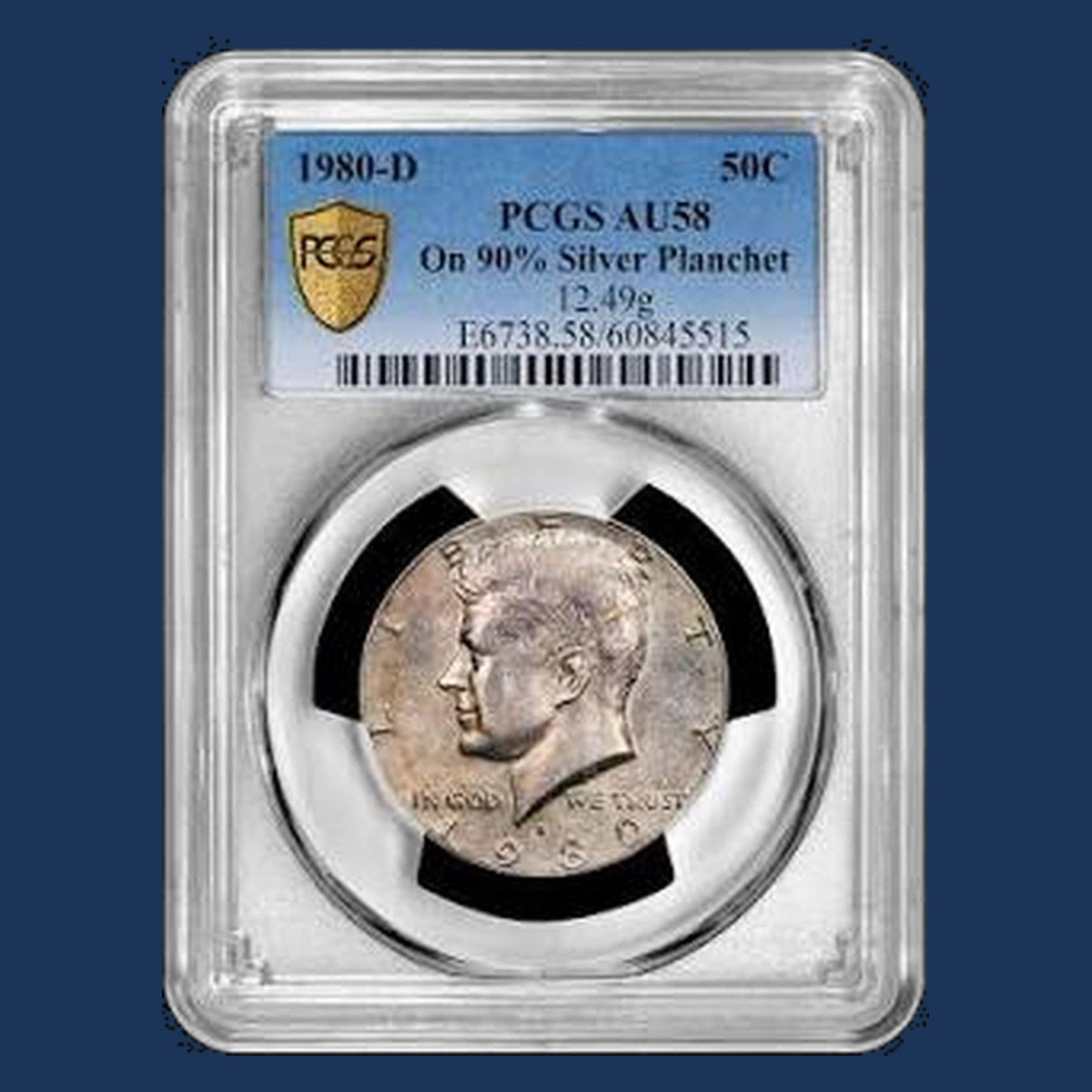
Four kinds of unintended blank appear in the records: an Anthony-dollar disc, an unidentified foreign disc, a copper cent disc, and a ninety-percent-silver disc. They belong to separate coins.
The foreign example weighs 7.5 grams, but its country and exact alloy are unknown. The Denver silver example weighs 12.49 grams and retains a full-looking half-dollar picture.
The small cent example keeps the upper date but loses HALF DOLLAR. Its size cuts off much more of the design.
A suggested leftover-1964 origin for the silver blank remains a catalog explanation, not proof of when that blank was made.
Estimated Value
Estimate $600–$2,500 for Anthony or foreign blanks, $2,500–$6,000 for cent blanks, and $6,000–$20,000 for the silver error. The cent example sold for $3,840 in August 2024.
An Anthony-blank example brought $1,920 in December 2024. A 1977-D on forty-percent-silver metal sold for $6,405 in June 2026.
That last comparison has a different year and alloy. It should not be confused with the ninety-percent-silver 1980-D example.
How to Identify
Weigh the candidate first: Anthony blanks normally weigh 8.1 g, while the recorded foreign example is 7.5 g and the silver example 12.49 g. A contemporary copper cent blank normally weighs 3.11 g.
That cent figure is a standard, not a recorded measurement of this error. Compare diameter with 30.61 mm using calipers.
Use a magnifier at the edge to check metal layers, grooves, and how outer letters end on smaller blanks. Ordinary halves weigh 11.34 g.
Have the metal tested without damaging the coin to check the ninety-percent-silver claim. Match the measured weight and metal to the proposed blank first, then inspect the design’s natural edge for filing or alteration.
11. 1980 Kennedy Half Dollar Double Denomination Overstrike Error (Estimated Up to $30,000)
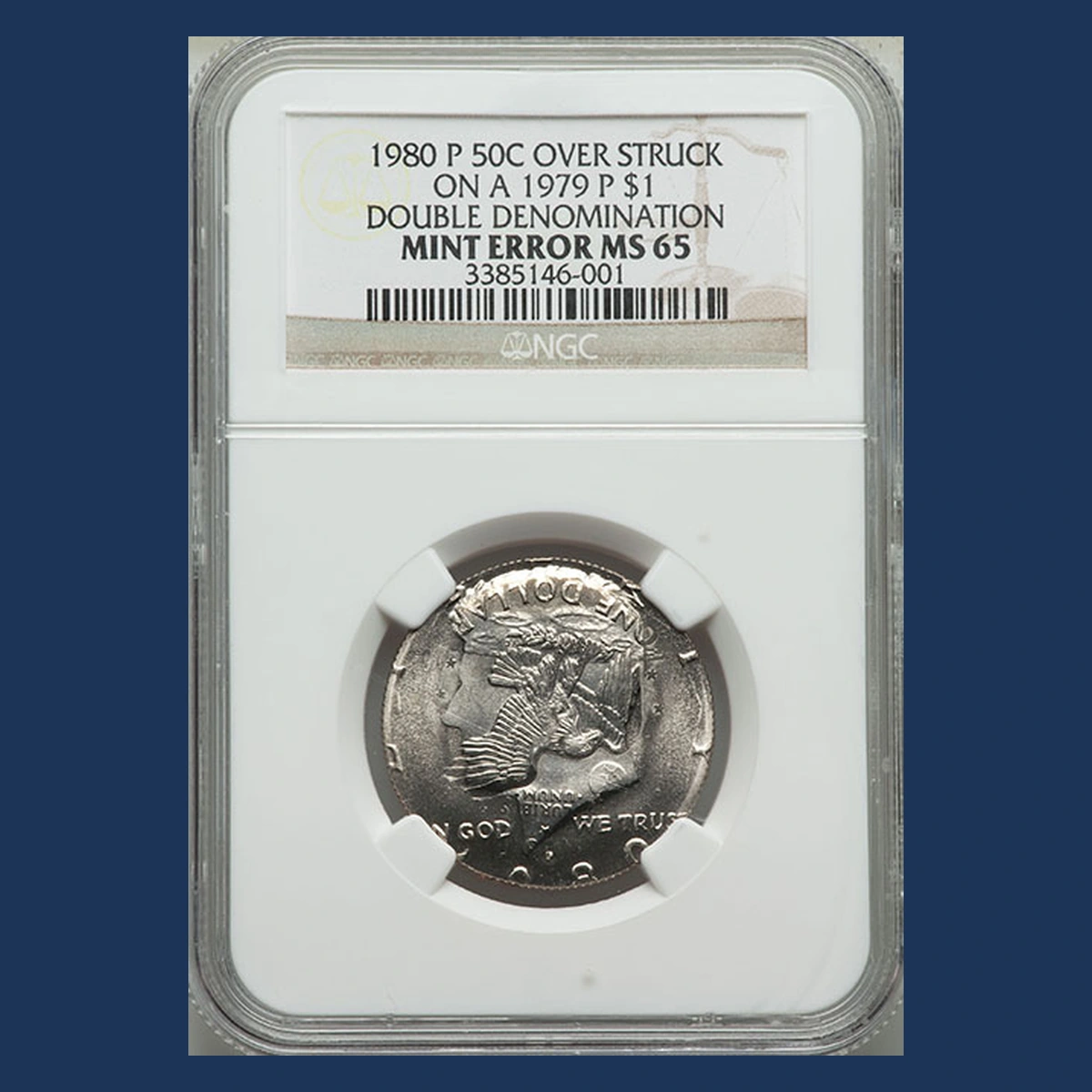
Parts of a 1979-P Anthony dollar remain beneath the 1980-P half-dollar design on this coin. It began as a finished dollar before entering the wrong press.
The later strike put Kennedy’s design over the older picture. NGC graded the example MS65, meaning attractive and unworn.
This is called a double denomination because two different coin designs occupy the same piece. The old portrait, lettering, and date show that the first design already existed.
A plain Anthony-dollar blank has none of those earlier marks. It produces a different wrong-blank error, even though the starting size and metal are similar.
Estimated Value
The January 2016 FUN result was $22,325 for the NGC MS65 example. An estimated $15,000–$30,000 reflects the unusual combination and visible remains of both designs.
That historical sale belongs to an already struck dollar overstruck as a half. The older picture is central to its identity and appeal.
Do not apply that price to a half-dollar design on an empty Anthony-dollar blank. The absence of an earlier picture makes it a different collector category.
How to Identify
Use a magnifier to trace Anthony-dollar details underneath the Kennedy design on both sides. The older marks must belong to the same metal, not a separate coin or altered photograph.
Use a scale against the dollar’s normal 8.1 g, rather than the half dollar’s 11.34 g. Calipers can compare its altered outline with the dollar’s original 26.5 mm and the half’s 30.61 mm.
Inspect the edge grooves for seams, cutting, and changes from the later strike. Spreading can change the dimensions, so measurements support the pictures rather than replacing them.
Find recognizable Anthony lettering or portrait detail beneath the half-dollar impression first; that shows it began as a finished coin.
Conclusion
The 1980 estimates span $5–$30,000. A tiny filled P and a half dollar struck over an existing dollar have very different evidence and values.
Check whether the metal is a small blank, thinner stock, a detached layer, or an already finished coin. Keep the undated layer example identified as undated.
For smaller tool marks, match the actual rim or letter pattern. Compare prices only after the coin’s material and surviving design explain the same mistake.