1966 Half Dollar Error List with Pictures

Two missing initials helped a 1966 Special Mint Set half dollar sell for $2,365 in 2014. The PCGS SP68 coin is a highly preserved example of the No FG variety.
This 1966 Kennedy half dollar error list spans estimated values from $50 to $4,000. It also covers smaller quarter-blank strikes and overlapping pictures.
Read on to check each feature. Neither ordinary nor Special Mint Set coins have mintmarks, so the finish and actual mistake matter.
1. 1966 Kennedy Half Dollar Reported Straight Clip (Estimated Up to $300)
A straight missing section can form when the cutting punch reaches the edge of the metal strip. It produces an incomplete blank, the disc used to make a coin.
The disc later receives the design with that gap already present. The striking press did not cut the edge away.
The 1966 error list reports straight clips without a particular finish or measured amount of missing metal. Each example needs its own check.
A straight cut made after minting can look similar. Original detail beside the opening helps distinguish the two causes.
Estimated Value
The year source gives about $90 for a straight clip, but no traceable auction lot supports that figure here. Use it as a guide reference within an estimated $50–$300 range.
A small clear clip usually falls toward the lower end. A larger, attractive original gap can bring more interest.
The missing section must predate the strike. Cutting or filing a finished coin can reduce weight without adding a genuine error premium.
How to Identify
Use a magnifier where the straight gap meets the original rim at both ends. Look for natural spreading toward a boundary that was already missing during striking.
Tool grooves, a fresh cut wall, or sharp burrs can show later alteration. Check the remaining grooves around the edge too.
The normal forty-percent-silver half weighs 11.50 g and measures about 30.6 mm. Use a scale and calipers to compare the missing weight with the surviving outline.
Look across the coin for weakness opposite the gap, which can support a clip. Start with original struck detail flowing into both ends of the straight opening, rather than the straight shape alone.
2. 1966 Kennedy Half Dollar SMS Rotated Dies (Estimated Up to $400)
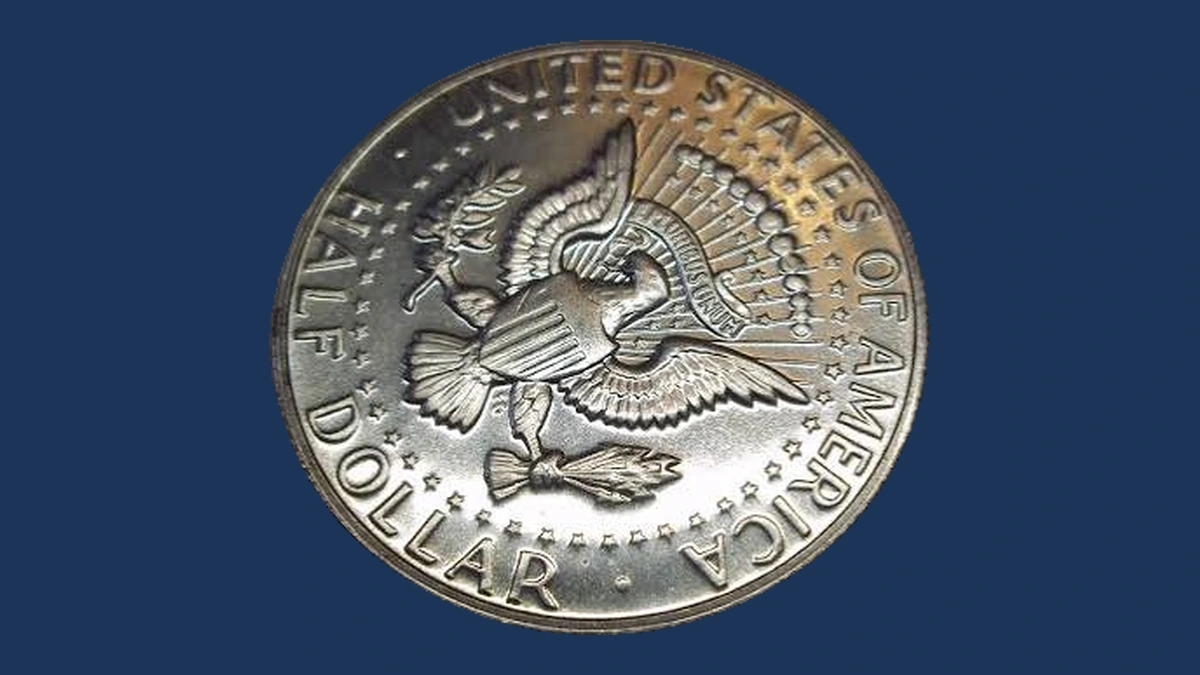
The eagle may land at an angle when a Special Mint Set coin is flipped from top to bottom. This can show that one stamping tool turned out of position.
Special Mint Set, or SMS, coins were specially finished collector issues. They are not conventional proofs.
Heritage lists one PCGS SP65 example rotated forty-five degrees clockwise and a separate NGC MS67 example with no angle stated. Both grades describe unworn collector coins.
Rotation concerns how the two pictures line up. It does not mean Kennedy sits closer to one edge or that the coin itself is bent.
Estimated Value
A 1966 SMS rotated example graded NGC MS66 sold for $141 at Heritage on April 26, 2015. Its listed description gives no angle.
It is separate from the forty-five-degree SP65 coin. Do not apply one example’s measurement to another.
An estimated $75–$400 covers collectible SMS coins with clear, repeatable rotation. A larger tilt and cleaner surfaces can support more interest, while a slight departure from normal may add less value.
How to Identify
Hold Kennedy upright and flip the coin from top to bottom without twisting sideways. The eagle should normally finish upright.
Repeat the flip several times, using a vertical line behind the coin as a guide. Measure any repeated tilt with a protractor rather than judging independently rotated photographs.
Use a magnifier on the grooved edge to look for a seam from two joined coin halves. Such novelty pieces can imitate odd alignment.
A loose forty-percent-silver SMS coin should weigh about 11.50 g and measure 30.6 mm with a scale and calipers. Watch for the eagle landing at the same wrong angle on every controlled flip; that is the quickest practical test.
3. 1966 Kennedy Half Dollar SMS Obverse Strike-Through (Estimated Up to $500)
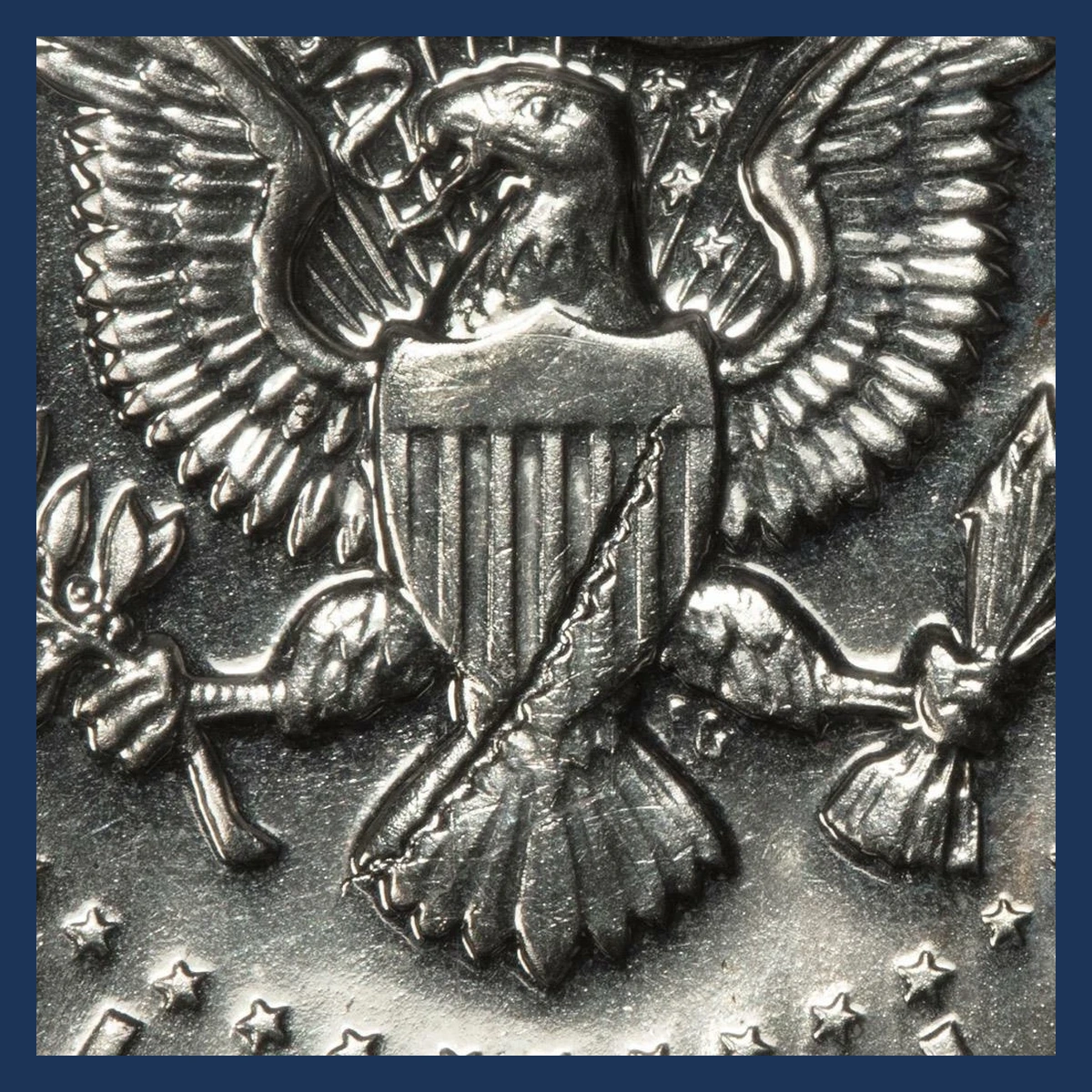
A patch of interrupted front design appears on a 1966 SMS half graded NGC MS66. Heritage listed it in a 2021 lot containing additional coins.
SMS means Special Mint Set, a collector issue with a special finish. MS66 describes a well-preserved unworn example.
Material between the stamping tool and the coin can leave a hollow or prevent some details from forming. This is called a strike-through.
The listing names no particular material. A shape may suggest an object, but a vague depression alone cannot identify cloth, wire, or grease as the cause.
Estimated Value
Estimate $50–$500 for a confirmed SMS strike-through, from a small weak patch to a clear impression on attractive surfaces. The MS66 listing does not provide an individual sale price here.
Its auction lot contains additional material, so a combined amount cannot be assigned to this coin alone. A 1992-D struck through a fragment bearing edge grooves sold for $336 in July 2021.
That ordinary unworn coin has a different date, metal, and finish.
How to Identify
Compare the sharp front details with the interrupted patch under low light. Use a magnifier to see how the surrounding design meets its boundary.
A later gouge may leave torn metal or a raised lip. An obstruction during striking should explain the local loss of detail without that damage.
Inspect the back and grooved edge for other marks. The normal forty-percent-silver SMS coin weighs 11.50 g and measures about 30.6 mm.
Use a scale and calipers only on an accessible loose coin; keep a graded piece protected. Check the boundary first for original design stopping at the patch rather than metal that was dug away afterward.
4. 1966 Kennedy Half Dollar Reported Missing Clad Layer (Estimated Up to $700)
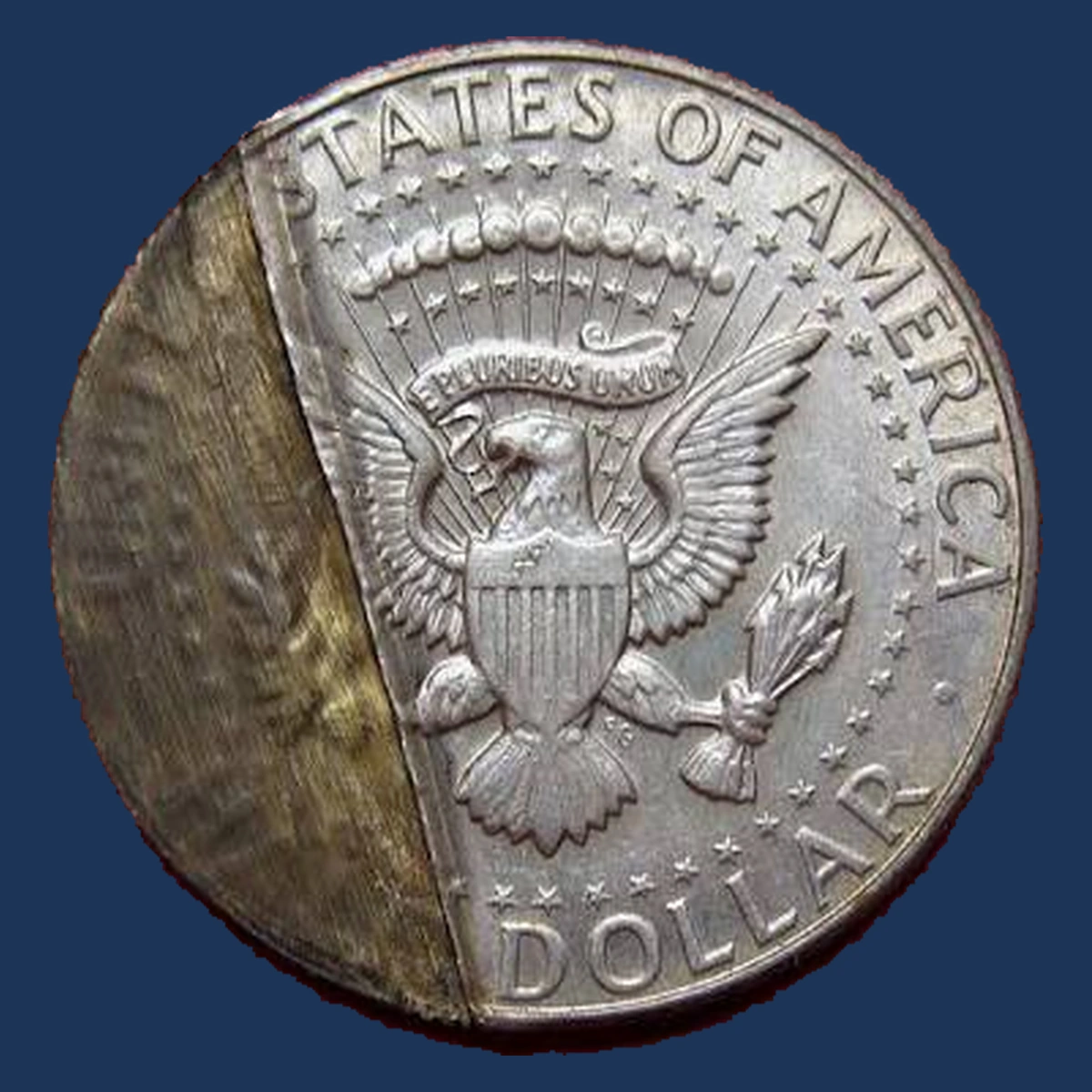
A missing layer on a 1966 half does not reveal the pure-copper core found in later Kennedy halves. Its outer layers are rich in silver, and its inner metal also contains silver.
The complete coin contains forty percent silver overall. Losing an outer layer therefore exposes a different silver-copper mixture, not necessarily a bright copper face.
The year guide reports this error without a particular coin or finish identified. Look for actual missing metal and a layer boundary.
Darkening, partial separation, and deliberate surface removal can look similar in pictures. Color alone cannot settle the cause.
Estimated Value
Genuine outer-layer loss has an estimated range of $150–$700. The amount missing, remaining struck detail, and overall condition affect a coin’s position within it.
A 1998-P with defective front cladding sold for $149 in March 2023. NGC graded it MS63, meaning unworn with noticeable marks.
That later coin has copper-nickel construction, so its color and weight do not transfer directly to 1966. The sale is a related comparison, not a same-year result.
How to Identify
Start with a scale and compare the weight with 11.50 g. Then use a magnifier at the edge to find where an outer layer is actually missing.
Measure the outline with calipers against about 30.6 mm and inspect the edge grooves. A visible layer boundary should fit the affected face, rather than stop at an unrelated stain.
Both normal inner and outer metals contain silver, so copper color is not required. Photograph both faces and check for etching, filing, or artificial peeling.
Low weight alone cannot prove this error. Look first for an actual lost-layer boundary beside original struck detail, supported by the corresponding missing weight.
5. 1966 Kennedy Half Dollar Reported Off-Center Strike (Estimated Up to $800)
An off-center strike leaves a plain area beside an incomplete picture. The metal disc was partly outside the stamping tools when they came down.
The area they reached received the design. The rest remained unstruck, with some outer details absent.
The 1966 report gives no particular percentage, direction, or finish. A bright surface alone cannot establish that a coin came from a Special Mint Set.
A surviving date helps identify the year even when other lettering is missing. Corresponding shifts on both faces help separate an off-center disc from one stamping tool sitting out of alignment.
Estimated Value
Estimate $100–$800 for a confirmed 1966 example in collectible condition. The range covers modest shifts through dramatic coins with readable dates and attractive surfaces.
A 1999-D struck sixty-five percent off center sold for $552 in March 2023. NGC graded it MS66, a well-preserved unworn grade.
That later coin uses a different metal composition. Its sale offers a scale for large shifts, not a 1966 price or measurement of the reported example.
How to Identify
Read the surviving 1966 date, then compare where the design stops on each face. Keep track of the same physical edge while turning the coin over.
A magnifier can reveal grinding marks where someone removed a design after minting. Genuine plain metal should fit the way the tools missed the disc.
Use a scale against the normal forty-percent-silver weight of 11.50 g and calipers against about 30.6 mm. Record any spreading rather than forcing the outline to match a normal coin.
Inspect remaining edge grooves and smoother parts outside normal ring contact. Matching interrupted pictures beside untouched metal on both sides give the quickest useful check.
6. 1966 Kennedy Half Dollar SMS Weak Strike, Cataloged as Die Adjustment (Estimated Up to $900)
Much of the design looks shallow on the SMS coin cataloged as a Die Adjustment Strike. The visible issue is weakly formed detail across broad areas.
The traditional name suggests a press being set up. Appearance alone does not tell us what an operator intended or which setting changed.
This differs from one small patch blocked by debris. The overall pattern of weakness matters.
Wear or chemicals can also make a design look faint. Original surface texture and the edge help show whether the detail failed to form or disappeared after the coin was made.
Estimated Value
A convincingly identified SMS weak strike has an estimated value of $200–$900. Original surfaces and the clarity of the weak impression matter more than faint lettering by itself.
No realized price is assigned here to the cataloged Heritage example. This is an estimate for the described kind of error.
It also differs from No FG pricing. Broadly shallow detail and two initials removed from a stamping tool are separate features with different collector appeal.
How to Identify
Study broad areas on both sides under soft light. Compare shallow details with the surrounding surface to judge whether they never formed fully or were rubbed away.
A magnifier can reveal corrosion, chemical roughness, or scratches. Ordinary wear usually affects high points first rather than making the whole strike equally shallow.
Check the grooved edge and use a scale for 11.50 g and calipers for roughly 30.6 mm. Those are the normal forty-percent-silver half-dollar measurements.
A single soft letter cannot prove reduced striking pressure. For the fastest first check, look for broadly shallow design beside preserved original texture instead of high-point rubbing or etched surfaces.
7. 1966 Kennedy Half Dollar SMS Doubled Die Obverse (Estimated Up to $1,000)
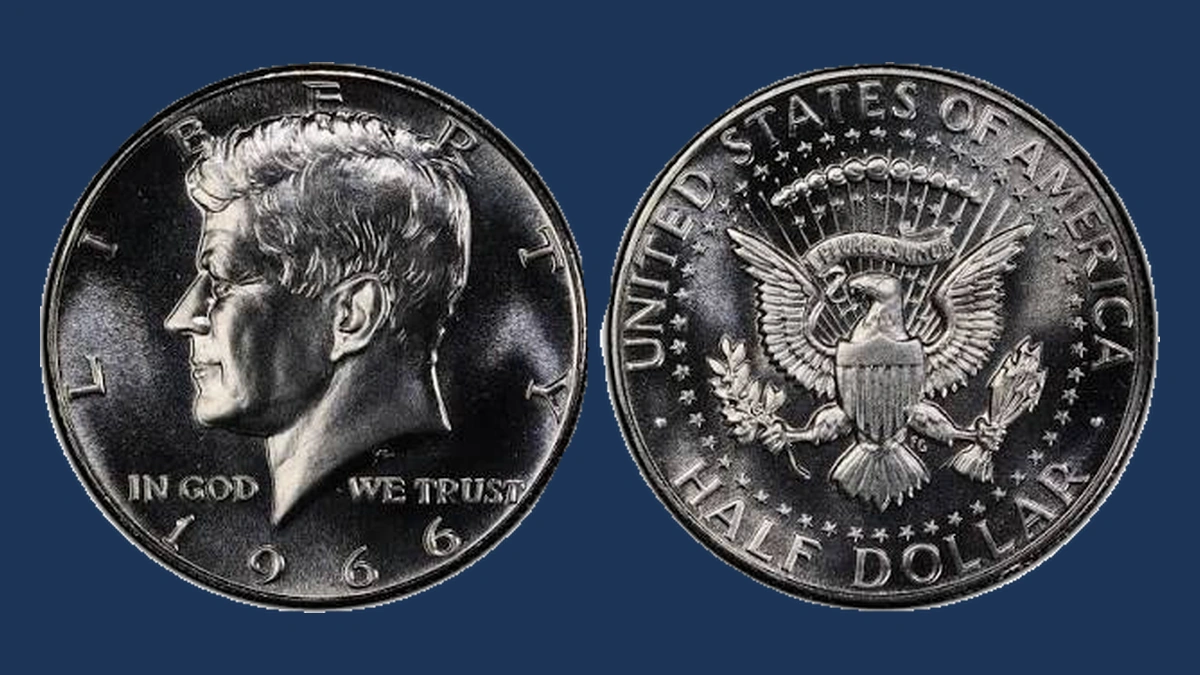
The motto IN GOD WE TRUST shows the useful extra outlines on SMS FS-103. The separation generally extends downward, described as southward in the listing.
GreatCollections listed a PCGS SP67 example of this variety. That grade describes a highly preserved Special Mint Set coin.
The repeated detail existed in the steel stamping tool, so other coins it made can share the pattern. The coin did not need to be struck twice.
Other 1966 SMS doubled dies exist. Match the extra lettering to FS-103 before using that name, rather than relying on the year or shiny surface alone.
Estimated Value
A confirmed SMS doubled die has an estimated range of $150–$1,000. Condition, visible separation, and the particular variety all affect its price.
The SP67 FS-103 offering started at $165 and ended in November 2025. Its final sale price is not given.
The $165 opening level is not a completed sale. It also should not be applied as a fixed value to every doubled-looking 1966 coin.
How to Identify
Keep the motto upright and use a 10× magnifier along IN GOD WE TRUST. Compare the downward extra edges with a clear FS-103 photograph.
Move the light to rule out reflections on the Special Mint Set surface. A thin flat shelf that reduces the main letter can come from movement during striking instead.
Do not call every bright 1966 coin a proof. Confirm the collector format as well as the doubled pattern.
On a loose coin, use a scale and calipers for the usual 11.50 g and about 30.6 mm. Check the edge grooves too.
Begin with a letter-for-letter match of the downward motto separation, rather than searching randomly around Kennedy’s portrait.
8. 1966 Kennedy Half Dollar Struck on a Quarter Planchet, Including SMS (Estimated Up to $2,200)
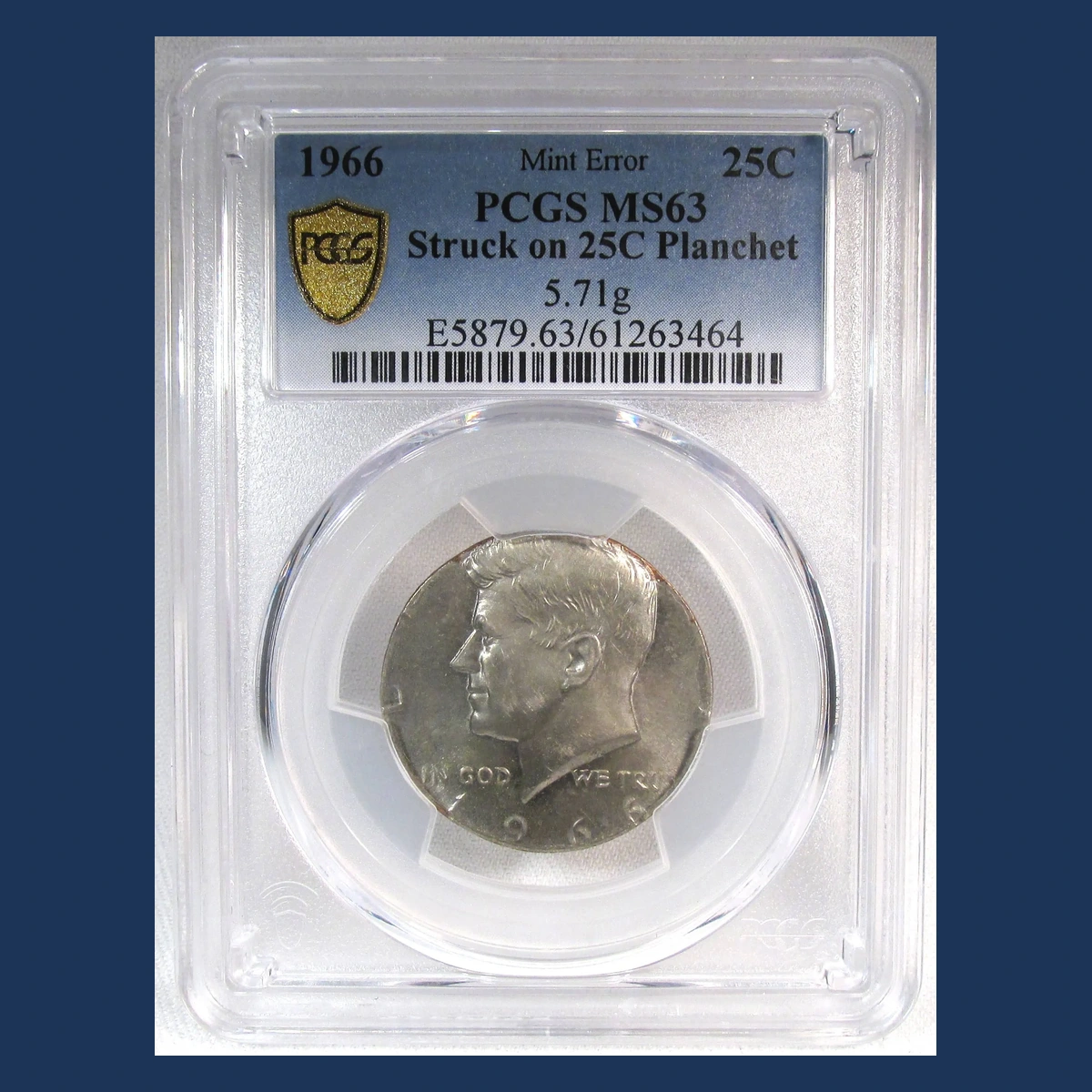
A quarter-size disc cannot hold the whole half-dollar picture. One ordinary 1966 example has strong central detail but distorted or missing outer lettering.
A separate SMS example retains the date and eagle while losing the denomination and parts of LIBERTY. Its edge shows the layers of a copper-nickel quarter disc.
That metal differs from the normal forty-percent-silver half dollar. The coin was not simply a regular half filed smaller after striking.
Several graded examples have different finishes and surviving letters. Compare each separately instead of assuming that every quarter-blank strike lost exactly the same parts.
Estimated Value
An ordinary NGC MS64 example sold for $575 in February 2005. An SMS NGC MS65 brought $1,527.50 in November 2012, and an SMS PCGS SP62 sold for $960 in August 2020.
These are separate unworn coins with different preservation and production formats. They support an estimated $600–$2,200 range for collectible confirmed examples.
The older sales are historical comparisons. A small 1966 half still needs its metal, original strike, and finish checked.
How to Identify
Weigh the coin before judging how much lettering is missing. A normal copper-nickel quarter disc starts at about 5.67 g, compared with 11.50 g for the intended half dollar.
Calipers can compare the quarter’s usual 24.3 mm with the half’s 30.6 mm. Allow for metal spreading during the oversized strike.
Use a magnifier where the design reaches the edge. Original details ending naturally differ from file marks cutting through a previously complete picture.
Inspect the layered edge and any grooves, and keep ordinary and SMS examples separate. For a quick first check, pair near-quarter weight with a half-dollar design naturally extending beyond the smaller original disc.
9. 1966 Kennedy Half Dollar SMS No FG (Estimated Up to $2,500)
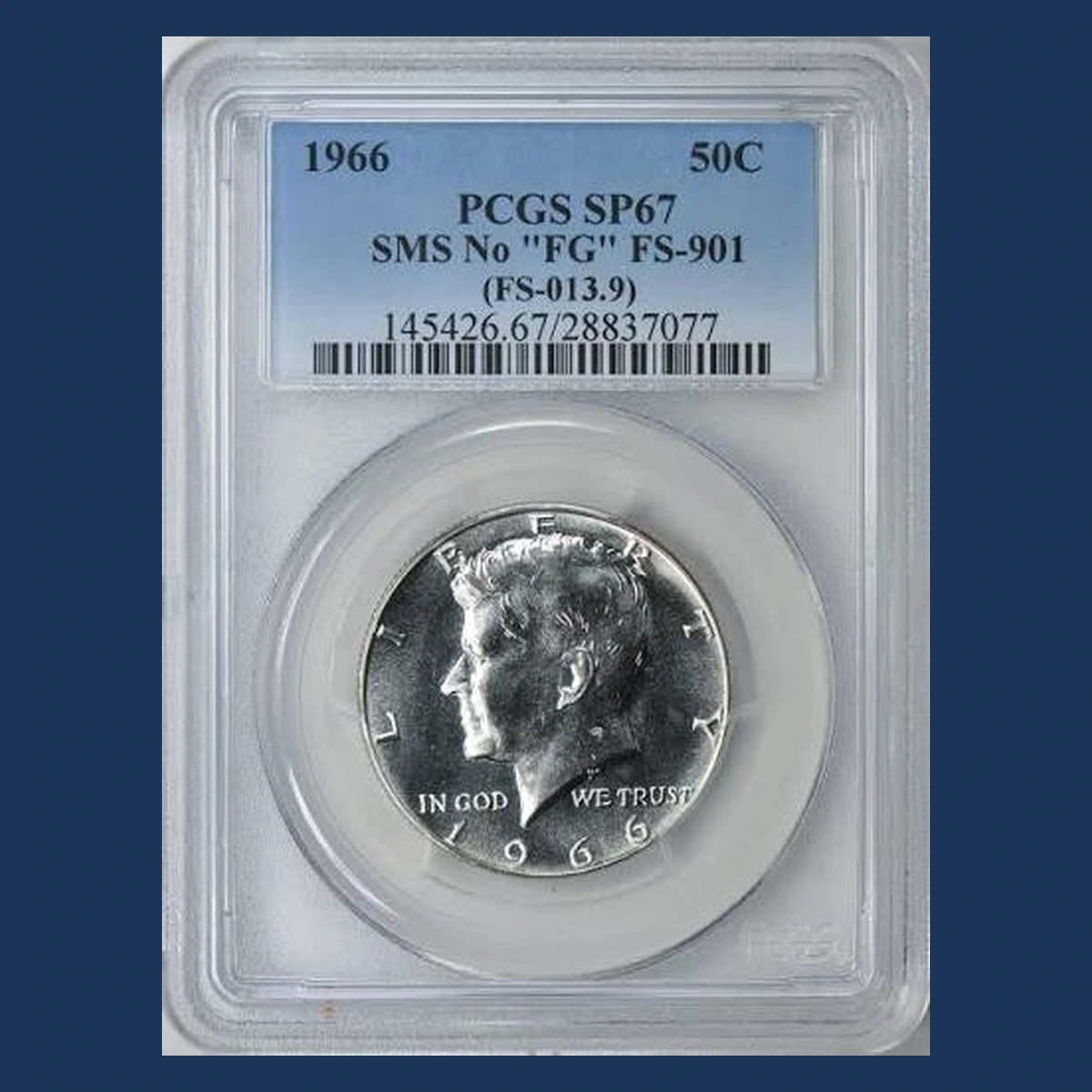
The letters FG normally identify back designer Frank Gasparro beside the eagle’s tail. On the recognized 1966 SMS No FG variety, both initials are completely absent.
PCGS explains that heavy polishing of the stamping tool removed the shallow letters while workers addressed clash marks. Nearby fine details may also look weaker.
Coins made afterward received that altered design. The letters were not individually erased from each finished coin.
Faint surviving strokes mean weak FG rather than No FG. Wear, dirt, or deliberate smoothing can also make the spot look empty without creating this variety.
Estimated Value
PCGS reported a $2,365 sale for an SP68 in 2014 and an approximate $200 level for SP65 in its 2020 article. Both grades describe unworn Special Mint Set coins, with SP68 much better preserved.
An estimated $200–$2,500 covers correctly identified collectible examples. Those dated prices are comparisons, not guaranteed current offers.
The initials must be completely absent and the surrounding surface original. A weak-FG coin should not borrow the same premium.
How to Identify
Find the space above and right of the tail feathers, below the eagle’s leg on your right. Examine it with a 5× magnifier.
Turn the light through several angles and look for any surviving part of F or G. Compare nearby details so broad wear is not mistaken for missing initials.
Do not clean the spot. Scratches, smoothing, or residue may explain an apparently blank patch.
Check a loose SMS coin with a scale against 11.50 g and calipers against about 30.6 mm. Inspect its edge grooves and retain evidence of the Special Mint Set finish.
The quickest screening step is simple: any visible F or G stroke rules out complete No FG.
10. 1966 Kennedy Half Dollar SMS Double Strike with Broadstrike and Brockage (Estimated Up to $4,000)
One 1966 SMS coin combines overlapping pictures, a wider outline, and a recessed mirror-image design. Heritage lists it as NGC MS62, meaning unworn with noticeable marks.
The mirror-image mark is a brockage. An already struck coin became trapped and pressed its design into this coin, leaving a hollow reversed copy.
The wider shape records a strike without normal restraint from the surrounding ring. Another blow also left overlapping detail.
These features belong to one coin. Read the raised and recessed pictures separately before deciding how they fit together, rather than combining several different error photographs.
Estimated Value
This combined SMS error has an estimated value of $1,000–$4,000. The catalog identifies the MS62 example, but no sale amount for that lot is used here.
A 1964-dated half with spreading and a full back brockage sold for $2,400 in March 2023. PCGS graded it MS65, an attractive unworn grade.
That comparison contains ninety percent silver and has a different finish and affected face. Its price offers context, not an exact value for the 1966 combination.
How to Identify
Use a magnifier to separate normal raised lettering from the hollow mirror-image picture. Change the light across the overlapping areas so a shallow shelf does not look like another full impression.
Compare both faces and the widened outline with the cataloged NGC MS62 example as one complete coin. Each visible feature should fit that same piece.
Use a scale against 11.50 g and calipers against the normal 30.6 mm, allowing for spreading. Inspect the edge grooves for altered ring contact or signs of later squeezing.
Start with letters that are both recessed and reversed like a mirror; they reveal the brockage component most quickly.
Conclusion
The estimated range for these 1966 errors is $50–$4,000. Missing initials, smaller wrong-blank strikes, and overlapping pictures can all attract collectors, but need different checks.
Identify ordinary coins and Special Mint Set pieces separately. Both normally contain forty percent silver and carry no mintmark.
Use weight and the edge for metal problems, and clear lettering comparisons for varieties. Preserve both faces in photographs so each price comparison stays attached to the right coin.