1974 Half Dollar Error List with Pictures

A 1974 half dollar struck on metal meant for a Taiwan five-dollar coin sold for $2,880 in September 2023. Its small blank could not hold the whole half-dollar design.
The 1974 half dollar errors below also include tiny filled letters, broken edge rings, and backward copied designs. Estimated values range from $5 to $5,000.
Read on to find the visible clues and checks that fit each error.
1. 1974-D Kennedy Half Dollar Filled Mintmark (Estimated Up to $75)
The opening inside a D can appear filled with raised metal. A report describes this feature on 1974-D halves.
A small piece may have broken from the die, the steel tool that stamps the coin. Coin metal can enter that gap and form a lump inside the letter.
The report also suggests grease, but grease normally blocks part of a design and makes it weaker. That differs from extra raised metal.
Dirt or a later hit can also make the D look filled. The key question is whether its center rises or the letter itself fades.
Estimated Value
A genuine minor filled-D feature has an estimated value of $10–$75. A clear raised fill on an original surface is more appealing than a barely visible change.
No certified 1974-D sale is used for this reported feature. The price range is an estimate, not an auction result.
The better-known Denver doubled die is a separate variety. Its prices do not apply just because another 1974-D coin has something unusual inside its mintmark.
How to Identify
Aim light from the side and inspect the D with a 10× magnifier. Decide whether the center rises above the surface or the surrounding letter is simply faint.
Do not scrape the opening. Dirt and glue may show a separate border, while an original metal fill should join the coin’s surface.
Look around the whole letter for marks from a hit. A normal 1974-D uses bonded metal layers over copper and weighs 11.34 grams.
A scale and calipers can check that weight and its roughly 30.6 mm width. Begin with the raised-versus-faint distinction: extra metal inside the D is different from a letter that failed to form.
2. 1974 Kennedy Half Dollar Die Crack or Local Die Break (Estimated Up to $150)
An extra raised line or lump may appear among the stars below UNITED. A 1974 report points to this area as a place to check for a damaged stamping tool.
A crack in the tool can leave a thin raised seam on the coin. A larger missing piece can leave a lump instead.
The reported location does not mean every odd star came from the same tool. The exact mint and finish need to be established on each example.
A small lump inside the design also differs from a cud, a larger raised break that connects to the rim.
Estimated Value
Estimate $10–$150 for clear small cracks or local breaks. Fine lines generally sit near the lower end, while larger raised patches can attract more interest.
The 1974 report gives a place to inspect but no certified auction price for that feature. This range is therefore an estimate for the type.
A small interior lump should not receive the price of a dramatic rim-connected break. The size and actual effect on the design matter.
How to Identify
Find UNITED on the back, then use a magnifier to examine the stars directly below it. Change the lighting to see whether the unusual line rises or cuts into the surface.
Follow a raised line beyond the star if it continues. Normal star edges should not be counted as part of a crack.
Check whether a larger lump truly reaches the rim. If it stays inside the design, it is not a rim cud.
A scale and calipers compare the coin with 11.34 grams and about 30.6 mm. The fastest useful surface check is a raised seam or lump joined to original coin metal, rather than a scratched trench.
3. 1974 Kennedy Half Dollar Reported Repunched Mintmark (Estimated Up to $200)
A second curved stroke beside D or S may show where a mintmark punch was used twice. The two impressions entered the stamping tool in slightly different positions.
Coins made with that tool can repeat the extra outline. It should resemble part of the original letter, not just a random bump.
A 1974 list reports this type but does not identify a mint, direction, or recognized variety number. Those details cannot be chosen from the date alone.
Philadelphia halves normally have no mintmark. Denver uses D, while San Francisco uses S, so first identify the actual letter.
Estimated Value
A professionally identified repunched mintmark is estimated at $25–$200. Greater separation and a recognizable second letter usually make the feature easier for collectors to appreciate.
The range is not a sale for a newly named 1974 variety. The general report does not supply that identity.
Very slight thickening may have another cause, including damage or movement during striking. A complete match matters more than giving every extra bump around D or S a variety premium.
How to Identify
Enlarge the entire mintmark with a 10× magnifier, keeping its inside opening and outer edges visible together. A real second punch should leave a recognizable piece of the same letter, rather than an isolated shapeless lump.
Check for flat shelves, scratches, or small broken-tool bumps that can imitate another stroke. All normal 1974 halves use clad metal, including San Francisco Proofs, which are specially made collector coins.
A scale and calipers compare the coin with 11.34 grams and about 30.6 mm, while an edge view checks for damage. The key first match is an extra curve or tip that follows the mintmark’s shape in a clear second position.
4. 1974 Kennedy Half Dollar Weak or Missing FG (Estimated Up to $250)
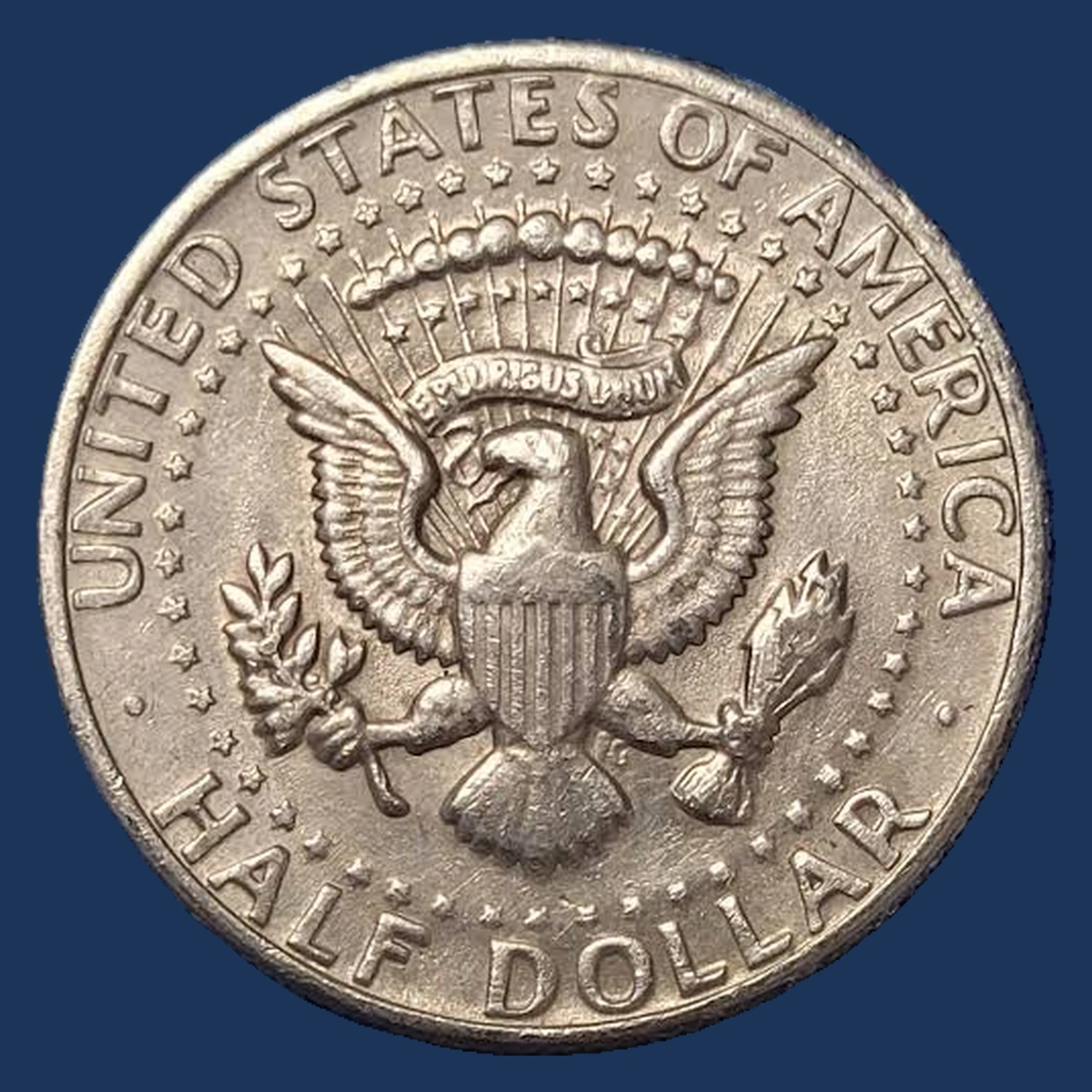
FG may look faint or absent beside the eagle’s tail on a reported 1974 half. The letters stand for Frank Gasparro, the designer of the back.
A public discussion suggested that polishing the stamping tool removed the tiny details. Other reported pieces still show parts of the letters.
Weak and missing are different. A faint stroke seen under side lighting means the initials have not disappeared completely.
Wear, lighting, blocked details, or later smoothing can create a similar empty-looking patch. The discussion does not establish the recognized variety number used for a different year’s No FG coin.
Estimated Value
Weak initials have an estimated value of $5–$30. A convincing complete absence made at the Mint, with original surrounding surfaces, is estimated at $50–$250.
A recognized 1972-D FS-901 graded NGC MS64 sold for $900 in December 2022. That different-year variety has its own established identity.
Its price cannot be transferred to the 1974 report. A coin still showing part of F or G also should not receive the premium for complete absence.
How to Identify
Look above and to the right of the tail feathers, beneath the eagle’s leg on your right. Use a normal coin to find the small FG position.
Now use a magnifier and move a lamp around it. Faint strokes often appear under side lighting even when a straight-on photograph looks blank.
Check the feathers and smooth background for wear, scratches, or deliberate smoothing. Do not polish the area to make it easier to see.
The normal coin is 11.34 grams and about 30.6 mm across, checked with a scale and calipers. Start by searching for any surviving F or G stroke before calling the initials completely missing.
5. 1974 Kennedy Half Dollar Die Clash (Estimated Up to $300)
A faint extra outline can come from the eagle or portrait on the other stamping tool. If the two tools meet without a blank between them, they can mark each other.
Later coins may then show pieces of the opposite design. This is called a die clash.
A 1974 list reports clashes, but it does not provide a reliable complete example with an exact mint and mapped marks. No specific line can be named from that general report alone.
The shape must match the opposite design. A scratch, flat doubled edge, or later contact mark needs a different explanation.
Estimated Value
For a clear clash on a regular-strike half, estimate $20–$300. A recognizable outline usually attracts more interest than a faint isolated line.
A pronounced clash on a 1973-S Proof graded PCGS PR68 Deep Cameo sold for $720 in October 2022. Deep Cameo describes strong frosted-design contrast against a shiny background.
That collector coin is a different year and finish. Its price does not establish a sale for the general 1974 report.
How to Identify
Compare a suspicious outline with full photographs of both designs. Its shape and position must fit where one stamping tool could have touched the other.
A magnifier can help trace the mark as you move the lamp. Random parallel scratches usually keep going without forming a recognizable piece of the opposite design.
A normal clad half weighs 11.34 grams and measures about 30.6 mm, which a scale and calipers can check. Inspect the grooved edge for seams or crushing from later work.
Backward sunken lettering from two coins squeezed together needs another explanation. Begin with a faint outline that matches a specific part of the opposite design.
6. 1974 Kennedy Half Dollar Broken Collar and Collar Cuds (Estimated Up to $350)
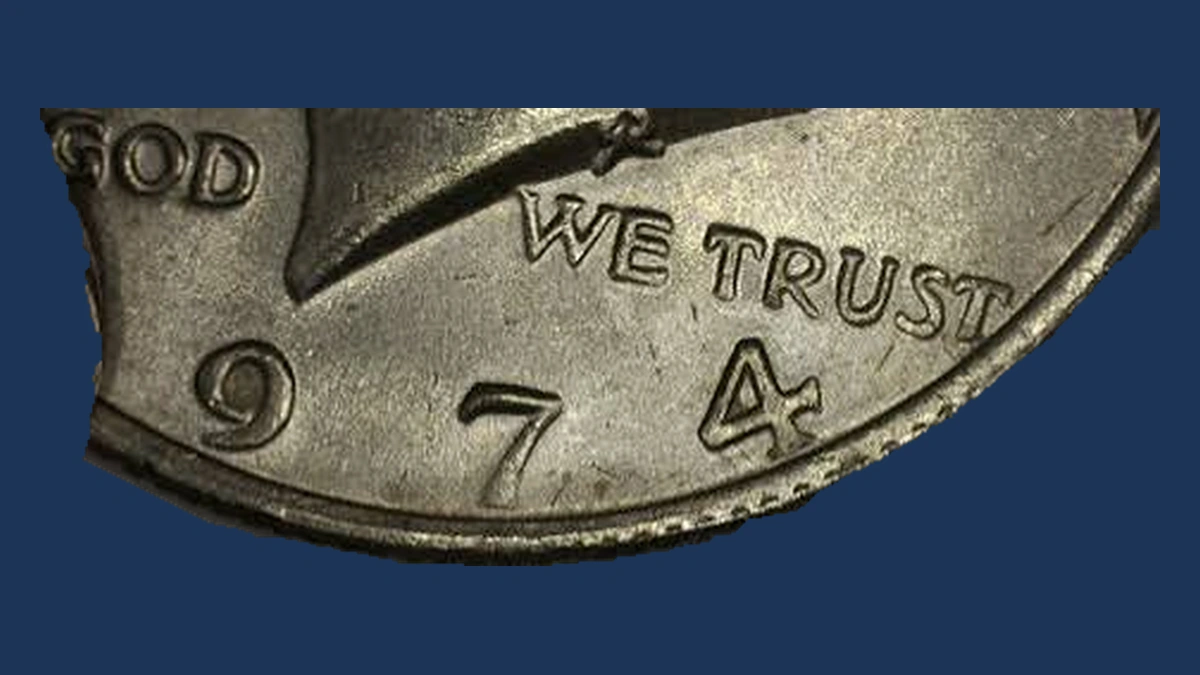
Two raised spots interrupt the edge grooves on a half described by specialist Ken Potter. They sit near 4 and 11 o’clock when the coin is viewed like a clock face.
These are collar cuds. A collar is the ring that controls a coin’s width and forms its edge grooves.
When a piece breaks from that ring, metal can escape sideways into the gap. The resulting lump is on the edge, not a missing part of either face’s design.
A separate ANACS MS64 has no circulation wear but noticeable marks. Its broken-collar pattern need not match Potter’s coin.
Estimated Value
Potter’s 2014 article suggested about $40 for a typical single collar cud and $100 for his double-cud form. Those were value observations, not auction results.
Use an estimated $40–$350 range for collectible examples, depending on the lumps’ size, clarity, and the coin’s condition. The separate ANACS MS64 has no sale assigned here.
An unusual edge feature can interest specialists without attracting every collector. Rarity alone does not guarantee a high price.
How to Identify
Hold the coin edge-on and follow every groove through a magnifier. Raised metal replacing a group of normal grooves is more useful than a dent in the face rim.
For Potter’s example, compare the two positions near 4 and 11 o’clock. A different coin must show its own pattern.
Look for solder, folded metal, or a heavy hit around each protrusion. An original collar failure should show the lump continuing naturally from the edge.
The usual 11.34 grams and 30.6 mm provide scale and caliper comparisons. Local spreading may change the width; begin with original raised metal filling an interruption in the edge grooves.
7. 1974 Kennedy Half Dollar Broadstrike (Estimated Up to $450)
A 1974 half graded ICG MS60 spread beyond its normal outline when the surrounding ring failed to hold the blank. The whole design still fits on the metal.
This is a broadstrike. The spreading can be uneven without making the coin an off-center strike.
If part of the design falls beyond the blank, an off-center effect must also be considered. A wide-looking border alone does not settle it.
The MS60 coin is separate from another reported 1974 half with multiple strikes and a broad outline. An enlarged coin does not need more than one blow to form.
Estimated Value
The ICG MS60 broadstrike sold for $126.50 in February 2009. An estimated $75–$450 range allows for differences in spreading, marks, and overall appearance.
MS60 describes a coin without circulation wear, though it may have many surface marks. A higher grade alone does not show how striking the error looks.
The sale covers a simple broadstrike. The separate multiple-struck coin has its own condition issues and cannot be priced by adding an arbitrary extra premium.
How to Identify
Check the complete lettering on both faces before measuring the border. The design should remain on the available metal, even where the outside edge spreads unevenly.
Calipers record that spreading against the normal width of about 30.6 mm. A digital scale should stay near 11.34 grams when the original metal remains.
Under a magnifier, look for natural outward movement rather than flattened letters or a ground perimeter. The usual edge grooves may be missing where the ring failed to hold the coin.
A truly overlapping second design would indicate another strike. For the simple broadstrike, start with complete, uncrushed designs contained inside an oversized original outline.
8. 1974 Kennedy Half Dollar Clips and Incomplete Punching (Estimated Up to $600)
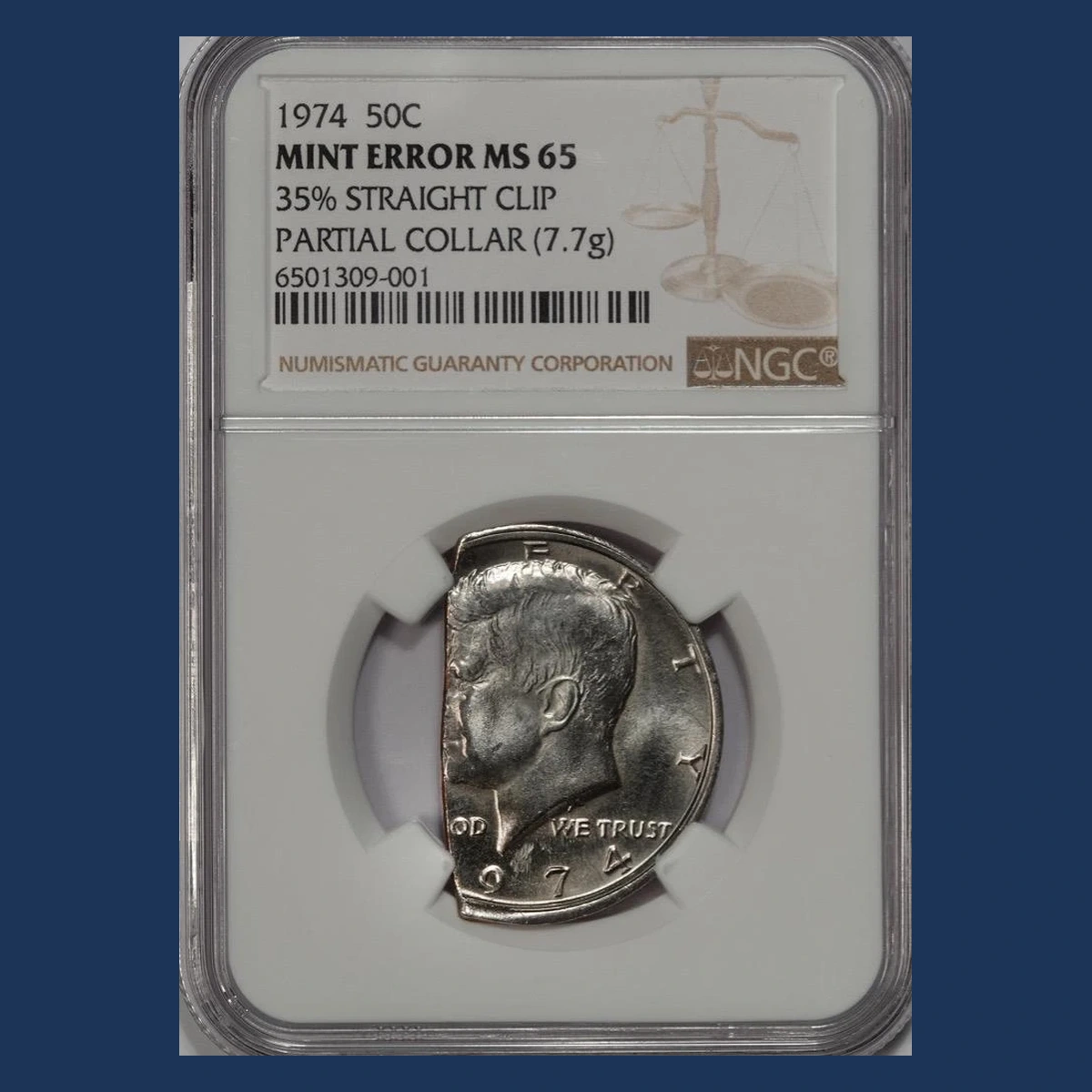
A large arc is missing from a Philadelphia half graded PCGS AU58 with a 34% clip. Another report describes a straight gap instead.
The NGC MS64 incomplete clip looks different again. A cut began during blank preparation, but the metal did not fully separate.
That coin can retain almost all its original metal. The visible line therefore should not be confused with a missing curved piece.
All three involve the way the blank was prepared before striking. Their boundaries should show how the later design formed around the cut or gap, rather than damage to a finished coin.
Estimated Value
The NGC MS64 incomplete clip sold for $384 in July 2021. Estimated values across these blank-cutting defects run from $40–$600.
The large PCGS AU58 curved clip is another documented shape, but no sale is assigned to it here. A straight clip also needs its own condition comparison.
The incomplete-cut result should not become the price of every missing arc. Size, original surfaces, and how clearly the cut can be seen affect collector interest.
How to Identify
First decide whether the area is empty or still contains attached metal. Do not bend an incomplete cut to see how deep it goes.
A magnifier should show how the original strike crosses or meets the cut. A fresh saw groove or filed gap interrupts a design that was already complete.
Compare weight with 11.34 grams on a scale. A full clip should be lighter, but an incomplete cut may retain nearly normal weight.
Calipers record the surviving shape against about 30.6 mm. Examine the rim at each end of the boundary; original struck metal adapting to the cut is the useful first clue.
9. 1974 Kennedy Half Dollar Off-Center Strike (Estimated Up to $700)
The design shifts toward 4:30 on a cataloged 1974 half dollar. Opposite it, a crescent of untouched blank metal remains.
The coin was struck 10% off center. Its blank was not properly positioned between the stamping tools, so part of the design missed it.
ANACS graded the example AU58 Details because of scratches. Details means a condition problem prevents an ordinary numerical grade alone from describing the coin.
Those scratches came later. They do not cause the off-center design, but they reduce the quality of this particular example and matter when comparing its price.
Estimated Value
Collectible 1974 off-center halves have an estimated range of $50–$700. A clear date, attractive surfaces, and a striking shift can improve demand.
The scratched 10% example has no recorded sale used here. For comparison, a 1999-D half struck 65% off center and graded NGC MS66 sold for $552 in March 2023.
That different-year coin has a much larger shift and no noted Details problem. Its result is not a direct price for the scratched 1974 piece.
How to Identify
Find both the cropped design and the untouched crescent. A magnifier should show an original boundary between the two, rather than grinding that removed a finished design.
Check both faces in the same orientation. The recorded example shifts toward 4:30, but another coin may shift elsewhere.
The intact clad blank starts near 11.34 grams and about 30.6 mm. Use a scale and calipers to record its remaining weight and changed outline.
Edge grooves may be incomplete where the blank missed the ring. Keep later scratches separate from the error, and begin by matching shifted designs on both faces beside original blank metal.
10. 1974 Kennedy Half Dollar Struck-Through Material (Estimated Up to $800)
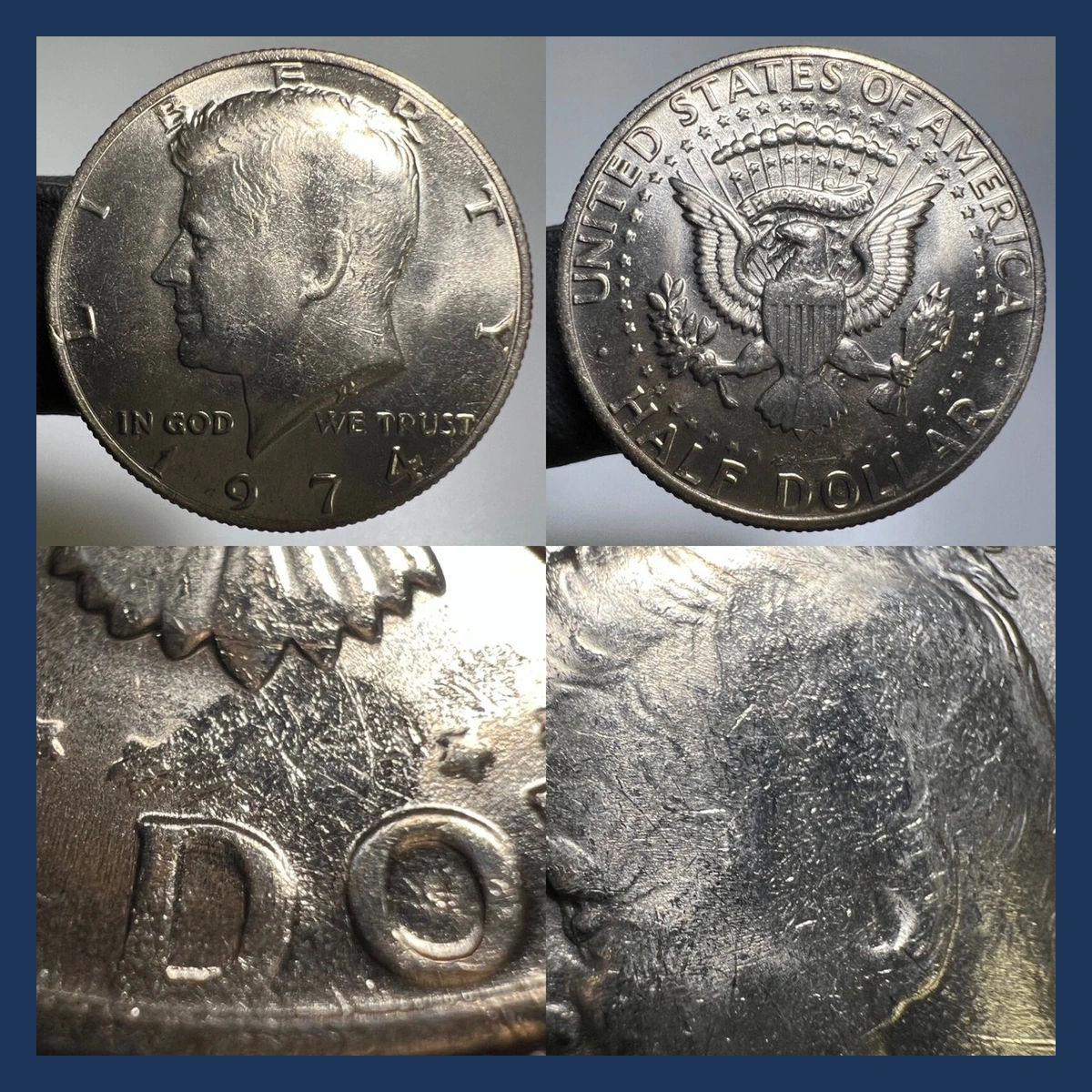
A small piece of grooved edge metal blocked the strike on a 1974-D half graded NGC MS64. It left an impression where the normal design could not reach the blank.
Collectors call this a strikethrough. The obstruction sits between the stamping tool and the coin during the blow.
The ridged fragment gives this example a more specific cause than a general report of blocked details. Its texture can be part of the evidence.
Other 1974 reports do not identify a second object or location. Cloth, grease, and wire should not be substituted for this particular metal fragment.
Estimated Value
A similar ridged-fragment impression on a 1992-D half graded NGC MS64 sold for $336 in July 2021. That different-year example provides a useful middle comparison.
For genuine 1974 strikethroughs, estimate $40–$800. Clear object texture and good condition generally support more interest than a small plain dent.
No sale is assigned to the 1974-D MS64 here. Its specific fragment impression, rather than the general error name, should guide the comparison.
How to Identify
Look inside the depression for a repeated groove pattern, using a magnifier and light from two directions. The object’s ridges should explain the mark better than a guessed outline around a plain dent.
Inspect the border for fresh cuts or metal pushed up by a later impact. A normal host weighs 11.34 grams and measures about 30.6 mm, which a scale and calipers can check.
An impression does not mean the fragment remains attached, so do not assume that extra metal is still present. Begin with repeated ridges pressed into the interrupted design, keeping the coin’s D mintmark and complete face in the same photograph.
11. 1974 Kennedy Half Dollar Doubled Dies (Estimated Up to $1,000)
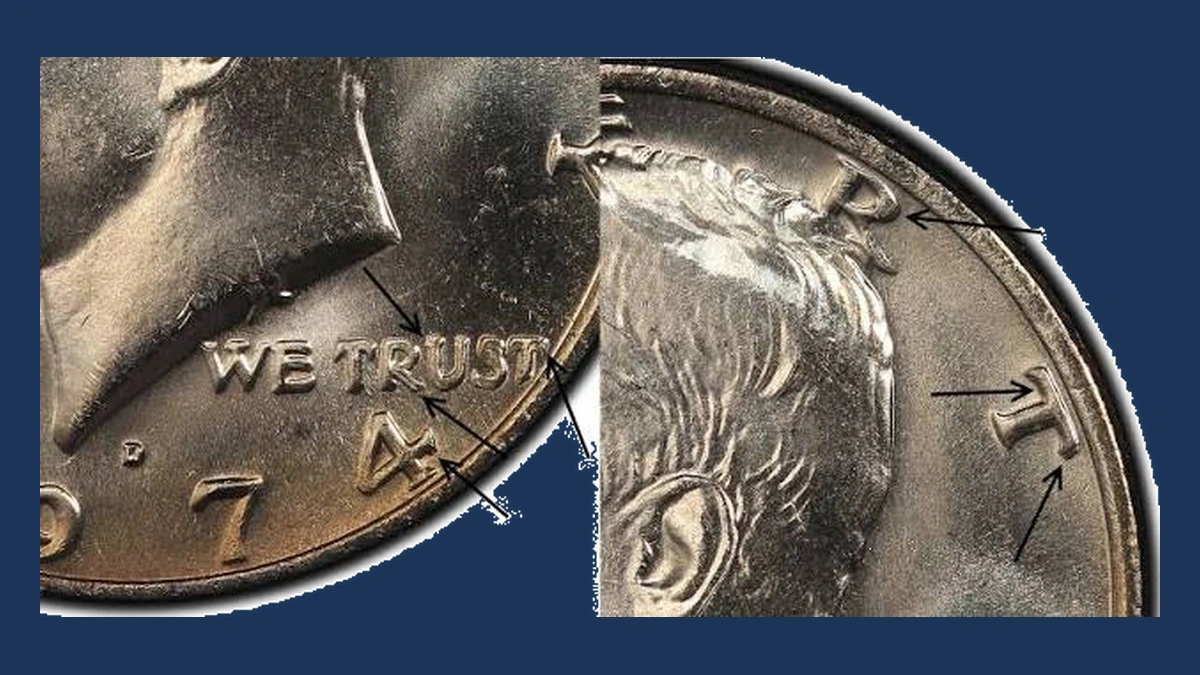
TRUST shows the most useful extra outlines on the 1974-D FS-101 doubled die. The pattern spreads counterclockwise and repeats because it was already part of the stamping tool’s design.
This variety is also called WDDO-001. A different Denver front variety carries the name WDDO-002.
Denver back doubling instead involves DOLLAR, AMERICA, and nearby stars. A San Francisco Proof has much slighter extra detail in WE TRUST.
These names describe different patterns. The strong Denver front cannot supply the identity of the subtle Proof, and the back needs its own letter-by-letter comparison.
Estimated Value
A 1974-D FS-101 graded MS66 sold for $575 in September 2005. MS66 means no circulation wear and relatively few marks.
Estimate $20–$1,000 across the listed doubled dies, with strong Denver front doubling and excellent condition supporting the higher prices. The range does not give equal value to every pattern.
A worn example, subtle back variety, or San Francisco Proof needs its own match. The old MS66 sale is not a guaranteed minimum.
How to Identify
For the strong Denver front, enlarge TRUST with a 5× to 10× magnifier. Compare the separated letter edges, then check LIBERTY, the remaining motto, and the date.
Switch photographs for the other types. Denver back doubling needs DOLLAR, AMERICA, and the stars, while the Proof needs its slight WE TRUST pattern.
Flat shelf-like doubling can appear beside real varieties, so a shelf alone is not the test. Rounded extra outlines must match the correct coin.
All normal 1974 halves use the same 11.34-gram, roughly 30.6 mm clad standard, checked with a scale and calipers. For FS-101, begin with the clear extra outlines in TRUST.
12. 1974 Kennedy Half Dollar Missing Clad Layer (Estimated Up to $1,500)
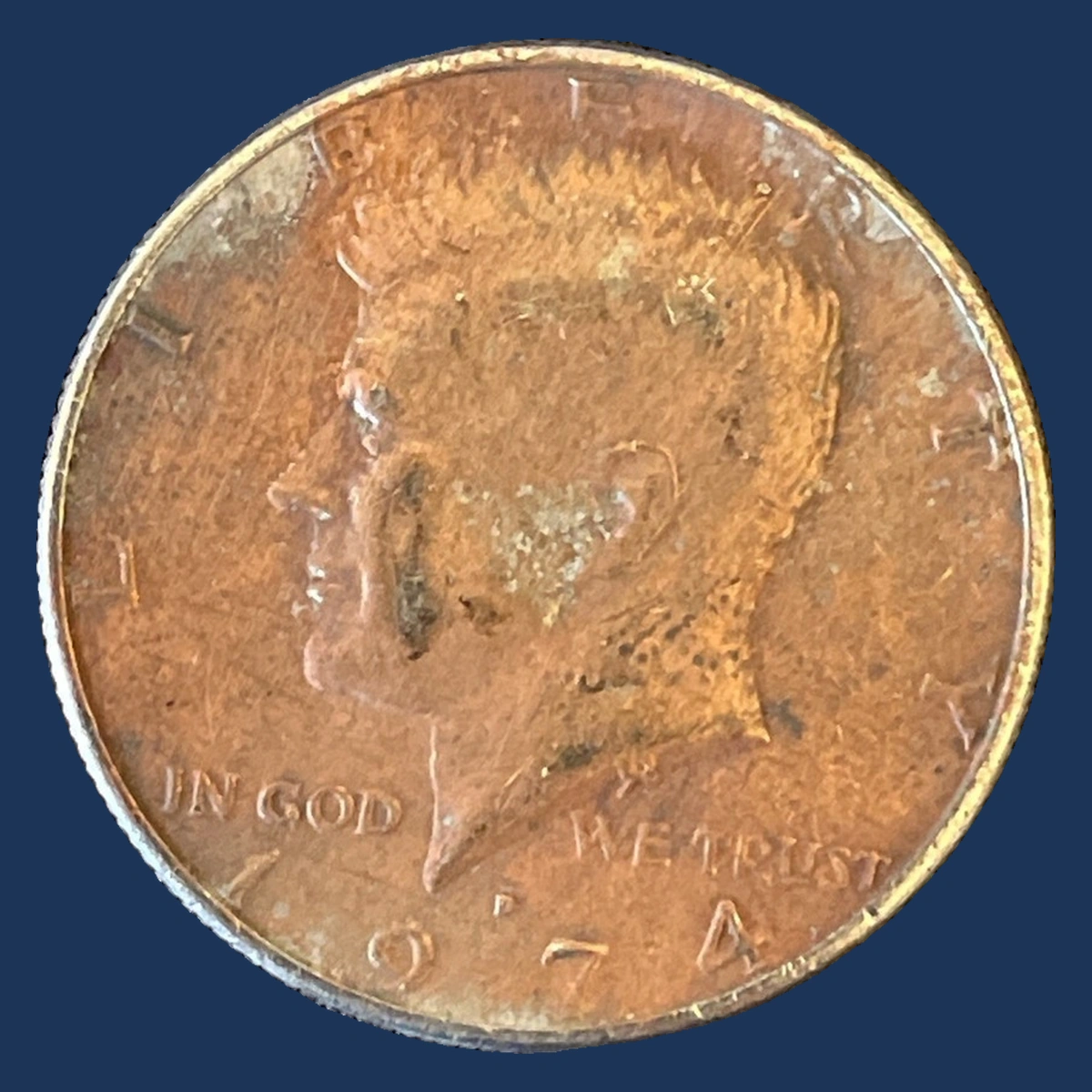
A missing outer layer can reveal the copper center of a 1974 half dollar. It does not turn the coin into one struck on a solid copper blank.
The year report describes this error without fixing a particular face, weight, or amount of lost metal. Each coin needs its own measurements.
If the outer layer was absent before striking, the design may be pressed directly into the exposed center. Metal peeled away later can instead tear through an existing design.
A brown surface alone does not settle it. Toning, chemicals, and later peeling can also change the appearance.
Estimated Value
A genuine missing-layer error is estimated at $100–$1,500, from partial exposure to a major loss. No particular 1974 sale is claimed for the reported type.
A 1998-P half with a defective front layer, graded NGC MS63, brought $149 in March 2023. That different-year example helps with a modest comparison.
A partial defect differs from an entire missing face. The upper estimate needs clear major loss and original surfaces, rather than copper color alone.
How to Identify
Weigh the coin before interpreting its brown color. A normal clad half weighs 11.34 grams; calipers compare its width with about 30.6 mm.
Use neutral light and a magnifier to follow the layer boundary into the edge. Look for a real separation, rather than an evenly stained or chemically attacked surface.
Check how the design meets the exposed metal. Details pressed into the center suggest a different sequence from peeling that cuts through finished letters.
There is no single low weight that proves every missing-layer case. Start with a visible layer boundary, then check whether the missing metal and the surviving design explain the reduced weight.
13. 1974 Kennedy Half Dollar Indent (Estimated Up to $2,000)
A depressed area covers part of the front on a half cataloged by Heritage as (1974). The parentheses matter: the year was assigned, rather than shown as a complete readable date.
The NGC MS64 coin has an indent. Another object overlapped the blank during striking and stopped the tool from reaching that area normally.
The border between the depression and the remaining design helps show what happened. It can also remove details that would otherwise identify the year.
The catalog does not identify the obstruction’s denomination or metal. Its shape alone is not enough to name either.
Estimated Value
Estimate $150–$2,000 for the cataloged indent type. Size, clear boundaries, and overall condition help determine where a particular coin fits.
No completed sale is assigned to this NGC MS64 example. The upper estimate is not a reported auction result.
Keep the parenthesized year when comparing the coin with offers. A large depression can attract more interest, but an obscured date does not justify claiming a fully readable 1974 or assigning a value by size alone.
How to Identify
Inspect the border of the depression with a magnifier, following how normal details stop where the object blocked the strike. A later hammer blow may instead crush finished lettering and push metal up around the injury.
An unstruck blank can leave a smooth or textured indent without copying another coin’s design. Recognizable backward sunken lettering would call for a brockage comparison instead.
Check the intended clad standards of 11.34 grams and about 30.6 mm with a scale and calipers, and preserve the (1974) identification. The direct first clue is an original strike interrupted at the indent boundary, without the rough displaced metal of later damage.
14. 1974 Kennedy Half Dollar Multiple Strikes (Estimated Up to $2,000)
A small second impression records another blow on a 1974 half graded NGC MS64. That second strike landed 85% off center, so only a little of it touched the coin.
The catalog does not assign a direction to that blow. Its position must be read from the actual example.
A separate coin has multiple strikes and a widened outline. NGC describes it as Uncirculated Details, meaning no circulation wear but a condition problem.
Counting-wheel marks damage both faces of that coin. Those later scratches are not extra strikes, and the broad outline reflects a separate failure of the surrounding ring.
Estimated Value
The MS64 with an 85% off-center second strike sold for $79 in December 2020. That modest result shows why a large error percentage does not guarantee a high price.
Estimated values across genuine 1974 multiple strikes range from $75–$2,000. Clear overlapping designs and good surfaces support stronger appeal.
The separate broadstruck example has counting-wheel marks and a Details grade. No sale is claimed for it, and its damaged surfaces must remain part of the price comparison.
How to Identify
Use low side lighting and a magnifier to find the small second impression. Trace a recognizable piece of lettering or portrait rather than counting every extra line.
On the broadstruck coin, inspect the expanded outline separately from the overlapping designs. Calipers can record its width against about 30.6 mm, while a scale compares weight with 11.34 grams.
Look along the edge and both faces for later pressure or added pieces. Counting-wheel scratches may cross either original impression without belonging to the striking sequence.
The quickest meaningful check is two recognizable sets of struck details, with the later blow crossing or flattening part of the earlier one.
15. 1974 Kennedy Half Dollar Wrong Planchet (Estimated Up to $3,500)
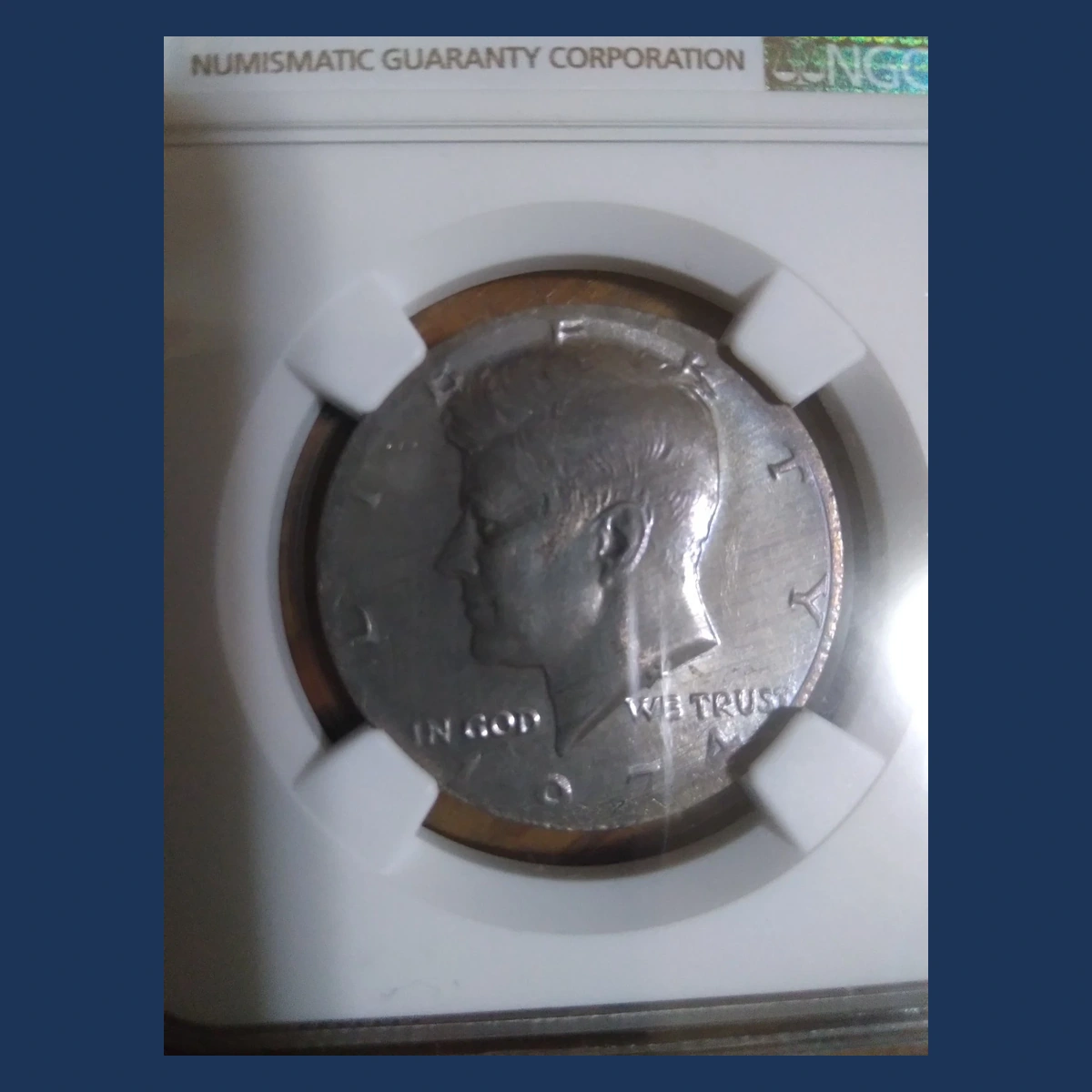
Half-dollar lettering runs beyond the edges of a blank intended for a Taiwan five-dollar coin. The U.S. Mint also made foreign coins, allowing the wrong stock to reach a half-dollar press.
Its foreign identity depends on measurements and the graded example, not small size alone. The starting metal must agree with the claimed blank.
A separate NGC MS62 was struck on a U.S. quarter blank and weighs 5.71 grams. It is not another description of the Taiwan coin.
Both small blanks lose outer design details because there is not enough room. Later cutting can create a similar cropped appearance.
Estimated Value
A Taiwan-blank PCGS AU55 sold for $2,880 in September 2023. A separate NGC MS64 weighing 9.6 grams brought $660 in September 2019.
The quarter-blank MS62 sold for $630 in August 2022. Estimated values for these wrong-blank forms are $400–$3,500.
The different results show why a higher grade does not always mean a higher price. Keep each coin’s metal, measurements, and auction history together when making comparisons.
How to Identify
The quarter-blank coin’s measured 5.71 grams is close to a quarter’s normal 5.67 grams. Compare that with the half dollar’s 11.34 grams on a scale.
A quarter blank starts near 24.3 mm, compared with about 30.6 mm for a half. Calipers record any spreading during the strike.
Use a magnifier on the edge to rule out filing around a finished half. For the Taiwan examples, compare with the correct grading photographs and recorded measurements.
The MS64’s 9.6 grams must not be assigned to the AU55. Begin with original cropped design and matching blank measurements; disputed foreign metal needs professional testing, not a guess from size.
16. 1974 Kennedy Half Dollar Brockage (Estimated Up to $5,000)
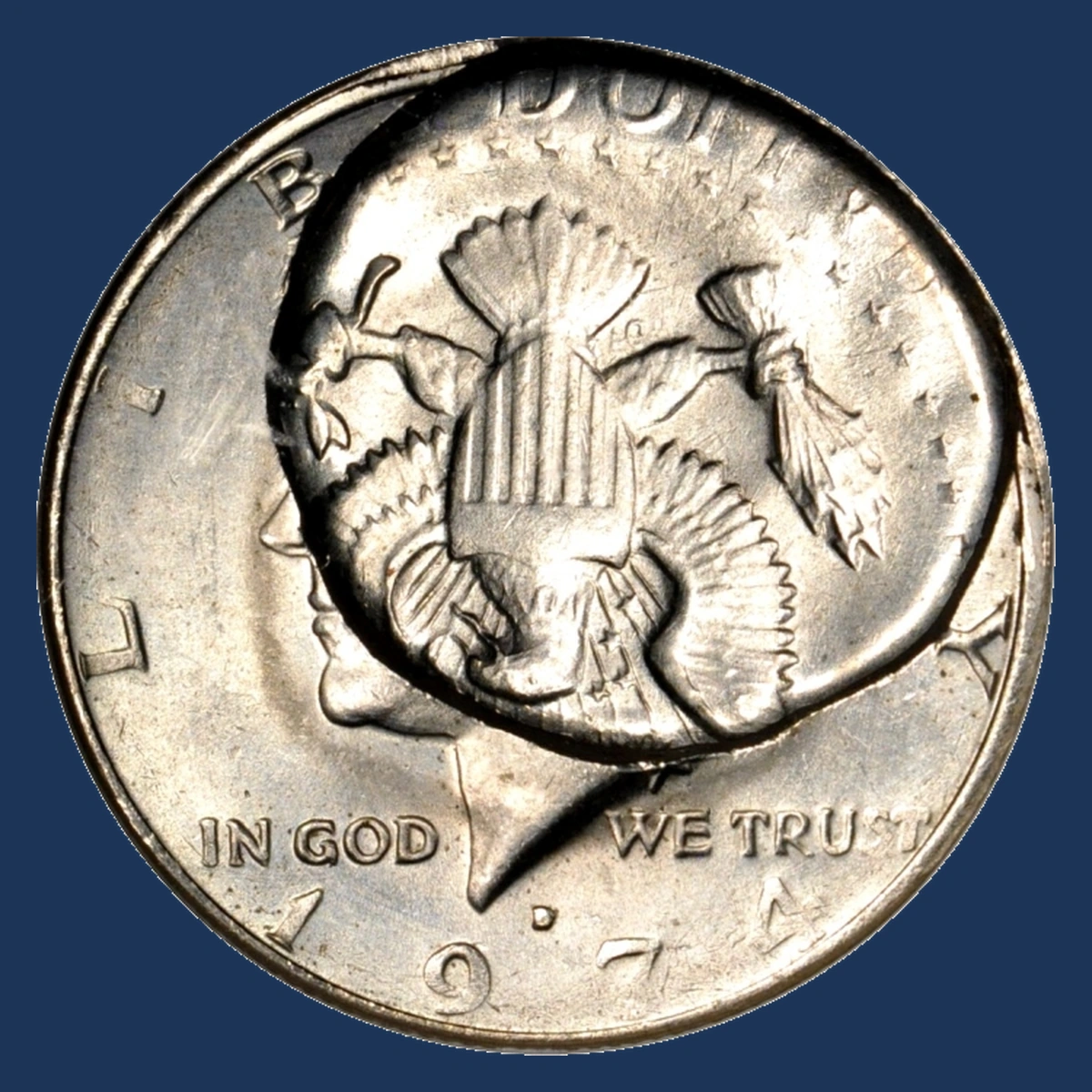
An unusual 1974-D half received a backward design from a small coin caught in the press. That obstruction carried a half-dollar design already struck on a cent blank.
The receiving coin remained an ordinary-sized half dollar. It was not itself struck on cent metal.
The ANACS MS62 account describes this small wrong-blank coin pressing its design into the half’s surface. Collectors call the backward, sunken copy brockage.
A separate NGC AU58 has a simpler front brockage plus an edge step from incomplete contact with the surrounding ring. It should not be confused with the unusual Denver sequence.
Estimated Value
The NGC AU58 front brockage with an edge step sold for $125 in June 2024. Comparable ordinary examples are estimated at $100–$600, depending on the copied design and condition.
The reported Denver ANACS MS62 has a more unusual obstruction and an estimated range of $1,500–$5,000. No sale is claimed for that specific coin.
The simpler AU58 result cannot set its transaction price. The high estimate depends on the documented wrong-blank connection, not just a sunken patch.
How to Identify
Look for recognizable backward design pressed below the surface with a magnifier. A plain smooth depression shows an obstruction, but not necessarily contact with an already struck coin.
For Denver’s unusual example, compare with the Mint Error News photographs. The small obstruction carried a half-dollar design, not Lincoln’s portrait.
The receiving half normally weighs 11.34 grams and measures about 30.6 mm. A scale, calipers, and edge views help keep that full-sized host separate from the cent-sized object.
Check any edge step as its own feature. The first brockage clue remains clearly readable backward design sunk into the receiving coin’s metal.
Conclusion
Estimated 1974 half-dollar error values range from $5 to $5,000. Weak initials sit near the modest end, while rare wrong-blank and backward-design combinations can be worth much more.
Choose the check that fits what you see. Compare a suspicious letter under changing light, inspect an unusual edge, or weigh a small coin before naming its blank.
Clear photographs and the correct comparison make price estimates more useful.