1961 Half Dollar Error List with Pictures

A 1961 half dollar with strongly doubled back lettering sold for $15,000 in November 2020. It was a Proof, a specially made collector coin, graded PR68 for its excellent condition.
The 1961 Franklin half dollar errors below range from small peeling areas to pictures stamped on the wrong metal blanks. Their estimated values stretch from $50 to $20,000.
Read on to find the visible clues and compare each error with the right kind of coin.
1. 1961 Franklin Half Dollar Lamination (Estimated Up to $300)
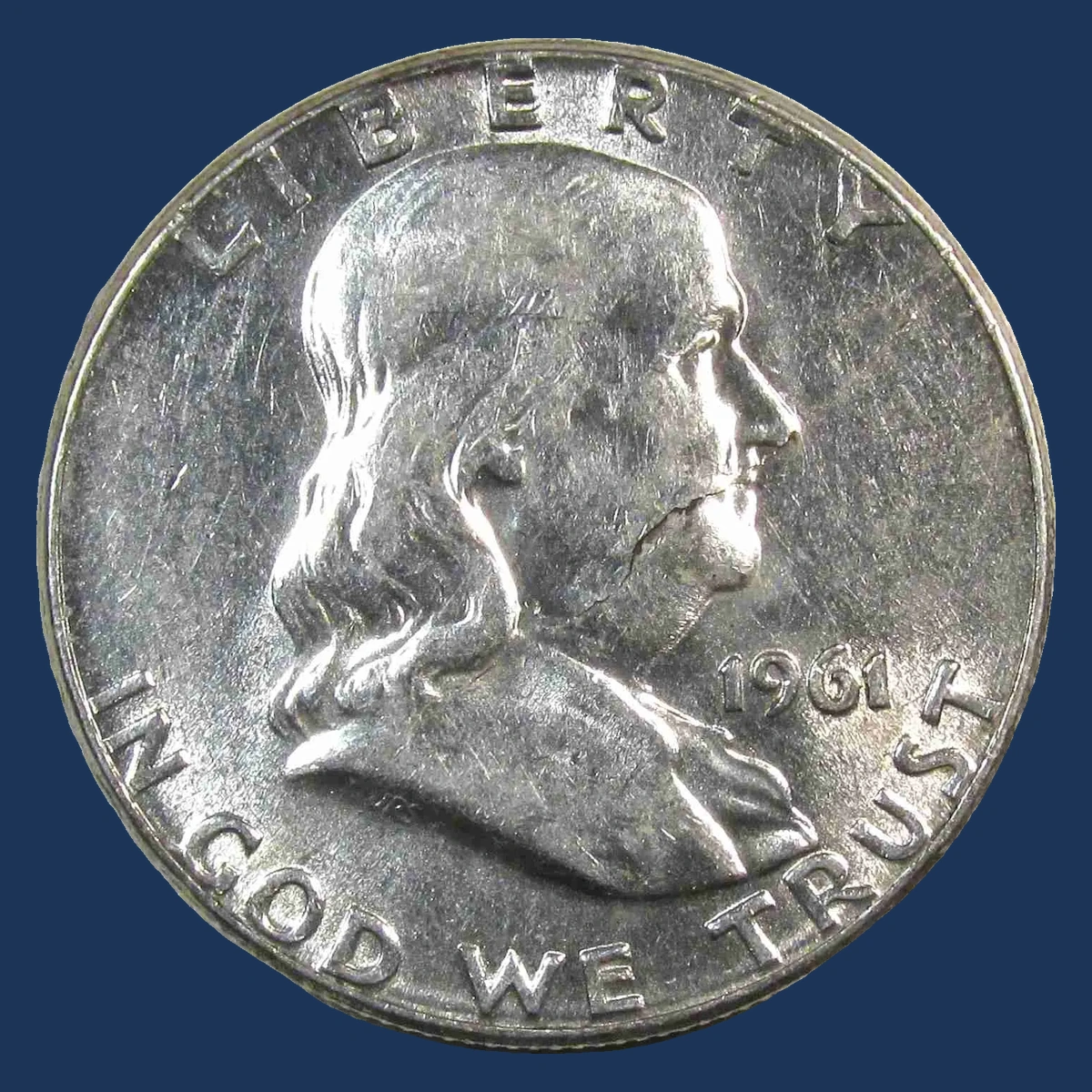
A thin layer of metal can lift from a 1961 half dollar. This peeling is called a lamination, and an example appears in Jeffrey Hoare’s 2002 auction catalog.
The catalog does not identify its exact position or say which face is affected. A photograph from another year cannot locate that mark.
The coin contains 90% silver. A weak bond inside its metal can let a small layer separate while most of the coin stays together.
A flap may remain attached, or it may fall away. This local peeling differs from a blank that splits through its thickness before stamping.
Estimated Value
Estimate $50–$300 for a visible local lamination on a worn to ordinary unworn coin. No sale amount from the 2002 catalog is used here.
A 1957 Franklin graded NGC MS63 sold for $74.49 including the buyer’s fee in January 2021. That was a different-year lamination.
It helps compare a modest error. A larger attached flap or a more visible break across the picture may change the price within the estimated range.
How to Identify
Leave any attached flake where it is. Through a 10× magnifier, look for a thin overhanging edge or a clear boundary between layers.
Scratches and corrosion pits can make a coin rough without separating a layer. Photograph the surrounding picture while moving the light to show any depth.
Check the edge grooves and the mintmark area on the back. The short catalog description does not settle which mint made the reported coin.
When safely accessible, use a scale and calipers against 12.50 grams and about 30.6 millimeters. An attached layer may leave the weight nearly normal; follow the seam where the thin layer meets the original stamped surface.
2. 1961 Franklin Half Dollar Clipped Planchets (Estimated Up to $400)
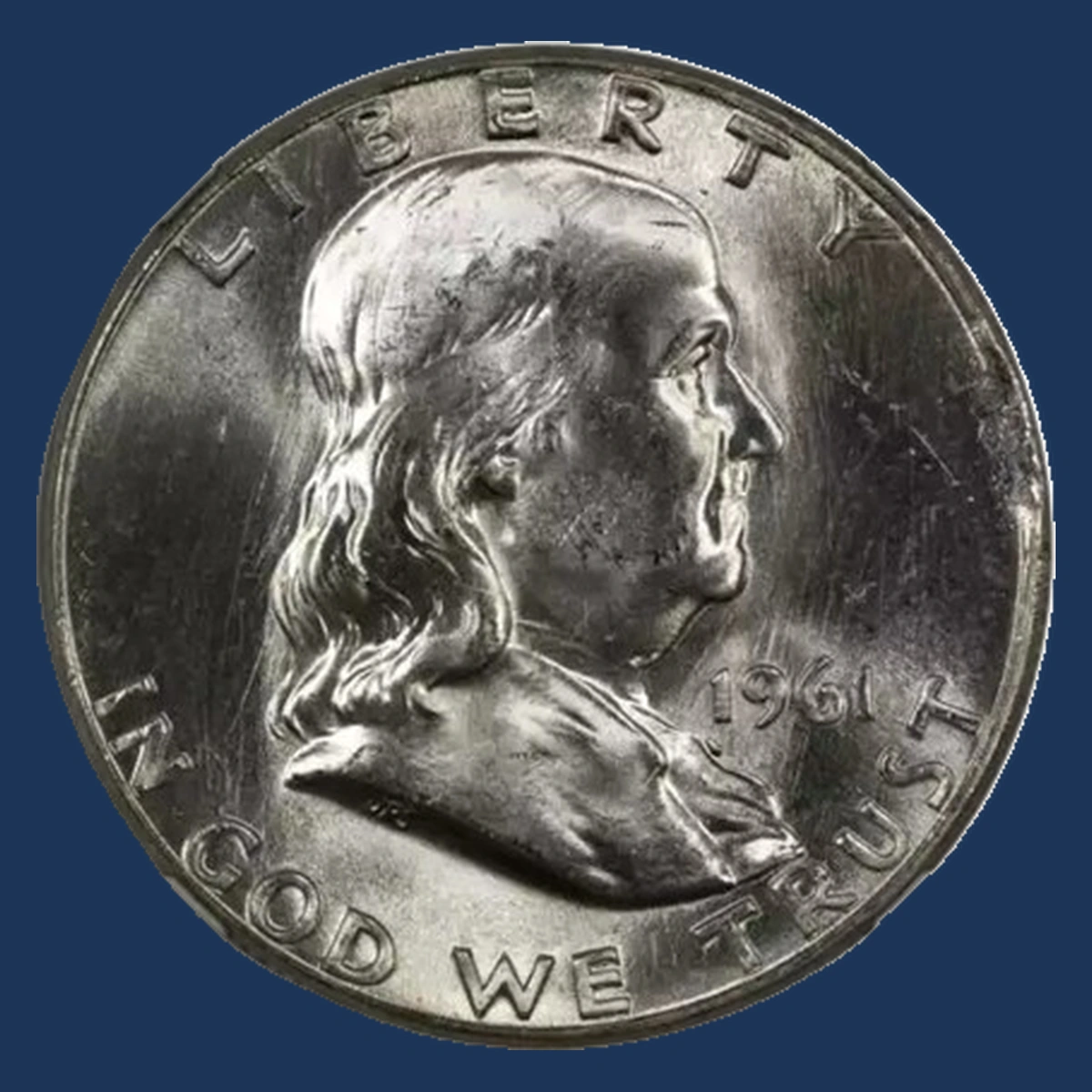
A tiny gap may remove almost no measurable weight. A 1961-D curved clip graded ANACS MS63 weighed 12.48 grams, close to the normal 12.50 grams.
Other examples have different outlines. Records include a Denver ANACS MS63 rim clip and a PCGS MS62 double clip totaling four percent.
Collectors also list separate Philadelphia clip and rim-clip coins. Their grades and gap shapes should not be mixed together.
Each error began with an incomplete metal blank before stamping. Two gaps still belong to one coin, and a small rim clip need not look like a large curved bite.
Estimated Value
Estimate $60–$400 for ordinary collectible clips. Size, condition, and the appearance of the original gap affect the price.
A Heritage lot sold for $120 in 2021 contained two straight clips. One was a 1958 PCGS MS63; the other was a 1961 ANACS MS63.
The $120 covered both coins, not either one separately. More noticeable gaps may bring more, but two clips on one coin should still receive one total valuation.
How to Identify
Do not reject a small clip just because its weight is almost normal. The known Denver curved example weighed 12.48 grams against the usual 12.50 grams.
Record the scale reading, then use a 10× magnifier at both ends of the gap. Look for details that spread around the missing area during stamping.
Calipers across intact sections should be compared with about 30.6 millimeters. Check the surviving edge grooves and look opposite the gap for possible rim weakness.
On a double clip, examine both openings separately. The most useful clue is an old gap with naturally stamped edges, rather than a sharp cut through an already finished picture.
3. 1961 Franklin Half Dollar Repunched D Mintmark (Estimated Up to $600)
An extra piece of the letter D may sit beside the mintmark above the bell. Repeated hand punching could leave two overlapping letters in the steel stamping tool.
The tool would then pass that extra raised outline onto coins. Collectors call this a repunched mintmark.
A collector describes the feature on a PCGS MS65 1961-D. The unworn grade describes condition; it does not by itself confirm the mintmark variety.
Another owner reports a possible extra D on a coin with weak detail near the bell’s clapper. That separate coin is discussed below, and it does not inherit the MS65 grade.
Estimated Value
Estimate $75–$600 for a clearly identified minor repunched D on a collectible 1961 half. PCGS records a different 1952-S FS-501 repunched-mintmark MS65 sale at $590 in May 2021.
That transaction belongs to the earlier coin, not the owner’s 1961 example. It provides a comparison within the Franklin series.
The extra mark must resemble an earlier letter. A flat shelf or a small lump inside the D does not automatically deserve the same added value.
How to Identify
Find the D above the wooden support at the top of the bell. Use a 10× magnifier to inspect its straight stem, curved side, and nearby flat surface.
Compare with photographs of the same-year half-dollar variety. A Denver cent or another Franklin date cannot provide the exact match.
Check the edge grooves and, when safely accessible, use a scale and calipers against 12.50 grams and about 30.6 millimeters. Photograph any grading label without assuming it confirms the owner’s variety claim.
A flat extension along many raised details may come from movement during stamping. Look for a separate rounded stroke that fits part of an earlier D.
4. 1961 Franklin Half Dollar Struck-Through Errors (Estimated Up to $800)
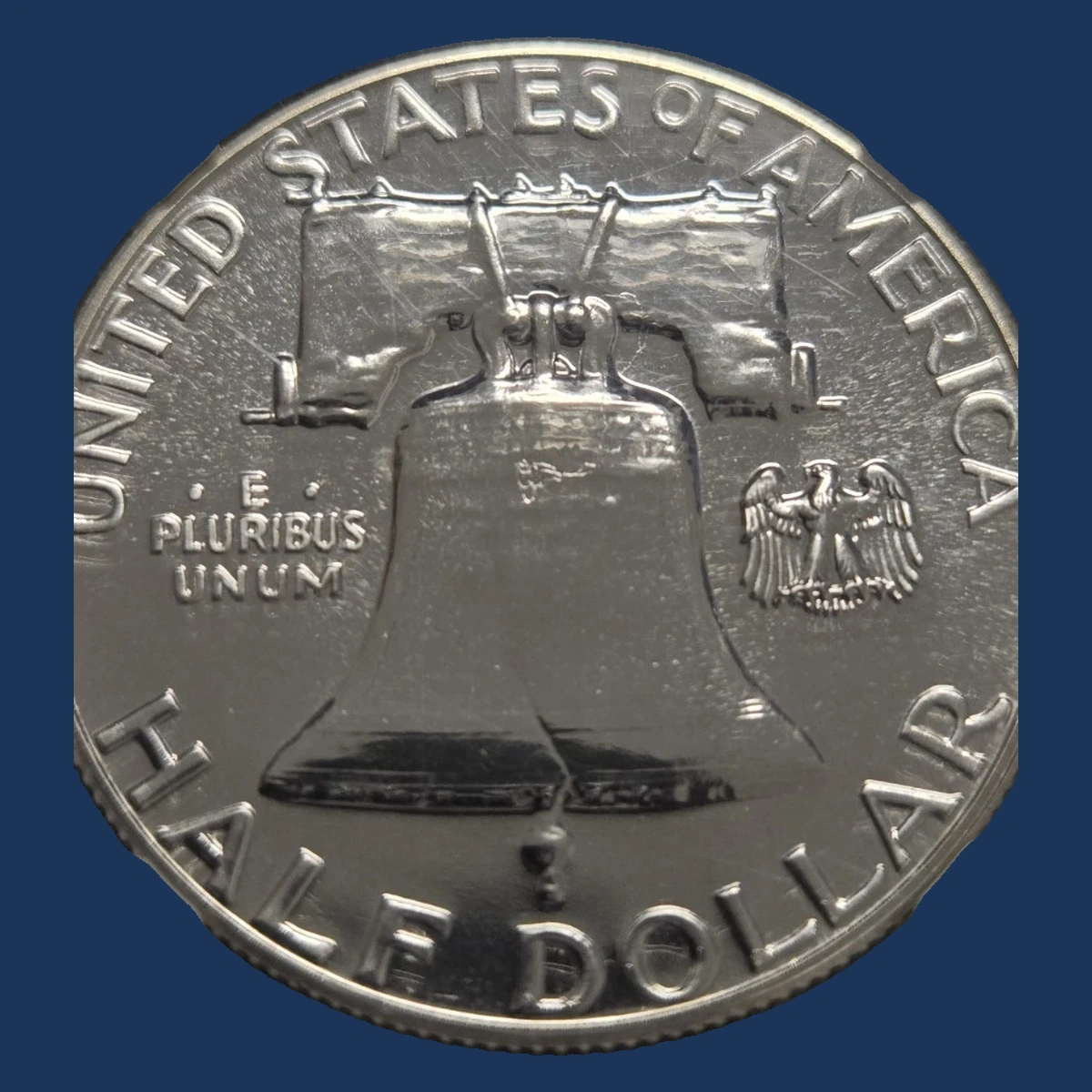
Part of the picture can fail to form when material blocks the stamping tool. This is called a strike-through.
An auction index lists a Philadelphia Proof 66 with the error on the front. A seller describes a separate PF67 Proof with it on the back.
An owner reports weak detail near the clapper on a regular Denver coin, possibly caused by grease. The same owner also suspects a repunched mintmark.
The reports concern three different coins. They do not show that the same material caused every mark, or that the Denver coin has either Proof grade.
Estimated Value
Estimate $50–$200 for minor weakness on a circulation coin. Clear impressions on Proof coins may fall around $100–$800.
A different 1951-S Franklin graded NGC MS64 is recorded at $134 in April 2026 for a strike-through. That offers a recent comparison for an ordinary circulation issue.
The Proof finish and a stronger impression can increase appeal. On the Denver report, consider the possible extra mintmark within one whole-coin price rather than adding two separate coin values.
How to Identify
For a Proof, first check whether the mark is on the coin or its holder. Change the light angle while viewing the affected face through a 10× magnifier.
Do not borrow the location from the other Proof example. Cloth or wire requires a recognizable impression, not just a vague hollow.
These halves normally weigh 12.50 grams, measure about 30.6 millimeters, and have edge grooves. Use a scale and calipers only when safely accessible.
On the Denver report, inspect the clapper separately from the D mintmark. Compare the weak patch with the nearby bell: look for missing detail surrounded by sharply stamped surfaces, without scraping or rubbed-down high spots.
5. 1961 Franklin Half Dollar Struck on a Split Planchet (Estimated Up to $1,200)
This half dollar weighs just 6.0 grams, less than half the normal weight. Its metal blank had split before the remaining piece received the design.
The Heritage example is described as struck on a split planchet. Planchet means the metal disc before stamping.
A specialist published a separate 1961 example with a rough front surface exposed by the split. The descriptions do not show that these are the same coin.
A thin piece can still be as wide as a normal half dollar. That helps distinguish it from a smaller quarter blank carrying only part of the picture.
Estimated Value
The 6.0-gram NGC example sold for $408 on July 15, 2021. Estimate $300–$1,200 for comparable pieces with original surfaces and readable detail.
The catalog gives no numerical grade for that coin. A different 1960 Franklin split-blank example brought $630 in June 2023.
That earlier-date sale provides another comparison. Its weight and appearance need not match the 1961 coin, so condition and the visible split surface still matter.
How to Identify
Check thickness as well as weight. The recorded 6.0 grams contrasts with a normal 12.50-gram half, but low weight alone does not explain what happened.
Use calipers against the normal diameter of about 30.6 millimeters. A thin, full-sized half differs from a coin stamped on a smaller quarter blank.
Under a 10× magnifier, inspect the rough face, the edge, and any surviving grooves. Grinding and chemical damage can remove metal after minting.
The timing matters: a later split exposes an inner surface that was never stamped. Look for actual letters or picture details pressed into the rough split surface, showing that it was exposed before the strike.
6. 1961 Franklin Half Dollar Bugs Bunny Die Clash (Estimated Up to $2,000)
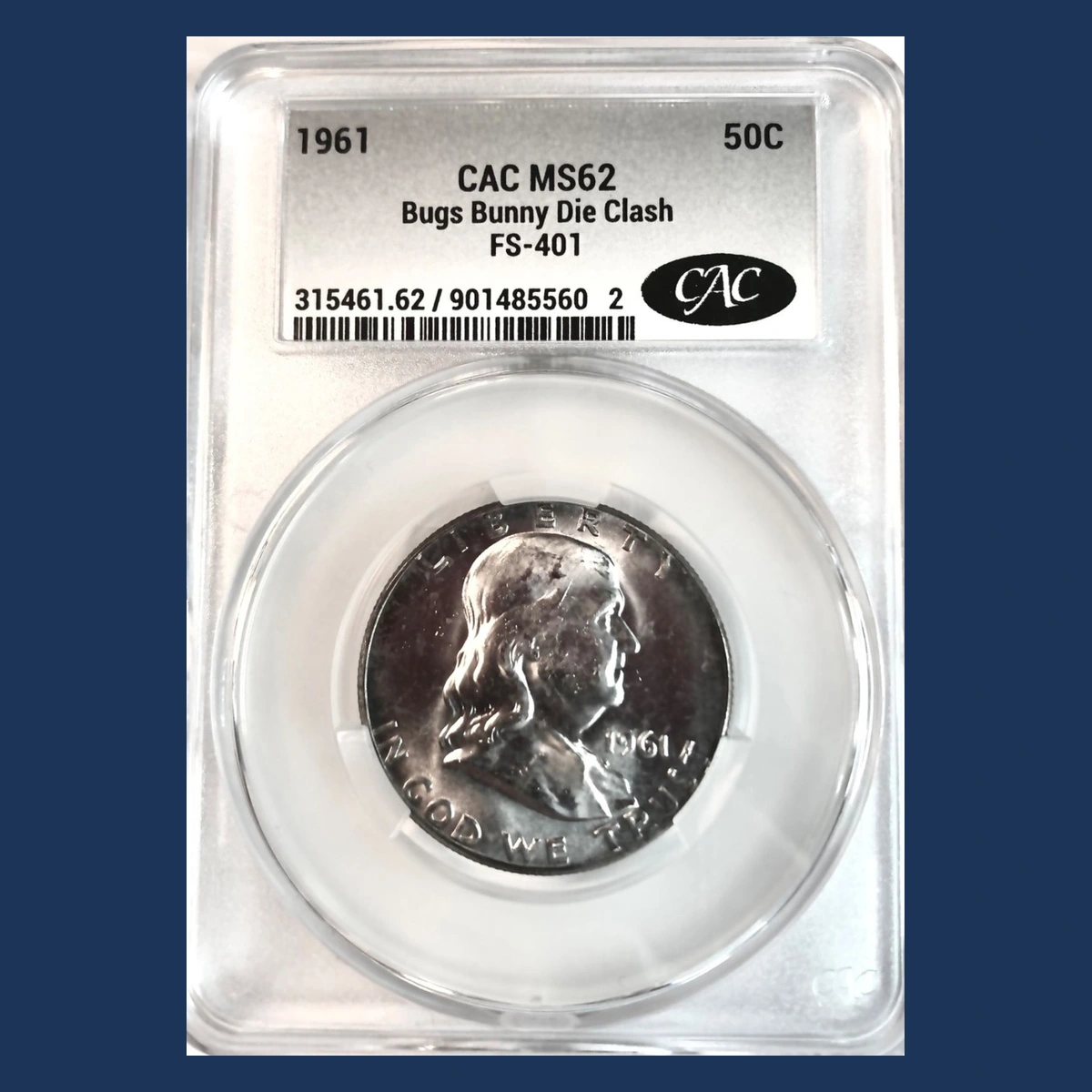
Little raised projections at Franklin’s upper lip give the Bugs Bunny variety its name. On the 1961 Philadelphia FS-401, they came from a clash.
A clash happens when the dies, the steel tools that stamp coins, hit without a blank between them. One tool picks up part of the opposite picture.
Later coins receive the unwanted shape along with their normal design. This recognized variety belongs to regular circulation strikes.
It does not automatically identify a Denver coin or a Proof. Other Franklin years share the nickname, so their mouth pictures cannot replace a clear 1961 comparison.
Estimated Value
A PCGS MS64 FS-401 sold for $250 in April 2018 at David Lawrence Rare Coins. Estimate $150–$800 for ordinary recognized examples.
Exceptionally well-preserved coins may fit a broader estimated $800–$2,000 range. That upper range is not a second recorded sale.
The entire coin needs to support a high price. Attractive surfaces and a sharp strike matter; two small marks near the mouth do not automatically make any 1961 half worth thousands.
How to Identify
Check the 1961 date and look above the bell for a mintmark. The Philadelphia variety has no D in that space.
A normal silver half weighs 12.50 grams and measures about 30.6 millimeters. Check with a scale and calipers when safely accessible, and inspect the grooves around the edge.
Now magnify Franklin’s upper lip and compare a recognized 1961 FS-401 photograph. A hit can push silver into a toothlike shape but usually leaves disturbed metal nearby.
Do not substitute a photograph of the more familiar 1955 variety. Look for the same raised mouth projections as the correct-year coin, without a nearby dent that explains them as damage.
7. 1961 Franklin Half Dollar Broadstrike Candidate (Estimated Up to $2,500)
A broadstrike has a complete picture on metal that spread wider than normal. The collar, a ring that controls the coin’s width during stamping, failed to hold it.
A 1961 year guide lists the error without identifying a specific original example. The description gives something to check, not a documented auction coin.
Width alone is not enough. The full outer design should remain visible on metal that spread during the strike.
An off-center strike loses part of the picture beyond the blank. Hammering a finished coin can also make it wider, but usually crushes details already on its surface.
Estimated Value
A genuine 1961 Franklin broadstrike has an estimated range of $400–$2,500. This is not a recorded price for a specific 1961 example.
A different 1903 Barber broadstrike brought $690 in July 2006. It was graded ANACS AU50 Details and had been cleaned.
That earlier series offers a silver-half comparison with obvious limits. A cleaner Franklin with more visible spreading may bring more, once its original mint-made expansion is confirmed.
How to Identify
Follow the outer lettering around both faces. Every intended part of the main picture should remain present, even though metal has spread beyond it.
Use calipers across several directions and compare with the normal 30.6 millimeters. A scale reading near the original 12.50 grams can fit expansion without metal loss.
Those readings also need a surface check. A later hammer blow can spread a coin while crushing its finished picture.
Through a 10× magnifier, examine the edge for incomplete grooves and later tool marks. Look for a complete, uncrushed design inside naturally spreading metal, with an edge that was not fully held by the normal ring.
8. 1961 Franklin Half Dollar Reported Off-Center Strike (Estimated Up to $6,000)
A blank crescent can sit beside a picture pushed toward the opposite edge. The metal disc was partly outside the stamping position when the tools came down.
The 1961 year guide reports off-center halves without naming a mint, finish, or exact percentage. Those details cannot be added to an unidentified coin.
Both faces should show matching displacement. Parts of the outer design never reached the metal and are missing.
An uneven rim on just one face can have another cause: one stamping tool shifted sideways. A photograph taken at an angle can also make a centered coin look misleading.
Estimated Value
Estimate $1,000–$6,000 for a genuine 1961 off-center Franklin with an obvious shift and readable date. No fixed percentage is assigned to the general report.
The January 2025 Mint Error News guide lists Barber halves struck 10–15% off-center at about $4,000 in XF/AU. Those grades describe worn to nearly unworn coins.
That is a guide value for another series, not a 1961 sale. A slightly uneven rim does not qualify for this major-error range.
How to Identify
Photograph each face straight on, with its design upright. Mark where the stamped picture ends and the untouched metal begins.
Use a 10× magnifier on the surviving date and mintmark area. Missing details cannot be filled in by guessing Philadelphia or Denver.
Calipers can record the outline against a normal width of about 30.6 millimeters. A scale should remain broadly consistent with the original 12.50 grams, since displacement alone removes no metal.
Check the remaining edge grooves for cutting or filing, and look for any second strike. The key view shows one shifted picture on each face, beside a real unstamped crescent opposite the missing design.
9. 1961 Franklin Half Dollar Proof Doubled Die Reverse (Estimated Up to $15,000)
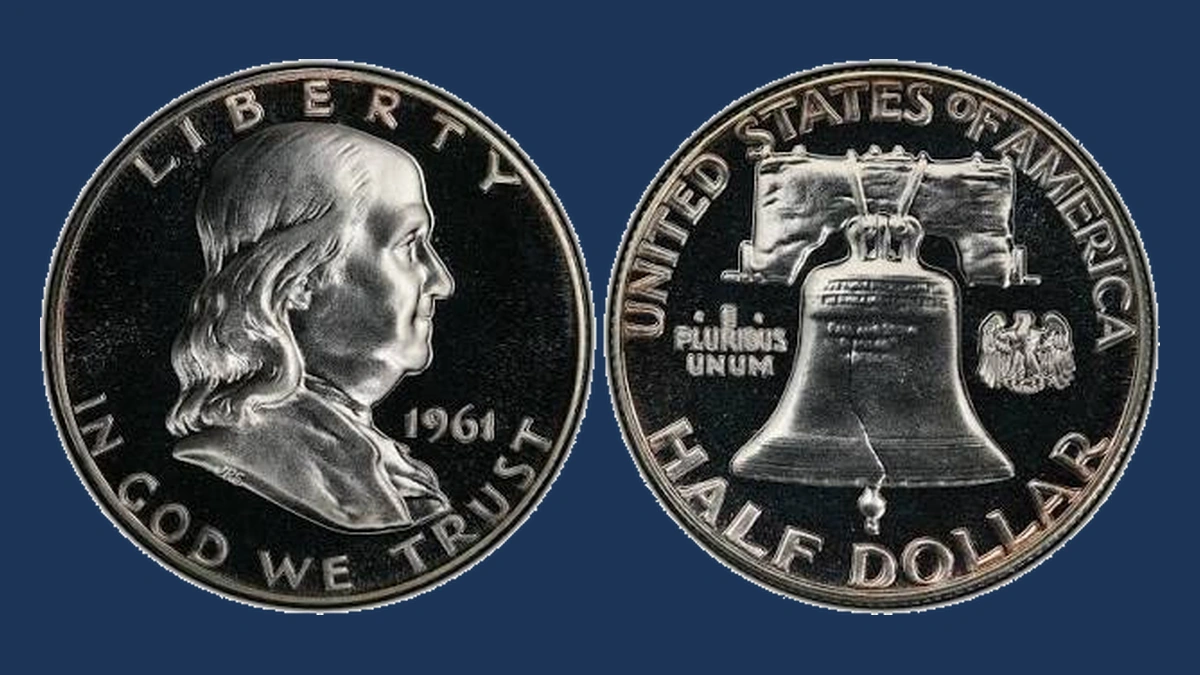
The back lettering looks plainly doubled on the strong 1961 Proof variety. Extra outlines stand out in E PLURIBUS UNUM, UNITED STATES, and HALF DOLLAR.
The repeated design formed in the steel stamping tool before it made the coins. The same pattern could therefore appear on more than one Proof.
PCGS distinguishes this dramatic variety from weaker doubled backs dated 1961. The name FS-801 belongs to the matching strong pattern, not any thick-looking letter.
Proofs normally receive repeated blows to bring up sharp detail. Those blows alone do not explain a repeated pattern already present in the tool.
Estimated Value
Estimate $2,500–$15,000 for ordinary Proofs clearly matching the strong variety. PCGS records a $15,000 PR68 sale at Stack’s Bowers on November 18, 2020.
Weaker doubled varieties from the same year need different comparisons. So do Cameo coins, whose frosted pictures contrast with shiny surrounding areas.
The range above is for the strong doubled back. Reflections, flat shelves from striking movement, or one thick letter do not qualify for the same price.
How to Identify
Start at E PLURIBUS UNUM, then compare UNITED STATES and HALF DOLLAR through a 10× magnifier. The strong variety repeats raised letter outlines across these areas.
Use the PCGS photographs to match the pattern. Move the lamp so reflections shift away from the letters.
Keep a sealed Proof holder closed. When safely accessible, compare scale and caliper readings with 12.50 grams and about 30.6 millimeters, and inspect the edge grooves.
A flat shelf can make a letter look doubled while reducing its original shape. Look for a separate raised outline that stays under changing light and matches across all three named inscriptions.
10. 1961 Franklin Half Dollar Wrong-Planchet Strikes (Estimated Up to $20,000)
A known Denver example holds half-dollar pictures on just 3.1 grams of copper-alloy metal. The blank was intended for a cent.
NGC graded the coin MS67 Red Brown. Its full date and D survive, along with WE TRUST and much of the eagle, despite the missing outer design.
Other records describe separate Denver quarter and nickel blanks. Philadelphia quarter- and nickel-blank examples are also reported.
These smaller blanks need not have been finished coins first. A genuine wrong-blank half does not require Lincoln or Jefferson underneath; its metal and oversized Franklin picture tell the story.
Estimated Value
Estimate $1,500–$5,000 for quarter blanks, $3,000–$8,000 for nickel blanks, and $8,000–$20,000 for cent blanks. The visible date and condition affect each range.
Stack’s Bowers cites a 1961-D cent-blank PCGS MS64 Red Brown sale at $9,400 in August 2013. That was not its separately cataloged MS67 coin.
A 1958-D quarter-blank NGC MS62 brought $1,440 in December 2020. This different-year sale helps compare the less expensive quarter-blank type.
How to Identify
Weigh the coin and measure it with calipers when safely accessible. Normal halves start at 12.50 grams and about 30.6 millimeters.
Cent blanks start near 3.11 grams and 19.05 millimeters; nickel blanks are 5.00 grams and 21.21 millimeters. Silver-quarter blanks are 6.25 grams and about 24.3 millimeters.
Stamping can spread these smaller blanks. Under a magnifier, check the date, mintmark, incomplete picture, and edge for signs of later trimming.
The smaller blank may never reach the ring that forms normal half-dollar edge grooves. Compare the Denver cent-blank example, looking for the large Franklin design ending naturally on metal whose weight and color fit the smaller blank.
Conclusion
A light 1961 half dollar needs more than a scale reading. A thin split blank and a small quarter blank can weigh similar amounts but carry different-sized pictures.
Prices here range from an estimated $50 to $20,000. Match the visible error, finish, and condition before comparing amounts.
Doubled Proof lettering and Bugs Bunny mouth marks come from different events. Each needs its own price comparison.