1959 Half Dollar Error List with Pictures

A small copper blank meant for a cent received Franklin’s portrait instead. The resulting 1959-D half-dollar error sold for $7,590 in 2006.
Other 1959 Franklin Half Dollar errors have peeling silver, a swollen throat, or two overlapping designs. A separate ten-gram coin with faulty metal brought $540 in 2021.
Estimated ranges below span $40–$14,000. Read on to compare the material and visible feature before choosing a price bracket.
1. 1959-D Franklin Half Dollar Reverse Strike-Through (Estimated Up to $150)
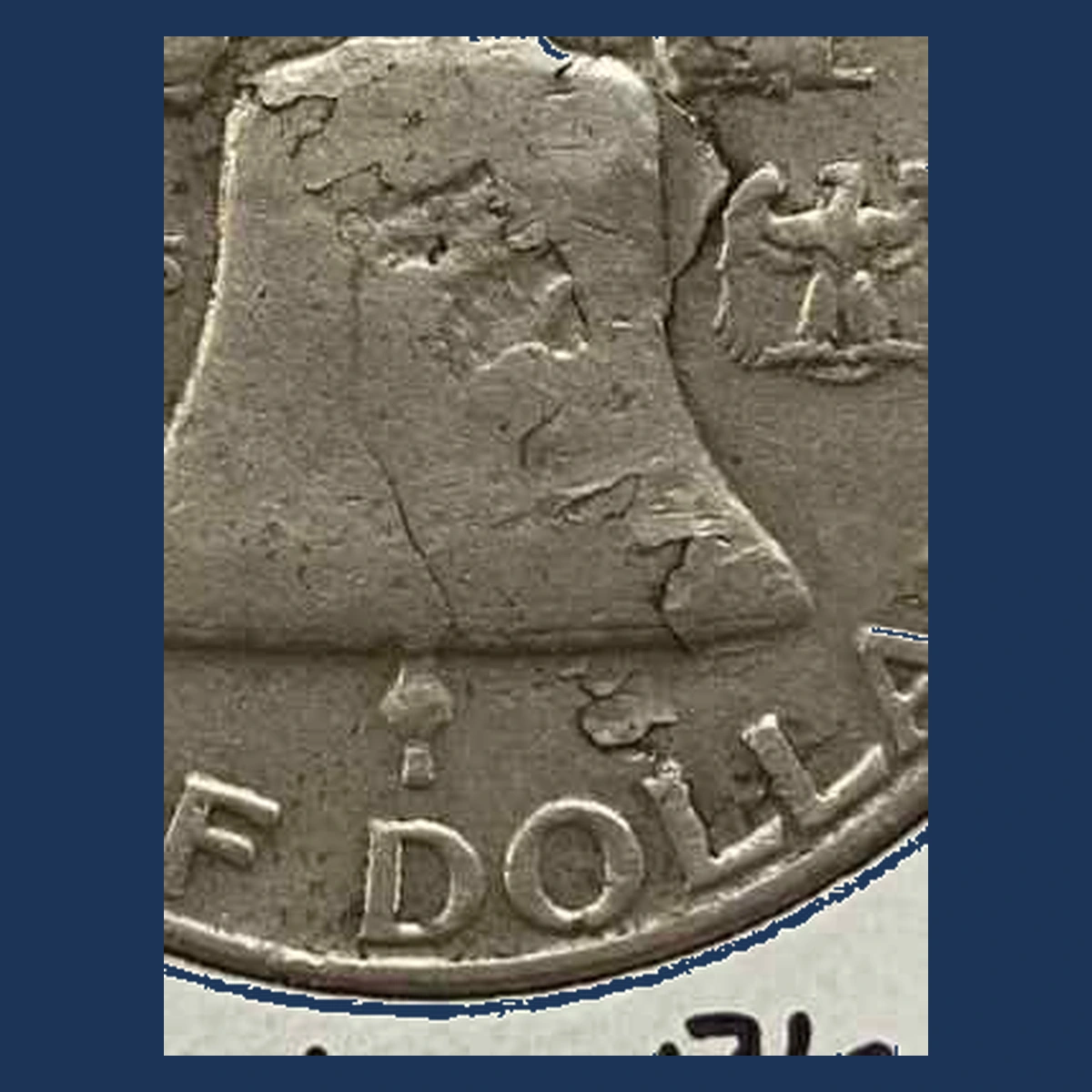
A small depression near A in AMERICA is the clue on this reported 1959-D. The year guide describes an MS64 example, an unworn coin with some noticeable marks.
It calls the feature a strike-through. Material blocked the die, the steel tool that stamps coins, while the design was being formed.
Such an obstruction can leave a hollow or prevent detail from appearing. A later blow instead damages design that is already present.
The report does not name the material. Calling it wire or grease would add a detail that the small mark alone may not establish.
Estimated Value
The year guide reports a sale around $80 for the MS64 example. It does not give the original transaction reference, so that figure remains a reported sale.
An estimated $50–$150 suits a similarly modest genuine mark on an attractive Denver coin. Clear margins and overall preservation affect the comparison.
A much larger impression needs its own price reference. The same applies when an object remains attached to the coin.
How to Identify
Look near A in AMERICA with a 10× magnifier and low light. Check whether the surrounding design formed naturally against the hollow or was cut and pushed aside afterward.
A scratch may continue across several design parts with a sharp channel. An original obstruction interrupted their formation instead.
Confirm D above the bell and inspect the edge grooves. Use a digital scale and calipers when safely accessible against 12.50 grams and about 30.6 millimeters; a depression need not mean metal was lost.
The localized mark with margins consistent with stamping is the useful match. Its outline alone does not identify the material that blocked the die.
2. 1959 Franklin Half Dollar Bugs Bunny Die Clash (Estimated Up to $200)
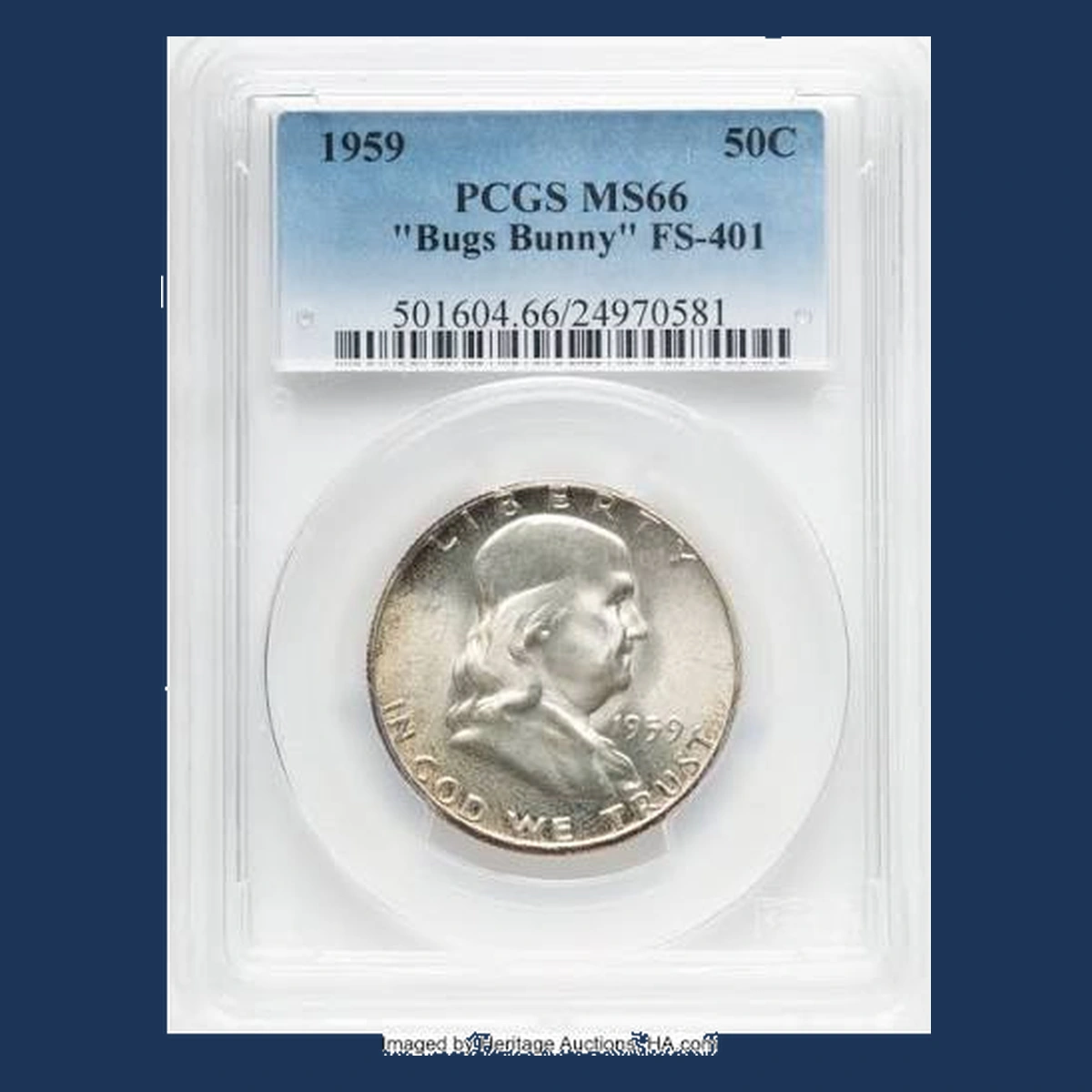
Franklin appears to have a protruding tooth on this Philadelphia variety. The extra shape at his upper lip comes from part of the eagle’s wing on the other die.
The dies hit each other with no metal blank between them. That contact marked the front die, and later coins picked up the unwanted shape.
This is a die clash. Bugs Bunny is the nickname for its toothlike effect, not a planned change to the portrait.
Other Franklin dates carry the same nickname. Their photographs cannot replace a correct 1959 comparison, including the original surface around the mouth.
Estimated Value
An estimated $40–$200 covers recognizable worn through ordinary unworn examples. PCGS records an MS64 sale for $122 in August 2013.
That historical comparison is from 1959, not the better-known 1955 variety. Exceptionally preserved coins with sharp, complete bell lines can exceed this ordinary bracket.
Those lines describe design quality, not another error. A fine grade alone cannot turn a scratch or attached particle at the lip into Bugs Bunny.
How to Identify
Keep Franklin upright and inspect the upper lip through a 10× magnifier. A genuine extra shape should rise as part of the design, rather than sit on it as a loose speck.
Philadelphia regular issues have no mint letter above the bell. Check the edge grooves and use a digital scale and calipers on accessible coins against 12.50 grams and approximately 30.6 millimeters.
Compare the mouth with a recognized 1959 example. Consider how the eagle’s wing supplied the shape, while checking for fresh cuts or disturbed surface nearby.
The matching raised lip projection identifies this clash. A general resemblance to teeth, without the right shape and original surface, is less useful.
3. 1959 Franklin Half Dollar Obverse Lamination (Estimated Up to $650)
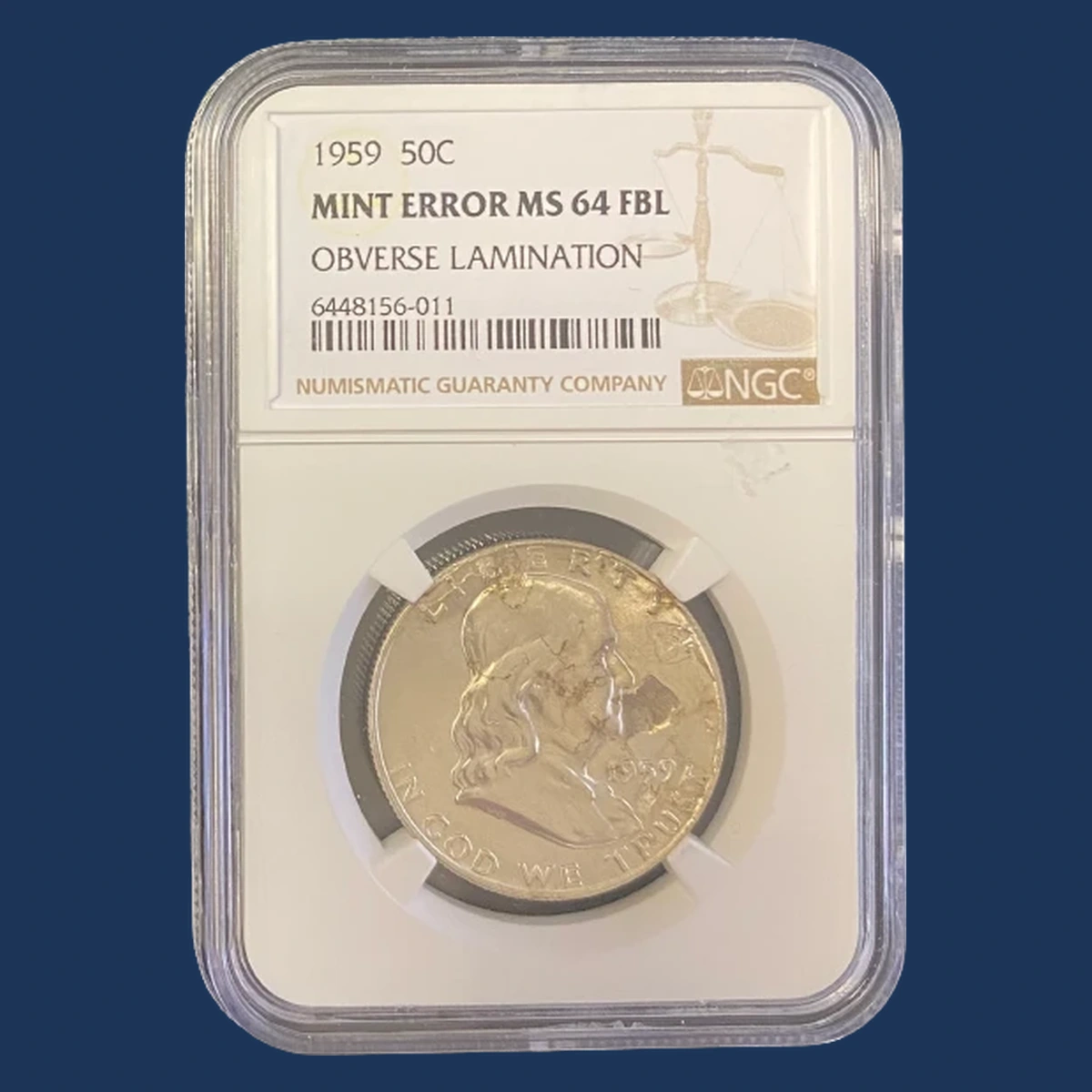
A layer of silver can lift or fall away from the front. A CoinsTV listing describes this on a 1959 labeled MS64 FBL, without specifying the flaw’s exact location.
The separation is called lamination. A weak bond within the silver-and-copper mixture allows part of the surface to peel.
FBL means Full Bell Lines: sharp, complete lines at the bottom of the bell on the back. Those lines describe design quality, not another error.
The front-side layer is the actual metal defect. Its boundary matters more than the strength of detail on the opposite side.
Estimated Value
A small peel on a worn or ordinary unworn coin has an estimated $40–$100 range. A conspicuous example on an attractive MS64 FBL coin is estimated at $250–$650.
The guide reports $599.95 for the CoinsTV example. Its original transaction status was not established here.
Treat that as a reported retail figure, not a confirmed auction result. The higher bracket includes the coin’s quality as well as its peeling layer.
How to Identify
Photograph the whole front before enlarging the defect. The report does not specify a clock position, so another coin’s location should not be borrowed.
Use a 10× magnifier to look for a thin flap or a natural boundary where a layer separated. Leave loose metal untouched.
For an accessible coin, compare a digital scale and calipers with the original 12.50 grams and about 30.6 millimeters. A lost flake can lower weight; inspect the edge grooves for related splitting or later cuts.
A continuous layered boundary supports lamination, while corrosion pits and gouges have different structures. Sharp bell lines on the back cannot establish what caused the front defect.
4. 1959 Franklin Half Dollar Defective Planchet (Estimated Up to $800)
Ten grams is well below the normal half dollar’s 12.50 grams. Heritage described this Philadelphia coin as struck on a defective planchet and graded it NGC MS63.
A planchet is the metal disc before stamping. The label identifies faulty material without saying that the disc was clipped, split completely, or intended for another denomination.
Low weight alone cannot choose among those explanations. The visible irregularity must also fit the way the design formed.
Removing metal from a normal coin afterward can make it light too. That creates a different physical history from stamping a blank that was already defective.
Estimated Value
The ten-gram NGC MS63 sold for $540 on July 15, 2021. It provides a direct defective-blank comparison.
Estimate $350–$800 for a similarly clear, certified example in comparable condition. This is not a price for every underweight half dollar.
The abnormal metal must fit the original stamped design. Trimming or chemical loss after minting does not qualify for the same added error value, even if the final weight is similar.
How to Identify
Compare both sides with the documented MS63 and note the recorded ten-gram weight. The defect’s shape should fit the original design rather than show newly cut edges or widespread corrosion.
A digital scale records the actual weight of an accessible candidate against the normal 12.50 grams. Use calipers to record its dimensions relative to the usual 30.6 millimeters.
Inspect the entire edge with a 10× magnifier for filing or other removal, including disturbance to its grooves. Do not call it a clip or lamination simply because it is light.
Abnormal original metal carrying an undisturbed strike is the key combination. The ten-gram reading supports that interpretation but cannot replace the surface evidence.
5. 1959 Franklin Half Dollar Goiter Die Break (Estimated Up to $1,200)
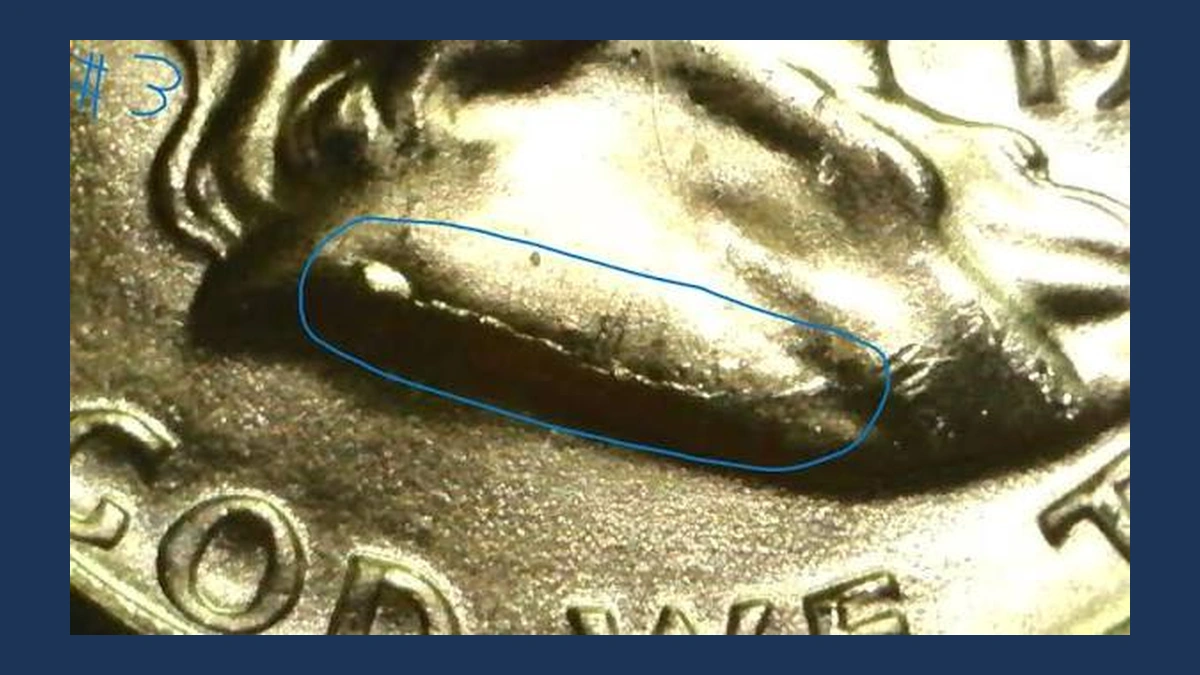
The throat below Franklin’s chin looks swollen. Collectors call this the Goiter feature, caused when damage to the die allowed extra metal to rise into that area.
Heritage’s 2021 error auction included a Philadelphia example graded PCGS MS64. The raised feature lies inside the front design rather than joining the outer rim.
That location helps explain the terminology. A rim cud is a raised area connected to the border, so that name would imply a feature not established here.
Compare the throat shape instead. A deposit or a blow that pushed metal sideways can imitate swelling without the same cause.
Estimated Value
Ordinary unworn examples have an estimated $75–$350 range. Better-preserved coins with Full Bell Lines fit a separate $500–$1,200 comparison tier.
The year guide reports a $1,128 FBL auction result from March 2019. Its numerical grade is not supplied here.
That historical report supports the higher context. It is not the sale price of Heritage’s different MS64 example, and both estimates value the whole coin rather than the swelling alone.
How to Identify
Follow Franklin’s profile from the chin into the throat with a 10× magnifier. Compare the swollen outline with both a normal portrait and a known Goiter example.
Look for attached material or signs that pressure pushed part of the portrait sideways. Those effects may disturb the nearby surface instead of repeating a feature from the die.
Confirm no mint letter above the bell and inspect the edge grooves. Accessible coins can be checked with a digital scale and calipers against 12.50 grams and roughly 30.6 millimeters.
A matching raised swelling under the chin with continuous original surface supports Goiter. It does not need a connection to the rim, because this is an internal die break.
6. 1959 Franklin Half Dollar Doubled Die Reverse (Estimated Up to $3,500)
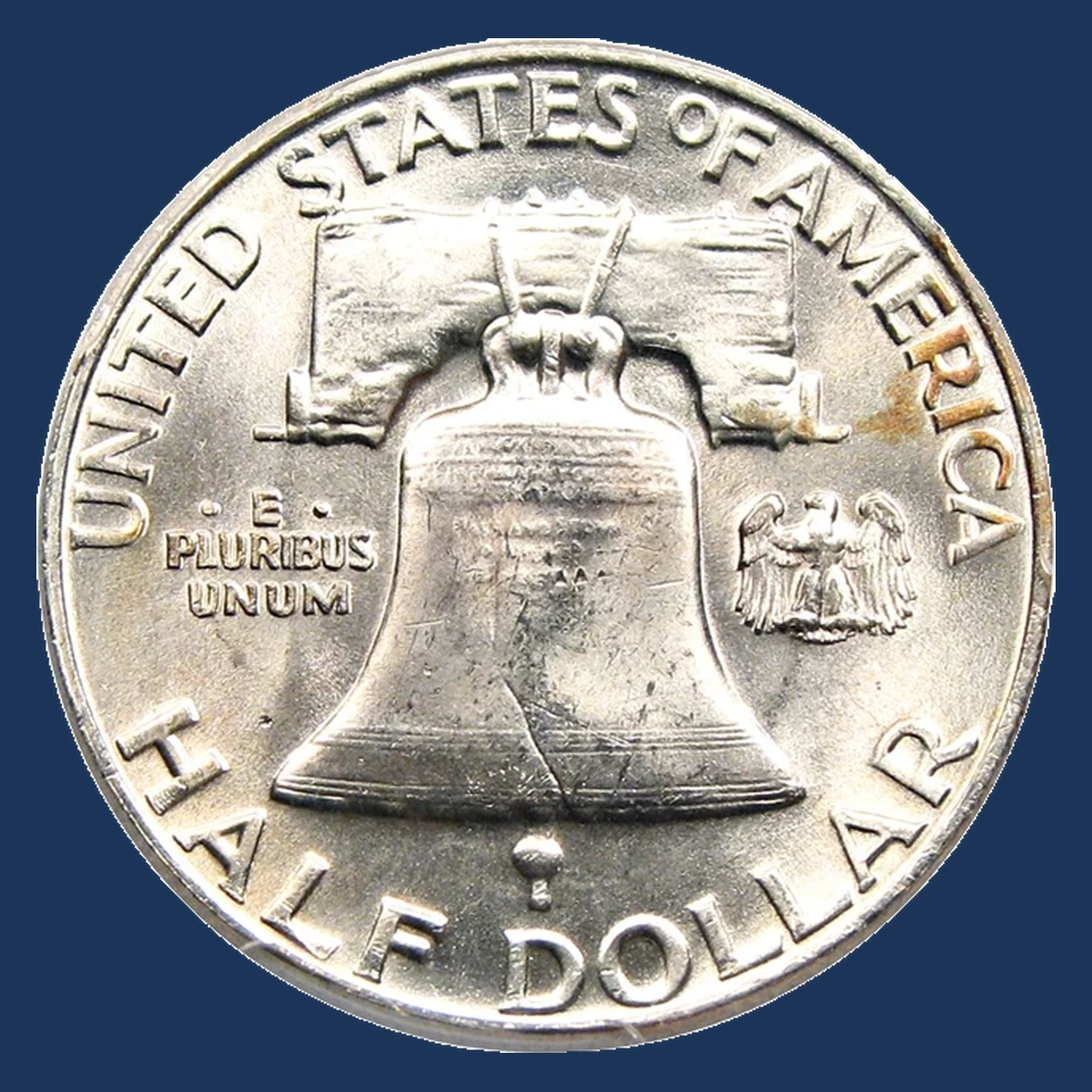
This coin mixes details from two versions of the back design. While the die was being made, impressions from the two designs overlapped in the same tool.
The result is a doubled die reverse; reverse means the back. It is not evidence that the coin itself received two strikes.
The small eagle, the bell’s support, and E PLURIBUS UNUM provide places to compare. Matching several areas helps separate it from either normal design.
The catalog number FS-801 and the name Type 3 refer to this same feature. FBL separately describes sharp bell lines and does not establish the doubling.
Estimated Value
Ordinary unworn examples have an estimated $90–$500 range. Strong MS66 FBL comparisons occupy a separate $1,200–$3,500 tier.
The PCGS page records $2,992 for an MS66 FBL sold in January 2022. A nearly unworn AU58 sold-listing reference gives $110 in September 2026.
The different conditions help explain the spread. Normal Type 2 detail alone does not qualify, even when the coin has attractive bell lines.
How to Identify
Compare the eagle with both normal back designs, called Type 1 and Type 2. A 10× magnifier should reveal overlapping outlines rather than just the normal feathers of either form.
Confirm a Philadelphia regular issue without a mint letter. Check accessible coins with a digital scale and calipers against 12.50 grams and about 30.6 millimeters, and inspect the edge grooves.
Look for supporting duplication at the bell support and E PLURIBUS UNUM. A flat shelf caused by movement during stamping differs from overlapping detail already present in the die.
Matching extra shapes across several back-side areas identifies the doubled design. Counting feathers alone may only identify one of the normal forms.
7. 1959 Franklin Half Dollar Wrong Planchet Errors (Estimated Up to $10,000)
A half-dollar design landed on three very different blanks: silver intended for a quarter, copper for a cent, and a five-gram disc for Venezuela’s 12½-centavo coin. Each gave the design less space than normal.
The quarter reports include an NGC MS64 FBL weighing 6.2 grams. The Denver cent-blank example was graded ANACS AU58.
The foreign-blank coin, graded NGC MS64, was also 20% off center. Its date is written ‘(1959),’ meaning inferred rather than fully readable.
These are separate coins. Their metal, weight, and date evidence must stay attached to the correct example when making comparisons.
Estimated Value
Estimated ranges are $2,500–$6,000 for quarter blanks and $5,000–$10,000 for Denver cent blanks. The foreign-blank example has a $4,500–$7,500 comparison range.
The 1959-D ANACS AU58 cent-blank coin sold for $7,590 in January 2006. The foreign-blank NGC MS64 brought $5,520 in December 2022.
The quarter range is an estimate without a quoted sale here. The foreign coin’s off-center strike is already included in its price, not added separately.
How to Identify
Use a digital scale and calipers together when safely accessible. A normal half starts at 12.50 grams and about 30.6 millimeters; a silver quarter blank starts at 6.25 grams and 24.3 millimeters.
A copper cent blank instead starts at 3.11 grams and 19.05 millimeters. The foreign example’s label records five grams and puts its estimated date in parentheses.
Inspect the edge with a 10× magnifier for trimming, plating, or machining. Stamping can expand a small blank, and normal half-dollar grooves may not form completely.
Naturally cropped half-dollar design on metal with the correct alternative weight and composition supports a wrong blank. A small diameter by itself does not.
8. 1959-D Franklin Half Dollar Double Strike (Estimated Up to $14,000)
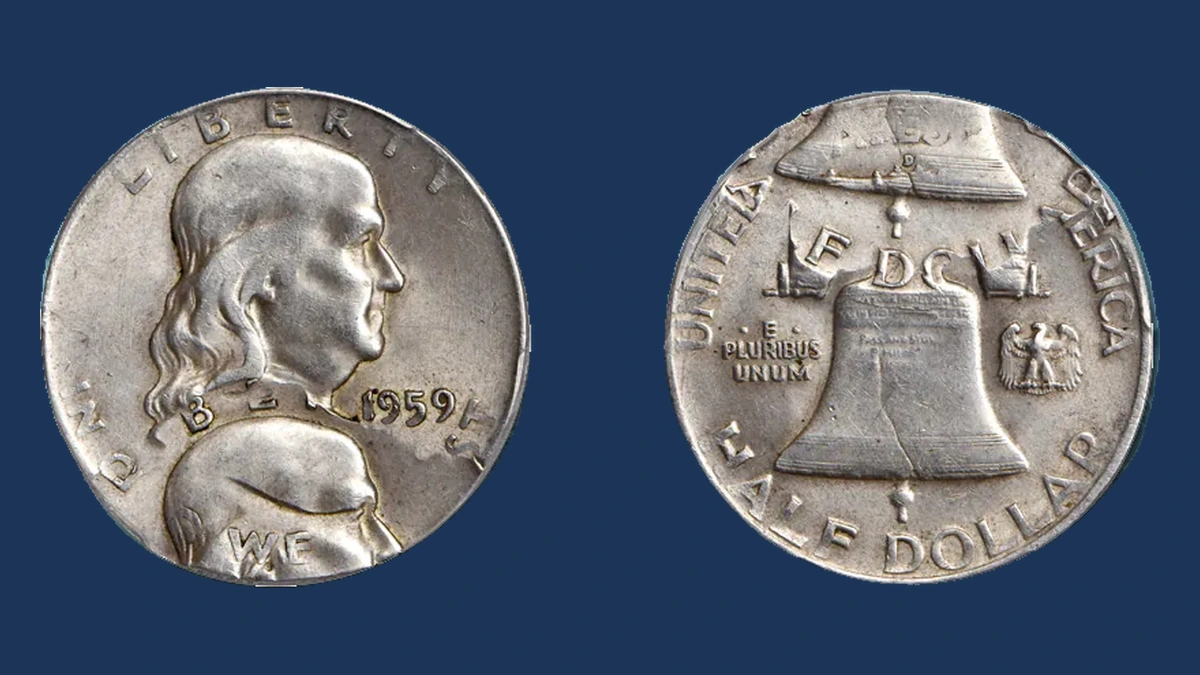
Two portraits and two bells show what happened to this Denver coin. A normal first strike was followed by another blow after the coin failed to leave the press and moved.
Stack’s Bowers describes the second strike as 55% off center toward 6 o’clock. The two designs remain nearly parallel rather than turning relative to each other.
Coin World identifies the specimen as PCGS AU58, meaning nearly unworn. This is one coin with a combined striking accident.
The displaced second strike is not a separately priced off-center coin. It also differs from small doubled letters already present in a die.
Estimated Value
A certified double strike with similar separation and preservation has an estimated $8,000–$14,000 range. No realized price for the published 1959-D is used here.
A 1962-D NGC MS60 double strike sold for $11,400 in November 2022. Its second impression was 70% off center.
That different-year coin supplies the comparison. Its grade and displacement differ, so the estimate is not a newly identified transaction for the nearly unworn 1959-D example.
How to Identify
Trace the normal portrait and bell, then find their shifted counterparts toward the bottom. Their near-parallel positions should explain two successive blows.
The auctioneer’s description gives the 55% shift toward 6 o’clock. Use a 10× magnifier to inspect the overlap for real raised design rather than later sunken impressions or machined outlines.
For an accessible coin, a digital scale compares with the normal 12.50 grams. Calipers record the altered outline against an ordinary 30.6-millimeter half, while edge photographs preserve surviving grooves.
Keep the date and D visible. A second portrait and bell shifted together from the normal first design provide the direct match for this double strike.
Conclusion
A sharp bell, a swollen throat, and a smaller copper blank are very different clues. The bell lines describe quality, while the throat and wrong metal require explanations of how the coin was made.
Estimated values span $40–$14,000. Keep ‘(1959)’ on the foreign-blank comparison and value the Denver double strike as one coin; several visible effects do not create separate prices to add together.