1955 Half Dollar Error List with Pictures

A double-struck 1962-D Franklin half sold for $11,400 in November 2022. For comparison, a 1955 with a second strike near its bottom edge was offered for $3,800 in 2016.
The 1955 half dollar errors below have estimated values of $40–$12,000. Read on to compare those large striking mistakes with peeling metal, a missing edge, and the tiny “Bugs Bunny” projection beside Franklin’s mouth.
1. 1955 Franklin Half Dollar Lamination Error (Estimated Up to $175)
A thin flap or shallow opening can show where the coin’s metal has separated into layers. Collectors call this lamination.
A weak area inside the silver alloy can lift, split, or fall away. The problem concerns the metal itself rather than an extra design stamped onto it.
The 1955 account lists this type without naming a side or a particular spot on Franklin’s portrait. Look for the actual edge of a separated layer.
That edge should join the original metal beside it. A discolored patch alone cannot show that silver has peeled away, even if it resembles another year’s coin.
Estimated Value
Estimated value is $40–$175 for a clearly visible lamination on an ordinary worn to lower-grade unworn example. This prices the whole coin.
The range uses the year guide and similar Franklin surface errors, not a recorded sale of a particular 1955 flap. A small separation may add little extra value.
An attractive attached layer can interest collectors. Harsh cleaning or an ugly missing patch can reduce what they pay for the same general error.
How to Identify
Do not lift a loose flap. With a magnifier and changing light, look along the opening for a thin layer extending into the original metal.
A scale can help show whether material is missing: the intact standard is 12.50 grams, while an attached flap may leave nearly all that weight present. Calipers can compare intact widths with 30.6 millimeters.
Inspect the grooves around the edge and nearby surfaces for later damage. Corrosion leaves eaten cavities, while cutting can leave scrape tracks or sharp lips.
A separation following a layer inside the alloy, joined naturally to the surviving surface, provides the useful first distinction.
2. 1955 Franklin Half Dollar Die Crack and Cud Error (Estimated Up to $300)
The Liberty Bell is supposed to have a crack in its picture. That familiar feature is not the mint error being discussed here.
A real crack in the steel stamping tool can leave an extra raised line when silver fills the opening. A larger piece breaking from the tool’s edge can leave a lump joined to the rim, called a cud.
The 1955 listing includes both forms without tracing a particular example. Look for added metal beyond the normal design rather than treating the bell’s engraved crack or every stage of one growing line as a separate error.
Estimated Value
A modest raised crack has an estimated $40–$100 value on an ordinary worn or lower-grade unworn coin. A clear genuine rim-connected cud has an estimated $100–$300 range.
These are whole-coin estimates, not results from a named 1955 cud auction. The listing gives no exact path or measured break size.
Larger visible features can attract more interest. The actual coin’s appearance and remaining design must support that higher price, rather than the word cud alone.
How to Identify
Compare the back with a normal Franklin half first and locate the bell’s intended crack. Then use a magnifier to follow any extra raised line across the surrounding design.
For a suspected cud, check that the raised patch reaches the rim and replaces normal detail. A small lump entirely inside the design is different, while solder may show a seam.
Inspect the edge grooves for impact damage. A scale and calipers can compare 12.50 grams and 30.6 millimeters, allowing for wear.
Extra raised metal following a crack or joining the rim, beyond the bell’s normal design, gives the essential first check.
3. 1955 Franklin Half Dollar Curved Clip Error (Estimated Up to $400)
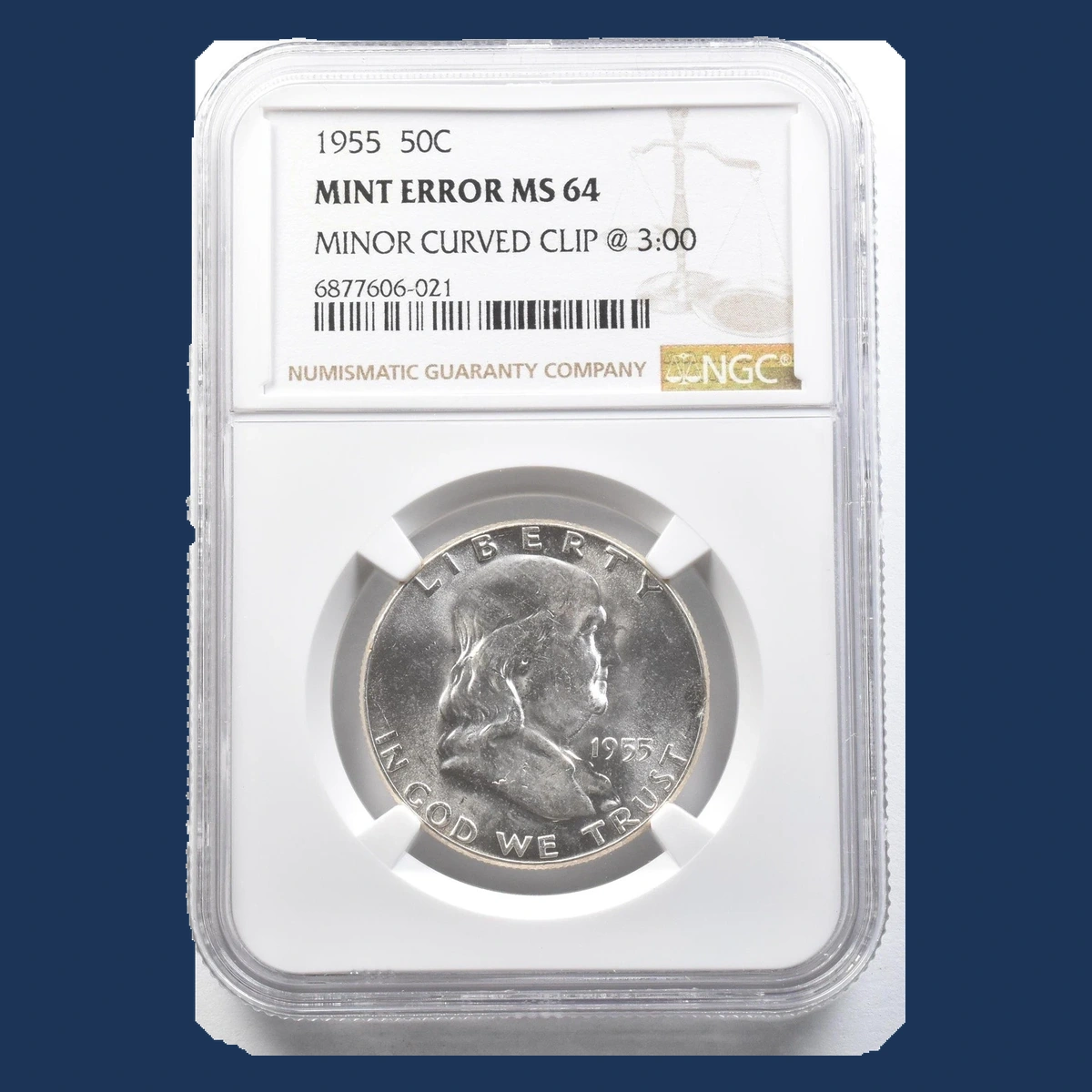
A curved bite can form before either side receives its design. A cutting punch overlaps a previously cut hole and produces an incomplete blank, the metal disc used to make a coin.
The 1955 guide includes this type. Its pictured positions are examples, not a required location for every genuine clip.
The incomplete disc still passes through the machines that form the rim and stamp the design. Those steps can leave clues beside the gap and directly opposite it.
A neat crescent shape is only the start. Check how the rim and nearby design formed around the missing piece.
Estimated Value
Use an estimated $75–$400 for a genuine curved clip with a readable date. The year guide allows higher values for unusually impressive or well-preserved examples.
A 1962-D with a four-percent clip sold for $84 in March 2011. PCGS graded it MS61, meaning no wear but noticeable marks.
That older Franklin sale shows an affordable example. It does not assign the same clip size or condition to a 1955 coin being examined.
How to Identify
Photograph the gap and opposite rim together before enlarging either. A weak rim opposite a genuine clip can help explain its manufacture, but it is not proof by itself.
Use a magnifier at the missing arc to look for sawing, filing, or a cut through completed design. Compare how the nearby lettering and rim approach the gap.
A scale should show weight below the intact 12.50 grams, allowing separately for wear. Calipers compare surviving widths with 30.6 millimeters, and an edge view shows the remaining grooves.
Natural striking at the gap, supported by compatible opposite-rim formation, gives the strongest immediate assessment of a clip.
4. 1955 Franklin Half Dollar Off-Center Strike Error (Estimated Up to $1,500)
Smooth, untouched metal can remain beside a design that has run off the opposite edge. This happens when the round disc sits partly outside the stamping tools during one strike.
Both sides should show a related shift. A wide border on only one side is not enough.
The 1955 guide reports single off-center strikes and gives general prices for different amounts of shift. It does not identify a certified 1955 at a particular angle or percentage.
A second blow landing off center is a different error. That coin already had a design before it was struck again.
Estimated Value
The year guide estimates $150–$500 for modest shifts with readable dates. More dramatic attractive examples have an estimated $500–$1,500 range.
These figures concern genuine single strikes. They do not price the separately listed coin that received a second blow.
A larger shift does not guarantee more value. Missing date information, damage on the blank area, or poor overall appearance can reduce interest even when a large part of the design falls off the metal.
How to Identify
Compare full photographs of both sides before estimating any percentage. Missing design should occur in a way that agrees with the untouched area on each face.
Use a magnifier to inspect the border between stamped and blank metal. Grinding can make a smooth patch later, but it removes metal and changes that transition.
A scale starts from 12.50 grams, while calipers compare the actual outline with the normal 30.6 millimeters. Inspect where edge grooves formed and where they are absent.
Matching cut-off design on both faces beside an original blank crescent is the direct test for a single off-center strike.
5. 1955 Franklin Half Dollar Bugs Bunny Die Clash (Estimated Up to $3,500)
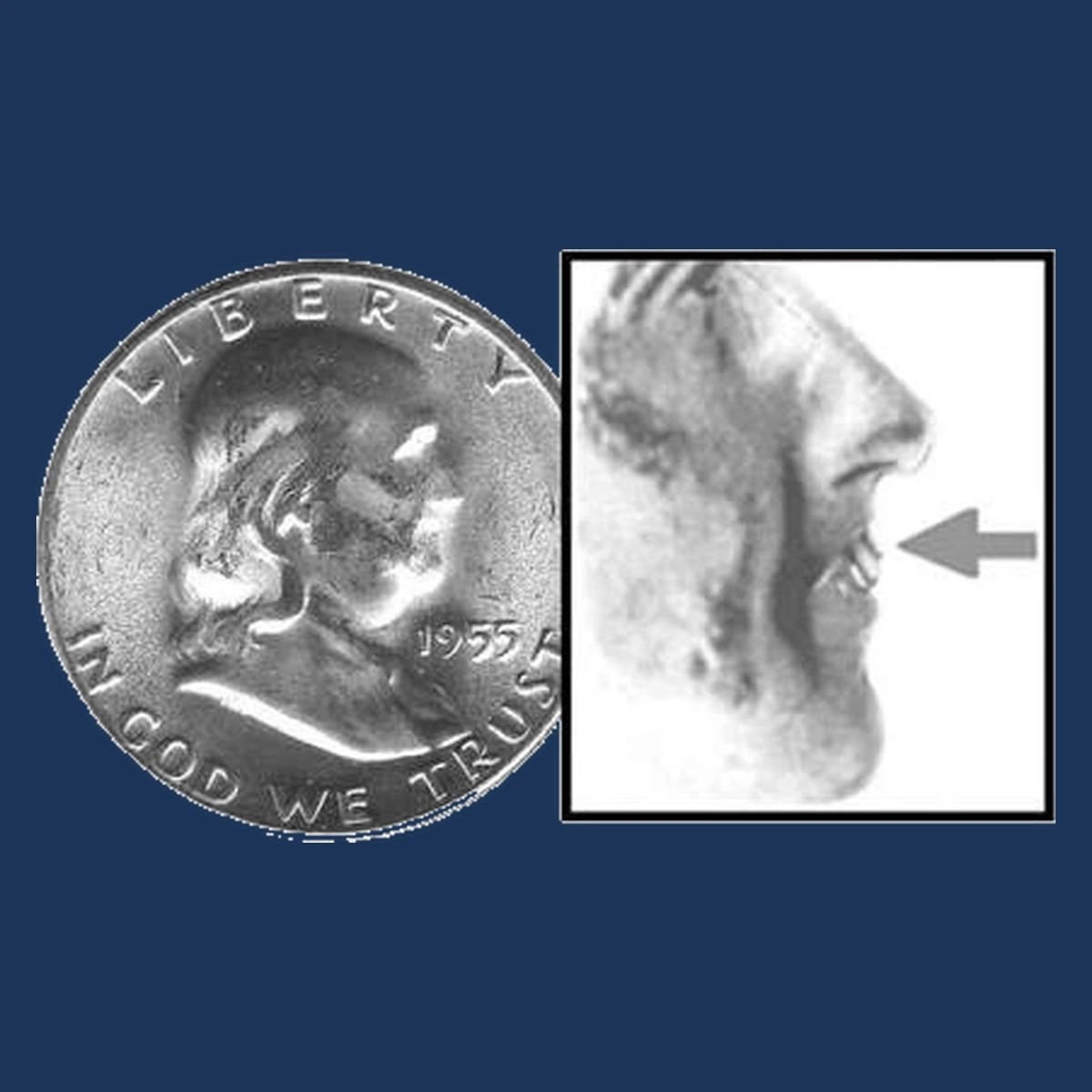
Franklin seems to have an extra tooth beside his mouth. The shape came from part of the eagle’s wing on the opposite stamping tool.
The two tools met without a metal disc between them, leaving an unwanted mark in the front tool. Later coins received the small projection, which collectors call the Bugs Bunny clash.
The familiar variety is named FS-401. It is unrelated to the doubled 1955 Lincoln cent.
It also differs from a second portrait stamped over Franklin. Other clash marks need their own shape comparisons; they do not all receive the Bugs Bunny name.
Estimated Value
Many identified lower-grade unworn examples have an estimated $50–$250 range. Exceptional certified coins have a separate estimated $250–$3,500 range.
The year account reports $3,360 for an MS67 FBL in April 2024. FBL means Full Bell Lines, describing clearly defined lines on the bell.
That high result reflects excellent preservation and strong bell detail together. The little mouth projection alone does not put a worn or heavily marked coin in that price class.
How to Identify
Find the mouth mark in the illustrated example, then compare its exact shape with your coin under a magnifier and angled light. An unusual-looking lip alone is not enough.
Check the nearby surface for cuts, glue, or metal pushed up by a hit. Inspect the bell lines separately, since they affect condition labels but do not create the tooth.
Confirm the 1955 date and Philadelphia back without a mintmark. A scale and calipers can compare 12.50 grams and 30.6 millimeters, and the edge should have grooves.
The correctly positioned raised projection matching the known mouth shape gives the useful quick identification.
6. 1955 Franklin Half Dollar Nickel Planchet Error (Estimated Up to $6,000)
A half-dollar design is too large to fit onto the metal disc intended for a nickel. A genuine wrong-blank coin therefore loses much of its outer design while retaining recognizable Franklin details.
The year account reports this type and an NGC example. It does not supply independently measured dimensions for that particular coin.
A normal nickel blank starts near five grams and 21.2 millimeters, much smaller than a silver half dollar. Striking can widen it.
These numbers describe the blank before stamping. They are not exact measurements taken from the reported 1955 coin.
Estimated Value
The year account reports a $3,600 auction result for an NGC example. That remains a published report rather than a newly matched original auction lot.
Estimated value is $2,500–$6,000 for a genuine nickel-blank strike with readable identity. Date visibility, remaining design, condition, and metal confirmation affect the price.
A silver half dollar cut down to a smaller size is not comparable. It needs to be distinguished from a coin struck on the wrong metal disc.
How to Identify
Begin on the scale: compare the reading with 12.50 grams for a normal half dollar and about 5.00 grams for a nickel blank. Calipers should record width and thickness against the normal half’s 30.6-millimeter diameter.
Use a magnifier to inspect the entire outer edge for filing, cutting, or artificial rounding. A professional metal test can distinguish copper-nickel from silver alloy without damaging the coin.
The smaller disc may have spread during striking, so its final diameter need not be exactly 21.2 millimeters. Compatible weight, metal, and an originally struck small outline provide the decisive combination, rather than small size alone.
7. 1955 Franklin Half Dollar Double Strike Error (Estimated Up to $12,000)
Only a small part of this 1955 coin met the tools on its second strike. Fred Weinberg’s catalog describes the later blow as ninety-five percent off center at six o’clock, meaning the bottom edge.
The first strike made the main picture. The second left additional detail near the lower rim, rather than making the entire coin one extremely off-center strike.
PCGS graded it MS64, meaning no wear but some marks. The same coin appears in several catalog issues.
Those repeated advertisements show one coin offered several times. They do not establish several different coins or completed sales.
Estimated Value
Weinberg’s 2016 catalog offered the 1955 coin for $3,800. That is an asking price, not a recorded sale.
A 1962-D double strike sold for $11,400 in November 2022. Its second blow was seventy percent off center, and NGC graded it MS60.
Together they help frame an estimated $3,000–$12,000 for substantial genuine Franklin double strikes. The different-year sale and historical offer show why percentage alone is not a reliable price scale.
How to Identify
Locate the bottom edge while keeping the main portrait visible. The ninety-five-percent figure describes only the second blow, so most of the first picture should still remain.
Record the altered outline with calipers against a normal 30.6 millimeters and weigh it against 12.50 grams. Inspect the edge grooves and any spreading for damage after minting.
With a magnifier, follow where the small second impression meets the earlier design. A vise can create pressure damage or a recessed mirror-image mark instead.
Look for a recognizable second impression at the bottom edge. Its design should overlap the first strike rather than look like a later dent.
Conclusion
The estimated $40–$12,000 range includes tiny surface features and much larger press mistakes. Franklin’s Bugs Bunny mouth needs a close shape match, while the bottom-edge double strike needs evidence of two separate impressions.
Keep ordinary condition separate from exceptional grades, and asking prices separate from sales. Clear views of both sides and the edge, plus an untouched surface, make it easier to tell which description and price range fit the coin.