1810 Half Dollar Error List with Pictures

An 1810 half dollar missing almost all of AMERICA beyond its edge sold for $8,225 in September 2016. Its twenty-percent off-center strike outweighed the appeal of its heavily worn condition.
Other 1810 half dollar errors leave smaller clues, including a shifted front picture or faint extra lines. Estimated ranges span $150–$10,000.
The seven sections below explain how to inspect the face, surface, and edge before choosing a price comparison.
1. 1810 Capped Bust Half Dollar Reported Planchet-Line Candidate (Estimated Up to $700)
A long sunken line crosses much of the back of this dealer-listed coin. It begins near the denomination.
Several explanations have been suggested: a weakness in the blank, a peeling layer, an adjustment mark, or damage related to the stamping tool. A later scratch is another possibility.
These causes differ. Peeling separates metal within the coin, while an adjustment mark comes from removing metal to change a blank’s weight.
The coin is graded VF35, meaning worn with substantial detail. Its front picture is also described as misaligned, but that separate feature does not explain the back line.
Estimated Value
Use an estimated $250–$700 for a worn example with this reported combination. No separate peeling-layer premium is included because the line’s cause has not been established.
The Coin Town listing shows $639.99 and says sold out. That display does not document the actual transaction price.
The sunken line and shifted front belong to the same coin. Their separate discussions should not be added together as two purchases or two extra charges.
How to Identify
Start beside the denomination and follow the line under a 10× magnifier. Inspect its bottom and both edges rather than judging only its length.
A peeling layer may show a seam or flake boundary. A simple smooth groove does not establish that structure.
Light the coin from opposite sides to confirm that the line is recessed. Look for cut metal or a pushed-up lip, and compare it with nearby surviving design.
Keep the shifted-front question separate. The normal Philadelphia half has edge lettering, no mint letter, a 13.48-gram original weight, and roughly 32.5 mm diameter.
Check safely accessible coins with a scale and calipers. Before calling this line a lamination, look for an actual separating layer along it.
2. 1810 Capped Bust Half Dollar Misaligned Obverse Die (Estimated Up to $900)
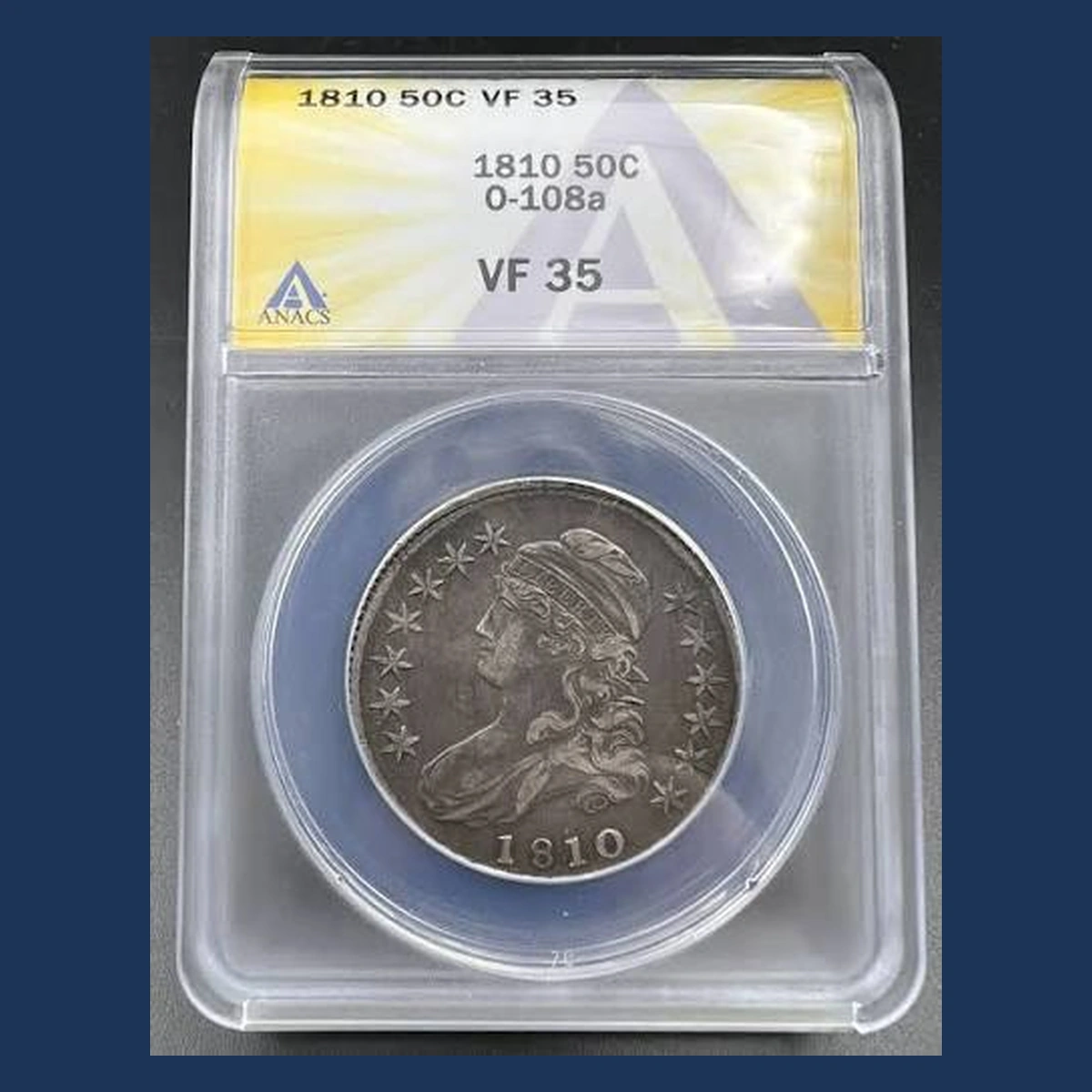
The front and back do not share the same border balance on this example. The dealer describes its front stamping tool as misaligned.
A die is the steel tool that stamps a coin. If one tool sits out of position, its picture can shift while the opposite picture remains more centered.
That differs from moving the entire blank away from both tools. A true off-center strike usually affects both faces together.
This is the same coin with the sunken back line discussed above. The shifted picture and unexplained line are separate observations, even though they appear on one half dollar.
Estimated Value
For a coin similar to the listed VF35 example, estimate $300–$900. The displayed retail amount of $639.99 sits within that range, but sold-out status does not prove the paid price.
The whole coin’s appearance matters, including how clearly the unequal borders remain after wear. Damage and surface quality also affect its value.
The back-line section discusses this same example. Its range is not an extra amount to add to the misalignment estimate.
How to Identify
Place equally sized photographs of both faces beside each other, showing every part of the border. Compare the picture’s distance from the rim in several directions.
The front should be noticeably displaced while the back stays more centered. A cropped photograph or heavy rim wear can create a false impression.
Use a 10× magnifier to inspect the actual boundaries. Photograph the lettered edge as well, looking for damage or removed metal.
For safely accessible coins, calipers compare the outline with roughly 32.5 mm and a scale checks against 13.48 grams. This Philadelphia issue has no mint letter.
The useful pattern is a genuinely shifted front picture beside a relatively centered back, not simply one photograph with uneven margins.
3. 1810 Capped Bust Half Dollar Die Clash Traces (Estimated Up to $1,200)
Shield stripes can appear where Liberty’s picture should be. On the O-101 variety, references describe transferred shapes near LIBERTY and traces below the eagle’s right wing.
They formed when the stamping tools contacted each other without a blank between them. Later coins received parts of the opposing picture as unwanted details.
This is a die clash, not another complete strike on the same coin. The marks can repeat on several coins made with those tools.
A separate O-110 was cataloged with front clash traces in 2002. Its own photographs must guide the comparison, rather than borrowing every O-101 feature.
Estimated Value
Estimate $150–$1,200 for worn 1810 examples with recognizable clash traces. Better preservation can make shallow shapes much easier to see.
A recent same-series comparison is an 1826 AU58 half with cracks that sold for $1,020 in August 2025. AU58 means only slight wear.
That sale illustrates condition and underlying coin value, not a clash price. A faint extra line on an 1810 does not automatically justify the upper end of the range.
How to Identify
Check near LIBERTY for the shield-related pattern, then move below the eagle’s right wing. Try to connect each extra shape with the picture on the opposite face.
For O-110, use its own photographs instead of expecting all the O-101 marks. The two varieties were made with different tool pairs.
A 10× magnifier and changing light help distinguish shallow struck traces from scratches. Normal feather detail should not be mistaken for an extra transferred fragment.
Inspect the lettered edge and full date. Use a scale and calipers when safely accessible against the original 13.48 grams and about 32.5 mm.
A recognizable piece of the opposite design in the reported location provides the clearest starting match.
4. 1810 Capped Bust Half Dollar Die Cracks (Estimated Up to $1,400)
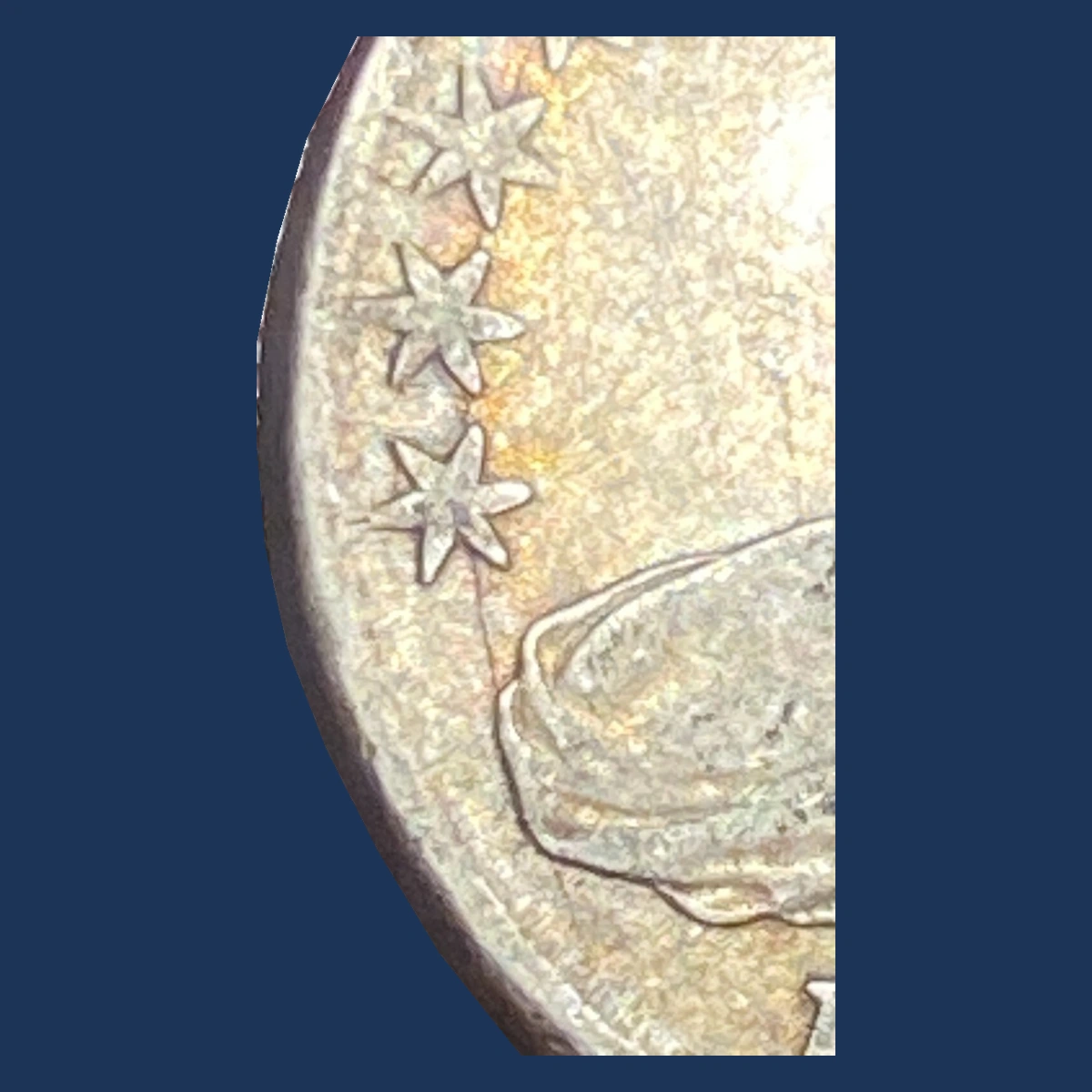
On the O-103 variety, raised lines extend from the date’s base toward both sides. They show where the stamping tool had cracked.
Silver entered those openings during striking and left ridges on the finished coin. Later wear can soften the lines without removing every part of their route.
O-101a has different paths through the portrait and stars and around the back lettering. These belong to another tool pair.
Choose the matching reference before tracing a line. A surviving branch should agree with its own example, rather than being joined to unrelated scratches to make a longer pattern.
Estimated Value
A worn through slightly worn 1810 with clear cracks has an estimated $150–$1,400 whole-coin range. Stronger detail and attractive surfaces support higher values.
An 1826 O-104 graded AU58 sold for $1,020 in August 2025. It had cracks on both faces and provides a different-year comparison within the same series.
Cleaning, dark deposits, and wear still matter. An extensive crack does not make a damaged 1810 equal in value to that better-preserved auction coin.
How to Identify
Find the date on O-103 and follow the raised branches outward. Keep nearby design intersections visible so you can compare the actual route.
For O-101a, use the portrait, stars, and back-lettering paths from its own reference. Do not expect the same arrangement as O-103.
Tilt the coin under low light and inspect it with a 10× magnifier. A ridge should rise above the surface; a scratch usually cuts down, sometimes pushing metal up along its sides.
Check the complete date, Philadelphia’s lack of a mint letter, and the lettered edge. Use a scale and calipers when safely accessible against 13.48 grams and roughly 32.5 mm.
Start at a known intersection and follow one continuous raised branch, rather than an isolated bright line.
5. 1810 Capped Bust Half Dollar Reported Mint-Flattened Rim Segments (Estimated Up to $1,800)
Some O-106a examples have a short flattened section of rim. Reported positions include star 1, the gaps between stars 5–6 or 6–7, and the area beside stars 11–13.
Those positions belong to different coins. One example is not expected to carry every flattened section.
The researcher suggests an object moved through the striking area and interfered with the border. No recovered object or specific material is identified.
A flattened rim is different from missing blank metal. Later hits or filing can create a similar appearance, so the shape alone does not prove that the Mint caused it.
Estimated Value
Where inspection supports mint-made flattening, estimate $250–$1,800 for worn examples. Condition and a clear connection between the flat rim and strike affect the value.
This is an estimate, not a recorded sale of the pictured O-106a coins. An 1821 half struck through a thread sold for $176.25 in January 2015.
That is a different obstruction shape. The upper 1810 estimate requires a much stronger example with convincing physical evidence and better preservation.
How to Identify
Locate the flat segment and keep its neighboring stars in view. Compare with the O-106a reference, which shows several positions on separate coins.
Under a 10× magnifier, inspect the transition into normal rim. File marks, freshly exposed metal, or metal pushed aside by a hit can reveal later damage.
Look at the nearby struck design as well. Its interruption should fit the proposed obstruction, although the exact object remains unidentified.
Use calipers and a scale when safely accessible against about 32.5 mm and 13.48 grams. Photograph the edge lettering and both faces.
The key comparison is a natural struck transition into the flat section, rather than a border cut or compressed after manufacture.
6. 1810 Capped Bust Half Dollar Collector-Reported Clipped Planchet (Estimated Up to $2,500)
A collector posted an 1810 O-108 with a reported clip in December 2023. The claim concerns the missing part of that half dollar.
A clip starts before striking, when the blank lacks a piece of its intended outline. The remaining metal then responds to pressure around the existing gap.
That process can leave different detail from cutting a finished coin. The gap’s shape is therefore only part of the evidence.
The report gives neither certification nor a clock position for the clip. Those details should not be borrowed from other coins pictured in the same discussion.
Estimated Value
Estimated values of $300–$2,500 cover genuine worn 1810 clips, depending on size, preservation, and clarity. No sale price is assigned to the collector’s O-108.
A smaller defect formed before striking on an 1832 half brought $263.25 including fees in July 2025. Its XF45 grade indicates wear with strong detail.
That comparison concerns a modest defect, not the same clip. A larger authenticated clip can bring more, while a later cut receives no such error value.
How to Identify
View the missing segment from both faces and edge-on. A 10× magnifier can reveal saw marks, file lines, or cuts through an already finished design.
Compare with the collector’s O-108 report. Examine how the struck metal flows beside the gap.
The opposite rim may show weakness from the incomplete blank, but the effect need not be equally strong on every genuine clip. Keep that clue alongside the boundary itself.
A scale should show the effect of missing metal against the original 13.48 grams. Use calipers when safely accessible against roughly 32.5 mm, and record the remaining edge letters.
Natural strike changes beside the missing segment help show that the gap existed before the coin received its pictures.
7. 1810 Capped Bust Half Dollar Off-Center Strikes (Estimated Up to $10,000)
Almost all of AMERICA lies beyond the blank on the twenty-percent off-center O-102. Its design shifts toward two o’clock.
A separate O-102 has a smaller five-percent shift toward one o’clock. Another example, graded AU58 for slight wear, shifts toward 10:30.
The AU58 catalog uses “partial collar” in quotation marks but explains the appearance as off-center striking. Its missing border marks affect the upper front and lower back.
These early halves had lettered edges and used an open retaining ring. A modern explanation for partly formed edge grooves does not automatically describe their uneven edges or missing letters.
Estimated Value
The twenty-percent O-102 sold for $8,225 in September 2016. Its Fine12 grade indicates heavy wear but recognizable design.
Estimate $6,000–$10,000 for similarly dramatic worn examples. Milder shifts on better-preserved coins around XF or AU have an estimated $1,500–$5,000 range.
The stronger mistake can outweigh condition. A heavily worn coin may cost more than a lightly worn example when much more of its picture missed the blank.
How to Identify
On the twenty-percent example, follow AMERICA beyond the blank’s edge while checking the remaining date and design. Keep the separate five-percent coin’s smaller shift with its own photograph.
For AU58, compare missing tiny border marks around nine to one o’clock on the front with those around five to eight on the back. Both faces should support the displaced blank.
Use a 10× magnifier at the boundary between struck and bare metal. Check the lettered edge, allowing for incomplete letters where the strike missed.
A scale and calipers record safely accessible examples against about 13.48 grams and 32.5 mm. The outline may be distorted.
Matching lost design on both faces is more useful than the catalog’s quoted “partial collar” label.
Conclusion
The estimated $150–$10,000 range includes small raised traces and strongly off-center coins. First decide whether metal is missing, a rim is flattened, or a picture has shifted; those observations lead to different comparisons.
Look at both faces before accepting a label. A centered back can help identify a one-sided tool shift, while an unexplained line on that same coin still needs its own examination.