1934 Half Dollar Error List with Pictures

An oversized 1934 half dollar can keep its complete design; a smaller blank can leave parts missing. A documented 1942 example made on a quarter blank sold for $16,200 in 2018.
That different-year coin provides a comparison for one of the 1934 half dollar errors discussed below. Estimated ranges span $50–$18,000, from small surface flaws to major errors needing authentication.
Read on to compare the outline, design, and metal—and keep confirmed 1934 examples separate from reported possibilities.
1. 1934 Walking Liberty Half Dollar Reported Lamination Error (Estimated Up to $250)
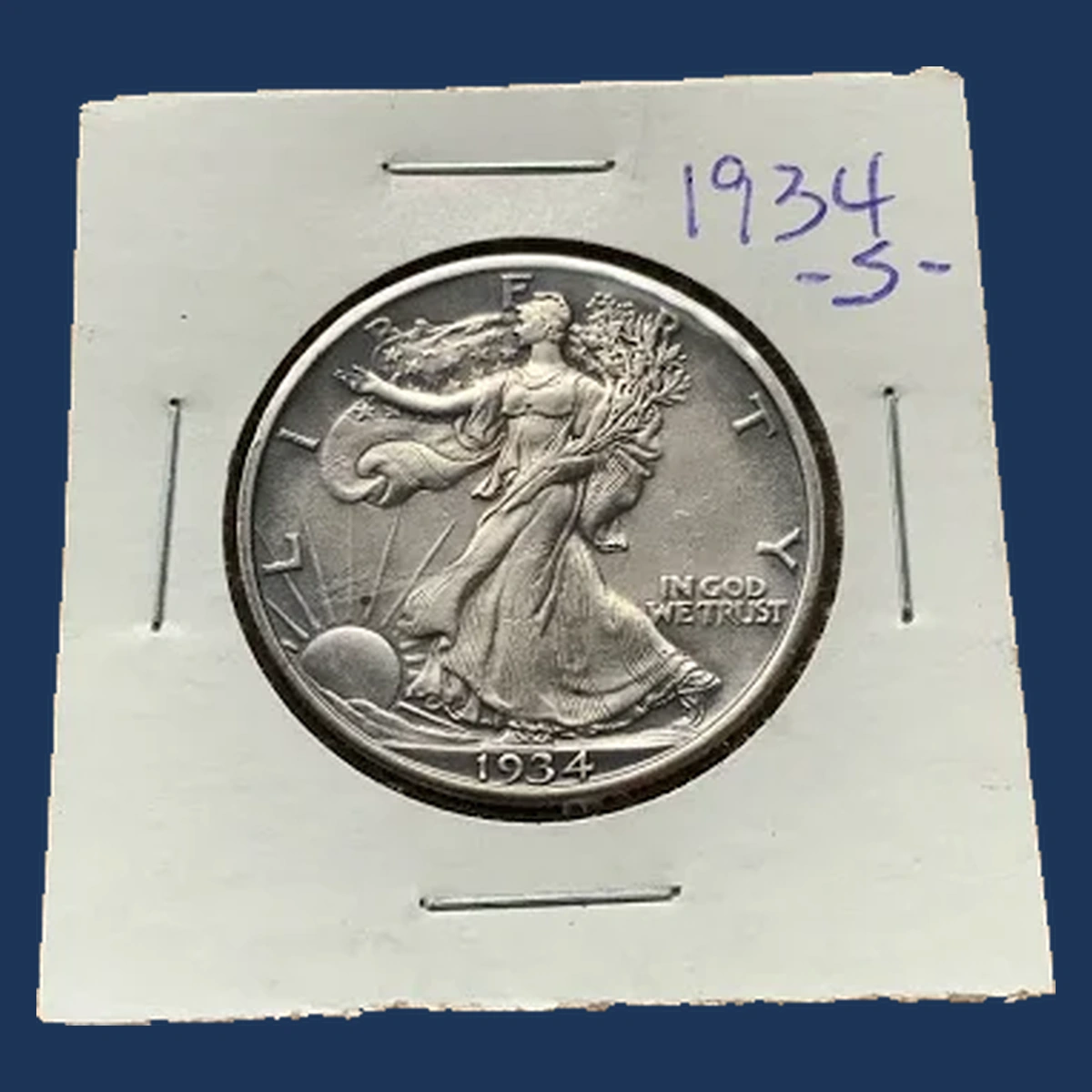
A thin layer of silver can lift or fall away. This is called lamination, caused by a weak bond within the metal rather than something pressing into its surface.
An attached flake may curl upward. If it detaches, an irregular shallow hollow can remain where the layer once sat.
A 1934 year reference reports this error without identifying a particular mint or certified coin. It describes local peeling, not a whole coin splitting into two discs.
Roughness alone does not establish lamination. Scraping and corrosion also remove metal, but they leave different boundaries and surface textures.
Estimated Value
An estimated $50–$250 suits a worn 1934 with a modest original peel. A 1912-S Barber with an attached lamination sold for $89 at Heritage in March 2026.
That comparison coin was graded VG8, meaning heavily worn. Its date and design differ, but both are silver half dollars with peeling metal.
Mint, remaining detail, and surface quality still affect the comparison. A larger missing layer does not always make a coin more desirable.
How to Identify
Find the border between the affected area and intact silver with a 10× magnifier. A lifted sheet or distinct ledge is more helpful than a flat patch of changed color.
Use side lighting and leave loose metal untouched. Scraping tracks and rounded corrosion pits point to different causes.
Photograph the full date and the mint-letter area on the back below the pine branch. For accessible coins, compare a digital scale and calipers with the original 12.50 grams and about 30.6 millimeters, then inspect the edge grooves.
A physical layer separating from the metal underneath supports lamination. An ordinary sunken mark, without that layered boundary, does not show the same kind of flaw.
2. 1934 Walking Liberty Half Dollar Grease or Debris Strike-Through Error (Estimated Up to $500)
Grease can make a letter disappear; a solid object can leave a hollow mark. Both can block a die, the steel tool that stamps the design onto a coin.
This is called a strike-through. CoinValueChecker reports a 1934 grease example graded NGC MS62, meaning unworn with noticeable marks.
A separate illustrated account places an impression just above the eagle’s head. It describes material caught between the metal and stamping tool.
Those accounts do not establish one shared specimen. The second description concerns an obstruction, not proof that a different-sized metal blank was used.
Estimated Value
Allow an estimated $75–$500 for a modest strike-through on a worn or ordinary unworn 1934. No specific sale is assigned to the reported MS62.
A 1976-D Kennedy with strike-throughs on both sides sold for $114 at Heritage in March 2025. NGC had certified that coin.
The recent comparison has a different design and metal mixture. A much larger impression or an object still attached needs its own price comparison.
How to Identify
For the illustrated back-side example, look just above the eagle’s head. A 10× magnifier and low light can show whether the mark was impressed or cut into the completed design.
For a possible grease blockage, compare nearby lettering and high points. Broad weakness or ordinary wear differs from one localized area where detail failed to form.
Check both complete sides, the mint-letter area, and the grooves around the edge. Use a digital scale and calipers when safely accessible against 12.50 grams and about 30.6 millimeters.
An isolated interruption surrounded by otherwise well-formed detail supports an obstruction during stamping. One weak letter alone cannot identify grease or name the material involved.
3. 1934 Walking Liberty Half Dollar Reported Off-Center Strike Error (Estimated Up to $1,500)
A wide rim on one side is only a starting clue. For a true off-center strike, the blank—the metal disc before stamping—sat away from the center of the dies.
Part of the design can run out of room while another area remains unstamped. Both sides need examination to explain the shift.
An expanded coin with its full design is a different error, called a broadstrike. Its metal spread outward during stamping.
The 1934 year reference names no certified off-center specimen, mint, direction, or percentage. Those details must come from the actual dated coin being checked.
Estimated Value
A 1976 Kennedy struck 15% off center sold for $480 at Heritage in December 2025. Its NGC MS64 grade describes an unworn coin.
The date, design, and metal differ from a 1934. For an authenticated 1934 with moderate displacement and a readable date, estimate $300–$1,500 in worn condition.
Mint, original unstamped metal, and surface quality affect the comparison. An unrelated illustration cannot establish the percentage on a particular coin.
How to Identify
Photograph the whole piece, including any blank crescent. Compare where each design sits relative to the metal’s center, keeping the same orientation when turning the coin over.
An uneven front beside a fully centered back may show one misaligned die instead. The two sides should support the same off-center blank explanation.
With a 10× magnifier, inspect for filing, trimming, or hammering. Calipers document the outline against a normal 30.6-millimeter half, while a digital scale compares with 12.50 grams when safely accessible.
Check surviving edge grooves and the mint-letter area. Matching two-sided displacement, original unstamped metal, and lost outer design together support off-centering more strongly than an uneven rim alone.
4. 1934 Walking Liberty Half Dollar Broadstrike Error (Estimated Up to $6,000)
This 1934 half dollar is wider than normal but still has its complete design. Mike Byers’ book illustrates the example, graded ANACS MS60, as a broadstrike.
During normal stamping, a surrounding ring called the collar controls the coin’s width. Without that restraint, the metal can spread outward under pressure.
The expanded outline and unusual rim are the result. This differs from a design shifted partly off its blank.
The book describes noticeable expansion but gives no measured diameter. The actual outline needs comparison, rather than assigning an arbitrary size because the label says broadstruck.
Estimated Value
Estimate $2,500–$6,000 for a clearly expanded 1934 in ordinary unworn condition. The book values its ANACS MS60 at $5,000.
That is a reference valuation, not an auction sale. A 1944 Walker with an unevenly centered broadstrike sold for $3,120 at Heritage in August 2020.
The 1944 was graded PCGS MS62. Its better condition and different design placement make it a related comparison, not a sale of the 1934.
How to Identify
Use calipers across several directions to record the expanded outline. Compare with the usual 30.6-millimeter width, then check an accessible coin on a digital scale against 12.50 grams.
A larger outline without much weight loss can fit outward spreading. The complete design should still remain on the coin.
Examine the rim and edge under a 10× magnifier, including any departure from normal edge grooves. Hammering can enlarge a finished coin too, but often flattens details and leaves impact marks.
Keep the date and mint-letter area in the photographs. Full design retention, outward-spread metal, and surfaces consistent with stamping are the useful combination for comparison with the published broadstrike.
5. 1934 Walking Liberty Half Dollar Reported Double-Strike Error (Estimated Up to $13,000)
A coin can stay in the press long enough to receive another blow. If it shifts or turns first, pieces of the earlier design may remain beside the later impression.
That is a double strike. It requires more than a thin doubled-looking edge beside one letter.
The 1934 year reference lists this category without a specific authenticated coin or mint. An undated San Francisco example used for price comparison therefore cannot simply be called a 1934.
Several surviving details should explain the same shift. Random extra lines do not establish two complete blows.
Estimated Value
An authenticated 1934 with a clearly shifted second impression has an estimated $4,000–$13,000 range. It covers worn through nearly unworn condition.
An undated San Francisco Walker sold for $11,400 at Heritage in August 2025. Graded PCGS AU53, it had a second strike 90% off center.
That dramatic comparison is not a 1934 discovery. A faint unconfirmed trace does not belong in the same bracket.
How to Identify
Check the date first so an undated coin is not assigned to 1934. Record any surviving mint letter and photograph the full outline of both sides.
Map repeated pieces of the portrait, eagle, lettering, or date. Their positions should fit a particular shift or turn between strikes, although both sides need not preserve every trace equally.
Use a 10× magnifier to distinguish real raised design from blurred photography. Calipers and a digital scale can compare accessible coins with the usual 30.6 millimeters and 12.50 grams; inspect edge grooves and deformation as well.
Several related remnants reconstructing one earlier design position support a second strike. A doubled rim segment alone gives much less evidence.
6. 1934 Walking Liberty Half Dollar Wrong-Planchet Examination (Estimated Up to $18,000)
A smaller blank could run out of space before receiving the whole half-dollar design. The proposed 1934 error involves a silver quarter blank mistakenly entering the half-dollar press.
The year reference does not establish a certified 1934 example. It describes a possibility that would need testing on an actual coin.
A quarter blank starts much smaller and lighter than the correct half-dollar blank. Missing outer design would follow naturally from that shortage of metal.
But a smaller outline alone proves little. Filing a finished half dollar also reduces its size and weight without changing which blank originally received the design.
Estimated Value
A documented 1942 quarter-blank Walker sold for $16,200 at Stack’s Bowers in 2018. It was graded PCGS MS62.
That different-year coin supplies a known comparison for the design on a smaller blank. Estimate $3,000–$18,000 for a newly authenticated 1934 with a readable date, from almost unworn through unworn.
This is not a realized price for a known 1934 example. Other blank sizes or metal mixtures need different comparisons.
How to Identify
Check that the design keeps normal half-dollar proportions. A small replica differs from a full-sized design cut short by the edge, as on the documented 1942 comparison.
Use a 10× magnifier around the entire edge to look for machining, trimming, or compressed metal. A smaller blank need not develop complete half-dollar edge grooves.
A digital scale and calipers can compare accessible coins with a quarter blank’s starting 6.25 grams and roughly 24.3 millimeters. A normal half is 12.50 grams and 30.6 millimeters; stamping can spread the smaller disc.
A readable 1934 date, correct silver mixture, natural edge, and mutually consistent measurements make this specific claim worth authentication. Size alone does not.
Conclusion
The known 1934 broadstrike is wider while keeping its design. An off-center strike, another blow, or a smaller blank changes the relationship between design and metal in other ways, so each needs its own explanation.
Estimated ranges span $50–$18,000. Keep later and undated comparison coins labeled correctly, and use measurements alongside photographs; a dramatic example from another year cannot establish what happened to a 1934 coin.