1911 Half Dollar Error List with Pictures

A second S helped put one 1911 half dollar in a high-value variety category. PCGS records a $5,875 Heritage sale for an MS66 example in January 2016.
That extra letter is different from an upside-down mintmark or a back design turned the wrong way. These 1911 half dollar errors require different checks.
Estimated comparisons span $75–$5,875, with the top range limited to high-grade coins. Try the letter comparisons and simple coin flip below to see what each feature means.
1. 1911-S Barber Half Dollar Inverted Mintmark Error (Estimated Up to $250)
An upside-down S can be easy to miss. Unlike many letters, it still looks much like an S after a half turn.
The shapes of its top and bottom ends reveal the difference. An inverted mintmark forms when the letter punch is held upside down while marking the die, the steel tool that stamps coins.
The Barber Coin Collectors’ Society survey lists this variety for 1911-S, though its 2016 respondents reported no examples. That listing does not identify a newly confirmed specimen.
Only one letter needs to be inverted. Two overlapping S impressions instead point to a repunched mintmark.
Estimated Value
For a genuine circulated example of the reported inverted S, estimate $75–$250. This range uses the better-established 1909-S variety as a comparison.
The GreatCollections archive shows $17–$231 for worn 1909 examples graded Poor 1 through Fine 15. A PCGS VG8 sold for $64 in November 2013.
Those are other-year prices. They help estimate the type of error but do not establish a completed sale for a 1911 inverted S.
How to Identify
Hold the back with the eagle upright. Compare the S with a normal 1911-S at the same magnification, without rotating either close-up.
Study the top and bottom ends through a 10× magnifier. Their shape matters more than a vague impression that the letter looks odd.
Wear or a hit can change one end. An extra lower stroke may instead be another S impression, so it does not prove that the main letter is upside down.
Check the normal 12.50-gram unworn weight, 30.6-millimeter diameter, and grooved edge with a scale and calipers when safely accessible. A specialist’s comparison with the normal same-year punch is needed before treating a candidate as the reported inverted variety.
2. 1911 Barber Half Dollar Rotated Dies Error (Estimated Up to $300)
Liberty can be upright while the eagle ends upside down after a normal coin flip. That relationship reveals a rotation between the two dies.
Dies are the tools that stamp the front and back. Turning one of them changes how the two faces line up, without moving the letters within either design.
A Davissons catalog lists a 1911 half with a 180-degree reverse rotation in a four-coin group. It does not state that coin’s mint or finish.
A half turn is also called medal alignment. Separate upright photographs cannot show this relationship between the faces.
Estimated Value
An estimated $100–$300 suits a genuine circulated half with the reported half-turn rotation. The catalog’s $200 figure covered four coins, not an individual sale of the 1911 half.
For comparison, a 2000-P Kennedy half with 75-degree rotation sold for $79 in March 2025. It graded PCGS MS61.
The 1911 estimate allows for an older silver coin and a larger turn. The Kennedy result is a comparison, not a price for the cataloged specimen.
How to Identify
Set Liberty upright and flip the coin from top to bottom. Do not add a sideways twist.
A normal half ends with the eagle upright. On the reported 180-degree example, the eagle ends upside down.
Repeat the flip beside a fixed line or record one continuous video. Two photos that have been rotated separately cannot prove the error.
Use a magnifier along the edge to check for a seam that might reveal an altered coin. The normal half with edge grooves weighs 12.50 grams and measures about 30.6 millimeters.
A scale and calipers can check a safely accessible coin, but the fixed top-to-bottom flip demonstrates the rotation. Keep the full coin in view throughout that movement.
3. 1911-S Barber Half Dollar Repunched Mintmark Error (Up to $5,875)
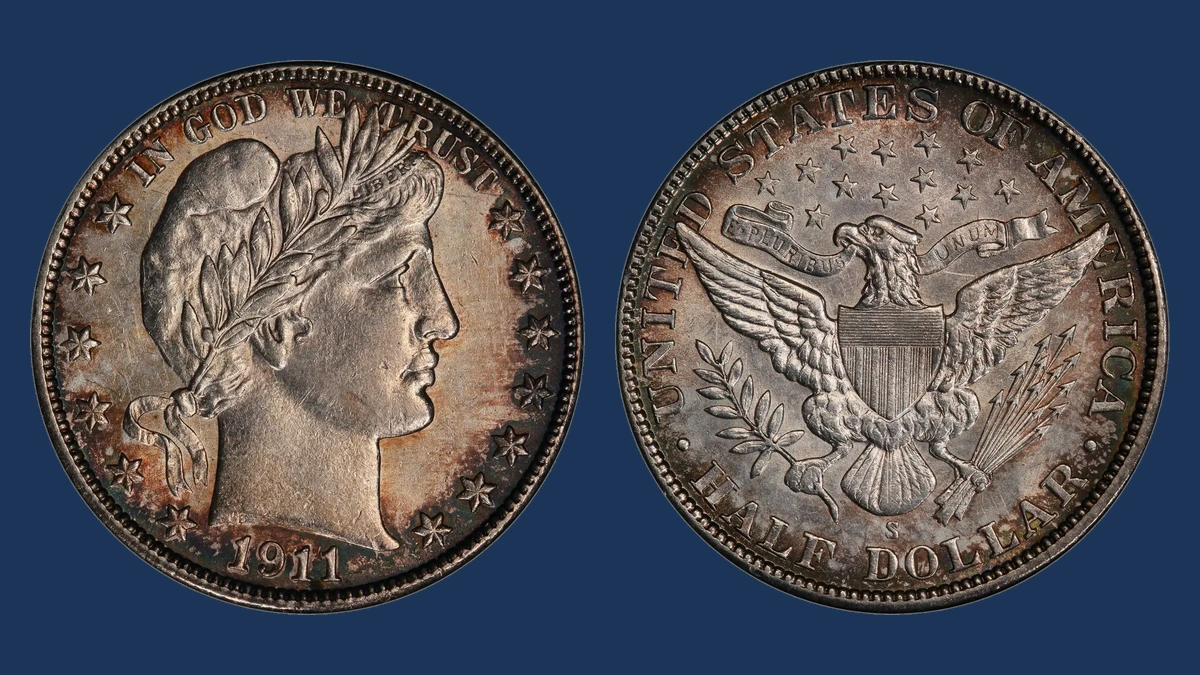
A small piece of another S remains near the bottom end of the mintmark on FS-501. That catalog label names a recognized 1911-S/S half-dollar variety.
The earlier letter survived when the worker punched the mintmark again in a slightly different position. Later coins struck from the die repeated the same overlap.
This is a repunched mintmark. It does not mean that the whole back design was doubled or that the coin was struck twice.
Check the denomination as well as the number. FS labels occur on many different coins, and a photograph of a cent cannot identify a half dollar.
Estimated Value
PCGS lists a $5,875 Heritage result for an MS66 in January 2016. An estimated $4,500–$5,875 comparison range applies specifically to certified coins around that high unworn grade.
It is not a range for worn examples. The shine, number of marks, and overall preservation matter alongside the second S.
A clear extra mintmark does not erase wear elsewhere. Match both the variety and the high grade before using the quoted auction result.
How to Identify
First confirm the 1911 date and HALF DOLLAR denomination. Then enlarge the S below the eagle, leaving some surrounding surface in the picture.
At the lower end, look for the remnant of an earlier letter. A 10× magnifier and an identified FS-501 half-dollar photo should show whether the shapes agree.
A flat shelf, corrosion, or metal pushed up by a hit may thicken that edge. None is enough without the matching earlier-S outline.
When safely accessible, check with a scale and calipers against 12.50 grams and about 30.6 millimeters, and inspect the grooved edge. The lower remnant matching the correct half-dollar variety is the useful confirmation, rather than any second-looking line nearby.
Conclusion
An upside-down S, a second S, and an upside-down back design are three different findings. Use the correct test before comparing prices.
The estimated span is $75–$5,875: $75–$250 for a confirmed circulated inverted S, $100–$300 for circulated half-turn rotation, and $4,500–$5,875 for MS66 repunched-mintmark coins. The high-grade sale does not price every unusual S on a worn half dollar.