1900 Half Dollar Error List with Pictures

A raised crack links the lower stars around Liberty’s bust on a remarkably well-preserved 1900-S half dollar. That coin sold for $57,500 in August 2010.
These 1900 half dollar errors also include peeling silver, extra date strokes, and an off-center design. Estimated values span $160–$60,000, with the highest range reserved for exceptional condition.
Read on to compare the marks and choose a price for the right kind of coin.
1. 1900 Barber Half Dollar Obverse Lamination Error (Estimated Up to $300)
The reported peeling sits behind Liberty’s head, near nine o’clock when the front is upright. A dealer described the coin as VF30, a grade showing moderate wear.
This separation is called lamination. A weakness inside the silver-copper mixture lets a thin layer lift or break away.
An attached flap may remain, or a shallow patch may show where metal came off. That differs from the narrow raised ridge left by a cracked stamping tool.
The report concerns this dealer’s coin, not every rough patch behind Liberty. Its grade was a seller assessment rather than an independent certification.
Estimated Value
Estimate $160–$300 for a moderately worn 1900 with a clear, modest front lamination. An ordinary PCGS VF30 sold for $192 at Heritage on April 29, 2025.
That sale compares the date and condition, not a peeling error. A heavily worn 1912-S with an attached lamination brought $89 in March 2026.
The later coin offers a related flaw to compare. No completed sale price is supplied for the reported 1900 example.
How to Identify
Hold the front upright and find the area behind the head near nine o’clock. Use a 10× magnifier and light from the side to follow the opening.
Look for a thin layer separating from the coin’s body. Scattered corrosion pits or a gouge with metal pushed aside have a different form.
Leave any flap untouched. Check the back for the absence of a mintmark, matching the reported Philadelphia coin.
Use a scale against 12.50 grams and calipers against 30.6 millimeters, then inspect the edge grooves. A tiny peel may barely affect weight.
The useful first clue is a connected metal layer lifting beside an otherwise intact surface.
2. 1900 Barber Half Dollar Repunched Date Error (Estimated Up to $500)
Small extra strokes appear beneath 1 and 9 on the reported Philadelphia date. The description calls their direction southward, simply meaning downward when the coin is upright.
A worker punched the date into a die, the steel stamping tool. Repeating the punch at a slightly different position could leave pieces of the earlier numbers.
Coins made with that tool copied the extra strokes. The date still reads 1900, rather than another year hidden below it.
This report concerns Philadelphia. New Orleans and San Francisco coins need their own matching examples instead of borrowing the same pattern.
Estimated Value
Estimate $250–$500 for a matching Philadelphia repunched date with only slight wear. A regular PCGS AU53 sold for $300 at Heritage on January 21, 2025.
AU53 describes that lightly worn condition. The sale provides a starting comparison for the complete coin, not a measured bonus for extra date lines.
Clear remnants may add interest. Cleaning, damaged surfaces, or heavier wear can make the same date feature worth less.
How to Identify
Keep the entire date upright and examine beneath 1 and 9 with a magnifier. Include the surrounding open silver and small rim teeth in the view.
The extra strokes should fit pieces of earlier numbers. A flat shelf, a sharp cut, or metal pushed up by an impact does not have the same shape.
Confirm the Philadelphia coin has no mintmark on the back. Check its edge grooves for signs of alteration.
For a loose example, compare caliper and scale readings with 30.6 millimeters and 12.50 grams. Wear can reduce the weight.
The direct match is a raised earlier stroke below each named digit in the same position as the confirmed comparison.
3. 1900-O Barber Half Dollar Off-Center Strike Error (Estimated Up to $5,500)
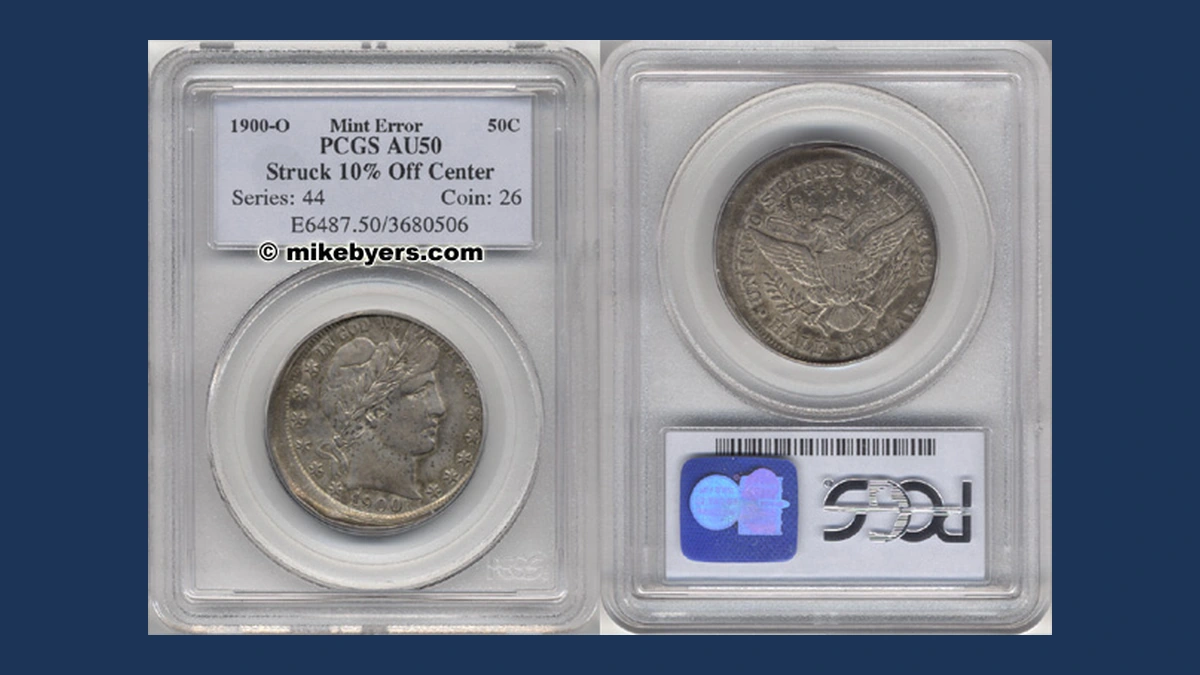
Part of the design misses the metal on the documented 1900-O half dollar. Elsewhere, a blank area remains because the stamping tools did not reach it.
The metal disc sat too far to one side when the press closed. Both faces show the effect of that misplaced disc.
Dealer Mike Byers identifies this coin as 10% off center and graded PCGS AU50. AU50 means light circulation wear.
Its direction needs to be read from the actual photographs. An uneven rim on another 1900 half dollar does not prove the same error.
Estimated Value
Estimate $3,000–$5,500 for a similar 10% off-center 1900-O with light wear. The Byers example is marked sold, without a displayed selling price.
A dealer offered an 1896-S 10% off-center coin for $4,820.40. Its AU Details grade describes light wear plus a surface problem.
That different-year coin supplies an asking-price comparison. It does not establish what the 1900-O sold for, and its condition problem matters when comparing values.
How to Identify
Compare the missing design and blank areas on both faces. A shift on only one face can come from a moved stamping tool instead.
Use a magnifier at the boundary between design and plain silver. Keep the complete outline visible so a cut-away piece cannot be mistaken for blank metal.
Find 1900 and the O mintmark before using the New Orleans comparison. Inspect surviving edge grooves for filing or other damage.
A scale can compare with the original 12.50 grams, while calipers record the outline against the normal 30.6-millimeter diameter. The shape may be distorted.
The quick check is missing design opposite untouched metal on both sides of the same coin.
4. 1900-S Barber Half Dollar Die Crack Error (Estimated Up to $60,000)
A raised line runs from the first star into Liberty’s lower bust and reaches the thirteenth star. Smaller cracks appear on the cap and near the back’s outer border.
The Duckor auction catalog describes these features on an exceptionally preserved coin. They came from cracked stamping tools rather than rough handling afterward.
Silver entered the tool’s openings and copied them as ridges. Several cracks could therefore appear while the finished coin remained unworn.
The catalog also mentions faint lines left while rolling the metal strip. Those are separate from the crack pattern.
Estimated Value
The Duckor coin sold for $57,500 at Heritage in August 2010. PCGS graded it MS67+, indicating exceptional unworn condition, and CAC approved its quality.
An estimated $50,000–$60,000 applies to that exceptional level of preservation. The cracks do not create a separate fifty-thousand-dollar bonus.
A worn 1900-S with a raised line needs a comparison in its own grade. The complete coin’s surfaces and appearance account for much of the difference.
How to Identify
Start at the first star and follow the raised line along the lower bust toward star thirteen. Keep Liberty’s full portrait upright while tracing it.
Use a 10× magnifier to inspect the cap and back border separately. Move the light to see whether each line rises above the silver.
Scratches cut inward, and a peeling layer separates from the coin itself. Neither should be folded into the tool-crack pattern.
Confirm 1900 and the S below the eagle. Compare a loose coin with 12.50 grams on a scale and 30.6 millimeters using calipers, and inspect the edge grooves.
The useful match combines the star-to-bust ridge with the smaller cracks, not just one isolated line.
Conclusion
These estimated $160–$60,000 values apply to different features and conditions. The highest range belongs to an exceptionally preserved 1900-S, not any coin with a crack.
Look behind Liberty for the reported peel, below 1 and 9 for the repeated date, and at both faces for an off-center strike. Match the mint and condition too, while keeping dealer asking prices separate from actual sales.