1870 Half Dollar Error List with Pictures

An 1870-CC half dollar with a fine crack and extra shield outlines sold for $22,200 in July 2023. Its scarce Carson City date and lightly worn condition explain much of that price.
The 1870 half dollar errors below also include a repeated 1 and a reported flaw in the silver blank. Estimated values span $150–$25,000.
Read on to locate each feature and choose a price comparison that matches the mintmark and condition.
1. 1870-S Liberty Seated Half Dollar Planchet Flaw Error (Estimated Up to $1,200)
A ringlike “halo” on an 1870-S coin prompted a dealer to describe a flaw in its blank. The blank is the silver disc that receives the design.
Skyline offered the coin as BU, meaning the dealer considered it unworn. The flaw was listed as a reason to discount it.
The description does not identify peeling metal, a hole, or the exact face affected. Those features need to be visible before using a more specific error name.
A flaw can make a coin less attractive. Being created at the Mint does not automatically make every unusual patch worth more.
Estimated Value
Skyline asked $947 for the reported BU example and discounted it because of the flaw. That is a dealer’s asking price, not a completed sale or a numerical grade from a grading service.
An estimated $500–$1,200 fits a comparable coin. The size and appearance of the flaw matter, along with the remaining shine and detail.
An independent condition check is useful before applying the dealer’s unworn description to another piece.
How to Identify
Turn the coin under a lamp. A 10× magnifier should show whether the halo has a physical change in the metal or is only a ring of color.
The dealer description gives no exact position. Locate the patch on the actual coin and check how the struck design crosses or surrounds it.
Chemical staining, cleaning, and impact damage can also create obvious patches. Look for cuts, pushed-up metal, or altered texture before calling it a blank flaw.
Use a scale and calipers against 12.44 g and about 30.6 mm, and inspect the grooves around the edge. A matching physical defect on the correctly identified coin gives the quickest useful assessment.
2. 1870 Liberty Seated Half Dollar Repunched 1 Error (Estimated Up to $1,600)
An extra stroke beside the first 1 can reveal a repeated date punch. The Philadelphia variety is known as WB-1, a catalog name for the die pair.
Workers punched the date into the die, the steel tool used to stamp coins. When they applied it again in a slightly different place, part of the first impression could remain.
That leftover shape then appeared on coins made with the die. It does not need to form a complete second date.
Look for a stroke that fits another 1. A thick digit or a mark beside it cannot establish the variety alone.
Estimated Value
A cleaned PCGS VF Details repunched-1 example brought $149 in June 2026. A PCGS MS62 CAC WB-1 sold for $1,560 in June 2025.
The estimated $150–$1,600 range reflects the gap between a worn, cleaned coin and an unworn one. The sale records value complete coins.
The Details label flags a condition problem. The $149 result should not be treated as a standard price for an undamaged coin with the same amount of wear.
How to Identify
Center the magnifier on the first 1 while keeping the full date visible. Move the light to see whether the extra stroke rises from the surface.
A scratch cuts into the metal, and a hit can push up an irregular edge beside it. A flat shelf from movement during striking can also make the digit look thicker.
Compare the shape with an identified repunched-1 coin instead of guessing its direction. Check that the back has no mintmark for this Philadelphia variety.
Inspect the edge grooves and use a scale and calipers against 12.44 g and about 30.6 mm. A matching earlier impression beside the first 1 gives the quickest identification.
3. 1870-CC Liberty Seated Half Dollar Reverse Die Crack Error (Up to $22,200)
A raised line crosses MER in AMERICA on an 1870-CC half dollar. Heritage described the feature on its July 2023 auction coin.
The line came from a crack in the die, the steel tool stamping the back. Silver entered the opening during striking and formed a ridge on the coin.
Following the line through the letters is more useful than deciding that the back looks scratched. A real ridge and a cut into the surface have different causes.
The same coin has extra outlines inside the shield from a die clash. Those are separate marks, not extensions of this crack.
Estimated Value
An estimated $1,500–$25,000 spans heavily worn examples through a lightly worn coin like the auctioned AU53. Heritage sold that NGC AU53 for $22,200 on July 20, 2023.
The scarce first-year Carson City issue already carries substantial value. Its mintmark and preservation explain much of the result.
The crack through AMERICA is not a separate $22,200 addition. A coin from another mint, or one with much more wear, needs a different comparison.
How to Identify
Follow MER one letter at a time with a 10× magnifier. Where the line crosses open surface, side lighting should show a ridge rather than a cut.
Compare the route with Heritage’s AU53 example, keeping the 1870 date and CC mintmark visible in full-coin photographs. A close-up of three letters alone cannot prove the date.
Examine the shield separately if extra outlines are present. They help describe the coin but do not replace the crack check.
Use a scale against 12.44 g and calipers against about 30.6 mm, and inspect the grooved edge. A matching raised line through MER gives the quickest confirmation.
4. 1870-CC Liberty Seated Half Dollar Clashed Dies Error (Up to $22,200)
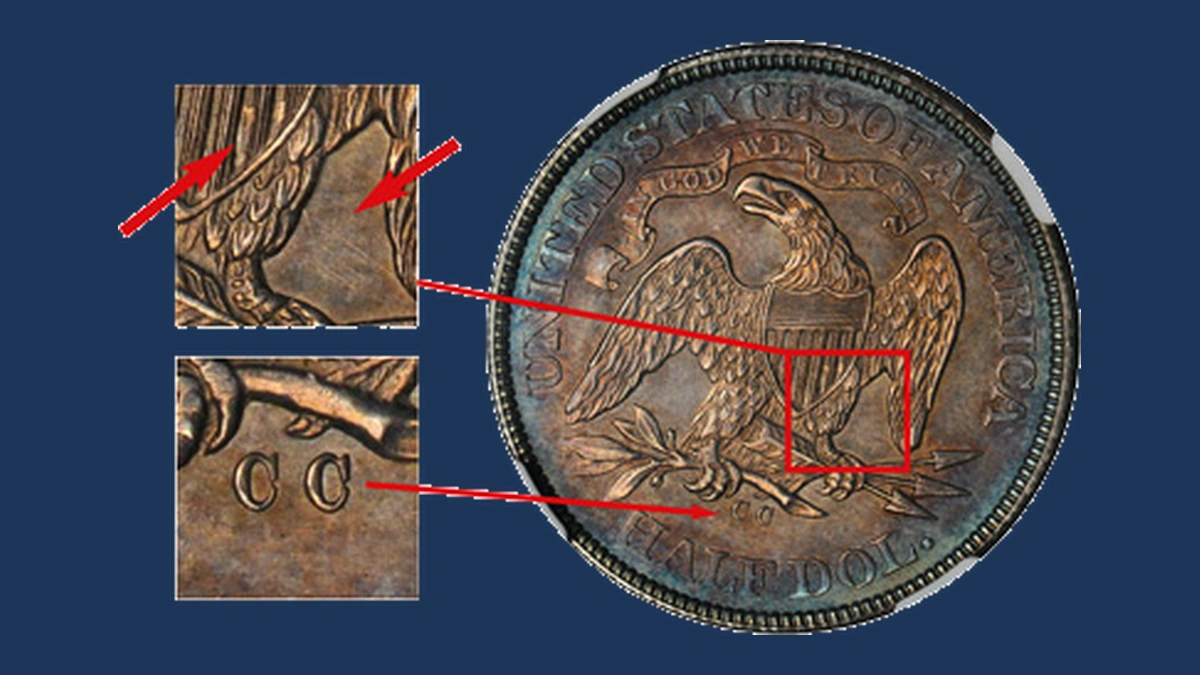
Extra outlines inside the shield can be traces of the opposite design. They form when the dies, the steel stamping tools, collide without a blank between them.
The collision marks their surfaces, and later coins can pick up those marks. Collectors call this a die clash.
The auctioned 1870-CC AU53 shows repeated clash outlines within the shield. A separate WB-1 reference shows marks at the shield’s lower right and beneath the wing on the viewer’s right.
Keep the examples separate. More than one transferred outline can come from repeated die contact without the coin itself receiving two strikes.
Estimated Value
The $22,200 July 2023 sale is the same NGC AU53 coin discussed under die cracks. It is not a second sale for the shield marks.
Estimate $1,500–$25,000 for worn through similar lightly worn 1870-CC examples. Clear clash marks can interest specialists, but the scarce date and condition remain central.
The separate WB-1 reference does not establish another $22,200 result. Two features on one coin do not double its auction value.
How to Identify
Inspect the shield with a 10× magnifier. Separate the normal design lines from shallow extra outlines, then compare those outlines with parts of the opposite face.
For the WB-1 reference example, also examine the lower-right shield and the area beneath the viewer’s right wing. Do not combine marks from separate coins into one pattern.
A scratch cuts into the surface, while a die crack follows a fracture rather than another design’s shape. Check the edge grooves for damage.
A scale and calipers should be compared with 12.44 g and about 30.6 mm. An extra outline that matches the opposite design at the correct location gives the fastest clash confirmation.
Conclusion
The mintmark helps choose the right comparison: Philadelphia for the repeated 1, San Francisco for the reported blank flaw, and Carson City for the documented cracks and clashes.
Estimated prices span $150–$25,000, with condition and rarity doing much of the pricing work. Examine each complete coin and keep a dealer’s asking price separate from an auction result, especially when several features appear together.