1894 Half Dollar Error List with Pictures

The date survived a badly misplaced strike, but the mintmark area did not. That 1894 half dollar sold for $7,800 at Heritage in December 2022.
Other 1894 half dollar errors need closer inspection: an expanded edge on a New Orleans coin and an extra outline inside the date’s 4. Estimated comparisons span $2,500–$8,500 for the conditions discussed here.
Check the full outline first, then the tiny date detail below.
1. 1894-O Barber Half Dollar Broadstrike with Slight Displacement Error (Estimated Up to $3,000)
A wider border can reveal a broadstrike. The coin spread outward because the collar, a metal ring that controls its width, did not hold it normally.
A 1978 catalog lists an 1894-O half as broadstruck with slight, five-percent displacement. The coin was described as XF, meaning worn but still well detailed.
The metal can spread unevenly. A broadstrike therefore does not have to look perfectly centered.
The old description records both features on one New Orleans coin. It gives no direction for the shift, so a comparison needs the whole coin rather than an assumed position.
Estimated Value
The estimated range is $2,500–$3,000 for a comparable Barber broadstrike in XF to AU condition. AU describes lighter wear than XF.
The Mint Error News price table supplies that bracket according to how far the coin expanded. It is a guide estimate, not a recorded 1894-O sale.
The 1978 seller asked $110. That historical price is neither a modern value nor proof of a completed sale at that amount.
How to Identify
Measure the coin across several directions with calipers when safely accessible. A normal half is about 30.6 millimeters wide; a broadstrike may extend beyond that size.
A scale should show a weight near the usual 12.50 grams, allowing for wear. Expansion during striking spreads metal rather than simply removing it.
Use a magnifier to inspect the expanded border and the edge grooves. Later flattening can also widen a coin, but it crushes or damages the finished design.
Photograph both sides, including the 1894 date and O below the eagle. The useful match combines an original expanded outline with the right date and mint, not width alone.
2. 1894 Barber Half Dollar Proof Repunched Date Error (Recorded Floor Price $4,875)
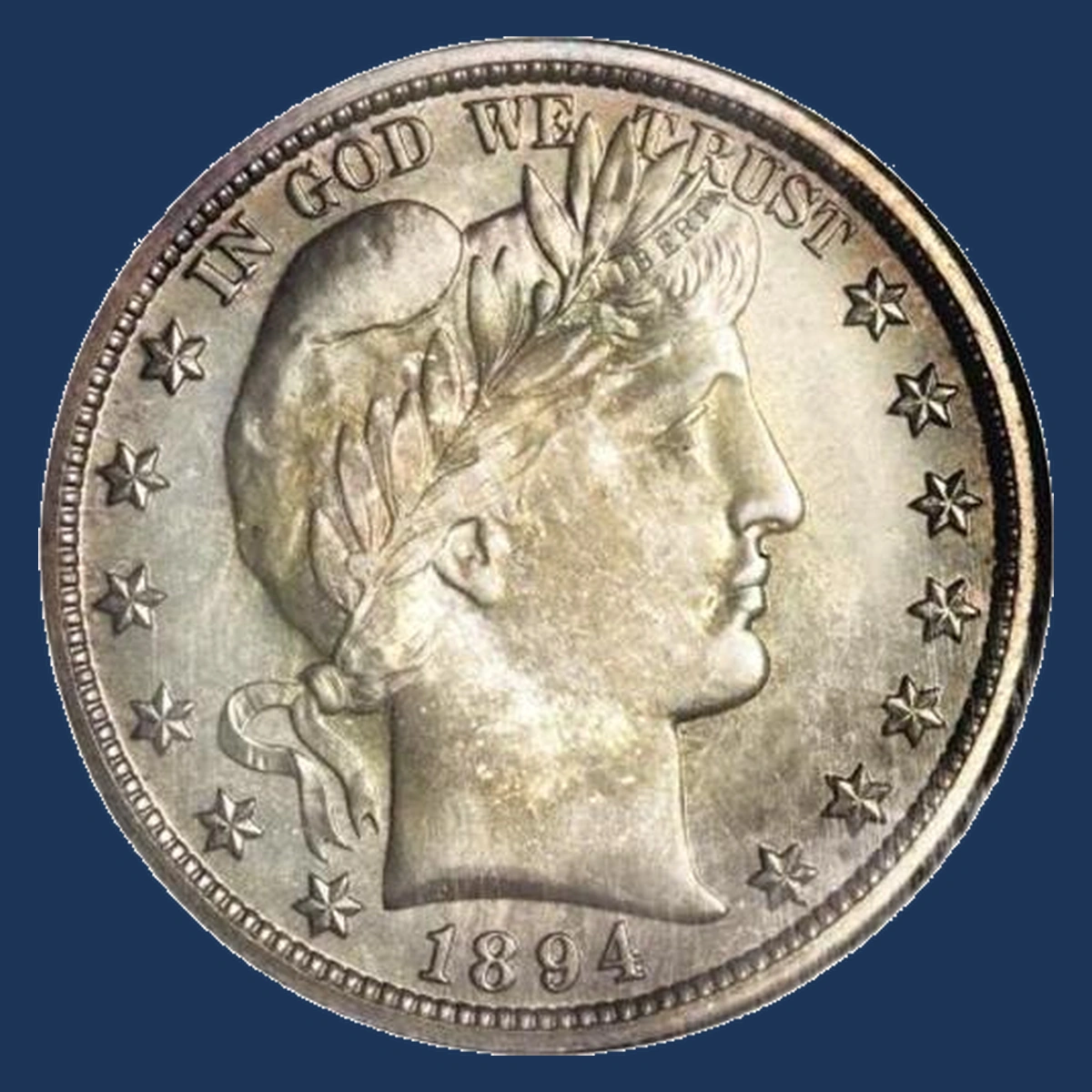
Inside the triangular opening of the date’s 4, a small extra outline records an earlier date punch. That repeated impression is called a repunched date.
The punch left the mark in a die, the steel tool that stamps coins. Later coins could then show the same extra detail.
Heritage described this feature on an NGC PR67 in March 2008. PR identifies a Proof, a coin specially made for collectors with carefully prepared surfaces.
The catalog name Breen-5052 refers to this variety. It concerns Philadelphia Proofs, so the same feature should not be assumed on every worn 1894 half.
Estimated Value
The archived Heritage lot records a $4,875 floor price for the NGC PR67 in March 2008. No buyer’s fee has been added to that quoted figure.
Comparable PR67 Proofs have an estimated $4,000–$5,500 range. The grade describes a highly preserved collector coin.
Fine scratches, color, and the reflective surfaces all affect the price. The tiny mark inside the 4 is one part of the coin, not the sole reason for its value.
How to Identify
Soft light helps reveal the inside of the 4 without a bright reflection hiding it. Use a magnifier and compare the extra outline with the catalog photo.
Keep the coin still while changing the light angle. A reflection moves, but the actual raised trace stays attached to the same place inside the number.
Look for a scratch crossing the area as another possible explanation. The example must also be a Philadelphia Proof, with no mintmark below the eagle.
The normal measurements are about 30.6 millimeters and 12.50 grams, with edge grooves. Use a scale and calipers only when safely accessible; leave certified coins in their holders and compare the fixed outline inside the 4.
3. 1894 Barber Half Dollar 40% Off-Center Strike Error (Up to $7,800)
This coin has a large blank crescent and a design struck forty percent off center toward two o’clock. The complete 1894 date remains visible on the part that received the strike.
Much of the back missed the design, including the place where a mintmark would appear. That makes the mint unknown.
No visible letter does not mean Philadelphia here. The missing area prevents that conclusion.
NGC graded the coin AU53, meaning light wear. Its major shift is quite different from the slight displacement described on the New Orleans broadstrike, even though both coins have uneven outlines.
Estimated Value
Heritage sold the AU53 coin for $7,800 on December 21, 2022. For a closely similar 1894 half with a major shift and full date, estimate $6,500–$8,500.
The price reflects the combination of a dramatic error, readable year, and good surfaces. It is not a benchmark for every uneven strike.
A much smaller shift, incomplete date, or serious damage needs a different comparison. More blank metal alone does not guarantee the same value.
How to Identify
Check what is still present, not just what is missing. An off-center coin retains untouched blank metal, while a clipped coin has part of its metal missing.
Follow the design’s boundary with a magnifier and confirm a matching shift on both faces. The complete date should remain within the struck area.
Now check the usual mintmark location on the back. If that area missed the strike, the coin’s mint must remain unnamed.
A scale and calipers can compare a safely accessible example with the normal 12.50 grams and 30.6 millimeters, while recording its irregular shape. Inspect the remaining edge grooves; the full date beside original blank metal and two shifted designs is the decisive visual combination.
Conclusion
A missing mintmark area cannot tell you which mint made a coin. The forty-percent off-center example shows why that distinction matters, even when the date is perfectly clear.
The estimated $2,500–$8,500 span covers different coins and conditions. An expanded border, a repunched Proof date, and a large blank crescent each need their own comparison; keep the old asking price and recorded auction figures separate.