1860 Half Dollar Error List with Pictures

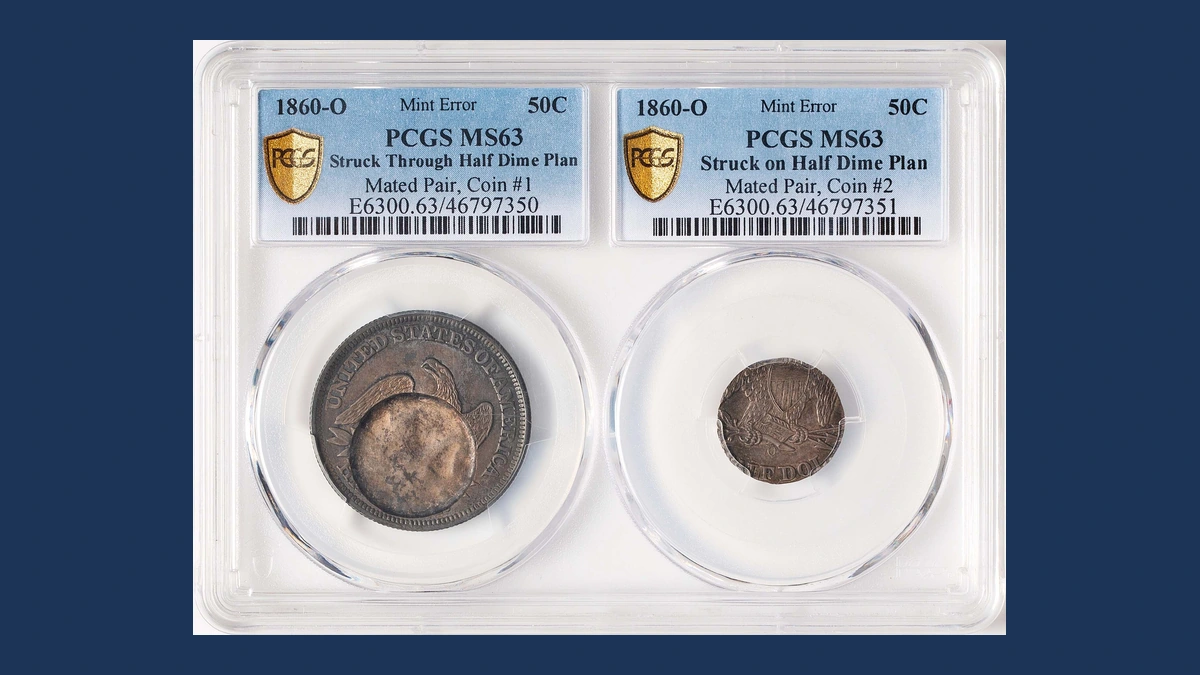
A small silver blank became trapped against an 1860-O half dollar during striking. Both pieces survive, and the pair reportedly sold for $219,600 at Heritage’s 2026 ANA auction.
These 1860 half dollar errors also include a small hollow mark and a repeated O mint letter. Estimated values range from $500 to $240,000, depending on the particular coin or pair.
Read on to see why these very different features need separate price comparisons.
1. 1860-O Liberty Seated Half Dollar Struck-Through Error (Estimated Up to $1,500)
A hollow beside star 4 has an outline resembling a seed pod. Heritage described it as a strike-through on the half dollar that belongs to the two-piece error.
Something lay between the front stamping tool and the silver blank. It blocked contact at that spot and left an impression in the surface.
The catalog identifies the shape and location, but not what the material was. The outline alone does not prove it was a particular object.
The much larger hollow on the back came from a half dime blank. That separate event should not be confused with this small mark.
Estimated Value
Estimate $500–$1,500 for an ordinary 1860-O with a comparable small strike-through, from worn through lower unworn grades. A same-date coin graded AU55 with CAC approval sold for $660 in April 2022.
AU55 means light circulation wear. That sale compares ordinary condition, not this exact hollow.
The illustrated coin belongs to the $219,600 pair below. That price covers both pieces and their major shared error, rather than the small star-area mark alone.
How to Identify
Count to star 4 on the left of the front, then examine the nearby hollow with a 10× magnifier. Compare its full pod-shaped outline with the recorded example.
Move the light across its boundary. A later gouge may push sharp lips of metal upward, while a crack in the stamping tool leaves a raised line.
Keep the normal design around the hollow in your close-up. One mark near a star is not enough to show the same feature.
Include the back photograph with its larger indentation to identify this particular half dollar. Use a scale and calipers where accessible against 12.44 grams and 30.6 mm, and inspect the edge grooves.
Start with the small matching hollow beside the correct fourth star.
2. 1860-O Liberty Seated Half Dollar Repunched Mintmark Error (Up to $64,625)
Look inside the O toward its upper left for another curved outline. It remains from an earlier position of the mint-letter punch in the die, the steel stamping tool.
Heritage described it on a half dollar with the Type Two back, graded NGC SP64. SP identifies a specially made specimen coin, rather than an ordinary circulation strike.
Its reflective background is part of that coin’s appearance. The small extra O identifies a feature of the tool used to make it.
Those are separate observations. A repeated O on an ordinary coin does not automatically make it a valuable specimen strike.
Estimated Value
The NGC SP64 Type Two coin sold for $64,625 in January 2017. Estimate $50,000–$70,000 for a similarly authenticated and preserved specimen strike.
This range concerns a special method of manufacture as well as condition. It is not a standard price for an ordinary repeated mint letter.
The extra O helps match the stamping tool. The complete coin’s finish, preservation, and documented identity are needed before the exceptional sale becomes a useful comparison.
How to Identify
Aim a 10× magnifier inside O, rather than looking only around its outer edge. Follow the earlier curve in the upper-left opening.
Move the lamp to distinguish raised metal from a shadow. A small chip in the tool can partly fill O without making another letter-shaped curve.
Check for corrosion or a contact mark that changed the opening afterward. The earlier outline should match the recorded specimen.
For the high price range, confirm the Type Two back and documented SP identification. A shiny patch alone cannot establish special manufacture.
Use a scale and calipers against 12.44 grams and 30.6 mm on an accessible coin, then inspect the edge grooves. Match the upper-left O remnant first, and assess specimen status separately.
3. 1860-O Liberty Seated Half Dollar Indented Mated Pair Error (Up to $219,600)
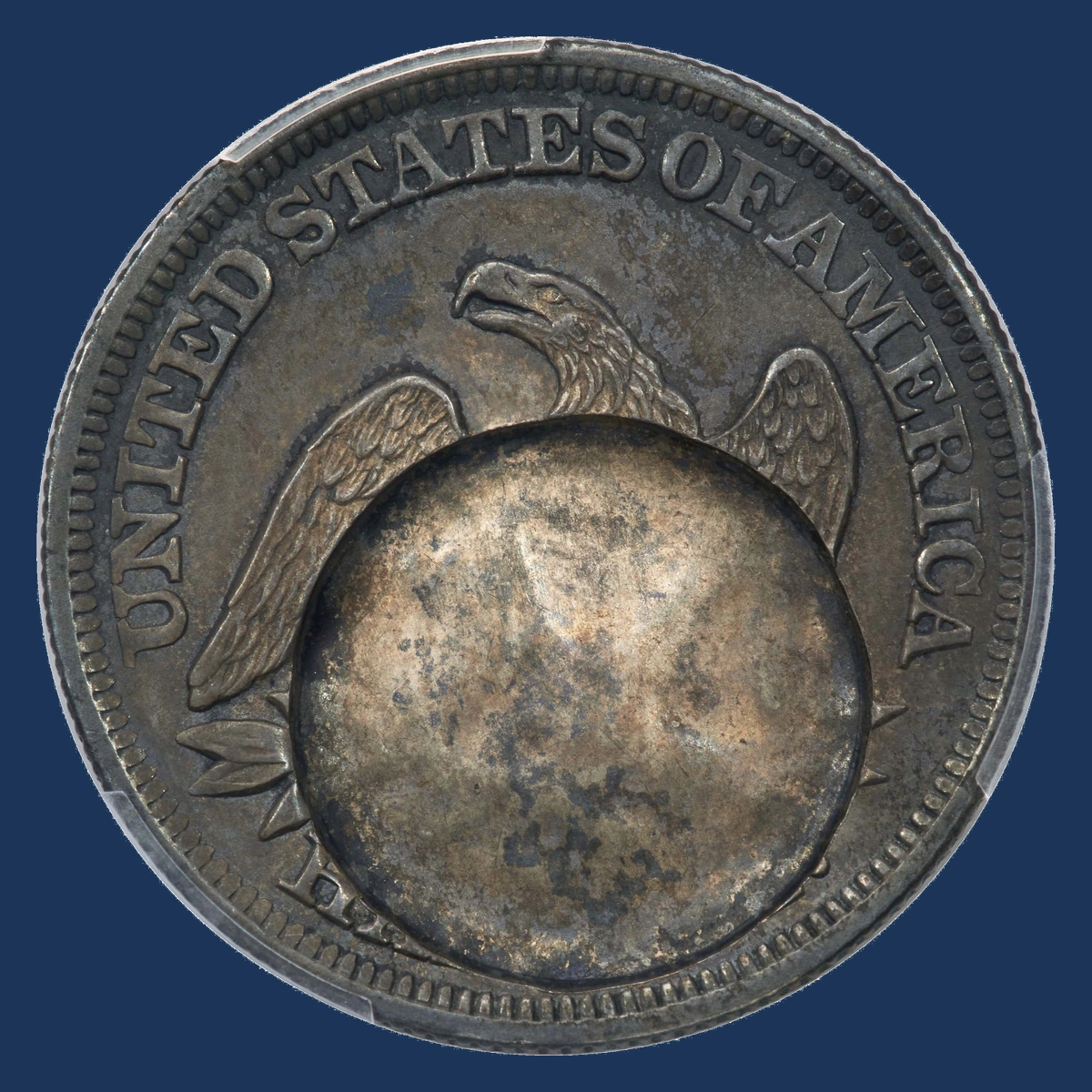
A half dime blank lay on the half-dollar blank when the press struck. The smaller piece sank into the larger one and received part of the half dollar’s eagle design.
Both pieces survive. The half dollar has a round hollow on its back, while the smaller piece carries details intended for that missing area.
Collectors call them a mated pair because they fit the same striking accident. The December 2023 club account illustrates both.
This differs from finding only a half-dollar design on a smaller blank. Here, the surviving larger coin also shows where the two pieces met.
Estimated Value
Mint Error News reports $219,600 for the PCGS MS63 pair at Heritage’s 2026 ANA auction. MS63 means unworn with noticeable marks.
Estimate $200,000–$240,000 for that documented two-piece rarity. Its earlier April 2026 offering was unsold and supplies no additional completed-sale price.
Keeping both pieces together is central to this comparison. A dented half dollar alone, or an unrelated small blank with a partial design, cannot inherit the pair’s result simply because it looks unusual.
How to Identify
Place photographs of the two pieces side by side without pressing the coins together. Compare the round recess with the outline of the smaller piece.
The smaller blank carries parts of the eagle’s shield, claws, tail, mint letter, and denomination. Those details should explain the same missing area on the half dollar.
Use a 10× magnifier to inspect the recess boundary and surrounding struck surface. Later damage must not be mistaken for the original contact.
The normal half-dollar reference is 12.44 grams and 30.6 mm, with edge grooves. Use a scale and calipers where accessible, recording each piece separately.
Begin by matching the smaller piece’s design and outline to the larger coin’s recess. Authentication needs both components, not just a picture of a dent.
Conclusion
Estimated comparisons range from $500–$1,500 for a minor strike-through to $50,000–$70,000 for the documented specimen class. The complete two-piece error has a separate $200,000–$240,000 range.
The small blank carries design that the hollow in the half dollar could not receive. Keep those pieces together in any comparison.
A small mark near a star or an extra O needs its own examination and does not inherit the pair’s price.