1865 Half Dollar Error List with Pictures

Small extra pieces of the 1 and 5 appear on an 1865 half dollar that sold for $3,360 in January 2025. The same coin also has fine raised cracks on both sides.
Estimated values for the 1865 half dollar errors below range from $350 to $4,000. Read on to check date mistakes, extra outlines, and a back that points in the wrong direction, while keeping features from different mints separate.
1. 1865-S Liberty Seated Half Dollar Clashed Dies (Estimated Up to $900)
Some 1865-S halves show extra outlines near Liberty’s legs and elbow. The reported locations are above the legs, below the elbow, and beside the right lower leg.
These marks can be pieces of the design from the other side of the coin. They are called clash marks.
The steel tools that stamp coins can mark each other when they meet without a metal blank between them. Later coins receive those unintended shapes.
Compare them with normal clothing folds. Scratches and fine lines left by polishing a tool can look different.
Estimated Value
Estimated value is $350–$900 for a worn coin with recognizable clash marks. Clear traces and good surfaces help it fit toward the upper end.
Ordinary 1865-S examples had reported sales of $535 for NGC XF45 in October 2025 and $495 for PCGS XF40 in January 2026. Those grades indicate moderate wear, and these are whole-coin comparisons rather than recorded sales of the particular clash examples pictured in the reference.
How to Identify
Compare the marks above the legs with those near the elbow and right lower leg. A magnifier should reveal pieces of a recognizable design rather than just extra lines.
Keep nearby clothing folds in view and change the light’s direction. This helps separate normal details and scratches from the faint transferred shapes.
Confirm the S mintmark on the back, then examine the grooves around the edge. On a coin outside a grading holder, a scale and calipers can compare the usual 12.44 grams and 30.6 millimeters.
A matching piece of the opposite design at a documented leg or elbow location gives the quickest useful confirmation.
2. 1865 Liberty Seated Half Dollar Misplaced Date (Estimated Up to $1,600)
A piece of a date digit can appear outside the place where that number belongs. A genuine misplaced date begins when a worker stamps a number into the steel coin-making tool in the wrong position.
The 1865 Philadelphia listing separates this feature from the double-date variety. The two names should not be used for the same unidentified mark.
Simply having uneven date spacing does not prove a misplaced number. The listing does not provide an exact location, so a candidate needs a clear match to an already identified example.
Estimated Value
The estimated range is $600–$1,600 for identified examples with moderate wear. Much of this amount comes from the value of the Philadelphia coin itself.
Ordinary 1865 PCGS XF40 sales were reported at $800 in April 2025 and $919.99 in November 2025. They support a whole-coin comparison, but they do not show a separate price for the misplaced number or identify its exact shape.
How to Identify
Find an identified Philadelphia example using the PCGS variety listing before choosing a mark on your coin. The name alone cannot tell you which digit or location to expect.
Under a magnifier, look for a curve or small tip shaped like part of a number. It should rise from the original surface rather than form a later cut.
Photograph the whole date and nearby design. Use a scale and calipers to compare 12.44 grams and 30.6 millimeters, and inspect the edge grooves for damage.
A number-shaped fragment matching the position and shape on an identified coin is the quickest meaningful check.
3. 1865 Liberty Seated Half Dollar Rotated Reverse (Estimated Up to $2,800)
Turn this reported coin over and the eagle does not point straight up. Collector Paul Brill measured a counterclockwise lean of about thirty-two degrees, allowing two degrees either way.
He used a rotation-measuring holder and judged his coin AU58, meaning very little wear. That was his own assessment, not a professional grading label.
Brill also reported a roughly thirty-one-degree measurement for another collector’s double-date example. These observations give collectors a reason to check the back, but they do not show that every double-date coin has the same amount of rotation.
Estimated Value
For a lightly worn double-date example with the reported rotation, use an estimated $1,500–$2,800. The ordinary Philadelphia price guide places AU53 around $1,500, AU55 around $1,750, and AU58 around $2,250.
These grades describe decreasing amounts of light wear. The figures are guide values for the underlying coin, not auction prices for Brill’s example, whose self-assessed grade and measured rotation remain separate from a professionally certified grade or a recorded sale.
How to Identify
Hold Liberty upright in a secure protective holder, and mark the upright direction on the holder rather than the coin. Flip it from top to bottom without letting the coin move.
Measure the eagle’s lean with a protractor and repeat the flip. A coin that shifts inside a loose holder can give a false result.
Use a magnifier to check the double date separately. Inspect the edge grooves, then use a scale and calipers on an unholdered coin to compare 12.44 grams and 30.6 millimeters.
A repeatable counterclockwise lean near thirty-two degrees after the controlled flip gives the quickest direct check of Brill’s report.
4. 1865 Liberty Seated Half Dollar Die Cracks (Auction Example $3,360)
Fine raised lines cross both sides of the Philadelphia coin sold in January 2025. Its description does not trace their exact paths.
San Francisco examples have more specifically described lines running from the small border teeth below the date toward the rock and stars. Other lines appear around the outer part of the back.
A crack in the steel stamping tool fills with silver and leaves a raised line on the coin. This differs from a scratch cut into the finished surface, and the San Francisco paths should not be assigned to the Philadelphia example.
Estimated Value
Estimated value is $500–$1,500 for worn examples, depending on the mint, condition, and clarity of the lines. A well-preserved Philadelphia example without wear fits roughly $3,000–$3,360.
The PCGS MS64 coin with cracks on both sides sold for $3,360 in January 2025. It also has a repunched date, so that one price covers both features and the coin’s condition rather than two separate sales or two added error charges.
How to Identify
Choose a comparison coin from the same mint first. For the San Francisco reports, follow the line below the date into the rock-and-star area, then check the back border.
The Philadelphia example needs its own photographs to locate the lines. Its general auction description cannot supply their exact positions.
A magnifier and side lighting help show a raised line rather than a cut with damaged edges. Inspect the edge grooves too, and use a scale and calipers to compare the normal 12.44 grams and 30.6 millimeters.
A continuous raised line following the correct mint’s reference photograph is the quickest reliable match.
5. 1865 Liberty Seated Half Dollar Repunched Date (Estimated Up to $4,000)
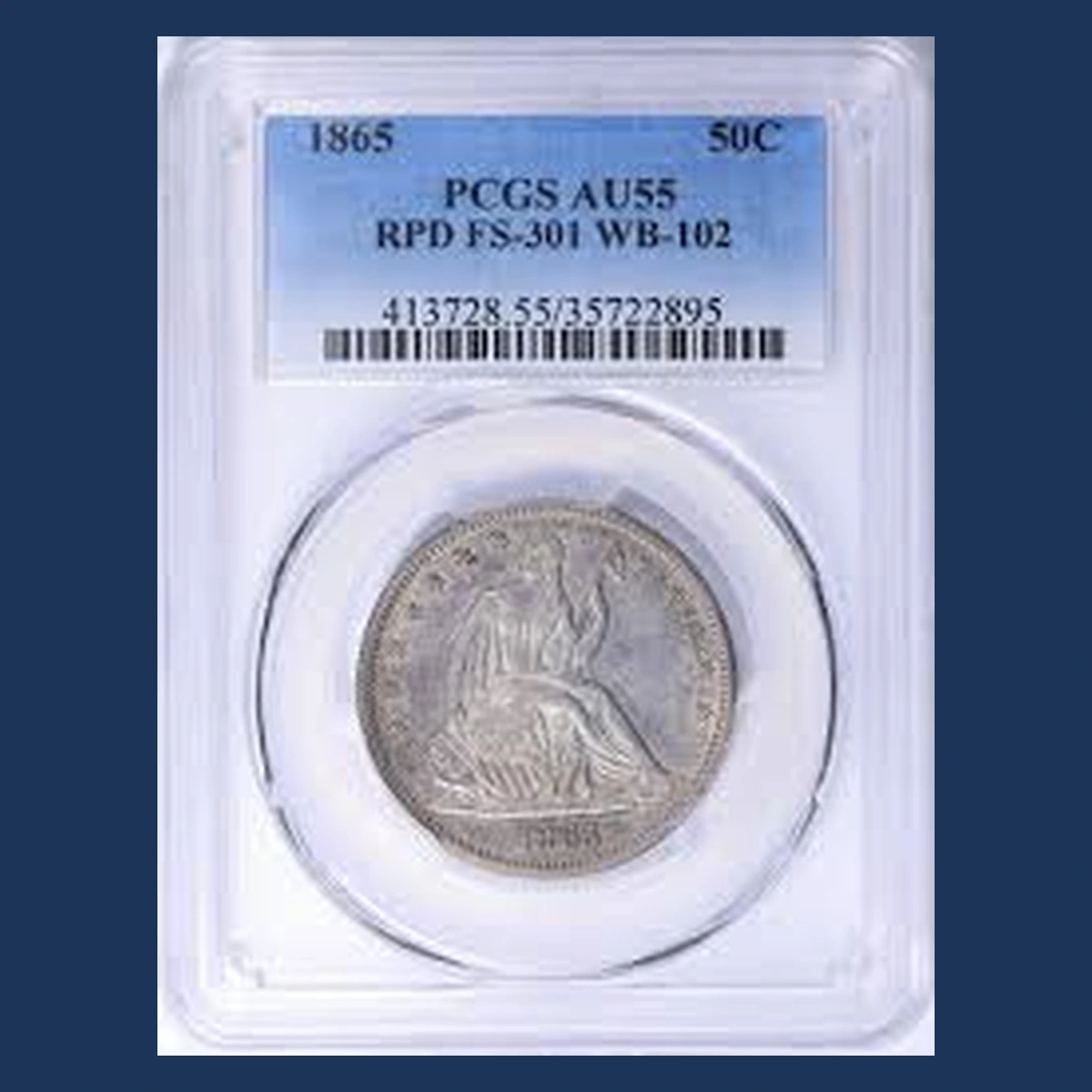
Small extra pieces of the 1 and 5 remain beside the finished date on the Philadelphia auction coin. A number punch struck the steel tool more than once in slightly different positions.
A more dramatic example shows both horizontal and slanted impressions of the date. This is the double-date form.
The published study uses a close-up from Bill Bugert’s coin and full views of Paul Brill’s separate coin. San Francisco reports also describe extra impressions of 1 and 5, but their direction must be checked on the appropriate example.
Estimated Value
Estimated values are $700–$2,500 for worn identified examples and $3,000–$4,000 for similarly preserved Philadelphia coins without wear. Both the clarity of the extra numbers and the coin’s condition matter.
The PCGS MS64 example brought $3,360 at Heritage on January 17, 2025. Its modest extra impressions provide a real sale, but the price cannot automatically be assigned to the different double-date form or to San Francisco examples.
How to Identify
Examine the 1 and 5 with a magnifier for an extra curved piece or small tip shaped like part of a number. A flat shelf beside a digit is not enough.
For the double-date form, include all four numbers in the comparison. The horizontal and slanted impressions should form a connected pattern.
Read the mintmark on the back before selecting a reference photograph. Check the edge grooves and use a scale and calipers to compare the normal 12.44 grams and 30.6 millimeters.
Matching raised pieces of earlier numbers, or a coherent second date on the double-date form, give the quickest convincing identification.
Conclusion
The estimated $350–$4,000 range reflects the whole coin’s condition as well as its unusual features. One coin can have both a repeated date and raised cracks, or a double date with a rotated back.
Check each feature separately without adding together prices from different examples. Keep Philadelphia and San Francisco comparisons distinct, and remember that close-up date pictures may show a different coin from the nearby full views.