1850 Half Dollar Error List with Pictures

A Philadelphia 1850 half dollar with extra strokes in its date sold for $5,520 in May 2025. Other interesting features are much smaller, including a doubled O mintmark and a missing fold beneath Liberty’s elbow.
These 1850 half dollar errors have estimated values from $250 to $6,000 across the conditions discussed. Read on to compare the date, mintmark, shield, and clothing before deciding what an unusual mark means.
1. 1850-O Liberty Seated Half Dollar No Drapery (Estimated Up to $800)
The fold beneath Liberty’s elbow is missing on the reported 1850-O No Drapery feature. Look at the nearby clothing before deciding whether this is simply wear.
The year guide explains the missing fold as the result of polishing a steel stamping tool too heavily. Polishing can remove a shallow part of the tool’s design, so later coins no longer receive that detail.
This is a change to a working tool, not the original No Drapery design introduced in 1839. A heavily worn 1850-O can also lose the fold without having this particular feature.
Estimated Value
Estimated value is $250–$800 for a worn example with convincing evidence of the reported polishing effect. Ordinary 1850-O sales provide comparisons of $336 for XF45 in April 2025 and $512 for AU53 in July 2026.
Those grades indicate moderate to light wear. The year guide supplies the No Drapery report, but it does not identify a certified specimen or a completed sale specifically pricing that missing fold.
How to Identify
Place a normal 1850-O with similar wear beside the suspected coin. If the arm and surrounding clothing are also flat, the missing fold may simply reflect circulation.
Check the O below the eagle and the grooves around the edge. Use a scale and calipers to compare the original 13.36 grams and roughly 30.6 millimeters, allowing for wear.
Now change the light and inspect the elbow area with a magnifier for scraping or smoothing. Abrasion after minting disturbs an existing surface.
A missing elbow fold surrounded by otherwise clear nearby detail is the first useful distinction from a generally worn front.
2. 1850-O Liberty Seated Half Dollar Doubled Die Obverse (Estimated Up to $1,000)
The reported extra outlines are inside Liberty’s shield rather than around the date. A collector describes doubling in the upper vertical lines and along the shield’s edge.
The description appears in the owner’s PCGS Registry entry. It does not mean PCGS separately certified that doubling.
A doubled die is a steel stamping tool made with repeated design details. It can pass the same extra shapes to many coins.
Several connected doubled lines are more convincing than one bright edge in a photograph. Light can make a normal raised line look as if it has a second outline.
Estimated Value
Use an estimated $300–$1,000 for a worn example with convincing shield doubling and a sound identification. Ordinary 1850-O sales of $336 in XF45 and $512 in AU53 help compare moderate and light wear.
Clear repeated details and attractive surfaces support the higher end. This is not a sale price for the collector’s displayed coin, and the report should not be extended to doubled stars or other positions it does not describe.
How to Identify
Begin with the collector’s shield description, then compare the upper vertical lines and adjacent border together. Keep their spacing visible under a magnifier instead of isolating one shiny line.
Change the lighting to test whether the extra shapes remain raised beside the original details. A flat shelf or scratch does not establish the reported doubling.
Record the date and O mintmark, inspect the edge grooves, and use a scale and calipers on an unholdered coin. Compare the normal 13.36 grams and 30.6 millimeters.
Consistent repeated shapes in both the upper shield lines and its edge provide the focused first check.
3. 1850-O Liberty Seated Half Dollar Repunched Mintmark (Estimated Up to $1,500)
The O below the eagle identifies New Orleans. On a repunched-mintmark example, parts of a second O can remain beside or inside the finished letter.
At the time, a worker punched the mintmark separately into the steel tool used to stamp the back. Repeating the punch in a slightly different position could leave both outlines.
GreatCollections has an 1850 Repunched O category, and the year guide also reports this feature. Dents or cracks near the letter need a different explanation, since a genuine earlier O should retain a recognizable part of the same curved shape.
Estimated Value
GreatCollections reports $1,186.88 for a PCGS XF40 example in its Repunched O archive, dated July 2026. XF40 means moderate wear.
An estimated $500–$1,500 suits worn coins with similarly clear extra mintmark detail. The range brackets that identified example.
Weaker remnants, cleaning, damage, or heavier wear can change the value. Ordinary New Orleans sales alone do not show what buyers pay for this particular feature.
How to Identify
Confirm the O and 1850 date before selecting a comparison photograph. The complete coin also needs edge grooves and measurements consistent with about 13.36 grams and 30.6 millimeters, checked using a scale and calipers.
Bring a magnifier over both the outside and inside of the O. Follow any extra curve rather than assuming it must point in a particular direction.
Compare that curve with an identified example and inspect nearby metal for dents, scratches, or attached material. These can create a false second edge.
A recognizable second O outline matching the reference coin supplies the quickest positive comparison for repunching.
4. 1850 Liberty Seated Half Dollar Clashed Dies (Estimated Up to $5,000)
Faint raised shapes appear just to the right of the eagle’s shield on a Philadelphia coin in the Maurice Storck auction. Heritage described them as clash traces.
A clash happens when the steel stamping tools meet without a blank, the round metal disc that becomes the coin. Part of one design can mark the opposite tool and then appear on later coins.
The cataloged half dollar graded PCGS MS63, meaning no wear but noticeable marks, and also had a repunched date. Those date strokes have a different cause from the blurred shapes beside the shield.
Estimated Value
Estimated value is $2,500–$5,000 for an MS63 Philadelphia coin comparable to the cataloged example. A different repunched-date Philadelphia half dollar graded NGC MS64 sold for $5,520 in May 2025.
That slightly higher-grade sale gives a recent comparison, not a recorded price for the Storck coin with clash marks. The estimate considers the entire coin’s condition and the visibility of the extra shapes rather than assigning a separate fixed price to the clash.
How to Identify
The correct reference is the Philadelphia coin without an O mintmark. Compare its Storck auction description and photographs, keeping the eagle’s shield beside the faint marks rather than cropping it away.
Before concentrating on the tiny shapes, inspect the edge grooves. Calipers and a scale can check the normal 30.6 millimeters and original 13.36 grams on an unholdered coin.
Use a magnifier with soft light, then light from one side, to distinguish a raised trace from a scratch cut into the metal. The matching raised pattern immediately right of the shield is the direct first comparison for this cataloged clash.
5. 1850 Liberty Seated Half Dollar Repunched Date (Estimated Up to $6,000)
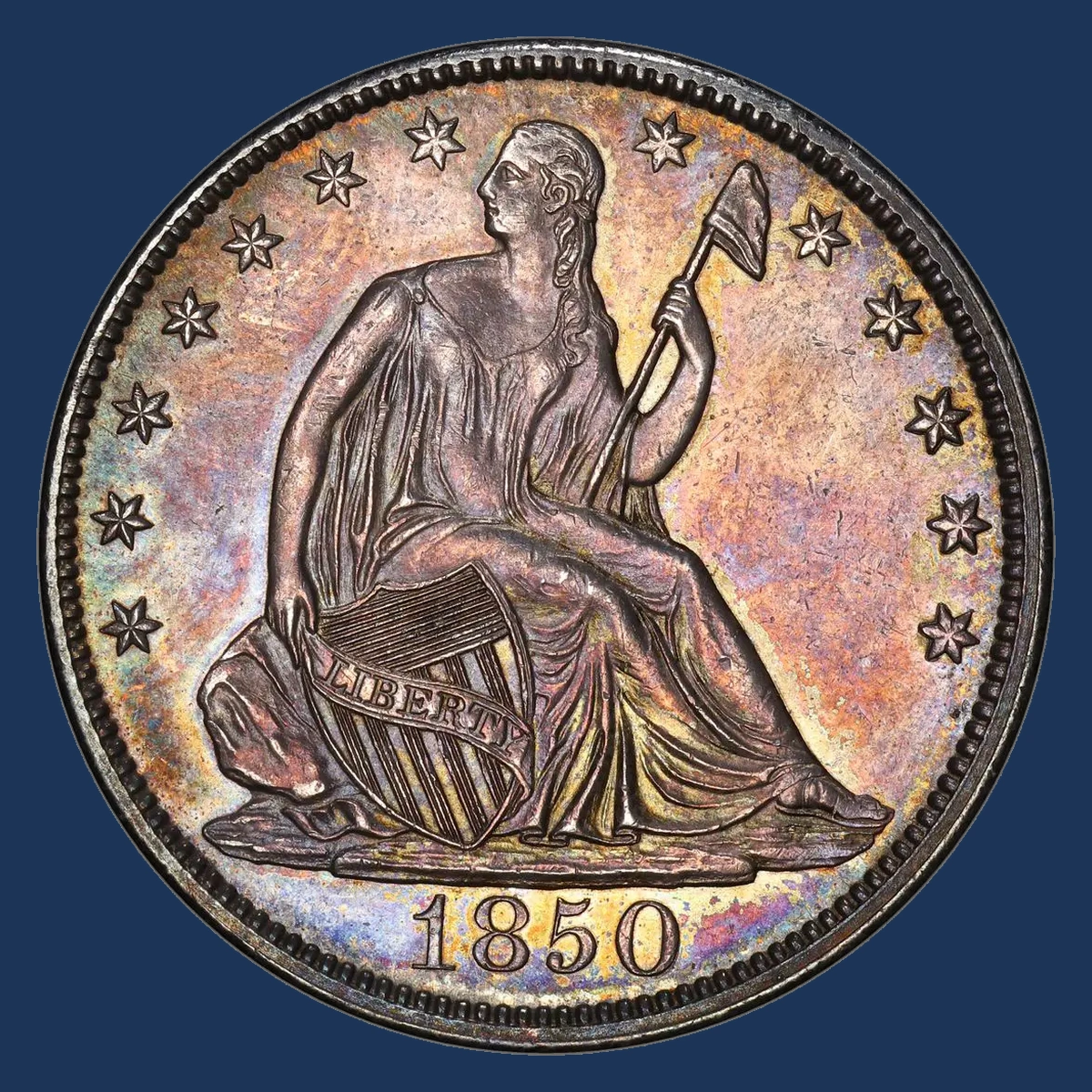
Small extra strokes can remain beside the 5 and 0 after the date was punched more than once into the steel stamping tool. They are pieces of the same year’s numbers, not a different date underneath.
One Philadelphia XF45 example in the Storck sale has extra detail at the top stroke of the 5 and lower-right edge of the 0. A separate MS63 has an earlier 0 impression below and to the right.
Those positions belong to their individual examples. The usual open or closed shape of a 5 alone does not establish repunching.
Estimated Value
A repunched-date NGC MS64 sold for $5,520 at Heritage in May 2025. That unworn example provides a recent identified comparison near the top of an estimated $1,000–$6,000 range.
The range also includes attractive worn coins. A clear extra stroke helps identify the feature, but wear, marks, and original surfaces still affect the price.
A much more worn coin does not receive the MS64 sale price simply because it shares an extra stroke.
How to Identify
Choose the date pattern first: the XF45 reference has extra strokes at the top of the 5 and lower right of the 0. The separate MS63 has its earlier 0 below and right.
Compare the whole date under a magnifier before focusing on the small remnant. It should be a recognizable raised part of a number rather than a scratch or flat shelf.
Confirm the absence of an O on the back, and inspect the edge grooves. Use calipers and a scale to compare about 30.6 millimeters and the original 13.36 grams.
The correctly placed earlier stroke on the 5 or 0 is the immediate identifying feature.
Conclusion
The estimated $250–$6,000 range covers different features and conditions, from a missing elbow fold to an unworn repunched-date coin. Check whether an extra shape belongs to a number, the O mintmark, the shield, or the design from the opposite side.
Keep Philadelphia and New Orleans examples separate. The $5,520 repunched-date sale and $1,186.88 Repunched O result provide concrete comparisons, while the other price brackets remain estimates.