1822 Half Dollar Error List with Pictures

A coin traditionally called 1822/1 sold for $69,000 at Heritage in July 2025. Specialists dispute whether its tiny extra date detail really came from an earlier 1, even though the catalog name survives.
Other 1822 half dollar errors have larger clues, including repeated edge words and a crack joining the stars. Estimated ranges below extend from $150 to $70,000 across very different conditions.
Read on to separate what is visible on each coin from the explanation attached to its name.
1. 1822 Capped Bust Half Dollar Reported Planchet-Flaw Appearance (Estimated Up to $450)
Unusual patches on the back prompted an owner to ask about this 1822 half dollar. The letters and scroll reportedly remained unaffected, while other collectors suggested a flaw in the original metal blank.
One suggestion was lamination, where metal separates into layers. That explanation needs a visible layer boundary, not just a rough patch.
Corrosion, rubbing, or later scraping can change a surface too. The reported appearance alone does not settle the cause.
No grading certificate or definite peeling location was established in the discussion. The coin remains a coin with surface changes that needs examination on its own evidence.
Estimated Value
Estimate $150–$450 for a circulated 1822 with moderate to light wear and modest surface changes. This values the whole coin without assuming a major peeling-metal premium.
A different-year comparison is an 1832 ANACS XF45 with a minor rim defect sold for $263.25 including fees in July 2025.
That defect is not the same diagnosis as these back patches. The actual cause, size, and surrounding condition determine whether the comparison is useful.
How to Identify
Compare an affected patch with a neighboring clear letter under low side light. Is metal missing, is a thin flap still attached, or does design continue through the disturbed area?
Use a 10× magnifier without lifting or scraping anything. Rounded pits, cutting lines, and residue suggest different causes from a naturally separated layer.
Photograph the back from two lighting angles, then inspect the front and lettered edge. A scale and calipers check the original 13.48 grams and about 32.5 millimeters, but those figures cannot explain a surface patch.
The actual structure at the boundary, especially an attached layer or surviving struck detail, is the most useful first observation.
2. 1822 Capped Bust Half Dollar Doubled Edge Lettering Error (Estimated Up to $650)
Repeated words or complete letters around the edge can reveal an error that the portrait does not show. A collector has presented an 1822 example with doubled edge lettering.
The inscription was added in a separate operation before the faces were struck. A shifted second impression could repeat characters along the edge.
A doubled stroke inside just one letter is not the same evidence. Crowding where the lettering sections meet also needs careful reading.
The edge and faces have different production steps. Repeated edge letters therefore do not mean Liberty or the eagle must also show a second impression.
Estimated Value
A cleaned 1834 with doubled edge lettering sold for $220 at Heritage in July 2026. ANACS graded it Fine Details, meaning considerable wear plus a condition problem.
Estimate $200–$650 for a readable 1822 example from Fine through lightly worn XF condition. The reported 1822 coin has no stated sale price.
Clearer repetition and better surfaces support a stronger comparison than the cleaned 1834. Ordinary crowded letters should not automatically receive the same estimate.
How to Identify
Read the inscription in order and write down what repeats. Take overlapping edge photographs, leaving unreadable gaps rather than guessing missing letters.
With a 10× magnifier, inspect the joins between words and the depth of extra impressions. An inscription upside down relative to Liberty is normal and does not prove doubling.
Compare the illustrated 1822 report with the same coin’s dated front. A scale and calipers check about 13.48 grams before wear and 32.5 millimeters, while edge filing needs separate attention.
The key evidence is repeated complete characters. A second line inside one letter does not answer the same question.
3. 1822 Capped Bust Half Dollar Double-Struck Obverse Error (Estimated Up to $3,200)
Parts of a first design can survive after a coin receives a second strike. Their shifted position helps explain a double-struck front rather than a merely blurred date.
The December 2005 John Reich Journal featured an 1822 O-105 double-struck obverse on its cover. Obverse means the front of the coin.
A later strike can cover much of the earlier impression. What remains depends on movement between blows and the force of the second strike.
The cover description gives no angle or exact affected feature. It identifies a silver half dollar, separate from copper test strikes or pieces of another denomination.
Estimated Value
Estimate $900–$3,200 for an authenticated circulated example with clear repeated front detail. Two other dates help frame that range.
An 1812 PCGS VF30 front double strike sold for $1,200 in February 2018. An 1824 PCGS VF20 brought $2,880 in January 2022.
Neither sale concerns the Journal’s 1822 cover coin. Their difference shows why visible separation and collector appeal can matter more than simply choosing the higher numerical wear grade.
How to Identify
Identify several surviving parts of the extra impression before naming a specific doubled letter. They should fit one understandable shift or turn between strikes.
The Journal cover identifies a double-struck front only. Inspect the back separately instead of requiring it to show identical repetition.
A 10× magnifier helps distinguish substantial leftover design from low flat ledges or recent dents. Use calipers and a scale against the normal 32.5 millimeters and original 13.48 grams, and inspect the lettered edge.
The strongest quick check is whether several displaced front details can be explained by the same second strike, rather than unrelated marks added later.
4. 1822 Capped Bust Half Dollar Die-Crack Error (Estimated Up to $22,000)
A raised line joins all the stars on Liberty’s right on the O-105a example. That differs from stars whose centers are simply weak or worn.
Heritage describes the line on a PCGS MS64+ coin. Another reference records a back crack running near the edge along OF AMERICA.
These are separate patterns, not a required combination on every 1822 half dollar. Each needs its own reference image.
A die is the steel stamping tool. Silver entering a crack in that tool forms a ridge, while a split in the coin itself or a later scratch leaves a different kind of break.
Estimated Value
NumisBids reports $17,000 for Heritage’s 2026 lot 3842, the PCGS MS64+ CAC O-105a with the right-star crack. Estimate $15,000–$22,000 for a comparable specialist example.
More ordinary circulated crack-bearing coins have a separate estimated range of $200–$1,000. MS64+ is an unworn grade, far above those worn comparisons.
Few coins show that late stage of damage to the stamping tool. This rarity and the coin’s excellent condition help explain the high price; a thin crack alone does not.
How to Identify
Keep Liberty upright and follow the right-side stars one by one. The documented late pattern joins them with raised metal; flat or weak star centers do not establish that line.
For the separate back example, follow OF AMERICA near the edge instead. A 10× magnifier and changing light help distinguish a ridge from a groove.
Compare the surrounding design with the correct variety. A scale and calipers check about 13.48 grams before wear and 32.5 millimeters, with a lettered edge.
The direct clue for the high-value Heritage example is the continuous raised connection through the right-hand stars, supported by the matching complete coin design.
5. 1822 Capped Bust Half Dollar Traditional 1822/1 Date Variety (Estimated Up to $70,000)
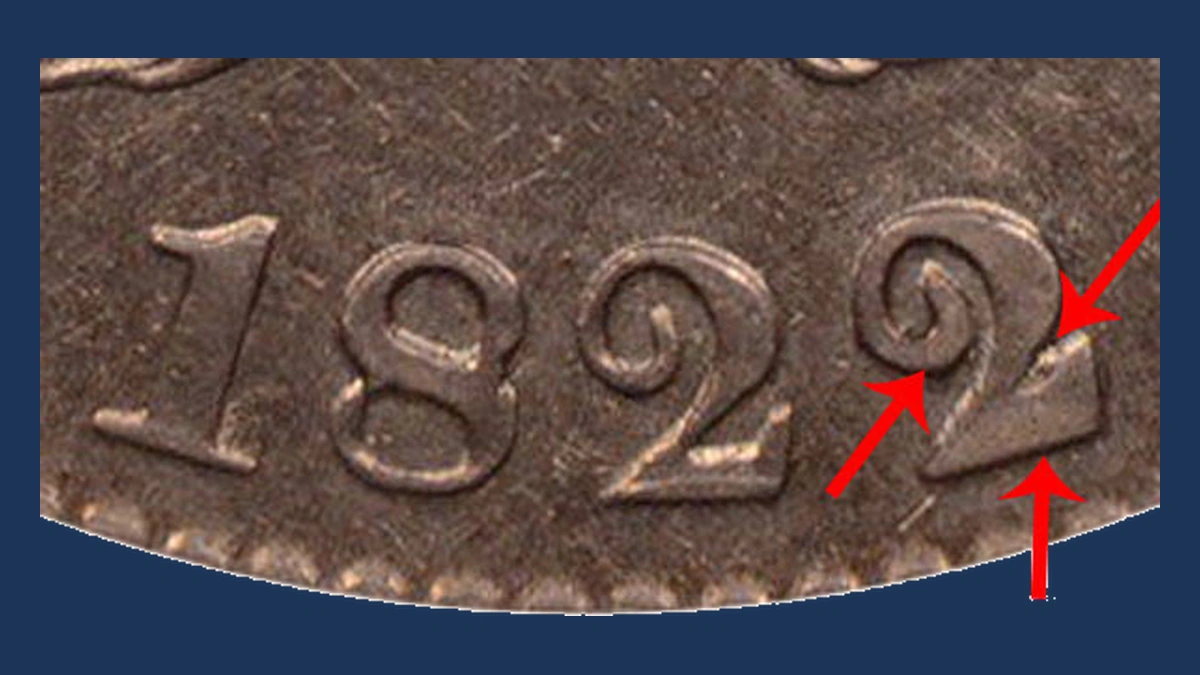
Extra detail near the base of the last 2 gave rise to the traditional 1822/1 name. PCGS uses that designation for the varieties called O-101 and O-102.
The proposed earlier 1 is disputed. Sheridan Downey’s catalog explains that the Bust Half Nut Club rejected those varieties as true overdates.
The coins and their visible marks still exist. The disagreement concerns whether the marks prove that an 1821 stamping tool was changed to 1822.
Collectors can use the catalog name while keeping that distinction clear. Matching the extra detail and the variety remains useful without claiming the older digit is proven.
Estimated Value
A PCGS MS65+ under the traditional 1822/1 name sold for $69,000 at Heritage on July 20, 2025, according to PCGS. Estimate $40,000–$70,000 for exceptional unworn examples near that quality.
Circulated VF-to-AU coins instead have an estimated $300–$2,500 range, from moderate to slight wear. These are very different condition levels.
The high sale does not prove the disputed overdate explanation. Nor does it apply to any stray mark beneath a 2.
How to Identify
Take a sharp photograph straight above the date. Through a 10× magnifier, inspect the last 2’s base and how the extra detail joins the main digit.
Compare the whole coin with an identified O-101 or O-102. One plausible stroke alone cannot establish either variety, and an 1822 quarter reference does not identify this half dollar.
A scale and calipers check about 13.48 grams and 32.5 millimeters. Inspect the edge lettering and date for cutting or alteration.
The goal is a match to the known coin, not proof of an imagined hidden 1. Matching the final-2 detail together with the complete variety confirms the traditional catalog attribution.
Conclusion
Estimated values range from $150 to $70,000 across these very different 1822 examples. The top prices belong to exceptional unworn variety coins, while ordinary circulated pieces need lower comparisons.
Read whole edge characters, compare overlapping design, and follow raised crack paths. For the traditional 1822/1, identify the actual final-2 detail and full variety while keeping the disputed explanation separate from what the metal clearly shows.