1844 Half Dollar Error List with Pictures

An 1844-O half dollar with a second date reaching into Liberty’s rocky seat sold for $35,250 in May 2015. That well-preserved example sits far above the prices of most worn coins.
The 1844 half dollar errors below span estimates and comparisons from $75 to $35,250. Read on to check peeling silver, raised lines, extra mintmark curves, a turned back, and misplaced numbers without confusing their different causes.
1. 1844-O Liberty Seated Half Dollar Obverse Lamination (Estimated Up to $250)
A peeling patch and deliberately carved marks can exist on the same coin. Heritage described an 1844-O with front lamination and graffiti in an NGC Details holder.
Lamination means a layer of the original metal has separated. A weak bond or impurities can let part of the silver surface lift, split, or fall away.
Graffiti means marks carved into a finished coin. It has a different cause from the peeling.
The Details label means a condition problem prevents a normal numerical grade. Look at the peeling and carved marks separately.
Estimated Value
Estimated value is $75–$250 for a worn coin with genuine surface separation. Carving, cleaning, or an unattractive missing patch can reduce its appeal.
An ordinary 1844-O graded VF30 sold for $207 in February 2026. VF30 indicates moderate wear.
That gives a whole-coin comparison, not a lamination sale. No completed price is used here for the NGC Details example, and its condition problem must stay part of any comparison.
How to Identify
Keep the peeling area separate from any carved lines on the front. With a magnifier and angled light, inspect where a lifted layer or shallow opening joins the surrounding surface.
Do not pull on loose metal. Trace any graffiti independently so different marks are not given the same explanation.
Confirm the O below the eagle and inspect the edge grooves. Calipers can compare about 30.6 millimeters, while a scale starts from the original 13.36 grams, allowing for wear and lost silver.
Look first for a thin layer lifting away from the original metal. Carved lines alone do not show lamination.
2. 1844-O Liberty Seated Half Dollar Die Cracks (Estimated Up to $500)
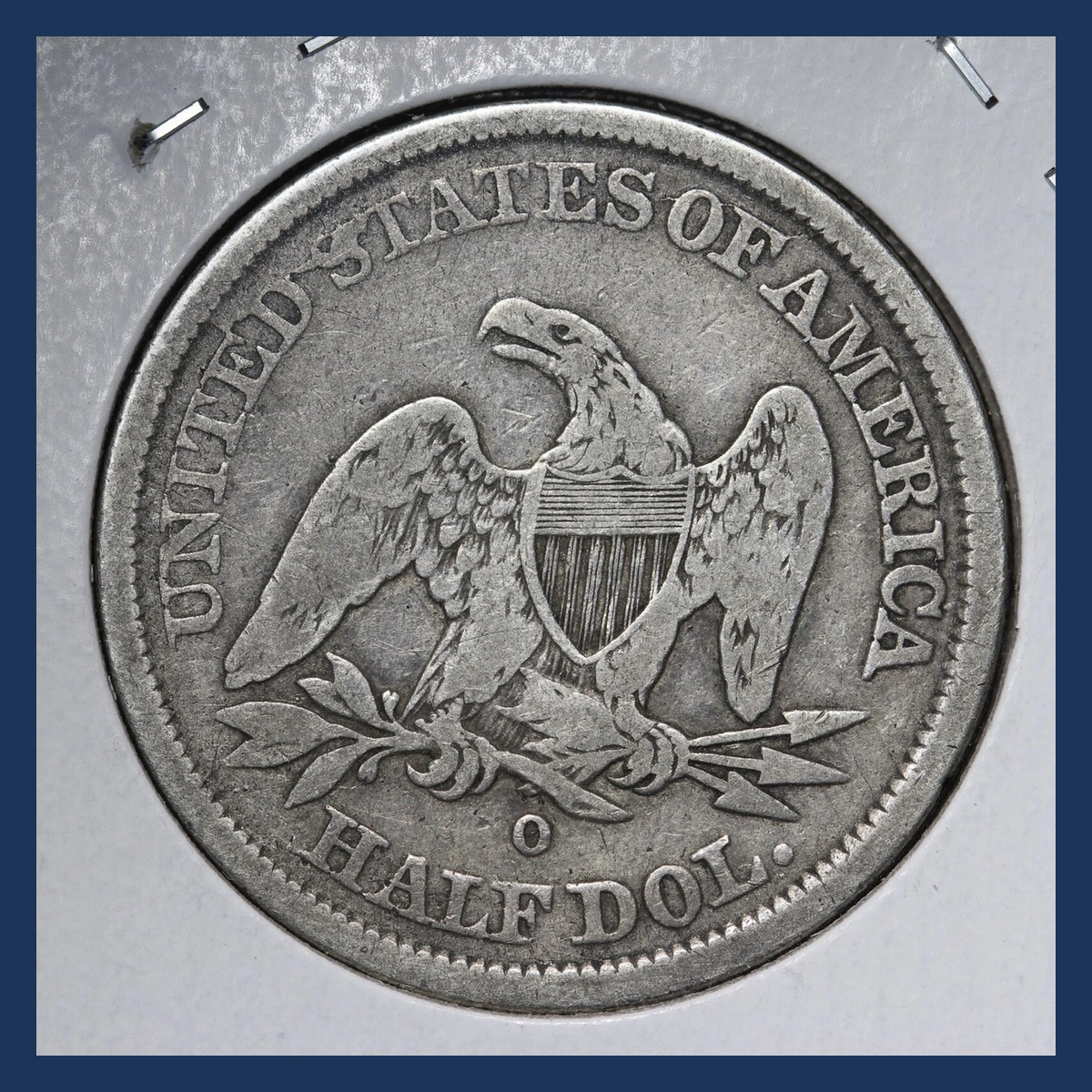
Raised lines around the lettering on the back provide useful landmarks. One reported 1844-O path arches through STATES, while another reaches toward the small border teeth above OF and AMERICA.
These paths come from different stamping tools. A coin does not need to show both to match one of the reports.
A crack in the steel tool fills with silver during striking and leaves a ridge on the coin. It can grow as the tool continues working, but the line’s height matters more than whether it appears dark or bright in a photograph.
Estimated Value
Estimated value is $90–$500 for identifiable cracks on worn examples. Attractive surfaces and more surviving detail support the upper end.
The year guide places ordinary 1844-O coins around $150–$175 in VF20 and $300–$346 in EF40. Those grades run from moderate wear toward better remaining detail.
These are normal-coin guide comparisons. They do not establish separate prices for the STATES or OF AMERICA lines, which may add less value than the underlying condition.
How to Identify
Identify the lettering touched by the line and compare it with the same reported example. Follow the path into the smooth area or tiny border teeth rather than joining unrelated marks.
Confirm the O and HALF DOL., then check the edge grooves. A scale and calipers can compare the original 13.36 grams and about 30.6 millimeters, allowing for wear.
Under a magnifier, move the light across the line to test whether it rises continuously. A scratch may instead have bright metal pushed up only along its sides.
First match the raised line to the letters it crosses in the reference picture. Its color is much less useful.
3. 1844-O Liberty Seated Half Dollar Reverse Die Gouge (Estimated Up to $600)
A raised line cuts across the arrowhead shapes on early examples from one 1844-O stamping tool. The reference starts it at the edge near five o’clock, using the coin as a clock face.
It reaches the middle arrowhead and continues through the upper one. The mark can be overlooked because it crosses existing raised details.
The damage was cut into the steel tool, so silver filled it and made a raised line on the coin. A scratch on the finished coin would cut downward instead, and the reported marker need not remain equally visible on later examples.
Estimated Value
Visible worn examples have an estimated $125–$600 range. A clear line through recognizable arrowheads is easier to identify than one mostly lost through wear.
The estimate uses ordinary 1844-O condition values rather than a recorded sale specifically pricing this tool mark. No fixed extra fee is assigned to the line.
Original surfaces and remaining detail still matter. A matching mark on a damaged coin does not make it equivalent to a much better-preserved example.
How to Identify
Hold the eagle upright and begin at the lower-right edge near five o’clock. Follow the line toward the middle and upper arrowheads through a magnifier.
Change the light to check whether it stands above the silver. A normal arrowhead border or later scratch may cross the same area without following the whole reported route.
Check the O, denomination, and edge grooves. A scale and calipers provide comparisons with 13.36 grams and roughly 30.6 millimeters, although correct size alone cannot identify the small line.
The raised connection from the specified edge position through those arrowheads is the shortest route to this documented mark.
4. 1844-O Liberty Seated Half Dollar Repunched Mintmark (Estimated Up to $650)
A second curve beside the O can be part of an earlier mintmark impression. The O was punched separately into the steel tool used to stamp the back.
More than one 1844-O tool has reported repunching. One description places a faint earlier curve below and left of the finished O, while another gives no matching directional claim.
A straight crack can run through the mintmark. That line and an extra curved O are different features, even in the same space.
Look for the shape of another O. A lump or split beside the letter is not enough to identify repunching.
Estimated Value
Estimated value is $125–$650 for a clearly identified repunched O on a worn coin. Better preservation and an obvious second curve support the upper portion.
Heavy wear may leave little price difference from an ordinary example. The estimate uses the year’s circulated values with some allowance for collector interest.
It is not based on the much more expensive Doubled Date record. That separate feature has a different appearance and stronger demand among collectors.
How to Identify
Check the date and surrounding back before focusing on the O. Inspect the edge grooves and use a scale and calipers to compare the normal 13.36 grams and 30.6 millimeters.
Look through a magnifier for part of a curved O repeated beside the finished letter. Separate it from any narrow straight crack through the center.
For the reported lower-left remnant, use a photograph of that specific example. Do not apply its direction to every 1844-O or confuse a larger normal O with two impressions.
A second O-shaped curve in the documented position distinguishes repunching from a straight fracture or an unexplained bump.
5. 1844-O Liberty Seated Half Dollar Rotated Dies (Estimated Up to $750)
The two pictures may each look normal until you turn the coin over. If the eagle leans after a controlled top-to-bottom flip, the back may be rotated relative to Liberty.
The year reference reports this for 1844-O without giving an angle or an identified certified example. The actual coin must supply that measurement.
Other 1844 denominations also have reported rotation, but their pictures and angles do not identify a half-dollar error. Rotation changes the direction of one side relative to the other without requiring missing metal, repeated letters, or a design shifted off the edge.
Estimated Value
Estimated value is $150–$750 for a worn 1844-O with clearly demonstrated rotation. The amount of turn and the coin’s condition both affect the comparison.
The year reference reports the category but gives no sale price for an identified rotated half dollar. Ordinary condition values provide the starting point.
The added allowance is an estimate for a visible alignment error. It does not assume an angle from a different coin.
How to Identify
Verify HALF DOL. and the O first so a quarter or half dime is not used as the comparison. Check the edge grooves with a magnifier for seams or other alteration.
A scale and calipers can compare 13.36 grams and about 30.6 millimeters. Then hold Liberty upright and turn the coin from top to bottom without twisting sideways.
Repeat the movement and measure the eagle’s lean from upright. A continuous video preserves this relationship better than two photographs turned straight independently.
A repeatable lean during the same controlled flip confirms rotation without borrowing a number from another coin or denomination.
6. 1844-O Liberty Seated Half Dollar Rim Cud (Estimated Up to $1,000)
A broad raised patch joined to the rim differs from a thin crack. Collectors call this type of rim-connected break a cud.
One 1844-O report describes a crack along the bottom of the denomination growing into such a patch. A supplementary reference pictures a separate example near seven o’clock.
These are individual coins, not one combined damaged area. A piece broke from the edge of each steel stamping tool.
Silver filled that empty space during striking. It left a broad lump where normal design should have appeared, rather than just a thin line.
Estimated Value
Estimated value is $200–$1,000 for a worn coin with an identifiable rim-connected break. Size, visibility, and the nearby design affect its appeal.
A 2023 catalog described an 1846 rim-break coin graded NGC AU58 CAC and quoted a $936 guide value. AU58 means very little wear.
That number is a different-year normal-coin guide reference, not a completed cud sale. The present range estimates a clear break on an 1844-O with its own condition.
How to Identify
Choose the appropriate picture in the supplementary record or main reference before following the raised boundary. The seven-o’clock example is separate from the break beside the denomination.
Under a magnifier, check that the patch reaches the edge and replaces normal design. Solder, stuck debris, or an impact can also create raised metal near a rim.
Inspect the remaining edge grooves, then use a scale and calipers to compare 13.36 grams and roughly 30.6 millimeters. Allow for normal circulation wear.
Continuous original metal joining the raised patch to the rim, with missing intended detail beneath it, is the defining first test.
7. 1844 Liberty Seated Half Dollar Misplaced and Repunched Date (Up to $35,250)
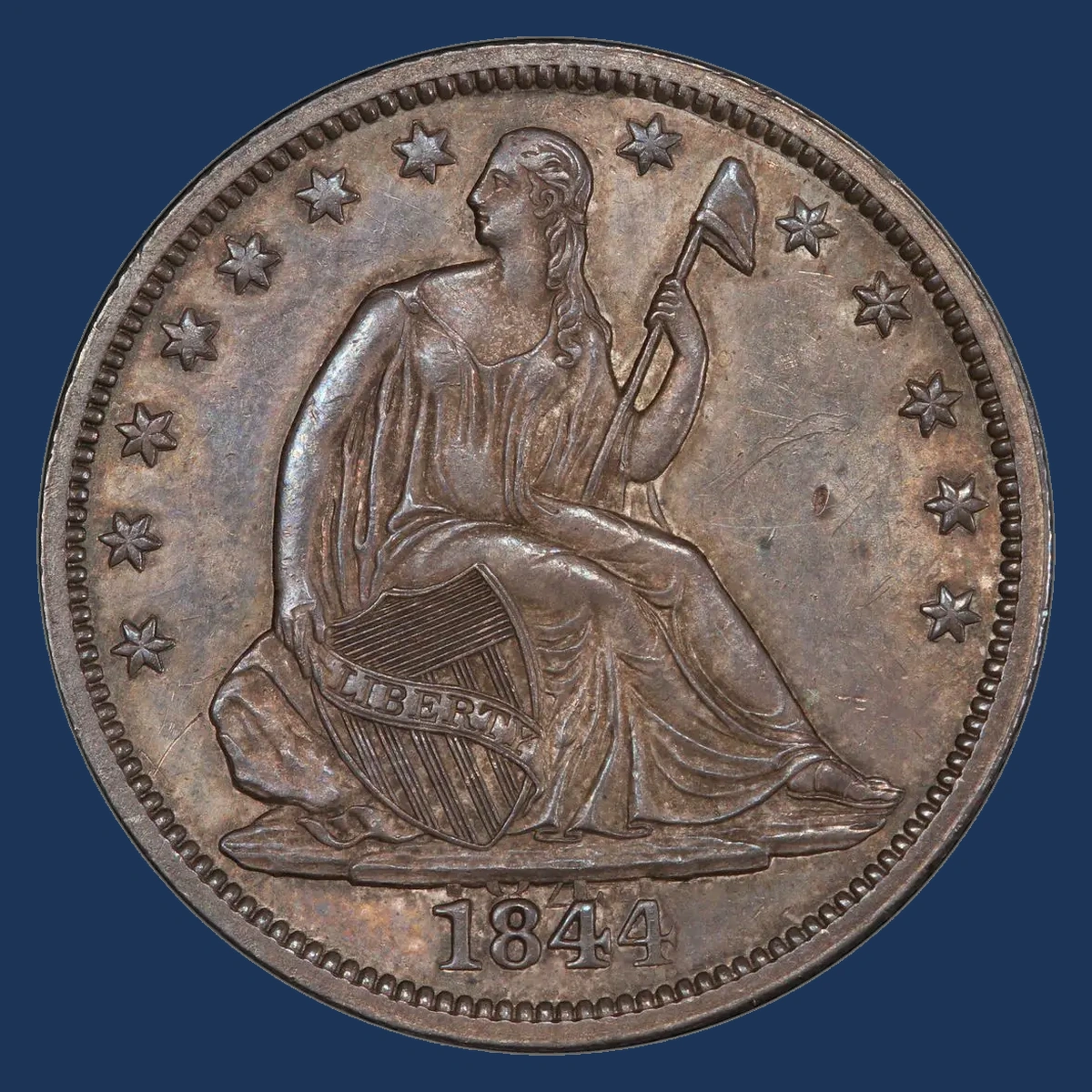
The famous 1844-O has tops of an earlier date reaching into the rock beneath Liberty. A corrected date below it did not erase the first misplaced impression.
Philadelphia has a different reported example: the top of an 8 remains among the tiny border teeth. Another New Orleans feature shows an extra curve beside the final 4.
All came from punching the date into a steel stamping tool, but their positions differ. The dramatic New Orleans date is called FS-301, and its high numbers should not be substituted for Philadelphia’s much smaller border remnant.
Estimated Value
The Doubled Date record is $35,250 for an unworn MS64 in May 2015. Recent worn examples sold for $2,280 and $3,120.
Estimated circulated value for that dramatic variety is $850–$8,000. Less prominent date-punching features have a separate $200–$1,500 estimate through lower unworn grades.
The Philadelphia MS62 catalog quoted a $1,200 guide value, not a sale. None of these comparisons gives every extra date stroke the record price.
How to Identify
Read the mintmark before selecting the search area. The O directs you toward the high date between the normal numbers and rock, while the Philadelphia report places an 8 among the border teeth.
Use a magnifier to trace a recognizable part of a number. Compare any second curve on the final 4 with its own reference rather than the high-date example.
Check for cuts or added metal around the date and inspect the edge grooves. A scale and calipers can compare 13.36 grams and roughly 30.6 millimeters.
The key is a recognizable piece of an extra number in the correct place. Check the mintmark before choosing your comparison picture.
Conclusion
The $75–$35,250 span runs from worn coins with small features to an exceptional Doubled Date example. That high auction price belongs to one scarce variety in strong condition, not every 1844 coin with an extra mark.
Keep the mint and exact location with each comparison. Peeling metal, raised lines, extra O curves, a rim-connected lump, and misplaced numbers need different checks before their price ranges can be used.