1839 Liberty Seated Half Dollar Error List with Pictures

An 1839 No Drapery half dollar with a slightly tilted back sold for $18,000 in January 2025. No Drapery means the design lacks the extra cloth fold below Liberty’s elbow.
These 1839 Liberty Seated half dollar errors also include raised cracks and copied design traces that can imitate that fold. Estimated values of $7,000–$20,000 concern the well-preserved examples below.
Check the whole design before judging a small extra line.
1. 1839 No Drapery Half Dollar Die Crack Error (Estimated Up to $10,000)
A raised line follows the bottoms of HALF DOL. on the back. Another runs inward from the rim near seven o’clock toward an olive leaf.
The PCGS registry record describes both on a No Drapery half graded AU58. That grade means only slight circulation wear.
The die, the steel stamping tool, had cracked. Silver entered the narrow openings during striking and formed raised ridges on the coin.
The coin itself did not have to split. Its lines record the tool’s damage, so compare their routes instead of treating every scratch near the letters as the same feature.
Estimated Value
Estimate $7,000–$10,000 for a well-preserved AU58 with this cracked back. A NumisBids archive records $9,000 for Heritage’s January 2025 example, described with heavy back-side cracks.
That is the price of the complete No Drapery coin. Its remaining shine and original surfaces matter alongside the visible lines.
The result does not assign a separate dollar amount to each crack. A much more worn coin needs a comparison in its own condition, even if the lines remain clear.
How to Identify
Start below HALF DOL. and follow the raised line across the letters. Then find the route from the seven-o’clock rim toward the olive leaf.
Use a 10× magnifier and move the light from one side to the other. A ridge stands above the silver, while a scratch cuts into it.
Keep the full back visible so the two paths stay in context. One enlarged bump cannot show the complete pattern.
Confirm Seated Liberty,1839, and the No Drapery design on the front. A same-year Capped Bust half has a different portrait.
Use a scale and calipers against 13.36 grams and 30.6 mm, and inspect the edge grooves. The quickest useful match is both raised routes on the correct Seated coin.
2. 1839 No Drapery Half Dollar Die Clash Error (Estimated Up to $11,000)
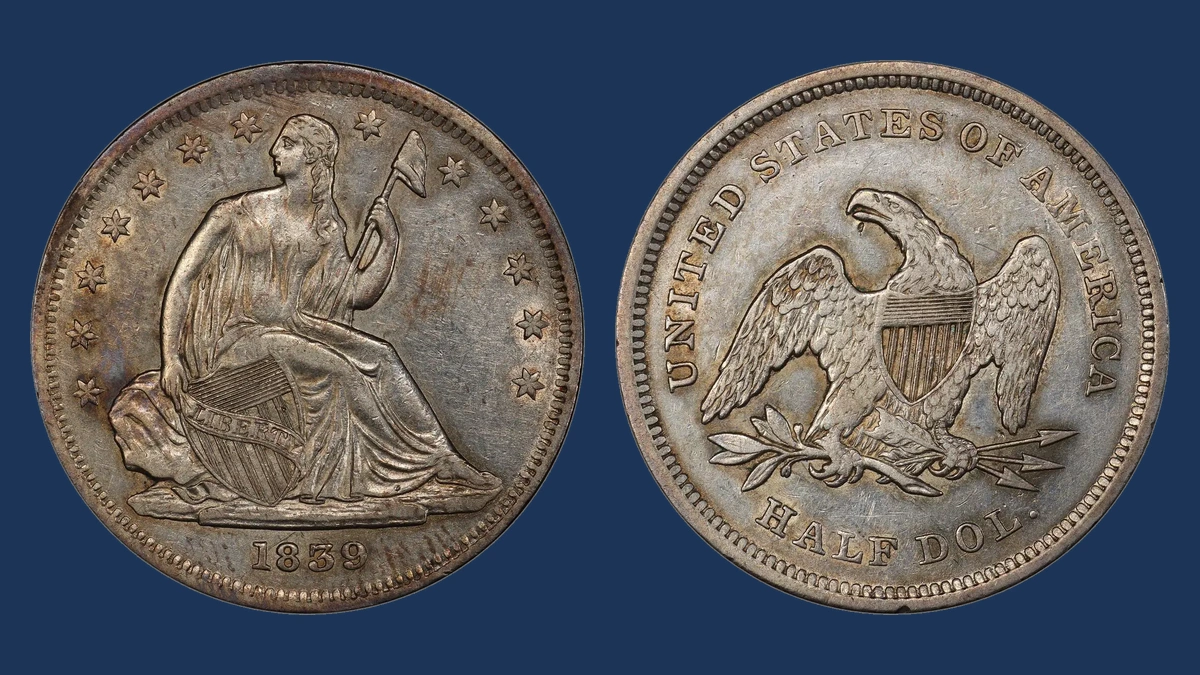
What looks like a cloth fold below Liberty’s elbow may be an unwanted design trace. Some No Drapery halves acquired that mark from clashed stamping tools.
The tools touched without a blank between them. Each could pick up part of the opposite picture and copy it onto later coins.
Bill Bugert’s reference discusses the misleading elbow mark. A separate auction description reports traces near the lower-right part of the back shield.
These extra marks do not turn the coin into the later With Drapery design. That version also changes the rock and gown, not just the area beneath the elbow.
Estimated Value
Estimate $7,000–$11,000 for an attractive AU58 No Drapery example with clear, matching clash detail. AU58 indicates only slight wear.
The $9,000 January 2025 Heritage coin provides a same-design, same-grade comparison. Its description identifies cracks, rather than establishing the clash marks discussed here.
The range therefore estimates a complete coin of similar quality. It does not assign unreported marks to the sold example or claim a separate measured price for the faint copied design itself.
How to Identify
Compare the rock and gown before deciding that the elbow mark is a true fold. On the original No Drapery design, the rock extends nearer the first star.
Use a magnifier on the suspected extra trace after checking those larger shapes. Compare it with a confirmed clash photograph showing how the opposite design lines up.
On the back, inspect the lower-right shield area separately. A scratch or normal shield line needs a different explanation from a copied picture fragment.
Use a scale and calipers against 13.36 grams and 30.6 mm, then inspect the edge grooves. Wear may reduce the weight without changing the basic design.
Begin with the original rock outline and a matching transferred trace, rather than naming the design from the elbow alone.
3. 1839 No Drapery Half Dollar Rotated Dies Error (Estimated Up to $20,000)
The eagle leans slightly to the left after the front is set upright and turned top to bottom. Heritage described this small rotation on a Philadelphia No Drapery half graded PCGS MS63.
MS63 means unworn with noticeable marks. Both pictures can remain complete despite the angle between the two stamping tools.
The auction supplies no measured number of degrees. Its description does not establish a dramatic half-turn.
This coin has Seated Liberty and the 1839 date. An 1839-O Capped Bust half is a different design, so its mint letter or features cannot be transferred to this example.
Estimated Value
The NumisBids archive records $18,000 for Heritage’s January 2025 PCGS MS63 example with slight rotation. Estimate $16,000–$20,000 for comparable No Drapery coins around that grade.
The first-year design and unworn preservation account for much of the whole-coin price. The tilt is an additional feature to verify.
These amounts are not a standard bonus for any sideways eagle. A worn coin or one with damaged surfaces needs a different comparison, even when its back is also turned.
How to Identify
Hold Liberty upright in a transparent holder with a vertical line behind it. Turn the holder from top to bottom without twisting sideways.
The eagle should normally finish upright. On this example it leans slightly counterclockwise, or left, from that position.
Repeat the turn to check that the same angle returns. Straightening the two photographs independently would hide this relationship.
Confirm the seated portrait and 1839 date, then examine the edge grooves with a magnifier. A seam or other alteration needs investigation.
Use a scale and calipers against 13.36 grams and 30.6 mm where accessible. The quickest direct test is the same slight leftward tilt after each controlled turn, rather than the slant of one photograph.
Conclusion
Estimated values of $7,000–$20,000 apply to the AU58 and MS63 No Drapery comparisons discussed here. They do not price every worn 1839 half dollar.
Trace both back-side cracks, compare the rock before naming an elbow fold, and use a controlled turn to test rotation. Each check answers a different question.
Keep the complete Philadelphia Seated coin and its condition with every close-up and price comparison.