1821 Half Dollar Error List with Pictures

A raised line beneath the date helped identify an 1821 half dollar that sold for $7,800 in January 2025. It was a well-preserved PCGS MS64 example of the O-103a variety.
Other 1821 half dollar errors involve a flaw in the silver blank or repeated words along the edge. Estimated values across the three types run from $40–$8,000.
Read on to compare the visible marks and learn which prices fit worn coins rather than top-condition examples.
1. 1821 Capped Bust Half Dollar Planchet Flaw Error (Estimated Up to $100)
An irregular patch on the back may come from a flaw in the original silver blank. The blank is the piece of metal that receives the coin design.
Dutch Country Auctions described such a flaw on a heavily worn 1821 half dollar. It appeared in a lot with coins dated 1830 and 1832.
The description identifies the affected face but not the precise type of separation or defect. It should not automatically be called a clip, a split, or a peeling layer.
Each of those names needs its own visible evidence. A general flaw can have several possible causes.
Estimated Value
A similarly worn 1821 coin with a modest original blank flaw has an estimated value of $40–$100. The December 2021 catalog estimated $80–$115 for the whole three-coin lot.
That amount was not a sale result or a separate price for the 1821 half. The individual estimate here considers the date, remaining detail, and flaw.
Do not assign the whole lot’s value to one small defect on one coin.
How to Identify
Begin with the date and both faces. Make sure the back being examined belongs to the 1821 coin, especially when photographs show several coins together.
Use a 10× magnifier to study the flaw’s edges and any design crossing it. Look for struck detail that helps show the defect existed before the design was impressed.
A later gouge can leave a sharp cut with metal pushed up beside it. Corrosion can create pits, so roughness alone does not establish a mint error.
Compare a scale reading with 13.48 g and calipers with about 32.5 mm, allowing for wear, and inspect the lettered edge. Clear signs of an original blank defect on the correctly dated coin give the quickest useful confirmation.
2. 1821 Capped Bust Half Dollar Doubled Edge Lettering Error (Estimated Up to $350)
The words along the edge may overlap or repeat. Edge lettering was applied before workers struck the main front and back designs.
If the lettering step went wrong, parts of two impressions could remain together. Turning the wording upside down, however, does not create a doubled-edge error.
Eye Appealing Coins described an 1821 O-104a under the doubled-lettering name. Its listing title includes MS92, a condition-problem code rather than a coin grade of 92.
The listing alone does not prove the grading service certified the edge error. The repeated strokes need to be visible on the coin itself.
Estimated Value
The dealer listing shows $230 and is marked out of stock. That is a posted retail price, not a published auction result.
Estimate $150–$350 for a worn or problem-designated example with clearly repeated lettering. Better surfaces and a stronger overlap can affect what buyers offer.
This listing does not support the price of an undamaged uncirculated coin. Judge the edge feature and the condition together before using the estimate.
How to Identify
Follow several words around the edge. A single crowded letter can look doubled even when only one impression exists.
Use a 10× magnifier and overlapping photographs to find parts of two recognizable sets of strokes. Check the holder label separately from the seller’s title to see what the grading service actually says.
Flattened edges or later added marks can spoil the original lettering. An upside-down inscription is only a change of orientation, not proof of repetition.
Use a scale and calipers against 13.48 g and about 32.5 mm when the coin is accessible. Do not remove it from a sealed holder for these checks.
Two clear overlapping sets of edge letters give the quickest practical answer.
3. 1821 Capped Bust Half Dollar Die Crack Error (Up to $7,800)
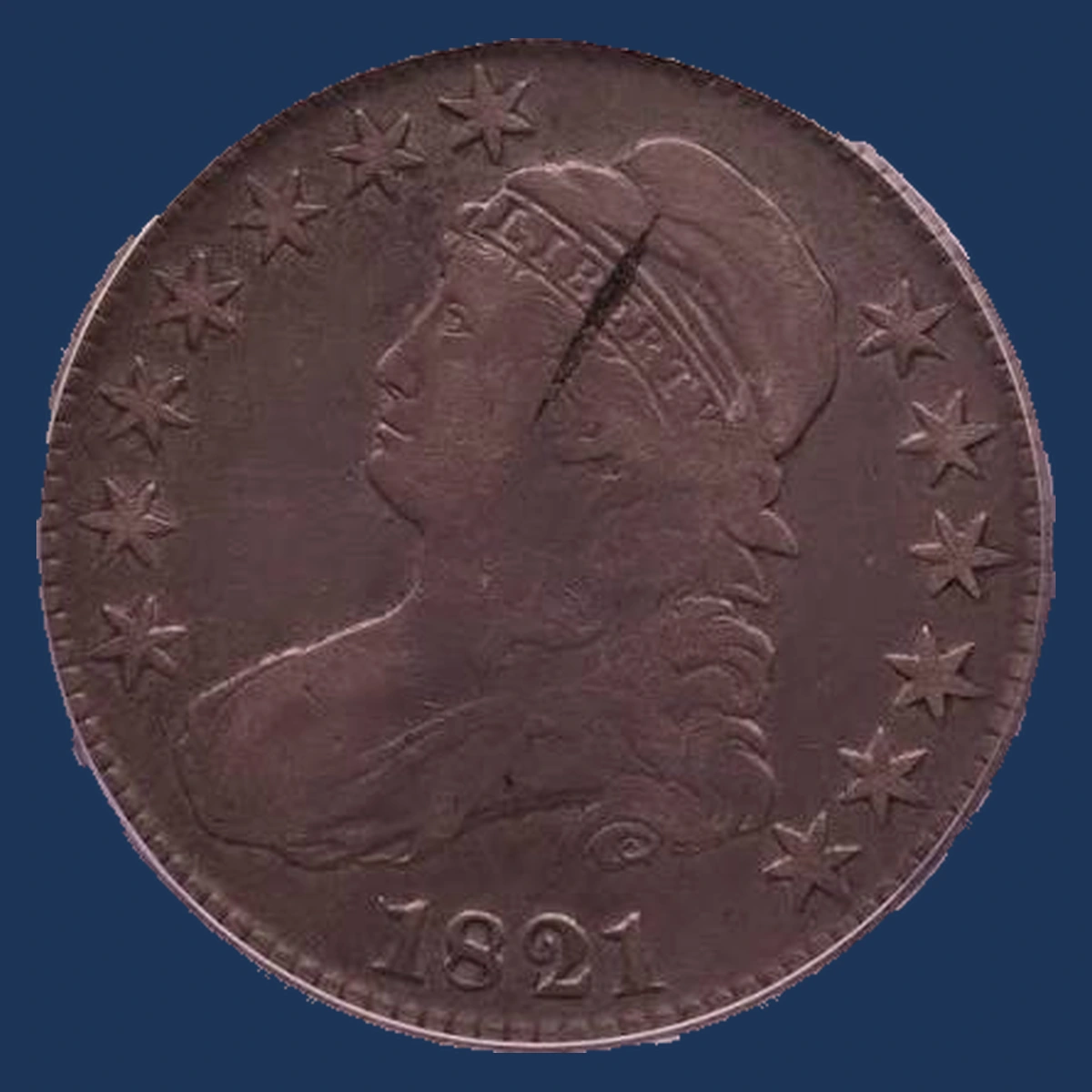
A raised line begins below the date’s 8 and passes the small foot of the final 1. It continues beneath Liberty’s curls toward the back of her cap.
Another branch runs from the ribbon tip toward star 10. These connected paths identify a stage of the variety called O-103a.
The lines came from cracks in the die, the steel tool that stamps the front design. Silver filled the narrow openings during striking and formed ridges on the coin.
Earlier coins from the same tools may have fewer lines. The pattern grew as the tool’s cracks developed.
Estimated Value
A PCGS MS64 O-103a brought $7,800 in January 2025. Another MS64 example with CAC approval sold for $7,050 in June 2013.
The estimated $150–$8,000 range spans worn coins through similarly well-preserved examples without circulation wear. Much of the higher price comes from condition and interest in the variety.
The crack identifies the coin, but it does not give a worn example the same value as those MS64 sales.
How to Identify
Trace the line below the date with a 10× magnifier. Follow it beneath the curls and toward the cap, then check the separate ribbon-to-star-10 branch.
Move the light from side to side. A ridge should remain raised, while a scratch cuts into the metal even if it appears dark in the same photograph.
Compare the whole route with an O-103a example showing the same amount of cracking. One short line cannot establish the full pattern.
The normal starting figures are 13.48 g and about 32.5 mm, checked with a scale and calipers. Inspect the words around the edge as well.
A continuous raised path through the matching landmarks gives the fastest identification.
Conclusion
A blank flaw, repeated edge words, and a raised date-area line point to different steps in making the coin. Start with what the feature actually looks like before choosing its name.
Estimated prices span $40–$8,000, from a heavily worn flaw example to a well-preserved O-103a. Keep group-lot estimates, dealer prices, and completed sales separate when comparing a coin you own.