1828 Half Dollar Error List with Pictures

An 1828 half dollar with doubled edge lettering sold for $3,840 in November 2019. The words FIFTY CENTS OR HALF A DOLLAR were meant to appear once around its edge.
Other 1828 half dollar errors include raised neck bumps, a long crack on the back, and an extra outline on C. Estimated ranges run from $100–$4,000.
Look through the four types below to see which details to check and what the recorded prices actually cover.
1. 1828 Capped Bust Half Dollar Die Rust Error (Estimated Up to $1,500)
Rust can leave bumps on a coin without the coin itself being rusty. It begins on the die, the steel tool that stamps the design.
Rust eats small holes in that tool. Coin metal fills the holes during striking and leaves raised grains on the finished surface.
A reported 1828 variety called O-110 has these bumps on Liberty’s neck. Another variety, O-101, has a reported defect inside F in OF on the back.
Those are separate observations. The mark inside F does not prove that every bump has the same cause.
Estimated Value
An estimated $150–$1,500 covers worn examples through selected lower-grade unworn coins. An O-110 graded MS63, meaning unworn with visible marks, sold for $1,320 in February 2020.
That price covers the complete coin, not a measured extra payment for neck bumps. A separate O-101 brought $240 in June 2025.
The latter had slight wear but a cleaning problem. It shows how damaged surfaces can outweigh interest in a small unusual detail.
How to Identify
Move a light nearly level with Liberty’s neck. Raised grains should cast tiny shadows; corrosion that eats into the coin leaves pits instead.
Use a 10× magnifier to compare the neck cluster with a clear O-110 photograph. A change in color alone is not a raised bump.
The F mark belongs to O-101 and needs a separate comparison. Check for stuck debris, solder, or metal pushed upward by a hit.
A normal example has edge lettering, weighs about 13.48 grams, and measures roughly 32.5 mm. Use a scale and calipers when safely accessible.
Concentrate on the arrangement of raised grains across the neck, matching their positions rather than calling any rough patch die rust.
2. 1828 Capped Bust Half Dollar Die Crack Error (Estimated Up to $2,200)
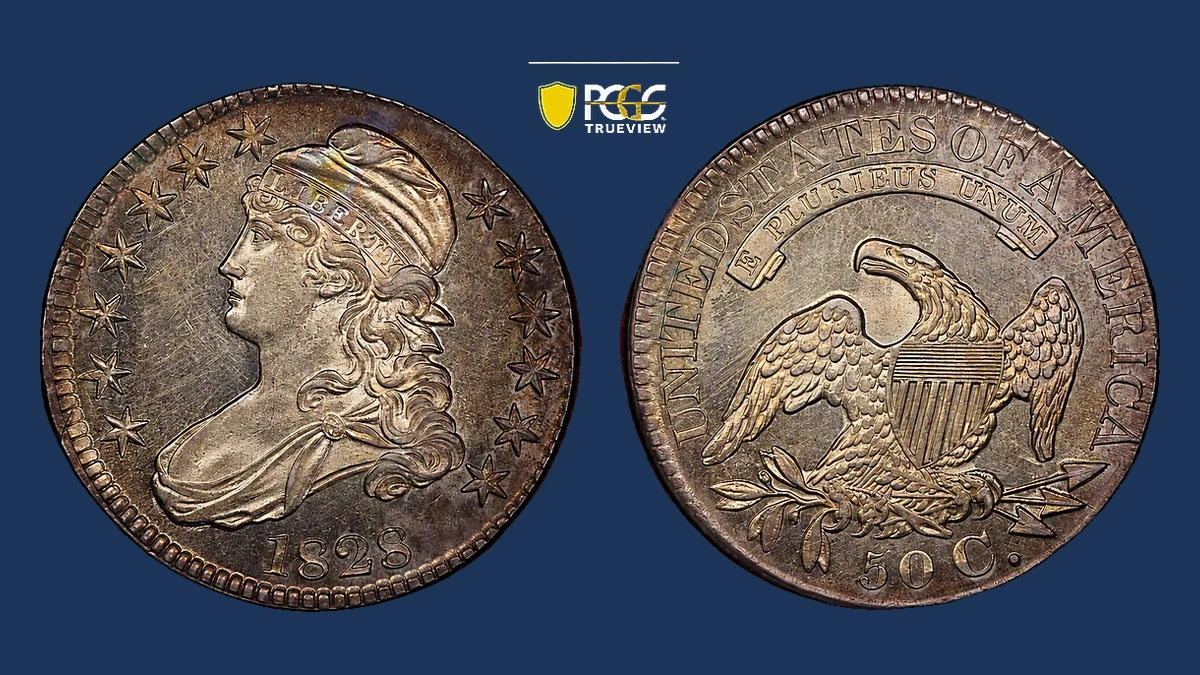
A raised line runs beneath the eagle’s left wing, then follows the tops of UNITED STATES OF A. It reaches the border above M.
This is the crack pattern on the variety called O-117a. The stamping tool fractured, and silver entered the opening when coins were struck.
The line stands above the surface because the damage was in the tool. It was not scratched into the finished coin.
Some examples show fainter sections than others. The crack grew during use, and later wear could soften its appearance, so follow its route through the lettering.
Estimated Value
An unworn MS62 O-117a sold for $1,980 in August 2019. A worn example with scratches brought $216 in August 2025.
Its XF Details label means much detail remained, but a condition problem prevented a normal numerical grade. Estimated values run from $100–$2,200 for worn coins through selected MS62 examples.
The wide spread reflects condition as well as interest in the crack. A long raised line does not cancel the effect of scratches.
How to Identify
Choose a matching photograph with the square-based 2, small 8s, and large back lettering. Those normal design forms help identify O-117a; they are not extra errors.
Check the edge lettering and measure a safely accessible coin with a scale and calipers. The expected figures are about 13.48 grams and 32.5 mm.
Next, place a light low across the back and use a 10× magnifier. A die crack rises from the surface, while a scratch usually cuts down into it.
Begin below the eagle’s left wing and follow the line past the letter tops. The useful match continues along UNITED STATES OF A toward the rim above M, rather than jumping between unrelated marks.
3. 1828 Capped Bust Half Dollar Recut Denomination Error (Estimated Up to $2,300)
The denomination below the eagle reads 50 C. On the O-117 variety, the upper end of C shows extra detail from work on the stamping tool.
The letter was cut again during preparation, leaving part of its earlier shape visible. Coins struck afterward could receive both outlines.
This small feature has a different cause from a cracked tool. The same family of coins can show both the recut C and a later crack.
Look at each feature separately, while remembering that they belong to one complete coin when deciding what it is worth.
Estimated Value
An O-117 graded MS64 sold for $2,040 in August 2023. That grade means unworn with some marks.
The estimated $150–$2,300 range covers ordinary worn examples through selected high-grade coins. The sale reflects the whole coin’s condition and variety, not a separate price for C.
The scratched $216 O-117a mentioned above offers a lower-quality comparison from a later stage of the same tool’s use. Its crack and letter should not receive added prices.
How to Identify
Turn to 50 C below the eagle. Enlarge the upper end of C with a 10× magnifier and compare it with the O-117 photograph.
Look for the small remaining outline of the earlier letter. A flat shelf beside a character can come from movement during striking and does not prove recutting.
Inspect nearby metal for scratches or added tool marks. Do not polish the letter or remove its natural color to make it stand out.
Use a scale and calipers when safely accessible: about 13.48 grams and 32.5 mm are normal, along with edge lettering.
The key target is the extra detail at C’s upper end, not any doubled-looking mark around 50.
4. 1828 Capped Bust Half Dollar Doubled Edge Lettering Error (Estimated Up to $4,000)
These half dollars received their edge words before the portrait and eagle were struck. A repeated or disrupted lettering step could make some words overlap.
A collector illustrated this on an 1828 variety called O-114. Another variety, O-123a, later appeared at auction with doubled edge lettering.
The repeated words come from work on the edge. They do not prove that the portrait and eagle were struck twice.
Reading direction is also a separate matter. Words facing the other way around an ordinary coin do not by themselves show that the lettering step was repeated.
Estimated Value
One O-123a sold for $3,840 in November 2019 and $1,920 in January 2025. Those are two sales of the same XF45 coin, worn but retaining strong detail.
Estimated values range from $250–$4,000. The auction example’s scarce variety and ownership history help explain the upper end.
Its prices should not be copied directly to O-114. Both have doubled edge words, but their rarity and condition can differ.
How to Identify
Read the inscription around the actual edge, keeping track of where you started. Overlapping photographs can accidentally show the same letter twice, so check each join.
A 10× magnifier should reveal a second impression crossing or repeating part of the first. Ordinary spacing at the end of the inscription is not enough.
Keep photographs of both faces with the edge record to preserve the date and variety. Look for filing, jewelry damage, or later added punches around crowded letters.
If safely accessible, check the coin with a scale and calipers against about 13.48 grams and 32.5 mm. The edge should carry words rather than grooves.
Trace a genuinely repeated stretch of lettering on the metal itself, not just a duplicated section in a photograph.
Conclusion
For 1828, useful clues range from tiny neck bumps to words crowded around the edge. A raised crack and a recut C can appear together, but they describe different stages in making the same coin.
Estimated prices span $100–$4,000. Compare wear, surface problems, and variety rarity alongside the unusual feature; the two sales of the same doubled-edge coin show how much a result can change.