1811 Half Dollar Error List with Pictures

A large blank crescent helped an 1811 half dollar bring $11,162.50 at Heritage in September 2016. It was struck twenty-five percent off-center, despite having substantial circulation wear.
Other 1811 half dollar errors need a closer look: raised cracks, separating metal, or traces beneath the date. This guide also examines reported broadstrikes.
Estimated values range from $200 to $12,000 for the examples covered. Read on to see why each feature needs its own comparison.
1. 1811 Capped Bust Half Dollar Die Crack Error (Estimated Up to $500)
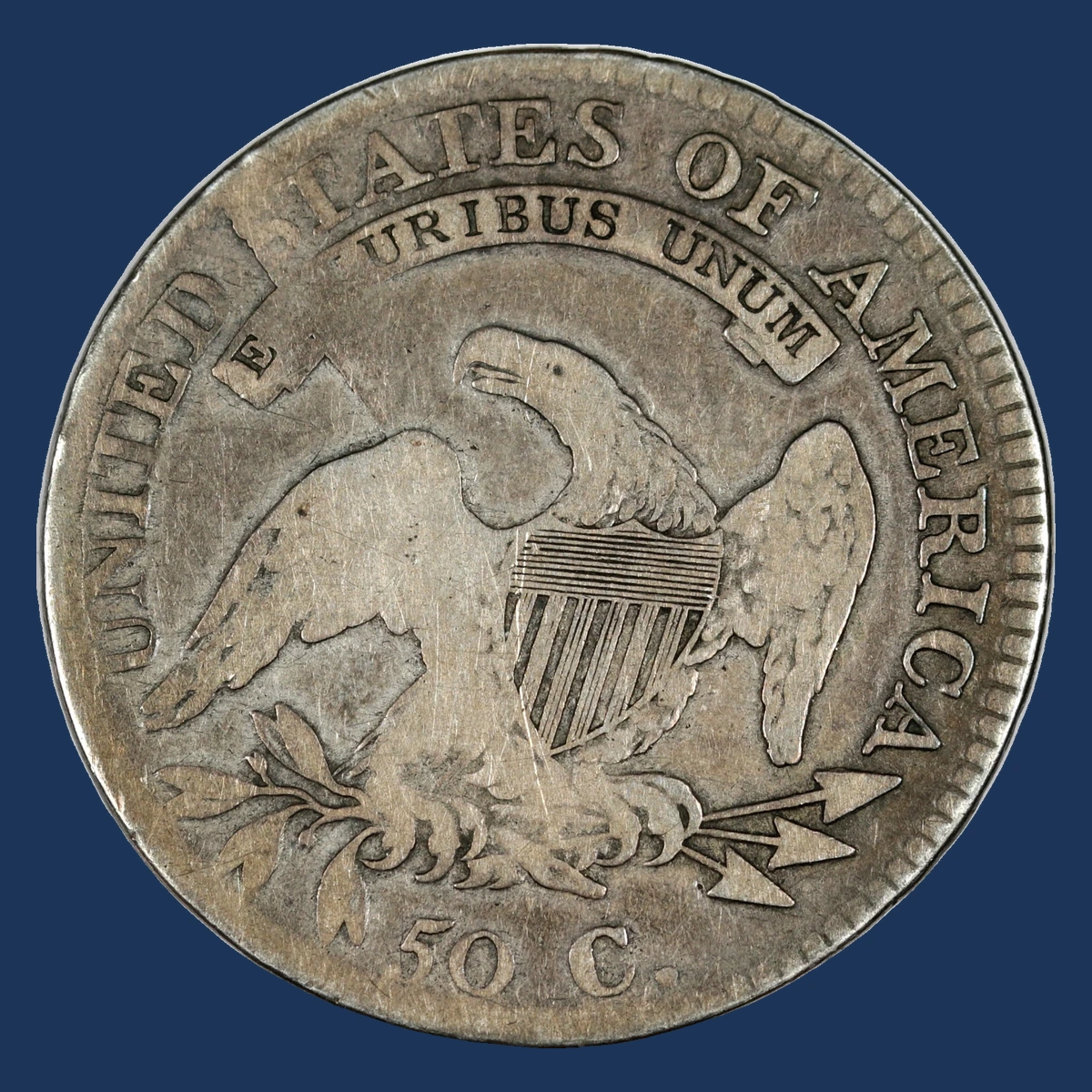
An arc appears in the upper-left area of the front on the variety called O.104a. Another variety, O.109, has a line on the back from an S toward the eagle.
These are different coins made with different stamping tools. Each line needs its own reference picture.
A die is the steel tool that stamps a coin’s design. When it cracks, silver can fill the opening and leave a raised ridge.
The famous off-center O.104a also shows the arc. That line helps identify its variety, but the same arc on a centered coin does not make it an off-center error.
Estimated Value
Estimate $200–$500 for an ordinary circulated 1811 with recognizable cracks and moderate Very Fine wear. A PCGS VF20 O.113 sold for $384 at Stack’s Bowers in November 2019.
That coin is a different variety, offering a general same-year comparison. Its result does not isolate a crack premium.
The $11,162.50 O.104a also had a major off-center strike. That much higher result cannot be used as the value of the crack alone.
How to Identify
Choose the face before the reference. The O.104a clue is the front arc, while the O.109 clue runs from a back letter toward the eagle.
A 10× magnifier and moving side light help establish whether the line is raised. The O.109 discussion explains why a coin may have both ordinary scratches and a genuine raised crack.
Photograph both faces with the 1811 date visible. Use a scale and calipers to check the original 13.48 grams and roughly 32.5 millimeters, allowing for wear, with a lettered edge.
A raised path matching its own documented variety is the direct confirmation to seek.
2. 1811 Capped Bust Half Dollar Broadstrike Report and Diameter Check (Estimated Up to $600)
An 1811 half dollar can look slightly wide without being an error. Its edge was not tightly held by the close-fitting collar used for later coins.
A collar is the ring around the coin during striking. These early lettered-edge halves used an open collar, allowing ordinary variation in their outlines.
A year guide reports broadstrikes, but it does not identify a traceable 1811 example proving unusual expansion. The label needs checking against the actual coin.
Later hammering or flattening can widen a coin. A complete design and slightly uneven diameter alone do not prove that the mint made an error.
Estimated Value
For a circulated coin with moderate to light wear submitted as an oversized example, estimate $200–$600. This values the ordinary coin before any broadstrike premium is established.
The PCGS VF20 O.113 sale at $384 in November 2019 provides a known comparison.
Normal early size variation and later flattening are different from a mint error. Their similar outlines do not mean they deserve the same price or error label.
How to Identify
Use calipers across several directions, not just one. Compare the measurements with normal coins of the same variety before treating a difference from about 32.5 millimeters as unusual.
The edge should carry letters, not the ridges found on later halves. Under a 10× magnifier, look for flattened designs, squeezed edges, or tool marks that suggest later widening.
A digital scale checks against the original 13.48 grams, allowing for wear. Photograph the full outline and both faces so the design and edge can be considered together.
An expert comparison with normal open-collar 1811 coins is the quickest way to separate genuine abnormal striking from ordinary size variation.
3. 1811 Capped Bust Half Dollar Lamination Error (Estimated Up to $650)
A thin flap or shallow peeling patch can show that the coin’s metal separated into layers. Collectors call this lamination.
The weakness started in the metal blank before the coin received its design. It differs from the raised ridge produced by a cracked stamping tool.
A year guide reports an example offered as NGC VF25 Mint Error Lamination. The guide does not give a certificate number or identify the exact location of the flaw.
Those details must come from the actual coin and holder. A shallow scar on another 1811 could instead be a later gouge or corrosion damage.
Estimated Value
The year guide reports a $499 asking price for an NGC VF25 lamination example. Estimate $350–$650 for a comparable circulated coin with moderate wear.
An asking price is not a completed sale. The holder and photographs should confirm the reported grade and error.
The range includes the early half dollar’s underlying value as well as visible metal separation. A scratch or corroded patch does not receive the same comparison.
How to Identify
Look at the boundary before the center of the patch. A thin flap or layered break can explain peeling more clearly than color or roughness alone.
Do not lift the metal. A 10× magnifier and side lighting let you inspect it without changing the evidence.
A gouge may show cutting lines and pushed-up edges instead of a shallow internal layer. Match the full 1811 coin with a readable holder label before relying on the reported VF25 grade.
The normal coin has a lettered edge, weighs 13.48 grams before wear, and measures about 32.5 millimeters with a scale and calipers. An untouched layer boundary, supported by matching coin and holder pictures, gives the clearest evidence.
4. 1811/0 Capped Bust Half Dollar With Period Overdate Variety (Estimated Up to $2,200)
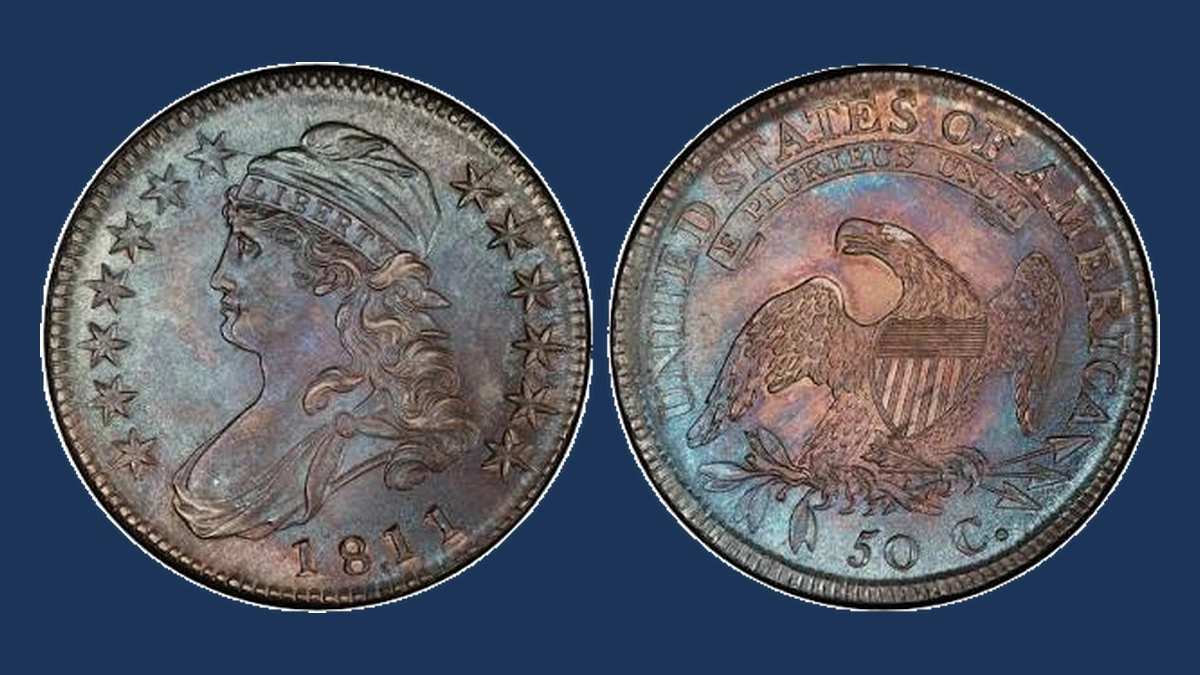
A raised dot sits between 18 and 11 on this familiar variety. It may be easier to see than the faint curved traces beneath the last 1.
Collectors traditionally call it 1811/0 or 1811/10, suggesting that a 1 was punched over an earlier 0. The variety is linked to the front tool called O.101.
Specialist Greg Reynolds notes how slight the surviving traces can be. Do not expect a complete, clearly visible zero on every example.
The dot belongs to the same variety. Its strength can vary with tool wear and striking, so the whole date remains the useful comparison.
Estimated Value
An estimated $200–$2,200 covers Fine through attractive About Uncirculated examples, from substantial wear to only slight wear. Readable date details help collectors identify the variety.
Greg Reynolds records a PCGS Fine 15 at $216 in September 2019 and PCGS AU55 at $1,980 in January 2020. The latter sold through Sheridan Downey with especially clear date features.
Those conditions differ considerably. A visible dot alone does not make a worn coin equal to the sharper AU example.
How to Identify
Photograph the complete date, including the space between 18 and 11. Find the raised dot with a 10× magnifier, then inspect the final 1 for curved traces.
Compare the arrangement with the illustrated 1811/0 with period reference. The traditional name does not require a complete zero to remain visible.
Check the rest of the O.101 design before relying on the dot alone. A scale and calipers provide the usual 13.48-gram and approximately 32.5-millimeter checks, with a lettered edge.
A contact nick is not an old numeral. Matching the full dot-and-date arrangement is the efficient first step, with faint arcs judged in that context.
5. 1811 Capped Bust Half Dollar Twenty-Five-Percent Off-Center Error (Estimated Up to $12,000)
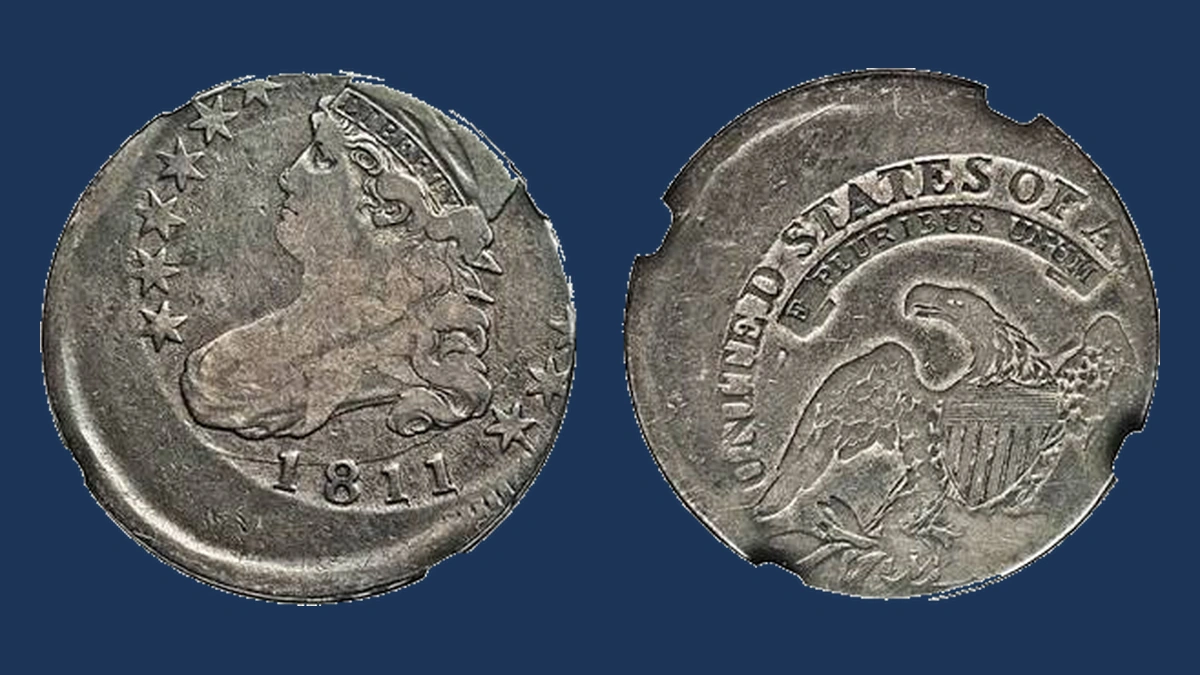
A broad blank crescent sits beside the design on the famous 1811 O.104a. The strike placed about a quarter of the intended design beyond the blank, leaving those parts off the coin.
Enough of the date survives to identify 1811. The curved line at the upper left also helps match the stamping tools used.
NGC graded this example Fine 12, reflecting substantial circulation wear. Heritage sold it in September 2016.
Wear softened the design but did not hide the large blank area. That clear contrast explains why a well-worn early coin can show a striking and easily recognized mint error.
Estimated Value
The NGC Fine 12 example realized $11,162.50 at Heritage on September 7, 2016, as reported by Coin World. Estimate $9,000–$12,000 for a comparable twenty-five-percent off-center coin.
The comparison assumes a readable date and similar surfaces. A smaller shift, heavy damage, or a missing date needs a different assessment.
This is an actual 1811 mint-error sale. Its raised crack helps identify the coin but does not explain the price by itself.
How to Identify
Compare the blank crescent with the missing design at the opposite edge. Both faces should show a compatible shift, rather than only one design sitting unevenly inside the rim.
Read the date and locate the upper-left arc. Together they connect the coin to the O.104a reference.
Use a 10× magnifier to inspect the blank area for later cutting. A scale checks against the original 13.48 grams, while calipers record the outline relative to the normal 32.5-millimeter size.
Inspect the edge lettering too. Keeping the whole coin visible, match the distinctive crescent, readable 1811 date, and curved crack to confirm this documented Fine 12 example.
Conclusion
Estimated values for these examples run from $200 to $12,000. The large off-center strike carries the highest range, while cracks, peeling metal, and the traditional overdate need their own comparisons.
Diameter deserves special care because normal 1811 coins were made with an open collar. Keep the lamination asking price separate from completed sales, and match both the feature and condition before judging value.