2015 Presidential Dollar Error List with Pictures

Faint letters on a Truman dollar and an unlettered Eisenhower dollar show two ways the edge-making step can go wrong. A second trip through that step would create an entirely different pattern: repeated inscriptions.
The 2015 Presidential dollar errors below have estimated values of $20–$400. As a different-year comparison, a 2007 Madison missing-edge dollar sold for $119 in July 2025.
Follow the remaining letters around the edge to see which explanation fits your coin. The president’s term dates on the face are not its minting year.
2015 Presidential Dollar Weak or Missing Edge Lettering
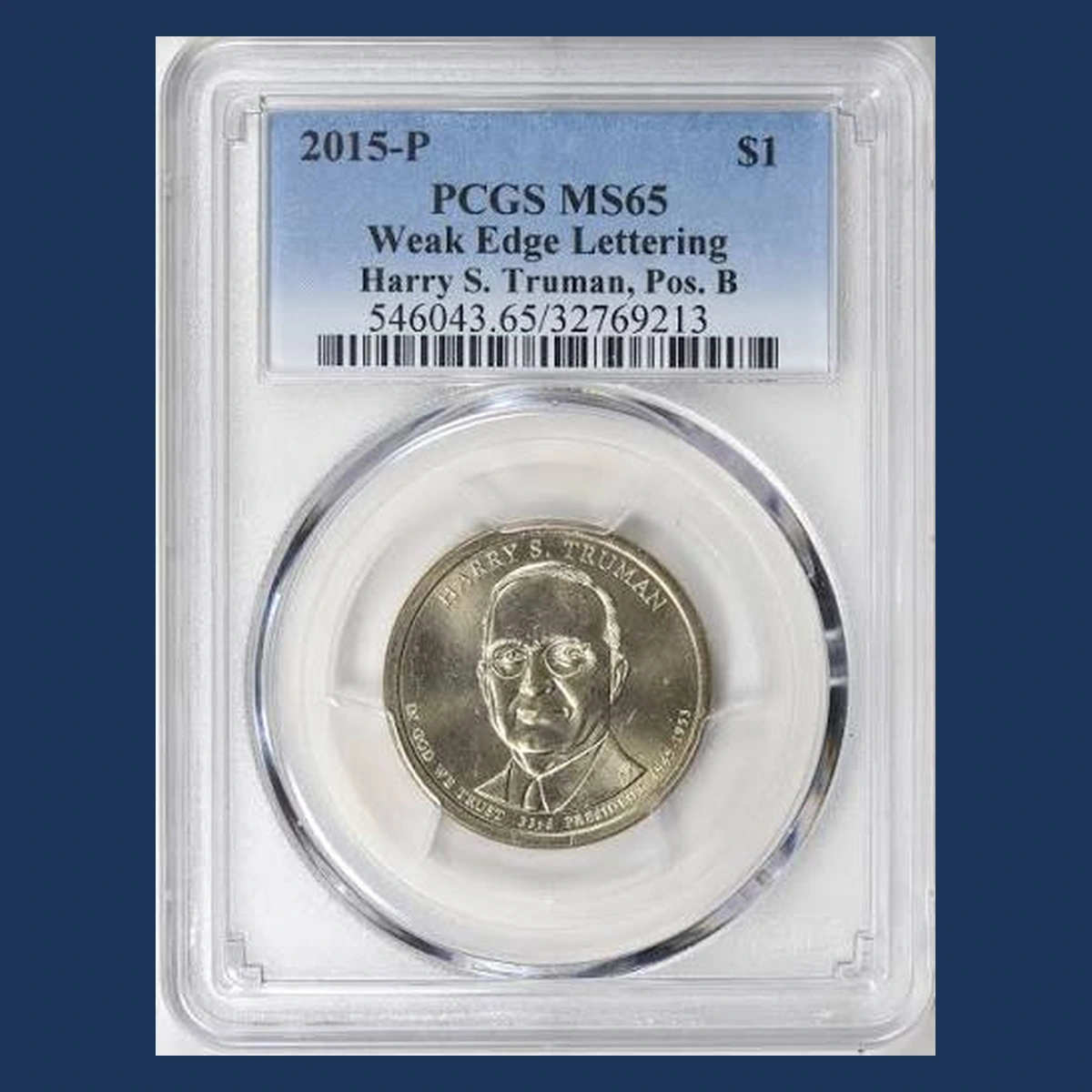
A Truman dollar can retain only shallow edge letters, while the documented Eisenhower type has no edge inscription. Check the whole edge, not just one smooth section.
GreatCollections listed the 2015-P Truman example as PCGS MS65 with weak edge lettering. MS65 describes an unworn coin.
For Eisenhower, PCGS lists the missing-letter type without a mint specified. The absent mint letter cannot be recovered from the portrait.
Ordinary dollars receive edge letters in a separate operation. Weak contact can leave faint impressions; missing the operation can leave none.
Estimated Value
Estimate $20–$100 for comparable genuine weak lettering and $50–$300 for completely missing lettering. The combined range is $20–$300, with condition and visible severity guiding the comparison.
The Truman auction page does not disclose its realized price publicly. A different-year benchmark is the 2007 Madison NGC MS67 missing-edge dollar sold for $119 in July 2025.
A faint inscription needs stronger evidence than an unfavorable photograph. Polishing or wear that removes letters does not earn an original Mint-error premium.
How to Identify
Read the president’s name first: the documented weak example is Truman, while the missing-letter listing is Eisenhower. Do not assume those records apply automatically to Kennedy or Johnson dollars.
Photograph adjoining edge sections with a little overlap, preserving the order around the coin. Check for the year, mint letter, and E PLURIBUS UNUM even where the characters are faint.
On the Truman type, compare the depth of surviving letters with a normal example under the same light. On an Eisenhower candidate, a complete missing-letter claim requires every original character to be absent.
Inspect where the edge meets each raised rim for scratches or polishing before deciding either result is original. Letters facing up or down are normal, called Position A or B; neither direction alone proves an error.
2015 Presidential Dollar Reported Doubled Edge Lettering
An edge can appear crowded when a coin receives a second set of letters over the first. More than one date or overlapping words may then occupy the same narrow strip of metal.
The letters are recessed, meaning pressed into the edge. A second pass through the lettering equipment can repeat them without doubling either main face.
The 2015 report does not identify a particular president, mint, or authenticated specimen. A candidate must show two actual sets of characters.
One normal inscription read upside down is still one inscription. Position A and Position B describe orientation, not repeated lettering.
Estimated Value
For an authenticated 2015 doubled-edge example, estimate $40–$400. A readable second inscription over a long stretch of edge offers a stronger display than one crowded letter.
A 2007-P John Adams dollar with overlapping edge lettering brought $59 at Heritage in March 2010. NGC described that older comparison as brilliant uncirculated, meaning unworn.
The $59 sale is an older comparison, not a 2015 sale. Longer stretches of clear overlap and an unworn surface can make another coin more desirable.
How to Identify
Find a repeated letter that can be followed into a second word or date, rather than judging one extra stroke in isolation. Work along the edge until each inscription has a recognizable sequence of characters.
Keep the same coin orientation while taking adjacent photographs so a repeated image is not created by turning one photograph upside down. Both sets must occupy the metal itself, with normal recessed letter shapes rather than random raised contact marks.
Read the president’s name and any surviving edge year, then look for fresh engraving cuts or polished areas. Follow both sets of letters across that same original edge; two readable sets distinguish doubled lettering from one inscription viewed upside down.
Conclusion
Truman’s documented weak letters and the Eisenhower missing-edge listing provide two distinct 2015 comparisons. A doubled-edge candidate instead needs two inscriptions on the same coin, not photographs taken in different orientations.
The estimated overall range is $20–$400. Preserve the complete edge in photographs and match the president, condition, and actual lettering defect before choosing a price.
Leave the edge unpolished so the surviving characters and original rim remain available for examination.