2009 Sacagawea Dollar Error List with Pictures

A missing date does not always hide this dollar’s year: the woman planting corn, beans, and squash identifies 2009. One plain-edge example brought $1,800 in January 2018, but it also had three overlapping strikes.
These 2009 Sacagawea dollar errors have estimated ranges from $20 to $2,500. The expensive combination above should not set the price for every dollar with missing edge words.
Start with the feature you can see, then follow its identification steps below.
1. 2009 Sacagawea Dollar Doubled Front or Back Design
Two nearby outlines can look alike at first but come from different causes. A doubled die is a steel stamping tool with a repeated part of its design.
It transfers that repeated feature to the coins it makes. Movement during striking can instead flatten one edge of a letter into a low shelf.
Front and back doubling has been reported for 2009-P dollars. The claim needs an exact match to photographed repeated details before a particular coin can be assigned to it.
The usual portrait and planting-scene outlines must not be mistaken for an extra image.
Estimated Value
For a confirmed doubled design, estimate $25–$400, depending on visibility, condition, and whether collectors recognize the particular pattern. Clear separation can be easier to sell than subtle thickening.
The range applies to genuine repeated design details, not to every doubled-looking edge. A claim involving both faces needs each face checked independently.
Two affected faces do not automatically double the value, and cleaning can reduce the appeal of an otherwise desirable coin.
How to Identify
Find an ordinary 2009 dollar and compare the same word or part of the picture at equal magnification. Begin with an area that looks different, rather than searching for a promised mark in one fixed place.
Examine the second outline under changing light with a 10× magnifier. Look at whether it rises above the surface like the main design or forms a flatter ledge beside it.
If both faces appear affected, photograph each separately and label the location. Evidence on the portrait does not prove that the planting scene is also doubled.
Before paying a variety premium, ask a specialist to match those particular repeated shapes to another coin made by the same tool.
2. 2009 Sacagawea Dollar Rotated Back Design
With Sacagawea upright, a normal dollar’s back becomes upright when you flip it from top to bottom. A rotated stamping tool changes that relationship between the two pictures.
The 2009-D report describes a rotation of about 100 degrees. That is a large turn, rather than a small tilt in a photograph.
The edge words are a separate matter. They can normally read in either direction relative to the faces, called Position A or Position B.
An upside-down edge inscription therefore does not show that the front and back tools were rotated.
Estimated Value
A genuine large rotation of the reported size is estimated at $100–$800. A clearly demonstrated angle on an attractive unworn dollar is more desirable than a small, hard-to-see shift.
The year guide reports a $585 result for a 2009-D example graded MS64, meaning unworn with noticeable marks. That figure is a reported comparison, not an independently checked auction record here.
Normal edge-lettering direction alone does not receive a rotation premium.
How to Identify
Place the portrait upright against a fixed vertical line on a card. Photograph it, then flip the coin top to bottom without turning it sideways.
The planting scene should now be upright. If it is tilted, keep the vertical guide in the second photograph so the difference can be measured.
Repeat the flip to check that your fingers did not rotate the dollar during the test. A loose holder or tilted camera can otherwise create a convincing false angle.
Measure the back’s departure from upright with a protractor or a photograph tool. The reported 100-degree coin is a comparison, not an angle to impose on yours.
Check the D on the edge separately after recording the face alignment.
3. 2009 Sacagawea Dollar Missing Outer Layer
A normal dollar has a copper center bonded between gold-colored manganese-brass layers. If an outer layer is absent, the copper beneath can become the visible coin surface.
The 2009-P report concerns this missing-layer error, rather than a thin coating of gold wearing away. These dollars are not gold-plated coins.
A layer lost before striking can leave the design impressed directly into the exposed center. A later chemical change may also produce a reddish or dark surface.
The color needs to be considered with the weight, remaining layers, and condition of the design.
Estimated Value
A broad exposed face with an undamaged design should attract more interest than a small, indistinct patch. Estimate $100–$1,000 for a confirmed missing layer on this issue.
The year guide reports an $820 eBay sale for a 2009-P MS62 example in 2020. MS62 describes an unworn coin with visible marks.
That reported comparison does not give a stained dollar the same value. The exposed metal and reduced weight must belong to an original minting error.
How to Identify
Use neutral lighting to compare the two faces before deciding that one is bare copper. Warm light and dark surface staining can make the normal brass layer look different.
For a loose coin, record its weight on a scale reading to 0.01 gram. The normal standard is 8.10 grams; missing a full layer should make the coin lighter.
Trace the edge to see where the layers remain and whether the exposed-looking face meets a clear boundary. Do not scratch the coin to test its metal.
Examine raised letters for pits, rough erosion, or metal removed after striking. A professional examination should establish the missing layer and its timing, using the surface and weight together.
4. 2009 Sacagawea Dollar Cracked or Broken Stamping Tools
A thin raised line and a broad rim lump can both come from damage to a stamping tool. The tool, called a die, first cracks or loses a piece.
Coin metal enters the opening under pressure and leaves a raised feature. A break connected to the outside edge can make a smooth lump called a cud.
The 2009 reports describe a large Philadelphia front crack and a separate large Denver cud. They do not establish the same location on both coins.
These raised features differ from a split through the blank or an ordinary scratch.
Estimated Value
Estimate $25–$500 for clear die cracks and $75–$1,200 for genuine rim cuds, depending on size and preservation. A fine line usually attracts less attention than a large break that replaces part of the picture.
The upper cud range requires a clearly original raised mass joined to the rim. Marks, wear, or a barely visible feature can keep the value down.
The crack and cud ranges describe separate coins, not two charges to add together.
How to Identify
View the suspect mark from a low angle to establish whether it is raised. A scratch usually cuts below the surface, while metal entering a crack in the tool rises above it.
For a narrow line, follow it through the picture and check how it crosses the nearby letters. For a broad lump, trace its connection to the outside rim.
A detached bump is not automatically a rim cud. Dents can also push metal upward, so inspect the surrounding area for a depressed impact mark.
Photograph the feature in relation to the portrait or back design, then record any readable P or D. Do not assume that a Philadelphia crack photograph identifies the separate Denver break.
5. 2009 Sacagawea Dollar Impression from Material over the Back
Part of the planting scene may fail to form when material sits between the blank and the stamping tool. Collectors call the result a strike-through because the tool presses through or around the obstruction.
The 2009-D report places this feature on the back. It does not identify the material or say that any object remained attached.
A smooth hollow, a narrow channel, and a textured patch can suggest different causes. Their appearance must be examined before naming the object.
A scrape made after minting can also remove design, but its cut edges tell a different story.
Estimated Value
The year guide reports $930 on eBay in 2022 for a 2009-D back strike-through graded MS61. That means an unworn coin with numerous marks, rather than a pristine surface.
For confirmed examples, estimate $50–$1,500, considering how much recognizable design the obstruction affected. A clear, attractive impression is easier to show a buyer than a shallow indistinct mark.
Neither the report nor this estimate assumes that the blocking object remained in the coin.
How to Identify
Compare the planting scene with a normal coin to see which detail stops at the affected patch. The woman, crops, and surrounding words give useful reference points without requiring a guessed clock position.
Inspect the boundary under a magnifier and follow any letter or plant stem toward it. A mint obstruction can interrupt the design as it forms.
Look for sharp scrape grooves and pushed-up metal that may show later damage instead. Move the light to see texture inside the impression.
Keep any attached material untouched. Neither poking the hollow nor removing a fragment will help preserve evidence.
Take one photograph of the whole back and another showing the transition from normal detail into the impression.
6. 2009 Sacagawea Dollar Curved Clip in the Blank
A curved piece can be missing before a dollar is struck. The blank cutter may overlap a hole already punched from the metal strip.
The incomplete disc then enters the press and receives the design around its missing section. This is called a clipped planchet; planchet means the prepared coin blank.
The 2009-D report describes a curved clip without a fixed size for every example. A missing crescent is the starting observation, rather than proof of how it formed.
A cut made through a finished coin removes similar metal but can leave different marks at the boundary.
Estimated Value
A large original gap can draw strong interest when the remaining design is clear. Small clips on worn coins tend toward the lower part of the estimated $50–$1,500 range.
The year guide gives $1,010 for a 2009-D MS63 curved clip in 2019. That is a reported result for an unworn coin with visible marks.
A different clip need not match that figure, and a later cut does not belong in the mint-error range.
How to Identify
Inspect each end of the gap where the raised rim approaches the missing metal. A genuine incomplete blank can leave weakened or stretched details near those points.
Compare the opposite rim for a weak patch as supporting evidence. Its absence alone does not rule out a clip, so continue with the exposed edge.
Parallel saw grooves, file marks, or sharply sliced design may indicate later cutting. A smooth-looking curve in a distant photograph is not enough to decide.
If the coin is loose, weigh it and record the missing section with a size reference. Less than the normal 8.10 grams supports missing metal, but the boundary explains whether that loss preceded striking.
7. 2009 Sacagawea Dollar Weak, Partial, or Missing Edge Inscriptions
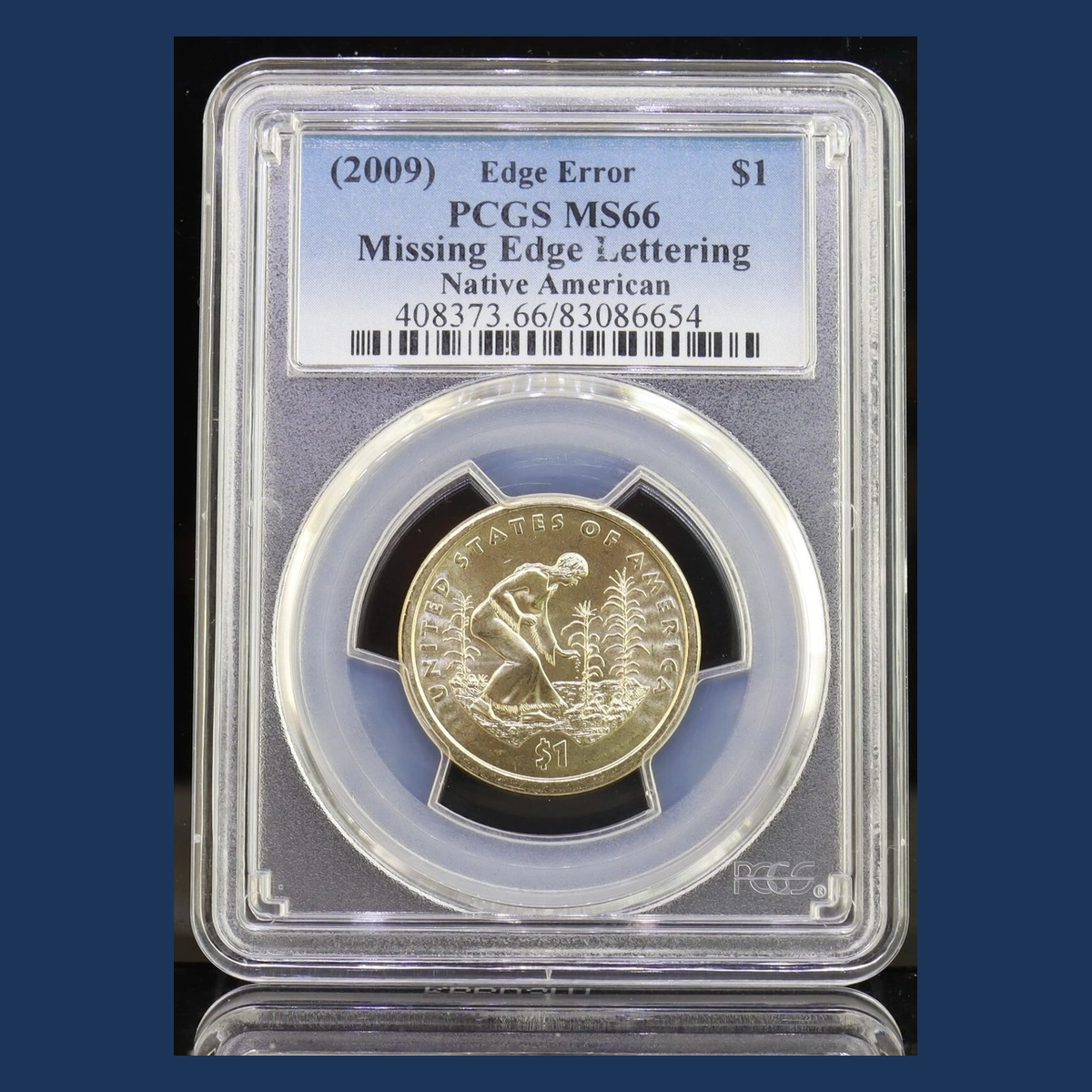
Edge lettering began on Native American dollars in 2009, with the date and mint mark on the narrow side. The ordinary coins pass through a separate lettering operation after striking.
A weak result can leave shallow letters, a partial result loses a section, and a missed pass leaves a plain edge. PCGS reported a weak example graded MS67 and the first complete missing-edge discovery in March 2009.
Philadelphia partial and weak types are also cataloged. On a completely plain edge, the planting scene establishes 2009, but the missing mint mark leaves the mint unidentified.
Estimated Value
Estimate $20–$400 for weak or partial lettering and $25–$800 for ordinary examples with a completely plain edge. A PCGS MS67 plain-edge dollar sold for $114 in February 2018.
The often-quoted $1,800 January 2018 coin also had three strikes, two of them off center. Mint Error News records that combination, not a price for the missing letters alone.
For comparable authenticated combinations, allow $800–$2,000 according to the complete error and condition.
How to Identify
Identify the planting scene first, since an earlier eagle-back Sacagawea dollar normally has a plain edge. The 2009 date should be on the edge, not below the portrait.
Use several overlapping photographs to cover the circumference. Mark any surviving letter grooves so a faint inscription is not mistaken for a completely blank one.
Check whether all strokes are shallow or only part of the normal wording is absent. Position A and B describe normal reading directions rather than missing lettering.
For a loose plain-edge candidate, compare its diameter and weight with the 26.5-millimeter, 8.10-gram standard. Search the edge for filing or sanding marks before treating it as a skipped lettering operation.
Proof coins have a specially prepared collector finish; satin-finish pieces have a softer, less reflective appearance. Compare those finishes separately from ordinary dollars when judging condition and price.
8. 2009 Sacagawea Dollar Off-Center Strike
The planting scene can be partly missing because the metal blank sat outside its intended position in the press. One area receives no picture while the opposite side runs out of room.
The 2009-D report describes a strike about 45 percent off center. That figure belongs to the reported example, not every uneven-looking dollar.
A year-specific back can identify 2009 even when no edge date remains. It cannot restore a missing mint mark.
The coin’s two faces and any surviving lettering must therefore be considered together before accepting a year and mint description.
Estimated Value
Estimate $300–$2,500 for a substantial authenticated off-center example, with clear identity and attractive surfaces supporting the upper end. Smaller shifts or heavy wear can bring less.
The year guide reports a $945 result in 2023 for a 2009-D coin described as 45 percent off center and graded MS65. MS65 means unworn with relatively few marks.
That reported single-strike comparison differs from the $1,800 triple-struck, plain-edge coin discussed above.
How to Identify
Find the boundary where the picture stops and the untouched blank begins. Follow it across one face, then compare the matching area on the other.
Both pictures should fit the same misplaced piece of metal. A front design sitting close to the rim while the back is centered suggests a shifted tool instead.
Look for extra overlapping pictures before treating the coin as a single off-center strike. More than one strike can leave several outlines and needs a different price comparison.
Record how much of the woman and crops remains, then photograph any readable edge characters. The planting scene can establish the issue without proving a D.
Keep the complete outline of the coin in both photographs; tight crops can hide the evidence needed to judge the displacement.
Conclusion
The ranges here run from $20 to $2,500, covering faint edge words, damaged stamping tools, and larger minting mistakes. The $1,800 auction coin combined a blank edge with three strikes.
Check the planting scene before using a price for this year. Then photograph the actual feature: a raised line, a missing piece, or an inscription that stops.
When the whole edge inscription is absent, the missing mint mark cannot identify Philadelphia or Denver.