2005 Dollar Coin Error List with Pictures

One 2005 dollar squeezed Sacagawea, her child, and almost the entire eagle onto a blank meant for a nickel. The smaller coin brought $24,000 at auction in August 2024.
That unusual piece tops this 2005 Sacagawea dollar error list, with estimated values spanning $10–$35,000. Less dramatic finds include a raised line on the eagle and a documented color-related error on a satin-finish coin.
Read on to compare the actual shapes, surfaces, and prices behind each type.
1. 2005 Sacagawea Dollar Denver Eagle-Breast Die Crack
An extra raised line across the eagle’s breast is the feature reported for a 2005-D dollar. It crosses an area that already contains feather details, so the normal design must be compared carefully.
A die is the steel tool that stamps a coin. When that tool cracks, coin metal can enter the opening and form a narrow ridge.
The report does not establish that this crack reaches the rim. It is therefore a breast crack rather than a confirmed cud, the larger raised patch left by a rim-connected tool break.
Estimated Value
A genuine eagle-breast crack has an estimated value of $10–$150, depending on its strength and the coin’s condition. A fine line visible only at high magnification belongs near the lower end.
Comparable small die cracks on golden dollars generally trade for much less than major striking errors. A clear ridge crossing the feather pattern is easier to display and explain.
An unusually high grade can increase the whole coin’s value. That amount should not all be credited to the crack.
How to Identify
First find the D below the front date, then turn to the eagle. The reported feature belongs to Denver; a line on another mint’s coin needs its own identification.
Use a normal eagle-back dollar to trace the breast feathers. Locate where the extra ridge leaves that expected pattern or crosses an existing feather line.
Move the light across the ridge and inspect its center. A scratched groove can have raised metal along its sides, so an apparently raised edge alone is not enough.
Photograph the whole back and a close-up without touching the line. Follow its visible extent, but do not describe a connection to the rim unless the coin actually shows one.
2. 2005 Sacagawea Dollar Denver Satin-Finish Annealing Error
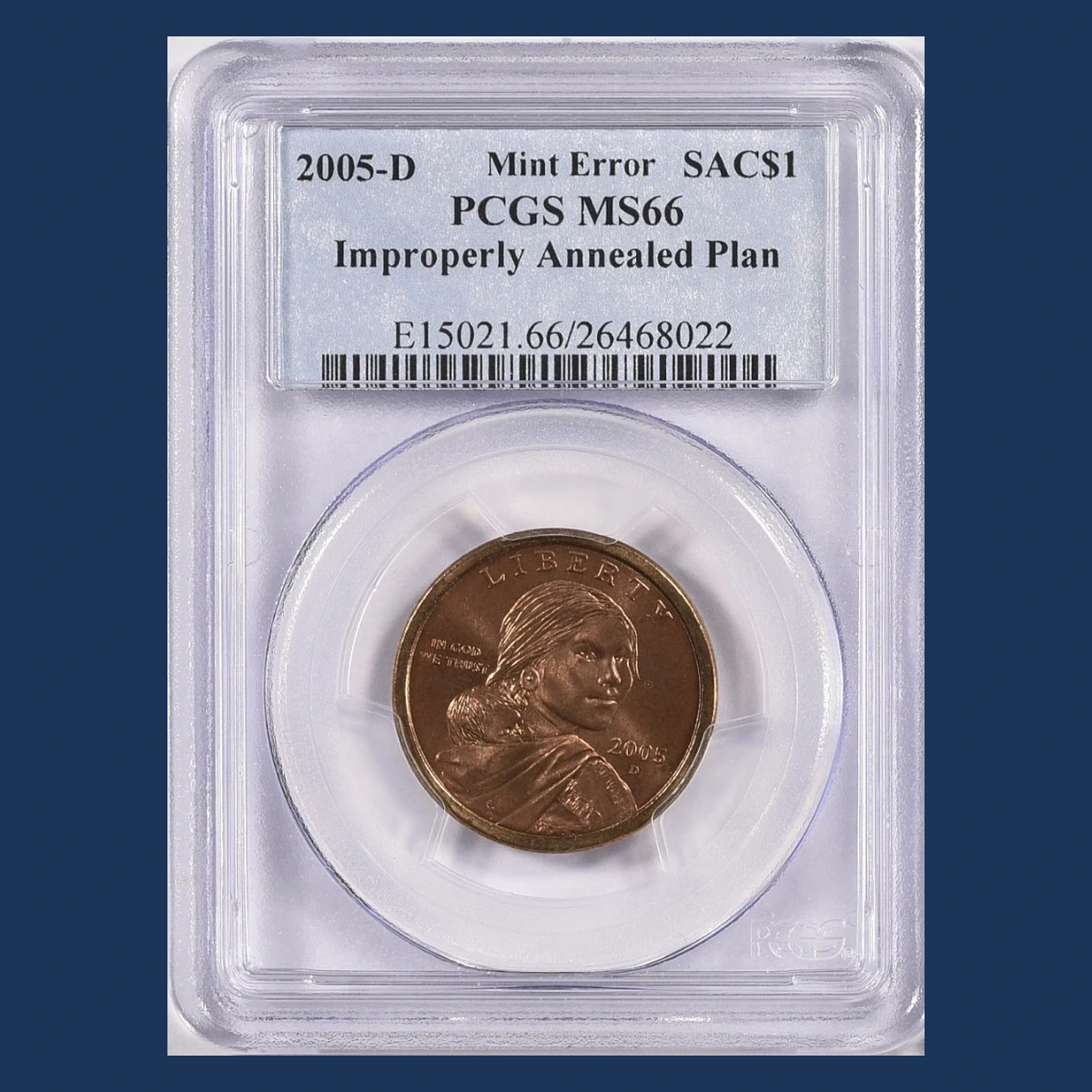
A dollar can leave the Mint with an unusual surface color even when its design is complete. Annealing is the heating treatment used to prepare the blank before striking.
An auction record identifies a 2005-D satin-finish example with an improperly annealed, or sintered, surface. Sintered describes material bonded to the surface during heating.
Satin finish is the softly textured finish used on collector-set coins, not the error itself. Ordinary dollars can darken after minting too, so a brown or black appearance alone cannot establish the same production problem.
Estimated Value
The documented satin-finish example sold for $37 in December 2013, according to the PCGS auction record. Its current entry lists SP65, a well-preserved collector-finish grade.
An estimated $25–$250 allows for differences in appearance and preservation among genuine examples. The recorded price is a useful reminder that a certified mint error need not cost hundreds.
Dramatic original color can attract interest, while corrosion or later heating needs a different assessment.
How to Identify
Keep the special finish in mind when comparing this coin with an ordinary dollar. A satin-finish surface normally has a softer texture, so subdued reflections alone do not indicate an error.
Examine the color across open areas and protected spaces beside the letters. Move one light slowly to record how the surface texture and shine continue through the discolored areas.
Do not polish a small test patch. Removing surface material can erase evidence of the heating process.
Compare the complete front and back with an authenticated example, including the D and date. A specialist must distinguish mint-related heating from ordinary tarnish, corrosion, or later burning; preserved shine is useful but is not proof on its own.
3. 2005 Sacagawea Dollar Doubled Die
An extra contour beside a letter or digit may come from doubling in the stamping tool. That is a doubled die, and it can repeat the same small feature on many dollars.
The 2005 year guide includes this type and suggests examining LIBERTY, the date, and the face. It does not establish an individual mint or a specific cataloged pattern.
A flat ledge beside a letter can instead result from movement during striking. That common lookalike should not be treated as proof of a genuine doubled tool.
Estimated Value
For an identified 2005 doubled die, estimate $25–$400. A subtle extra contour generally draws less interest than clearly separated detail visible in an ordinary close-up.
These estimates follow comparable minor and stronger doubled designs on golden dollars. A price comparison should match the actual repeated shape, not merely the word doubled in a sales title.
Coins with heavy marks can be harder to compare because the features are obscured. Flat mechanical doubling alone does not justify the same premium.
How to Identify
Choose the letter or digit that appears doubled and compare all its edges, not just the widest one. A normal example under the same light helps show whether the shape is actually unusual.
Look for rounded separation or a split corner that remains visible when the coin is tilted. A flat shelf beside a narrowed main stroke may point to movement during the strike.
Check nearby details to see whether the extra image follows a consistent pattern. A single scratch or bright reflection should not determine the identification.
Include the front date, mint letter, and finish in the photographs you send to a variety specialist. The complete comparison is needed before giving the coin a named doubled-die identity.
4. 2005 Sacagawea Dollar Off-Center Strike
A strike can miss part of the metal blank and leave a bare crescent beside an incomplete design. The portrait and eagle then sit away from their intended positions.
This happens when the blank is not centered between the stamping tools. It differs from a broadstrike, where the full design remains on metal that has spread too far outward.
Off-center dollars appear in the 2005 reports without a fixed mint, finish, or measured percentage. The often-used thirty-to-fifty-percent examples explain the type generally rather than identifying a specific 2005 coin.
Estimated Value
An estimated $200–$3,500 covers genuine 2005 off-center dollars, depending on displacement, date visibility, and preservation. Larger mistakes are most useful for comparison when enough design survives to identify the coin.
An earlier 2000-P eagle-back dollar struck 50% off center sold for $3,120 in April 2021. That is a different-year auction comparison, not a sale of the reported 2005 type.
Use the size of the bare crescent and the surviving picture together when judging a similar asking price.
How to Identify
Compare the amount of missing artwork with the unused metal still present. A true off-center strike leaves blank surface beside a picture that runs beyond the blank’s boundary.
Check the back before measuring the shift on the front. A centered eagle with only the portrait displaced can indicate a misaligned tool rather than a misplaced blank.
Read the front date and mint letter wherever they survive. Unlike later Native American dollars, a normal 2005 coin has no date around its plain edge.
Look across the bare crescent for marks showing that a finished picture was ground away or flattened. Photograph the entire outline so another collector can distinguish unstruck metal from a section physically cut out of the coin.
5. 2005 Sacagawea Dollar Struck on a Nickel Blank
Sacagawea and her child fit onto this smaller blank, but the eagle loses the tip of its rear wing. The metal was intended for a five-cent piece rather than a dollar.
ANACS graded the 2005-P error MS64, meaning unworn with some marks. It was struck against the surrounding ring near the four-thirty position, leaving a bold date and P.
The blank had not already received a nickel design. This is a wrong-blank error, not a dollar stamped over a finished nickel carrying Jefferson’s portrait or another nickel picture.
Estimated Value
The documented coin sold for $24,000 on August 16, 2024 at Heritage Auctions. An estimated $12,000–$35,000 frames comparable authenticated examples of this scarce 2005 error.
The clear date and mint letter make the identity easy to demonstrate. Its intact portrait also gives a collector more design to enjoy than a very incomplete strike.
That price does not apply to a normal dollar plated white. The blank’s metal and physical features must support the identification.
How to Identify
Match the bold 2005 date and P with the auction photographs before looking at the coin’s color. Sacagawea and her child are complete, but the eagle’s back wingtip falls outside the smaller metal.
Next record the weight of a loose candidate: a normal nickel blank is 5.00 grams, compared with 8.10 grams for a dollar. The nickel blank starts about 21.21 millimeters across, although the strike can change that diameter.
Those are blank standards, not measurements reported for this specific auction coin. A specialist can test the metal without damage and compare how the design fits, since white plating alone cannot explain the smaller blank.
Conclusion
The small nickel-blank dollar and the satin-finish color error show how different 2005 mint mistakes can be. Estimated prices run from $10–$35,000, with the documented wrong-blank coin providing the strongest auction result here.
Keep a raised eagle-breast line separate from surface damage, and check both faces when a design is displaced. The normal plain edge adds no error premium; the metal and the struck details must explain the unusual feature.