1999 Dollar Coin Error List with Pictures

A gold-colored Anthony dollar can be plated, struck on a Sacagawea blank, or made with a test alloy. The distinction helped one genuine wrong-blank coin bring $16,800 in January 2020.
This 1999 Susan B. Anthony dollar error list covers metal mix-ups, distorted strikes, and smaller clues, with estimated values of $50–$25,000.
The separately described experimental alloy belongs to the Mint’s testing work.
Read the checks below before using color, weight, or a repeated picture to choose a price.
1. 1999 Susan B. Anthony Dollar Doubled Front Design on a Proof
An extra raised outline in the front design can come from the steel tool used to stamp a coin. Collectors call such a tool a doubled die.
A front doubled-die variety is reported for 1999-P Proofs, specially prepared collector coins. The P belongs on this year’s Proof dollar and is not itself an error.
The reported comparison concerns details in the front lettering and date. A particular coin needs its own match rather than a general claim that all thick letters are doubled.
Flat ledges caused during striking and glare from mirror-like surfaces can produce misleading extra edges.
Estimated Value
Use an estimated $50–$250 for an identified Proof doubled-design example. Strong repeated outlines and an undamaged collector finish favor the upper end.
The year guide places the reported variety above ordinary Proofs, but that does not give every shiny P-mint coin an error premium. A faint shelf beside a letter needs to be separated from a feature actually carried by the stamping tool.
Fingerprints, scratches, or cleaning can reduce the coin’s appeal even after the variety is established.
How to Identify
Confirm the coin is a 1999-P Proof before comparing the alleged doubled design. Its specially prepared surfaces differ from an ordinary dollar, although a shiny surface alone does not establish that finish.
Use a 10× magnifier to examine LIBERTY and the date, keeping light glare away from the area being studied. Compare several affected strokes rather than choosing one thick-looking letter.
Look for a raised second outline that follows the original design. A flatter ledge beside a reduced letter points toward movement during striking.
Photograph the entire front and the small area at the same angle. A specialist should match the actual pattern to a documented Proof variety before a catalog name or premium is assigned.
2. 1999 Susan B. Anthony Dollar Clipped Blank
A gap in the outline may have been present before the dollar received its design. A blank cutter can overlap a previous hole in the metal strip, leaving an incomplete disc.
That disc, called a planchet once prepared for striking, becomes a clipped coin. A documented 1999-P example has a major curved clip and weighs 7.00 grams.
ANACS graded it MS63, meaning unworn with visible marks. Denver clips are also reported, but the Philadelphia coin’s weight does not apply to every clip.
Later cutting can imitate the shape, so the struck boundary needs examination.
Estimated Value
Estimate $75–$750 for authenticated clipped dollars, considering the missing area and the condition of the remaining coin. A small gap on a heavily marked dollar should not be priced like a large attractive clip.
The documented 7.00-gram Philadelphia example gives a concrete shape-and-weight comparison, rather than a price for every similarly light coin. A clear date and mint letter help establish the issue.
The range covers original blank-cutting errors, not metal removed with a saw or file later.
How to Identify
A light coin is a useful lead, not proof of a clip. For a loose dollar, record its weight and compare it with the normal 8.10 grams.
The documented Philadelphia clip weighs 7.00 grams, but a later cut can also remove metal. Follow the raised rim into both ends of the gap under a 10× magnifier.
Look for weak or stretched details where the original strike meets the missing section. A weak patch on the opposite rim can offer additional support.
Parallel grooves along the gap suggest a saw or file. Photograph the boundary from the face and from the side.
Include the date and mint letter in those photographs. Each coin needs its own examination; a different clip will not necessarily weigh 7.00 grams.
3. 1999 Susan B. Anthony Dollar Broadstrike and Unraised-Rim Blank
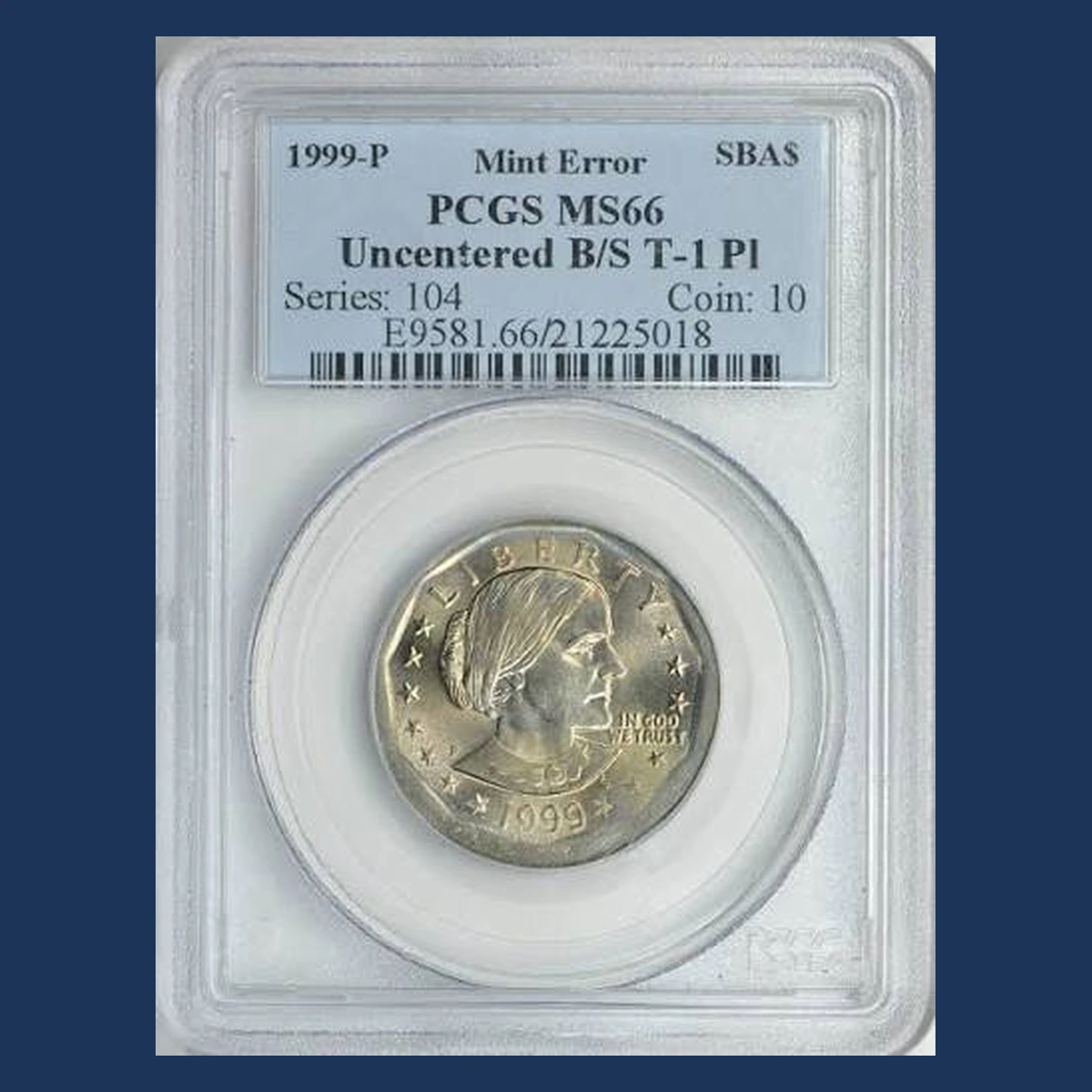
Without support from the surrounding collar, a coin blank can spread wider as it receives the design. The resulting broadstrike keeps the full picture inside an expanded outline.
Philadelphia examples include NGC MS67 coins, a high unworn grade. Another Philadelphia coin, graded NGC AU58 for slight wear, was struck on a Type One blank.
Type One means the blank had not yet received its preliminary raised rim. It describes the blank’s preparation, while broadstrike describes what happened when it was struck.
Denver broadstrikes are reported separately and do not inherit those Philadelphia grades.
Estimated Value
A genuine broadstrike is estimated at $100–$1,500, with a large clear spread and attractive surfaces supporting the higher end. Ordinary small rim differences do not receive the same premium.
An identified Type One blank can add interest because its preparation differs from a normal coin blank. That feature must be established independently of the wide outline.
The estimate concerns the complete coin; the blank type and broadstrike are not separate prices to add together.
How to Identify
A broadstrike retains the full intended design, even when the picture sits unevenly within the metal. Check the outer letters on both faces before measuring the coin; missing letters beyond the boundary point toward an off-center strike instead.
For a loose coin, measure several directions against the normal 26.5-millimeter diameter. Examine the widened edge and nearby raised details together: the picture should have formed as the metal spread, rather than being crushed flat by later hammering.
A wide outline does not by itself establish a Type One blank. That name describes an earlier preparation step, so have a specialist check the blank and strike together before using it on a label.
4. 1999 Susan B. Anthony Dollar Double and Triple Strikes
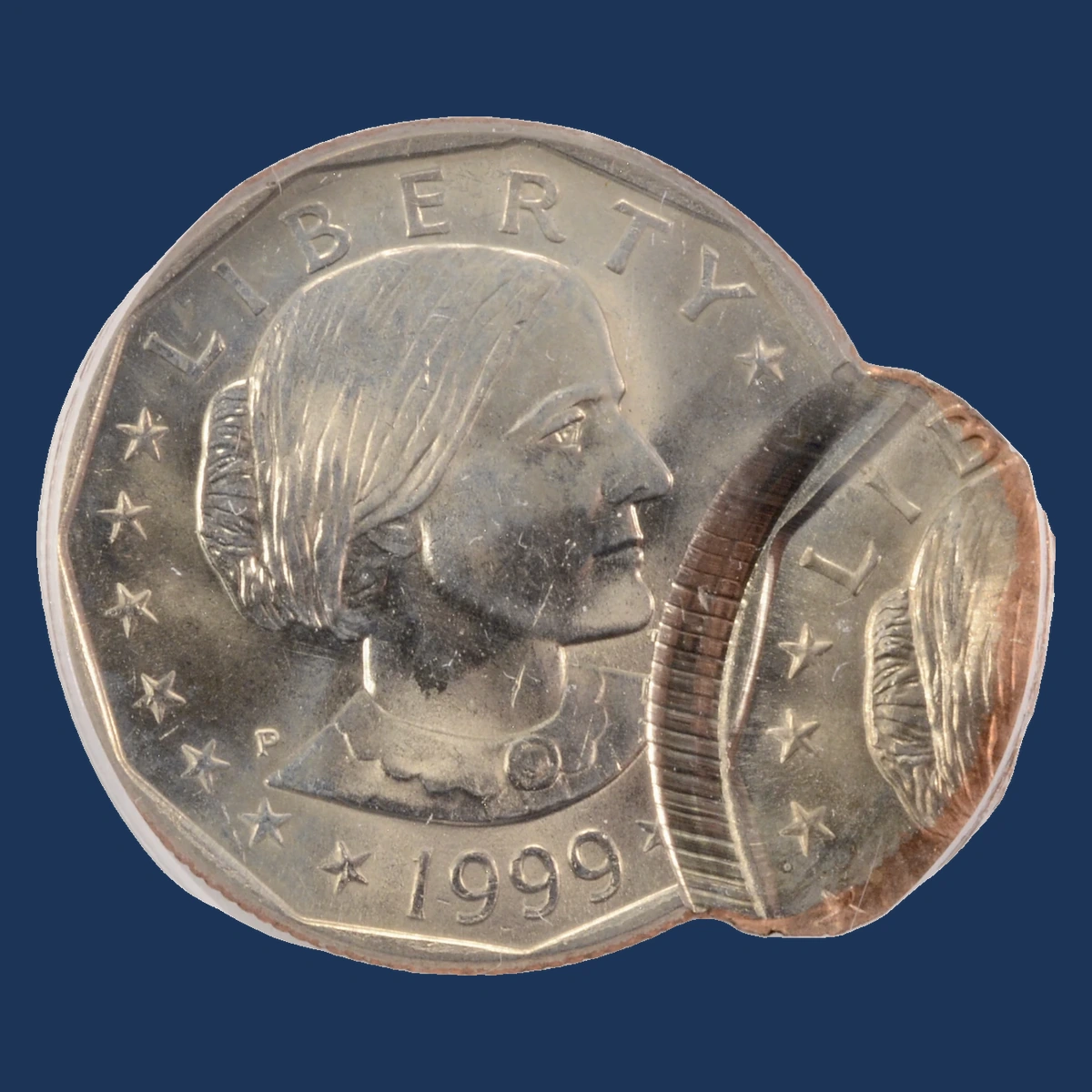
Two sets of large design features can show that a coin stayed in the press for another blow. The coin may shift between blows instead of receiving both impressions in the same position.
One 1999-P double strike has its second impression 75 percent off center near three o’clock. Another shows an 80 percent shift near four o’clock.
Both have a blocked back during the second strike rather than a normal second back impression. A separate Philadelphia triple strike has a second strike 25 percent off center.
These are different coins, not successive stages photographed on one specimen.
Estimated Value
Estimate $500–$3,000 for substantial authenticated double or triple strikes, with clear repeated designs and good preservation increasing interest. Small overlaps and damaged surfaces may be less attractive.
Sullivan Numismatics offered the 75-percent second-strike ANACS MS66 example at $1,750. That is a dealer asking price for an unworn coin with few marks, not a completed auction result.
A third blow does not automatically multiply the price; the visible combination on the whole coin matters.
How to Identify
A second date does not tell the whole story on these dollars. Turn the coin over and check whether the later blow also left a normal picture on the back.
The two reported double strikes have a blocked back during the second blow. Photograph that smooth or distorted area, then locate the shifted second portrait or lettering on the front.
Trace which front details belong to each impression, starting where one picture crosses the other. Keep the surviving date and mint letter visible so photographs of different coins are not mixed.
For a triple strike, three blows need to be shown by the overlapping designs. Several repeated lines within one shifted picture do not count as several separate strikes.
5. 1999 Susan B. Anthony Dollar Off-Center and Chain Strikes
An off-center dollar has an untouched area beside a picture that runs out of room on the opposite side. The blank was misplaced under the stamping tools.
A Philadelphia example is described as 75 percent off center, with only 199 visible from its date. The Anthony series has only one 1990s issue, allowing those digits to identify 1999.
Another Philadelphia coin is 40 percent off center and has a chain-strike edge. That means another blank pressed against its edge during striking.
The contact mark is an added feature on that coin, not a property of every off-center dollar.
Estimated Value
Heritage sold a 1999-P dollar struck 40 percent off center for $432 in March 2023. Its MS64 grade describes an unworn coin with noticeable marks.
Estimate $200–$3,500 for authenticated off-center examples, allowing for displacement, condition, and additional features. A separate 15-percent example graded MS66 brought $234 at the same auction.
The reported chain-strike coin needs its own edge comparison. Neither sale proves that its coin has chain contact, and several visible faults still belong to one whole coin.
How to Identify
Start with the surviving date and the Anthony portrait, rather than judging identity from blank metal. The visible 199 on the reported 75-percent example distinguishes the series’ 1999 issue.
Follow the transition between untouched blank and struck design on both faces. The two pictures should fit the same misplaced blank.
On the chain-strike example, inspect the edge where it met another blank during the blow. Compare that contact area with the adjacent struck surfaces, checking for later impact damage.
Use a side photograph as well as full-face views to show the relationship. A large blank crescent establishes neither chain contact nor a second strike without their separate visible evidence.
6. 1999 Susan B. Anthony Dollar Ordinary Designs on a Proof Blank
Proof coins start with specially prepared blanks and tools to produce a collector finish. An ordinary stamping tool can instead strike a blank prepared for that different process.
The resulting coin does not automatically become a Proof. Its blank preparation and the tools that made its picture tell separate parts of the story.
A documented 1999-P example is broadstruck on a Type One Proof blank, meaning no preliminary raised rim. Other reports describe off-center examples on Proof blanks.
The broadstrike and displaced examples should be examined individually rather than combined into one imagined coin.
Estimated Value
Estimate $750–$5,000 for a confirmed ordinary-strike dollar on a Proof blank with a substantial broadstrike or off-center feature. The blank preparation must be established as well as the unusual shape.
A larger visible error and attractive original surfaces can make the combination easier to appreciate. A shiny normal dollar does not qualify merely because its fields reflect light.
This range values the complete combination, including its condition, rather than adding separate blank and striking-error premiums.
How to Identify
Check the grading description for both the ordinary strike and the Proof blank. A label that merely says Proof describes a different situation and does not establish this error.
Examine the surface and edge preparation with the coin’s original photographs, keeping a sealed coin in its holder. Polish added after minting can imitate a bright field.
Next compare the outline with the stated strike: full design within a spread border for broadstriking, or missing design beside blank metal for off-center striking. Photograph those features separately from the surface close-up.
For a Type One designation, do not use the finished rim’s weakness as the only evidence. Have the blank preparation checked along with the tool-imparted design and the outward spread.
7. 1999 Susan B. Anthony Dollar Matching Pair with a Reversed Impression
Two coins can preserve opposite sides of the same accident when they meet during striking. A coin already bearing a design can press that picture into another coin.
The transferred picture is sunken and reversed, an error called brockage. A documented 1999-P pair has one double-struck coin and one with a partial brockage.
Both were graded ANACS MS64, meaning unworn with noticeable marks. Their labels identify them as a matching pair.
A partial mirror image must not be confused with a stepped edge caused by an incomplete collar; the visible transferred design is the important difference.
Estimated Value
The authenticated matching pair has an estimated value of $2,000–$6,000 for both coins together. Clear matching features and keeping the pair intact support collector interest.
A single coin offered without its partner needs a different comparison. Two unrelated errors of the same date do not gain the value of a matched pair simply because they are sold together.
This estimate depends on the coins’ physical relationship and preservation, not on doubling an assumed price for one of them.
How to Identify
Keep the two coins’ photographs in separate sets at first: front, back, and edge for each. This prevents the front of one partner from being mistaken for the back of the other.
Find the sunken mirror image on the brockage coin, using recognizable letters or portrait details. Compare its position and outline with the raised picture on the other coin, then inspect the double-struck partner’s overlapping designs.
The contact areas should explain how the two coins met during striking. Matching dates and grades alone do not show that relationship.
Check that the holders describe the same pairing seen in the photographs. Leave the coins sealed; pressing them together can damage the very details needed to compare them.
8. 1999 Susan B. Anthony Dollar Coins That Became Caps on the Stamping Tools
A coin can remain stuck to a stamping tool while more blanks enter the press. Repeated pressure changes its shape, turning it into a cap around the tool.
A 1999-P front-tool cap was graded NGC MS67, a high unworn grade. A separate 1999 coin recorded by PCGS as MS65 combined broadstriking, multiple blows, and a back-tool cap.
That second coin later received an exit strike about 80 percent off center. Its mint is not established by the description.
The cap itself is different from another coin that merely received an impression from its surface.
Estimated Value
Estimate $1,000–$7,500 for authenticated 1999 cap errors, depending on shape, repeated strikes, preservation, and how clearly the process can be seen. A deep cup is visually different from a shallow early cap.
The multiple-struck back cap with an off-center exit impression combines several features on one coin. They should be compared as one complete object, not separately added to a price total.
Original, undisturbed metal at the raised wall helps a buyer assess the error.
How to Identify
Ask for a side view before trying to understand a cap from its face alone. The metal may wrap upward around the tool, and a flat photograph can hide that shape.
Compare the face nearest the tool with the face that contacted later blanks. Their designs can become very different as repeated pressure changes the coin.
For the multiple-struck back cap, locate the separate displaced exit impression without assuming it created every distorted feature. Record which design survives in each area.
A bent coin can also form a cup, so inspect the wall for later folds, scratches, and forced reshaping. A specialist should relate the cup, repeated pressure, and surviving pictures to one minting event before assigning a cap description.
9. 1999 Susan B. Anthony Dollar Unadopted Experimental Alloy
This gold-colored dollar uses a trial alloy rather than the metal adopted for ordinary Anthony dollars. It belongs to the Mint’s testing of materials for the next dollar coin.
Heritage describes a 1999-P PCGS MS66 example as 73 percent copper, 25 percent zinc, and 2 percent nickel. That alloy was not adopted.
It is different from the manganese-brass clad material used for Sacagawea dollars. The two types must not share a diagnosis simply because both look gold-colored.
The experimental piece records a materials test, rather than proving an accidental mix-up with finished production blanks.
Estimated Value
The experimental PCGS MS66 coin sold for $10,575 in February 2013, according to the PCGS auction record. MS66 describes an unworn coin with few marks.
Use an estimated $8,000–$20,000 for a comparable authenticated experimental piece. Its identified alloy and history matter as much as its surface quality.
That range does not apply to a gold-plated souvenir or automatically transfer to the separate error struck on a normal Sacagawea blank.
How to Identify
Read the specific alloy description before comparing the color with photographs. The documented trial composition is 73 percent copper, 25 percent zinc, and 2 percent nickel, rather than the Sacagawea material.
A photograph cannot establish those percentages. Ask for professional composition testing and a grading description that distinguishes the experimental blank from an ordinary wrong-planchet error.
Examine the coin for signs of a later coating without scraping or filing the surface. Thin plating can change the appearance without creating the required metal throughout the blank.
Keep the 1999 date and P visible in the record. Color and a slightly unusual weight are starting observations, while the alloy identification is what separates this test piece from the alternatives.
10. 1999 Susan B. Anthony Dollar Struck on Another Coin’s Blank
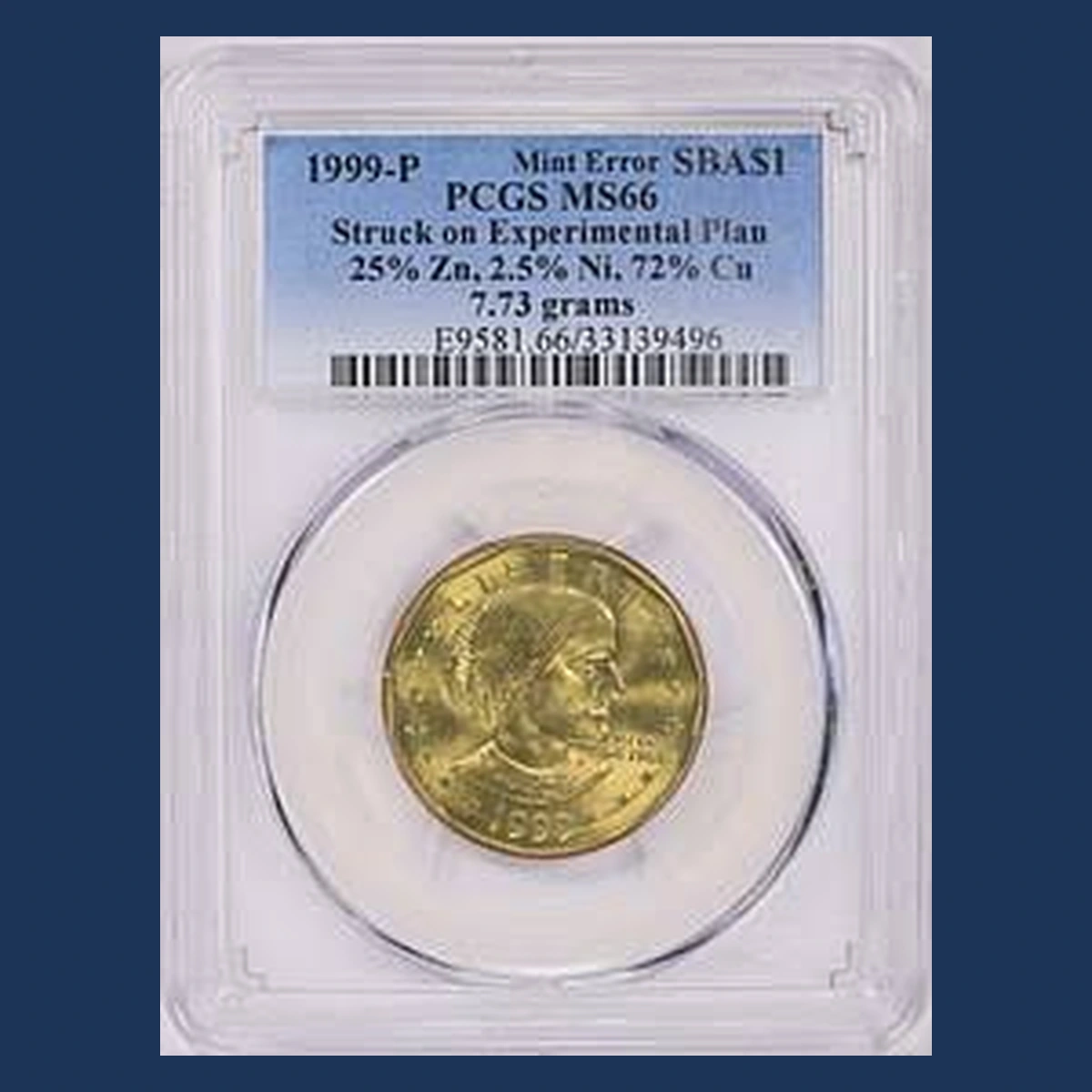
An Anthony design can appear on metal meant for another denomination or dollar series. The prepared disc is called a planchet, and a production mix-up sends it to the wrong press.
Philadelphia and Denver examples are documented on gold-colored Sacagawea blanks. The Denver NGC MS65 specimen weighs 8.1 grams and has normal edge grooves.
Smaller cent and nickel blanks are also reported for Philadelphia coins. Their size can cut off much of the intended dollar design.
A normal weight therefore cannot rule out every wrong blank, and gold color alone cannot distinguish an original alloy from later plating.
Estimated Value
A 1999-P dollar on a Sacagawea blank brought $16,800 in January 2020. Estimate $8,000–$25,000 for comparable authenticated examples, depending on preservation.
For the reported cent-blank type, use a conditional $1,000–$5,000 estimate; for a nickel blank, $2,000–$10,000. Those figures are type estimates, not documented sales for unnamed 1999 coins.
The three ranges concern different blanks. They should not be mixed just because each coin received the Anthony design.
How to Identify
Use measurements to choose which possibility to investigate, rather than treating every odd color as the same error. The normal dollar standard is 8.10 grams and 26.5 millimeters.
A cent blank is nominally 2.50 grams and a nickel blank 5.00 grams, though striking can spread their diameter. These are comparison standards, not measured weights for the reported 1999 candidates.
For a gold-colored full-size dollar, examine the edge and surfaces for a later coating. The documented 8.1-gram Denver example shows why normal dollar weight cannot reject the Sacagawea-blank error.
Have the metal and any layering professionally identified, keeping the coin untouched. A small coin also needs a natural struck boundary rather than file marks that explain its reduced size.
Conclusion
Estimated values run from $50 to $25,000, with different comparisons for small design changes, distorted strikes, and wrong metal. The $16,800 sale involved an Anthony design on a Sacagawea blank.
Keep that coin separate from the experimental alloy and from plated souvenirs. On a repeated strike or matching pair, preserve photographs of both faces and the edge.
The physical feature and the exact coin’s identity matter more than a dramatic listing title.