1972 Dollar Coin Error List with Pictures

A second, misplaced strike helped a 1972-S silver dollar bring $15,600 in August 2022. It was a Proof, a specially made collector coin.
This 1972 Eisenhower dollar error list also includes clipped edges, separated layers, and dollar designs squeezed onto smaller blanks. Estimates range from $20–$100,000, with the highest figures reserved for exceptional multi-coin or mixed-design pieces.
Silver is normal for the 1972-S collector issues. Read on to see what actually makes each example unusual.
1. 1972 Eisenhower Dollar Front Tool Misalignment
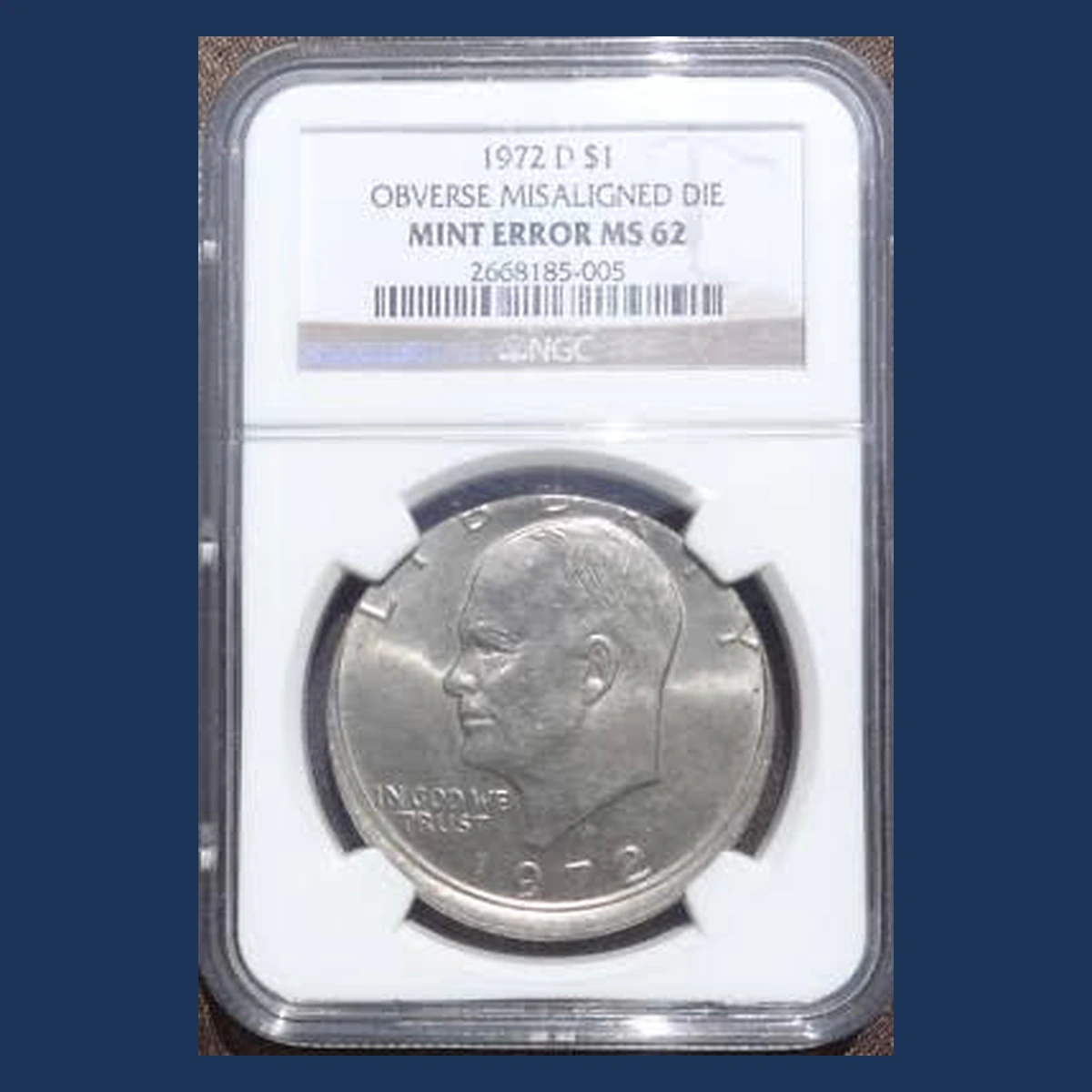
Compare the two faces of a dollar with an uneven rim. On a documented 1972-D example, the front design is displaced while the back is more normally centered.
A die is the steel tool that stamps a coin. When just one tool sits out of line, its picture can shift without moving the other face’s design equally.
PCGS graded this Denver coin MS64, meaning it has no circulation wear and some visible marks. The error concerns the tool’s position, not the amount of wear.
A flattened edge from a later impact needs a different explanation.
Estimated Value
The PCGS MS64 Denver example brought $114 in December 2024. For comparable genuine errors, an estimated range is $20–$250.
A visible difference between the two faces makes the error easier to display. Small shifts may bring only a modest premium, especially on a marked or circulated coin.
Compare the actual rims before paying more for a high grade. The grade describes preservation, while the degree of displacement determines how clearly the minting mistake can be seen.
How to Identify
Set the dollar upright with the date at the bottom, then compare the rim above and below the portrait. Check the left and right sides too, looking for a consistent shift in the picture.
Turn to the eagle side and repeat that comparison. Photograph both faces straight on, since a tilted camera can make a centered coin look uneven.
Under a magnifier, a struck narrow rim should remain distinguishable from a crushed edge with nearby metal pushed inward. If both pictures shift across the blank together, investigate the blank’s position instead.
The useful contrast here is one displaced face beside a substantially centered opposite face.
2. 1972 Eisenhower Dollar Curved Clip
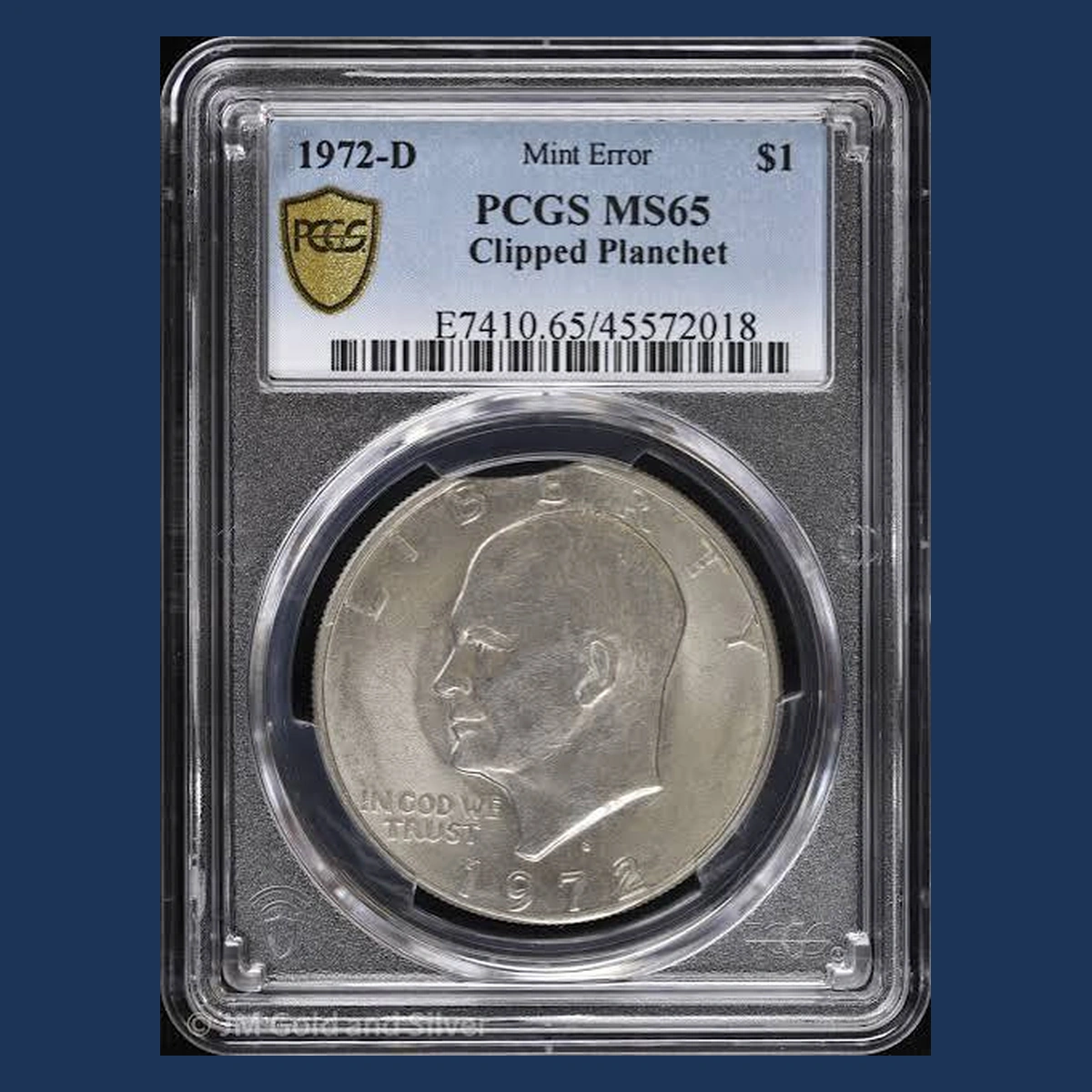
A small curved piece is missing from the edge of two documented 1972 dollars. The Philadelphia coin weighs 22.35 grams, while the Denver example weighs 22.49 grams.
Both were made from incomplete blanks. The circular cutter overlapped a hole in the metal strip, leaving a gap before either coin was struck.
ANACS graded the Philadelphia example MS64 and the Denver coin MS62. Their different weights belong to different coins, not two measurements of one specimen.
The Philadelphia holder’s Type Two description was corrected in the auction catalog. That label should not establish a scarce back-design variety.
Estimated Value
In March 2022, the Philadelphia MS64 clip sold for $180 and the Denver MS62 clip brought $51. These small clips show how widely two genuine examples can differ in price.
An estimated $40–$500 covers similar authenticated pieces. A clear curved gap, attractive original surfaces, and an intact date all help.
The clip’s size is only one factor. A mistaken design-type label should not add value, and a later cut does not deserve a mint-error premium.
How to Identify
Use a magnifier where the struck letters approach the missing section. Metal that flowed toward an existing gap can soften nearby detail rather than leave a sharp cut through a finished letter.
Check the opposite rim for weakness, a helpful supporting clue on some clipped coins. Fresh file lines, jagged tool marks, or a bright cut face may instead suggest later removal.
If the coin is loose, weigh it against the 22.68-gram copper-nickel-clad standard, remembering that later cutting also reduces weight. Preserve the boundary untouched, and judge the weight together with the rim and design near the gap, not as proof on its own.
3. 1972 Eisenhower Dollar Doubled or Tripled Design
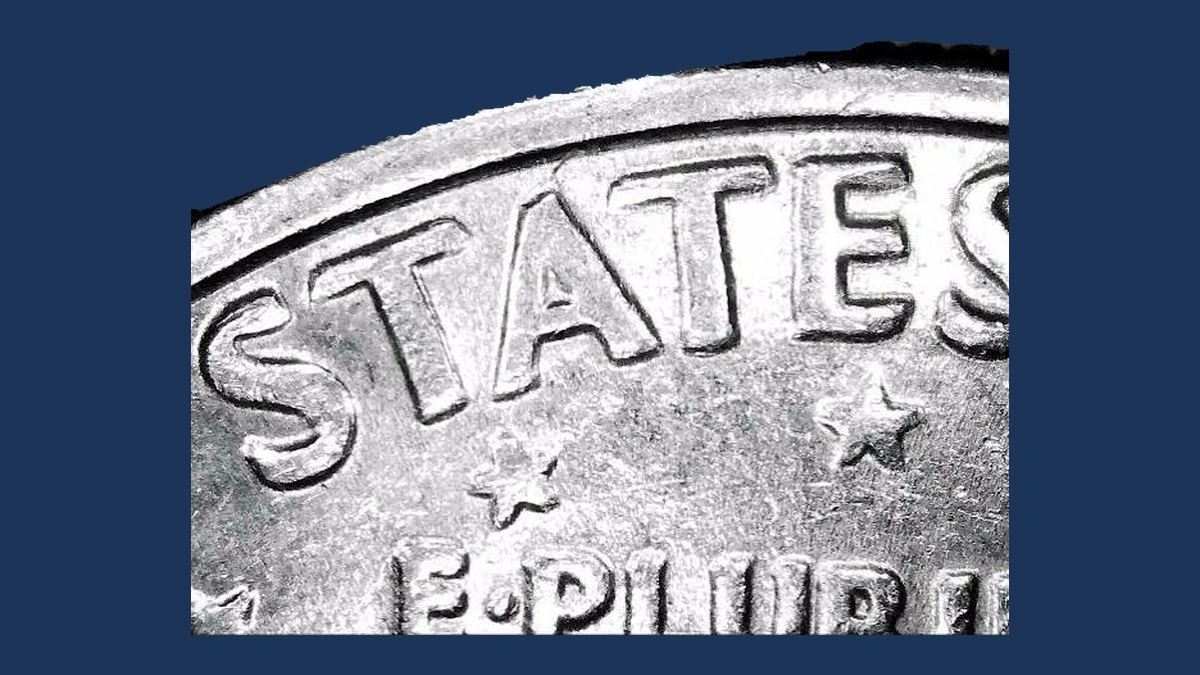
Extra outlines in Denver’s back lettering, stars, Earth, and moon craters identify one listed doubled design. They are not the normal differences between Philadelphia’s three back designs.
San Francisco has different front patterns. WDDO-005 on an ordinary silver collector coin shows tripling in the date, motto, and upper LIBERTY.
The Proof WDDO-006 has stronger doubling in LIBERTY and the hair, with lighter separation at the date. These outlines came from the stamping tool.
Other listed front and back varieties include Proof FS-101. Their names alone do not make every thick letter a match.
Estimated Value
Matched doubled or tripled examples have an estimated value of $30–$1,000. Different patterns and finishes do not share one uniform price.
Strong, readable separation can matter more than a subtle extra edge. On silver collector coins, the normal coin’s condition and metal value also contribute to the whole price.
A Proof designation or a straight-looking leg on LIBERTY’s R does not establish a doubled die. Pay for a visible pattern that matches the correct coin and finish.
How to Identify
Identify the mint and finish before choosing a comparison photograph. San Francisco made both ordinary silver collector coins and mirror-surfaced Proofs, so an S alone does not settle the matter.
For the Denver pattern, trace several back letters and then inspect the stars, Earth, and craters under a 10× magnifier. Repeated edges should follow the listed clockwise separation.
On the ordinary S WDDO-005, look for three outlines in the date, motto, and especially LI. The Proof WDDO-006 instead requires its own LIBERTY and hair comparison.
Do not identify a variety from the R’s straight leg alone. That feature can occur without the required doubling.
Use the exact catalog photographs for FS-101 or another listed number; a flat shelf beside a letter may be ordinary strike-related doubling.
4. 1972 Eisenhower Dollar Missing or Detached Outer Layer
One Philadelphia dollar kept the outer piece that broke from its back after striking. The detached section covers about 35% of that face, from roughly 1 to 4:30.
The coin and fragment received separate grades, AU58 and MS62. They are two parts of one dollar.
Other examples show partial front cladding on a Denver coin and a wholly missing front layer on a 19.0-gram Philadelphia dollar. A silver Proof also lost part of its back layer after striking.
Silver-clad construction is normal for that S Proof. Its error is the separated layer, not its silver content.
Estimated Value
The Philadelphia coin with its matching fragment sold together for $1,265 in February 2005. That amount should not be treated as the price of each piece.
Estimate $150–$2,500 for comparable ordinary layer errors and $1,000–$5,000 for authenticated silver Proof examples. The amount missing, surviving design, and finish influence value.
Keeping the original fragment can make the separation easier to understand. A copper-colored surface caused only by later chemicals is a different collecting proposition.
How to Identify
A matching detached piece can show when the layer separated. On the Philadelphia pair, struck design remains on the fragment, so it had already received the picture before breaking away.
Compare its outline with the missing back section using enlarged photographs. Do not press the pieces together or bend a loose edge.
For a copper-nickel-clad dollar, inspect a copper-colored area under a magnifier for an actual layer boundary rather than discoloration. A scale helps check missing metal against the normal 22.68 grams; the published fully missing-front example weighs 19.0 grams.
The S silver Proof has a different normal weight, about 24.59 grams. Its outer layer is 80% silver, but the complete coin’s overall silver content is 40%.
5. 1972 Eisenhower Dollar Struck through a Coin Covering the Back Tool
The back design on a 1972-D dollar was struck through another coin covering the stamping tool. NGC certified the affected dollar as MS66.
A previously struck coin can stick to a tool and act like a cap. When a new blank enters, that covering coin blocks direct contact with the tool beneath it.
The resulting design may be weak, distorted, or partly replaced by an impression from the covering coin. Its appearance depends on the cap’s condition.
The certified dollar is the coin struck through the obstruction. It should not automatically be described as the cap itself.
Estimated Value
The NGC MS66 example sold for $3,120 in August 2021. Its well-preserved surfaces and distinctive blocked back make it a useful same-year comparison.
Allow an estimated $1,000–$6,000 for similar authenticated examples. The strength of the unusual back impression and the visibility of the normal identifying details affect appeal.
A smooth area alone does not guarantee this value. Heavy wear, later grinding, and a different obstruction can all weaken a design without proving contact through a coin cap.
How to Identify
Inspect the back as a whole before magnifying individual marks. A cap can affect a broad area, so the relationship between weak and distorted features matters more than one missing letter.
Compare that face with the portrait side, where the date and D establish the dollar’s identity. Ordinary wear would normally affect exposed high points in a more predictable way.
Use angled light to check for scratches left by grinding or wiping. Metal removed after minting may leave a smooth-looking patch, but the surrounding surface often reveals the work.
A specialist should compare the unusual back with certified struck-through-cap examples. A mirror image can help in some cases, but it is not required on every coin struck through a worn cap.
6. 1972 Eisenhower Dollar Struck on a Philippine One-Piso Blank
A foreign blank received the Denver dollar design on this PCGS MS64 example. The auction identifies the metal disc as one intended for a Philippine one-piso coin.
The dollar design sits slightly off-center toward 6 o’clock. That is a direction, not a statement that it is 6% off-center.
A wrong blank can change the size, weight, and available space for the design. Its metal must also fit the claimed foreign coin.
This piece is described as struck on a blank, not over an already finished Philippine coin. An older Philippine design is therefore not required beneath Eisenhower’s portrait.
Estimated Value
The PCGS MS64 one-piso-blank dollar brought $747.50 in May 2005. More recently, an undated dollar assigned to 1973–1978 on a one-piso blank sold for $3,172 in June 2026.
Using those distinct examples as comparisons, estimate $750–$7,500 for a correctly identified 1972 foreign-blank dollar. The newer sale is not a second sale of the 1972 coin.
Readable identifying details and sound surfaces help. An alloy test and matching physical measurements are more useful than a silver-colored appearance alone.
How to Identify
Record the entire surviving dollar design before measuring the coin. The 1972 date and Denver mintmark must belong to the struck picture, even if nearby letters run beyond the metal.
A scale and calipers provide useful starting measurements. Compare them with the normal 1972-D dollar’s 22.68 grams and 38.1 mm, but do not treat those normal figures as this error’s actual measurements.
The foreign-blank claim also needs the right metal composition. Have a specialist test it without filing the edge or scratching the surface.
A trimmed dollar may become smaller and lighter while retaining the wrong edge structure. Follow the original struck boundary and its displaced design, then confirm that the measured metal fits a Philippine blank.
7. 1972 Eisenhower Dollar Double Strike with Movement
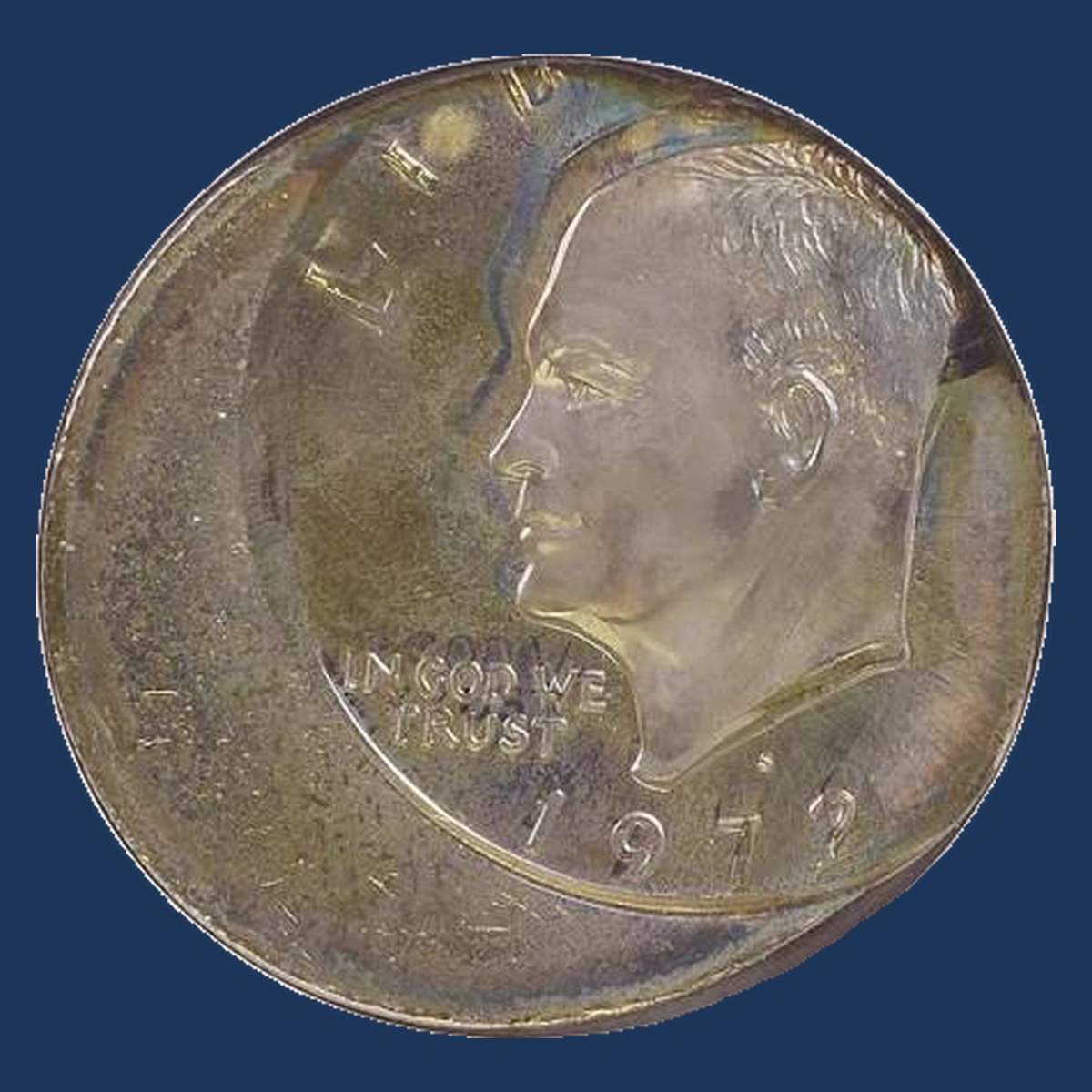
Two sets of LIBERTY and ONE DOLLAR appear on one 1972-S silver Proof. Both strikes landed about 10% off-center toward 5 o’clock.
This NGC PR66 Ultra Cameo coin lost parts of the outer lettering and the bottoms of 972. Its repeated design records movement between impressions.
Another silver Proof, graded PR68 Cameo, received a normal first strike and a displaced second strike toward 8 o’clock. It is a different example.
An ordinary Denver dollar also received two strikes, with the second 95% off-center. That tiny second impression belongs near the edge of its first design.
Estimated Value
The PR66 silver Proof brought $13,800 in August 2022. The separate PR68 Proof sold for $15,600 in the same auction.
Estimate $8,000–$25,000 for comparable silver Proof double strikes and $250–$2,000 for ordinary Denver examples. Finish and the visibility of the two impressions explain much of the difference.
A barely overlapping second strike can be dramatic despite its small area. Scratches, incomplete dates, or confusing damage may reduce demand even when the strike sequence is genuine.
How to Identify
Find two separate sets of design rather than merely a doubled edge on one letter. On the PR66 Proof, LIBERTY and ONE DOLLAR give useful starting points.
Follow the date’s 972 down to the boundary of the available metal. The missing lower portions should agree with the way the two off-center impressions landed.
The PR68 example needs a different check: trace the normal first design beneath the displaced second one. A magnifier and low light can reveal where later detail flattened earlier detail.
On the Denver coin, concentrate on the small second-strike area near the edge. Do not assign the Proof’s direction to it.
Tilt the coin to distinguish real overlapping impressions from glare. Separate struck fragments, rather than uniform close letter doubling, show that the coin moved between strikes.
8. 1972 Eisenhower Dollar Design across a Cent-and-Dime Blank Pair
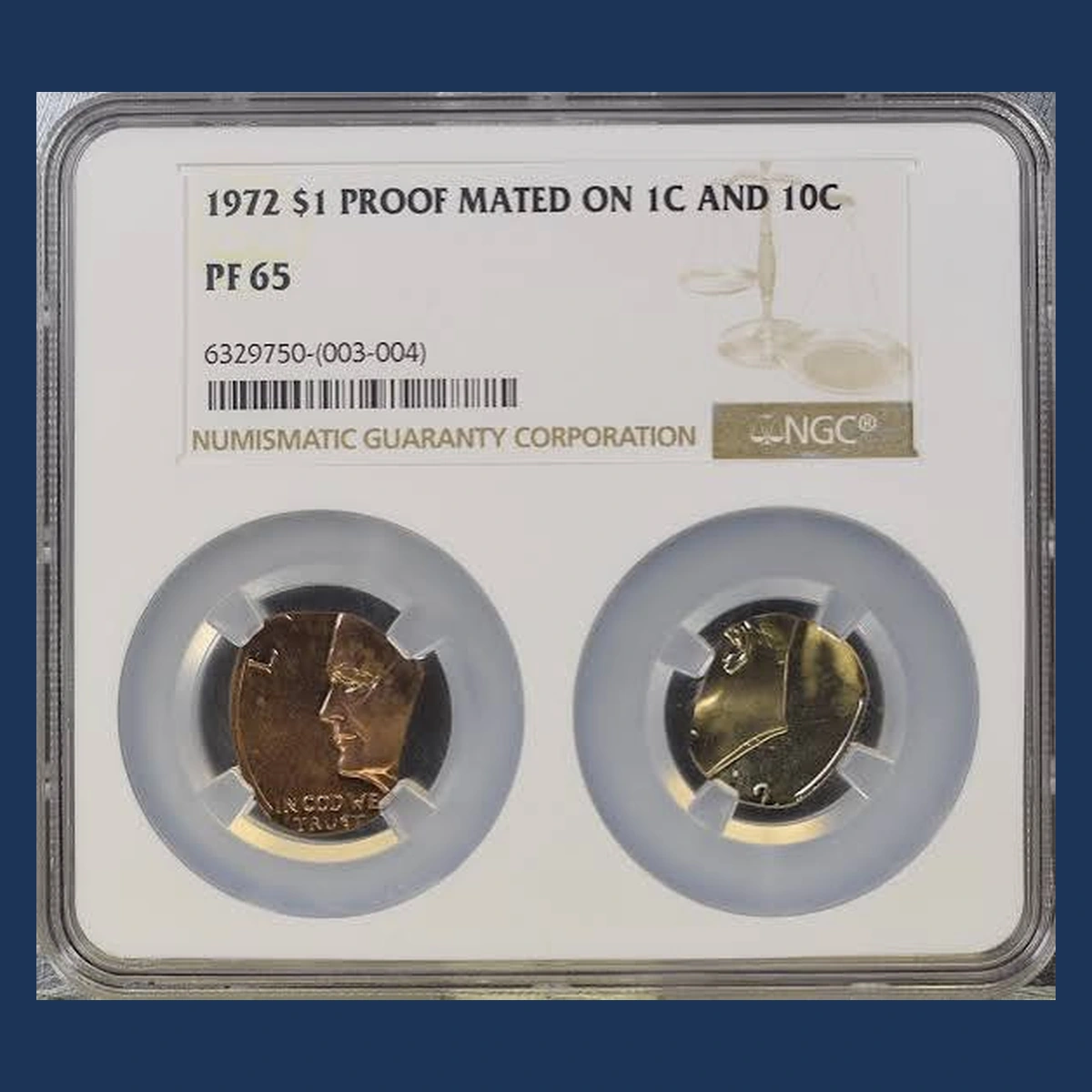
Two small blanks shared one strike from Proof dollar tools. One was intended for a cent and the other for a dime.
They lay side by side, expanding into oval shapes as the dollar design spread across them. TRUST and the ED in UNITED became stretched.
The pair is cataloged as 1972-S and graded NGC PR65. The dime-blank piece shows an S above-left of the final 2, while the rest of the date is absent.
Although the holder wording suggests finished cents and dimes, the auction found no earlier designs. The evidence describes blanks, not previously struck small coins.
Estimated Value
Estimate $25,000–$80,000 for this authenticated cent-and-dime pair, valued together. Its August 2025 auction appearance ended without a sale.
For scale, a different three-piece Proof Eisenhower design on adjacent dime blanks brought $105,000 in April 2021. That more complex arrangement is a comparison, not a realized price for this two-piece pair.
Keeping both original pieces is central to the display. Their shared impression explains the event more clearly than either small piece would alone.
How to Identify
Study both pieces at the same scale and orientation. Their neighboring edges and the divided dollar picture should explain how they sat together under the tools.
Find the S and final 2 on the dime-blank piece under a magnifier. A complete 1972 date is not present, so use the certified pair’s identification instead of imagining missing digits.
Look at the stretched TRUST and ED, then compare the oval outlines. These features reflect sideways restriction while the metal expanded elsewhere.
Do not force the pieces against each other. Use photographs to compare their contact edges, and keep their certified identification together.
Finally, inspect for any genuine earlier cent or dime design. This pair was cataloged as struck on blanks because no such underlying picture was evident.
9. 1972 Eisenhower Dollar Two Cent Designs Struck over a Dollar
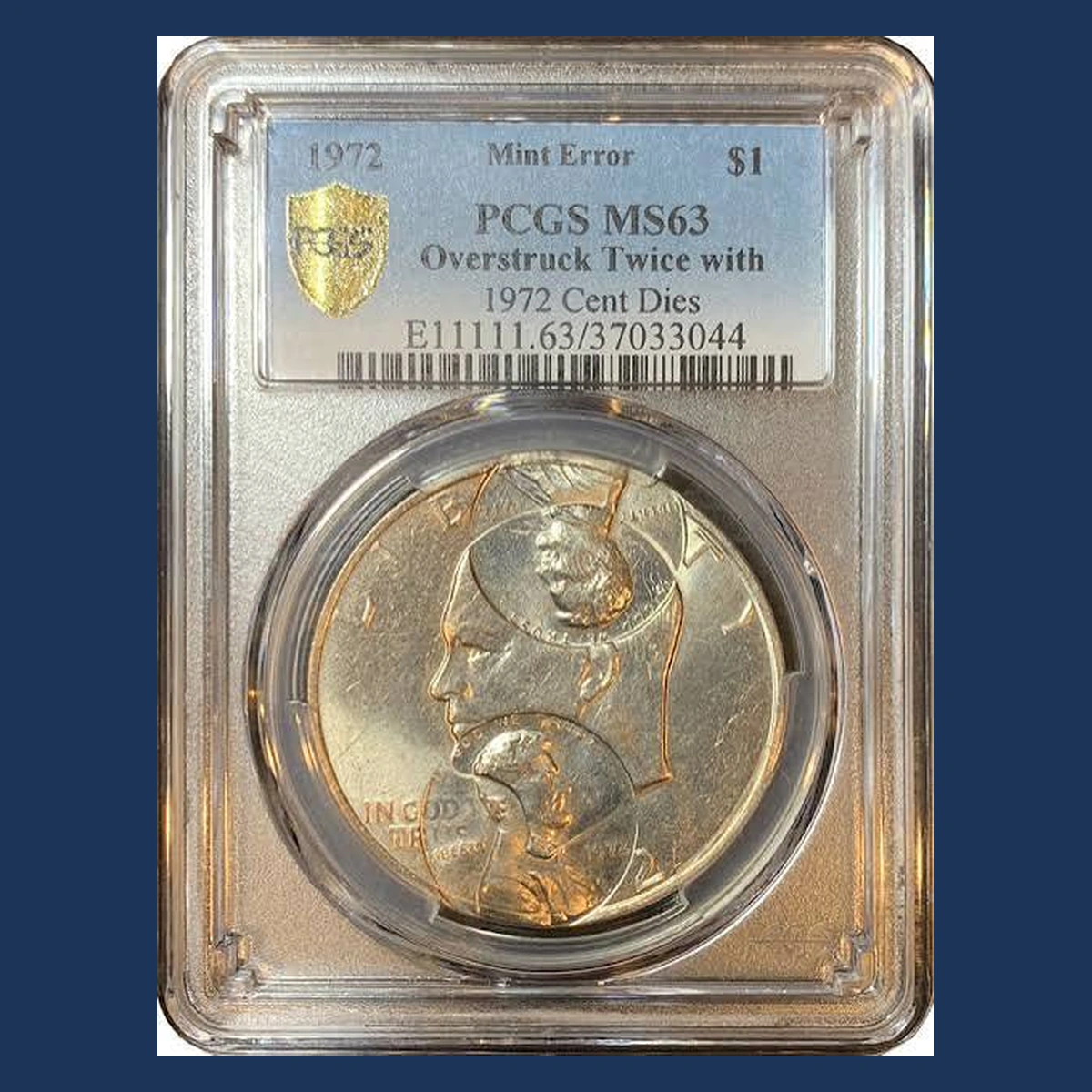
Two Lincoln cent designs sit over the picture of a 1972 Eisenhower dollar. The dollar had already been struck before receiving those smaller impressions.
Mike Byers describes two adjacent pairs of cent tools striking it at the same time. An unstruck strip remains between the two impressions, creating a saddle-like shape.
PCGS graded the piece MS63. Byers explains it as an intentionally made Mint product, rather than a proven accidental feed into the press.
Its mixture of dollar and cent designs makes it different from a dollar design struck onto small blank discs. Here, the large dollar came first.
Estimated Value
A whole-piece estimate of $30,000–$100,000 reflects the unusual two-impression arrangement and its certified identity. This is an editorial estimate, not a reported auction result for the 1972 piece.
As a simpler comparison, a 1979-S dollar design over a finished cent brought $3,904 in June 2026. Its design order and physical form differ from this saddle-shaped dollar.
The premium depends on the complete visible combination. Damage to the connecting strip or unclear underlying design would weaken that appeal.
How to Identify
Locate the large dollar picture before studying the small cent impressions. Surviving dollar detail beneath them establishes that an existing dollar received additional designs.
Examine both cent-shaped areas with a magnifier, looking for real struck detail rather than glued-on coins or shallow decorative engraving. Photograph the coin from the side to show the raised strip between the two impressions.
The whole dollar began at roughly 38.1 mm across, but this unusual strike changed its shape. Do not flatten it or expect every measurement across the finished piece to match a round dollar.
Compare the complete shape and overlapping designs with Byers’s published example. Those visible relationships matter more than a general claim that two presidents appear on one coin.
Conclusion
The most useful first distinction is the coin’s construction: ordinary copper-nickel-clad dollars and silver S collector issues have different normal weights. Silver alone does not make a 1972-S an error.
Across these nine groups, estimated values span $20–$100,000. Readable extra impressions, untouched layer boundaries, and properly matched pieces carry more information than an unusual color alone.
Compare the exact feature and finish before applying a price. Keep loose fragments and unusual surfaces protected.