1875 Dollar Coin Error List with Pictures

Look beneath the eagle on an 1875 Trade dollar: an S can partly cover older CC mint letters. That small remnant identifies coins made in San Francisco with a reused stamping tool.
PCGS records an S/CC example at $57,500 in November 2005. The price reflects a rare, well-preserved coin, not simply an extra curve beside any S.
This 1875 Trade dollar error list covers estimated whole-coin values of $300–$60,000. Continue below for mint-letter changes, uneven edges, and the checks that distinguish striking errors from later stamps.
1. 1875 Trade Dollar Clashed Designs
A stray part of the eagle’s design near Liberty can suggest a clash, provided its shape actually matches. A clash occurs when the two steel stamping tools meet without a blank between them.
The collision can mark one tool with part of the other tool’s picture. Later coins receive those unwanted fragments along with the normal design.
An extra line on an 1875 dollar therefore needs more than an unusual location. Merchant stamps, scratches, and ordinary design details can all look unfamiliar under magnification without being transferred artwork.
Estimated Value
For a genuine, authenticated 1875 Trade dollar clash, estimate $300–$3,000 across worn through attractive examples. This is a conditional whole-coin estimate, based on comparable visible tool errors and the underlying Trade dollar.
A clear transferred shape is more appealing than a faint line with no recognizable source. Surface condition and mint also influence the result.
The estimate does not apply to every coin described as clashed. Later stamps or scratches should be valued as part of that coin’s actual condition.
How to Identify
Use photographs of both faces together for this check. Try to match the unexpected line with a specific edge of Liberty, the eagle, or another element on the opposite tool.
Rotate and mirror a reference picture as needed for comparison, but keep the actual candidate photograph unchanged. A convincing clash pattern should explain the shape and its placement rather than merely resemble a random line.
Inspect the mark under changing light for a scratch, punched depression, or displaced metal from later damage. Merchant stamps can be sharply impressed and should not be mistaken for a ghost of the original coin design.
Compare the full transferred fragment with an authenticated example before assigning a clash premium. One unexplained raised line does not establish the cause.
2. 1875 Trade Dollar Reported Doubled Back Lettering
Tiny repeated edges appear below the back’s weight, purity, and denomination lettering on a reported 1875-S example. Heritage described this as a possible doubled design in the stamping tool.
The NGC MS64 coin has a Type II back. The affected areas include 420 GRAINS, 900 FINE, and TRADE DOLLAR, while the S itself is not doubled.
If the repetition belonged to the tool, one strike would copy it onto the coin. A flat edge caused by movement during striking can look similar, so the shape of the repeated detail matters.
Estimated Value
Estimate $500–$6,000 for an authenticated doubled-back example, depending on its condition and the strength of the repeated lettering. The upper end requires a desirable, well-preserved coin with a convincing pattern.
The reported MS64 coin provides a condition comparison, not a separate price for each doubled inscription. Its three affected text areas belong to one dollar.
Ordinary surface marks, cleaning, or flat striking-movement shelves reduce the case for a doubled-tool premium. Compare intact letter shapes before applying this estimated range.
How to Identify
Place a magnifier over 420 GRAINS and follow the bottoms of the letters and numbers. Compare the repeated edge with the corresponding detail below 900 FINE and TRADE DOLLAR.
The reported pattern points downward in those areas. Its mintmark remains single, so an extra outline on S would need a different explanation.
Change the lamp angle to separate real relief from a reflection. Tool-made doubling should preserve an identifiable repeated form rather than a flat shelf shaved against the main letter.
Look across the complete inscriptions, not just the clearest numeral. A consistent pattern in all the reported areas is more useful than one thick-looking character.
Use a normally struck Type II dollar beside it. This makes normal letter shapes easier to separate from the fine extra edges.
3. 1875 Trade Dollar Reported Cloth Impression
Crossing rows of fine lines can look like fabric pressed into silver. If cloth lay between the blank and a stamping tool, the blow could leave its woven pattern on the coin.
In 2016, a collector described an 1875-S Trade dollar that appeared to have been struck through burlap. That is a report of a candidate, rather than a certified identification.
A textured patch can also form after minting through contact, corrosion, or deliberate pressure. The relationship between the pattern and the original design helps distinguish those different causes.
Estimated Value
For an authenticated cloth-struck 1875 Trade dollar, use an estimated $500–$6,000. A clear woven pattern with sharp surrounding design can attract more interest than a shallow, indistinct patch.
This conditional range values the coin after the striking cause is established. It does not turn the collector’s description into a recorded sale.
Condition, visible texture, and the size of the affected area all matter. Cleaning or polishing the patch can remove the clues that make a genuine example collectible.
How to Identify
Photograph the textured patch before touching the surface, keeping the coin uncleaned so fine lines remain visible. Under a magnifier, look for a repeated woven pattern and follow it toward nearby letters or artwork.
Cloth caught during striking should affect how the original design formed in that same area. Compare the pattern with surrounding detail, looking for random corrosion pits or scratches cut across an already completed design.
Inspect the opposite face for dents or pressure marks, then check the edge for signs of later squeezing. A fabric pattern whose boundary fits an interrupted original strike is stronger evidence than a rough patch that merely resembles cloth.
4. 1875 Trade Dollar Tilted Partial-Collar Strike
The rim can resemble two side-by-side railway rails when a tilted blank meets the retaining collar unevenly. That metal ring normally controls the edge during striking.
On the 1875-CC PCGS VF30 example, the front rim is double-wide near six-thirty. It narrows around the coin and disappears near one o’clock, with an uneven rim on the back too.
The pattern accompanies a slight off-center shift toward one o’clock. These are connected features on one coin, rather than separate errors with separate prices.
This example has the Type II eagle-side design and visible circulation wear.
Estimated Value
The PCGS VF30 example sold for $960 in September 2019. Estimate $600–$8,000 for comparable authenticated partial-collar Trade dollars, from clearly worn pieces through attractive unworn examples.
The stepped rim, slight shift, and Carson City mint all belong to one whole-coin value. VF30 describes a circulated coin with substantial design still visible.
A stronger edge display and cleaner surfaces can support a higher price. Later rim filing or crushing can reduce appeal even when some original collar evidence remains.
How to Identify
View the rim from the side before studying the picture on the coin. On the documented example, start near six-thirty and follow the wide stepped area toward the narrow portion near one o’clock.
Turn to the back and compare its uneven border with the front. The two sides should make sense as one tilted strike, not just a dent or rolled edge on one face.
Check the transition for filing, crushed grooves, or added metal under a magnifier. Photograph several edge sections so a shadow is not mistaken for a real step.
Keep the CC and date in the same set of photographs. The original stepped edge and gradual change in rim width are the useful features to match.
5. 1875 Trade Dollar Reported Multiple Strikes
Two or more recognizable impressions of the dollar’s own design can result when a coin stays in the press for another blow. The coin may shift or turn between strikes.
A collector reported an 1875-S example with possible second and third strikes. The interpretation was disputed, and merchant stamps on the coin complicate the comparison.
These later stamps are often called chopmarks. They were applied during trade and are not extra strikes by the original coin-making tools.
A genuine multiple strike must show repeated parts of the dollar design, not merely several deep marks.
Estimated Value
If authenticated as genuine multiple striking, estimate $1,500–$25,000 for an 1875 Trade dollar with readable repeated designs. Separation between the impressions and the coin’s remaining condition drive much of that range.
This is a conditional estimate, not a sale price for the collector’s disputed example. Chopmarks need to be considered separately when comparing its appeal.
A second recognizable date or portrait can make the sequence easier to show. Random dents or added impressions do not receive the same Mint-error value.
How to Identify
Identify the original dollar design before tracing an apparent second image. Mark out which letters, portrait edges, or eagle details could belong to each separate blow.
Put merchant stamps aside during that comparison. A chopmark has its own shape and does not necessarily repeat any part of the original dollar.
Look for a consistent change between the possible strikes across more than one area. Two unrelated dents cannot explain a second portrait or inscription.
For a loose candidate, record weight and diameter against the normal 27.22 grams and 38.1 millimeters. Those checks can flag a suspicious coin, but they do not prove repeated striking.
Have the complete design sequence examined before accepting a multiple-strike identification. Recognizable repeated original artwork is the key evidence.
6. 1875 Trade Dollar Cracks in the Stamping Tools
A thin raised line can cross the design when the steel stamping tool develops a crack. Silver fills that opening under pressure, copying the line onto the dollar.
The S/CC FS-502 discovery coin has a crack beginning left of TRADE and ending at the left side of A. On the front, another runs from the lower-left rim through the waves and first star toward the second.
These lines are different from the coin’s original rolled-metal streaks. Small rust-related bumps near the mintmark also have a separate cause.
Estimated Value
For the S/CC variety with these cracks, estimate $500–$30,000 across worn through exceptional unworn examples. Much of the price comes from the rare mintmark variety and preservation, rather than the thin lines alone.
The NGC MS65 discovery coin sold for $24,000 in January 2019. Its cracks and overmintmark belong to the same coin and the same auction result.
A common dollar with a small tool crack does not automatically share that value. Match the underlying variety before comparing prices.
How to Identify
Follow the back crack from the open area left of TRADE into the left side of A. On the front, trace the lower-left line through the waves and first star toward the second, using those landmarks in the comparison.
Under low-angle light, the narrow tool-crack lines should stand above the surface, rather than cut into it. A scratch can have raised lips around its sunken center, so inspect the middle of the mark with a magnifier.
Keep the separate rolled-metal streaks out of the crack comparison, and examine the mintmark alongside the branching lines. Match both with the FS-502 photograph; a raised line alone does not establish this particular variety.
7. 1875 Trade Dollar Repunched and Changed Mint Letters
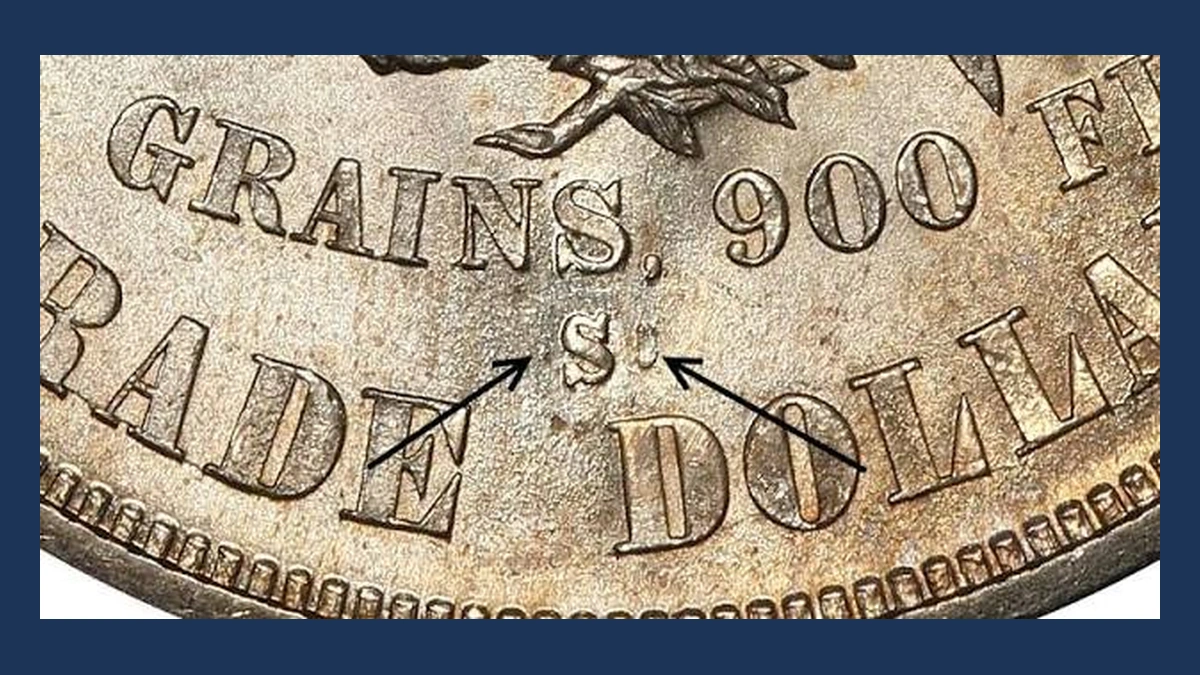
The mint letters sit below 420 GRAINS 900 FINE and above TRADE DOLLAR. Earlier letter remnants can survive when a worker punches the mintmark again into the steel tool.
The famous S/CC variety was made in San Francisco after S replaced partly removed Carson City letters. FS-501 also has a repunched S, while FS-502 does not share that feature.
A separate Carson City variety has larger CC letters over smaller CC remnants visible to the right. It is CC over CC, rather than another form of the San Francisco S/CC.
Estimated Value
Estimate $500–$60,000 for authenticated S/CC examples and $500–$5,000 for identified CC-over-CC examples. Condition and the particular mint-letter variety explain the wide difference.
PCGS records an S/CC sale of $57,500 in November 2005. The FS-502 discovery specimen later brought $24,000 in January 2019.
These are whole-coin results, not fixed premiums for mintmark remnants. Heavy wear, cleaning, or weak remaining letters can place another example far below the high-grade sale.
How to Identify
Read the main mintmark before searching for the earlier letters. An S-over-CC candidate needs a final S; the repunched Carson City variety still has CC as its main mark.
Under a magnifier, compare surviving C curves with the matching variety photograph. A rust bump beside S is not automatically part of an older C.
For FS-501, examine the repeated S as well as the earlier CC remnants. Do not require the same repeated S on FS-502.
For CC over CC, look to the right of the larger letters for the smaller earlier outlines. Compare both Cs rather than accepting one isolated bright edge.
Keep the surrounding surface visible when checking for added or altered letters. A complete match of the main letters and earlier remnants is the useful test.
Conclusion
The S/CC letters, an uneven collar strike, and fine cracks each tell a different part of an 1875 Trade dollar’s history. Later merchant stamps can complicate the picture, especially when a coin seems to show extra strikes.
Estimated values run from $300–$60,000 across the examples and authenticated error types discussed here. Compare the whole coin’s condition and variety, and keep later damage separate from features made by the Mint.