1874 Dollar Coin Error List with Pictures

Turn an 1874-S Trade dollar over from top to bottom and its eagle may sit slightly to the left. A recorded variety has about 15 degrees of rotation, a modest difference that historically brought no extra premium.
Carson City coins need different comparisons: an exceptional ordinary example sold for $54,625 in March 2001. That reflects its preservation, not a recorded error sale.
This 1874 Trade Dollar error guide covers four groups with working estimates of $150–$30,000. Read on for the distinct S and CC features and their practical checks.
1. 1874-S Trade Dollar Rotated Back
The eagle leans slightly left after the upright front is turned over correctly. Some 1874-S Trade dollars with a medium-sized S show about 15 degrees of counterclockwise back rotation.
The front and back stamping tools were not aligned at their usual angle. The design itself can remain complete and well centered on both faces.
This is a modest rotation, not a sideways or upside-down back. A photograph taken at an angle can make a normally aligned coin look similar.
The feature belongs to certain San Francisco examples and should not be assumed on every mint’s coins.
Estimated Value
Estimated whole-coin values are $150–$3,500 for worn through modest unworn examples with this slight rotation. Much of the price comes from the coin’s remaining detail and surfaces.
Bowers’s Trade dollar reference notes that these roughly 15-degree examples historically sold without an added premium. The rotation can be interesting without being a major error.
A cleaned or heavily marked coin remains less desirable than an attractive example in comparable condition.
How to Identify
Hold Liberty upright and keep the coin’s left and right edges fixed. Turn the top edge toward you and downward, as if turning a page over the top rather than sideways.
The eagle should normally appear upright after this top-to-bottom flip. On the recorded variety, its vertical axis leans about 15 degrees counterclockwise.
Repeat the movement to make sure your fingers have not twisted the coin. A holder can help maintain the same axis, provided the coin cannot shift inside it.
Compare both views against a vertical line instead of measuring two independently rotated photographs. A repeatable leftward tilt after the same controlled flip is the useful test for the reported rotation.
2. 1874 Trade Dollar Doubled Back Design
On the San Francisco variety, extra contours are easiest to see along the bases of TRADE DOLLAR. The repeated details are slight rather than a second full set of letters.
The back die, the steel tool that stamps the design, carried the extra outlines. Every coin struck with that tool could receive the same pattern.
A separate Carson City report also describes slight back doubling. Its exact doubled details must be checked against a matching CC example, rather than borrowed from the S coin.
This feature differs from flat ledges made by movement during the strike.
Estimated Value
Estimate $250–$6,000 for confirmed S examples and $500–$20,000 for CC examples, across worn through attractive unworn coins.
A different-year comparison is the stronger 1878-S FS-801 doubled back, which sold in MS63 for $2,760 in August 2019. That is not a sale of the subtler 1874 pattern.
Carson City’s higher normal value can account for much of its larger range. Buy the identified feature and the actual condition, not a generic doubled-letter claim.
How to Identify
Find the mintmark before deciding where to look. The S and CC reports involve different tools, so the same doubled feature should not be assumed on both.
For the S example, place the coin under a magnifier and follow the lower edges of TRADE DOLLAR. Compare small extra contours with a clearly identified example, keeping enough lettering visible to follow the pattern.
For a CC coin, use a confirmed CC comparison photograph. A shape visible on the San Francisco coin cannot supply a missing Carson City identification.
Flat, shelf-like edges can come from movement during striking rather than a doubled tool.
Consistent repeated contours at the same places on matching coins are the best check, rather than one blurry letter.
3. 1874-CC Trade Dollar Cracks and Rim Breaks
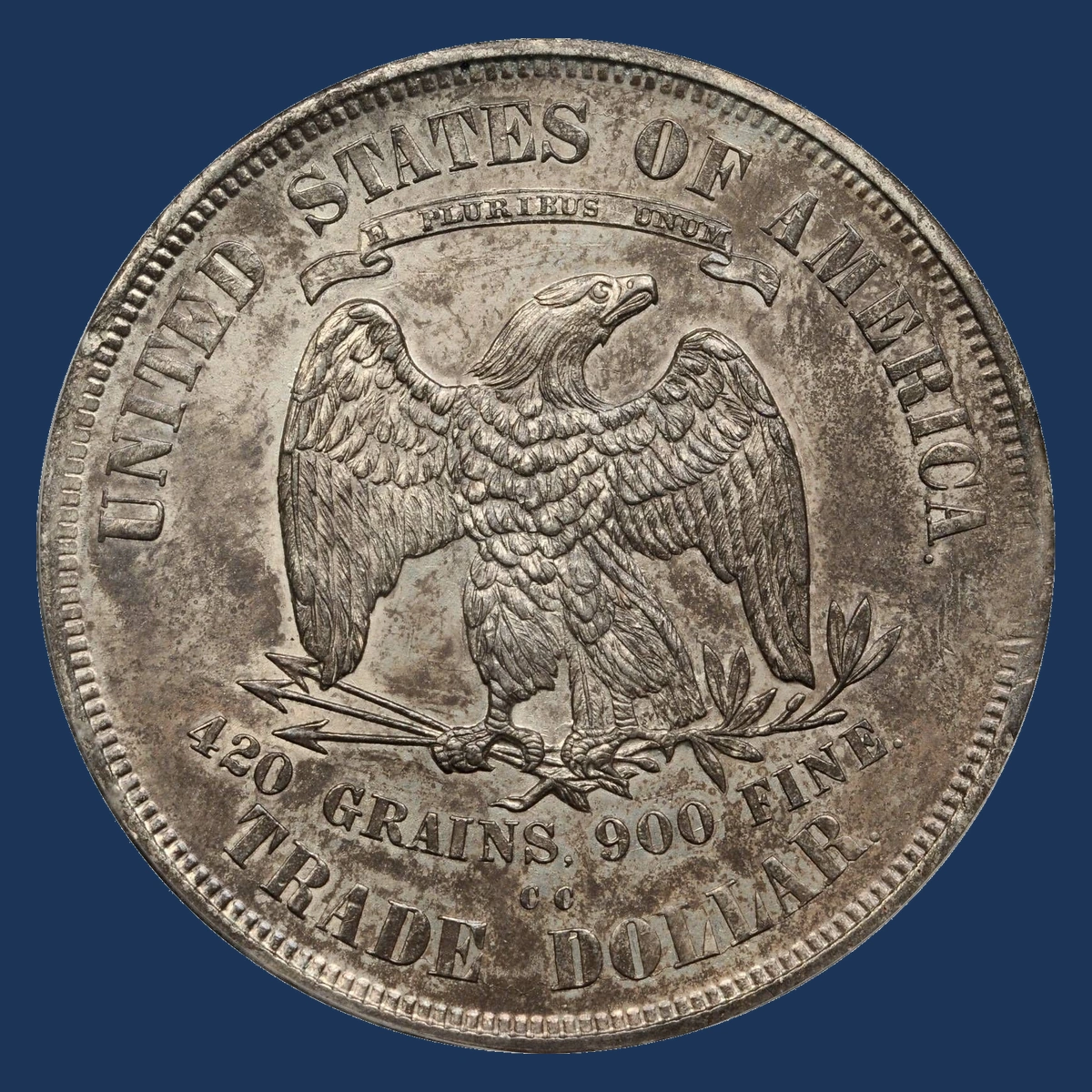
A raised line across the tops of MERI in AMERICA appears on one recorded Carson City example. Other coins have front rim breaks, where missing steel from the stamping tool allowed a raised lump to form.
A narrow tool crack makes a ridge as silver fills the gap. A larger missing piece can produce a broader area joined to the rim, often called a cud.
The patterns belong to different examples and should not be combined into one coin. A thin crack is not automatically a large rim cud.
Both features are raised, unlike ordinary scratches.
Estimated Value
For worn through attractive unworn CC examples, estimate $300–$20,000. A prominent original rim break can add interest, but the Carson City coin itself supplies much of the price.
A normal NGC MS64 sold for $9,600 on August 28, 2025. This is a same-year condition comparison, not a priced crack or cud specimen.
The exceptional $54,625 result lies above this working range. Small raised lines alone do not make an ordinary coin equally valuable.
How to Identify
First decide whether the feature is a narrow line or a broad raised area touching the rim. This determines whether you should compare a crack pattern or a rim-break example.
For the identified back crack, examine the tops of MERI in AMERICA under light from the side. A genuine ridge stands above the surrounding surface rather than forming a scratched channel.
For a front rim break, follow the raised area to its connection with the border. Inspect the edge for impact damage or signs of added metal.
Use a matching photograph from the Carson City variety study for the particular pattern. A raised feature in the same location and shape is more useful than a general resemblance to a lump.
4. 1874-CC Trade Dollar Struck Through Material
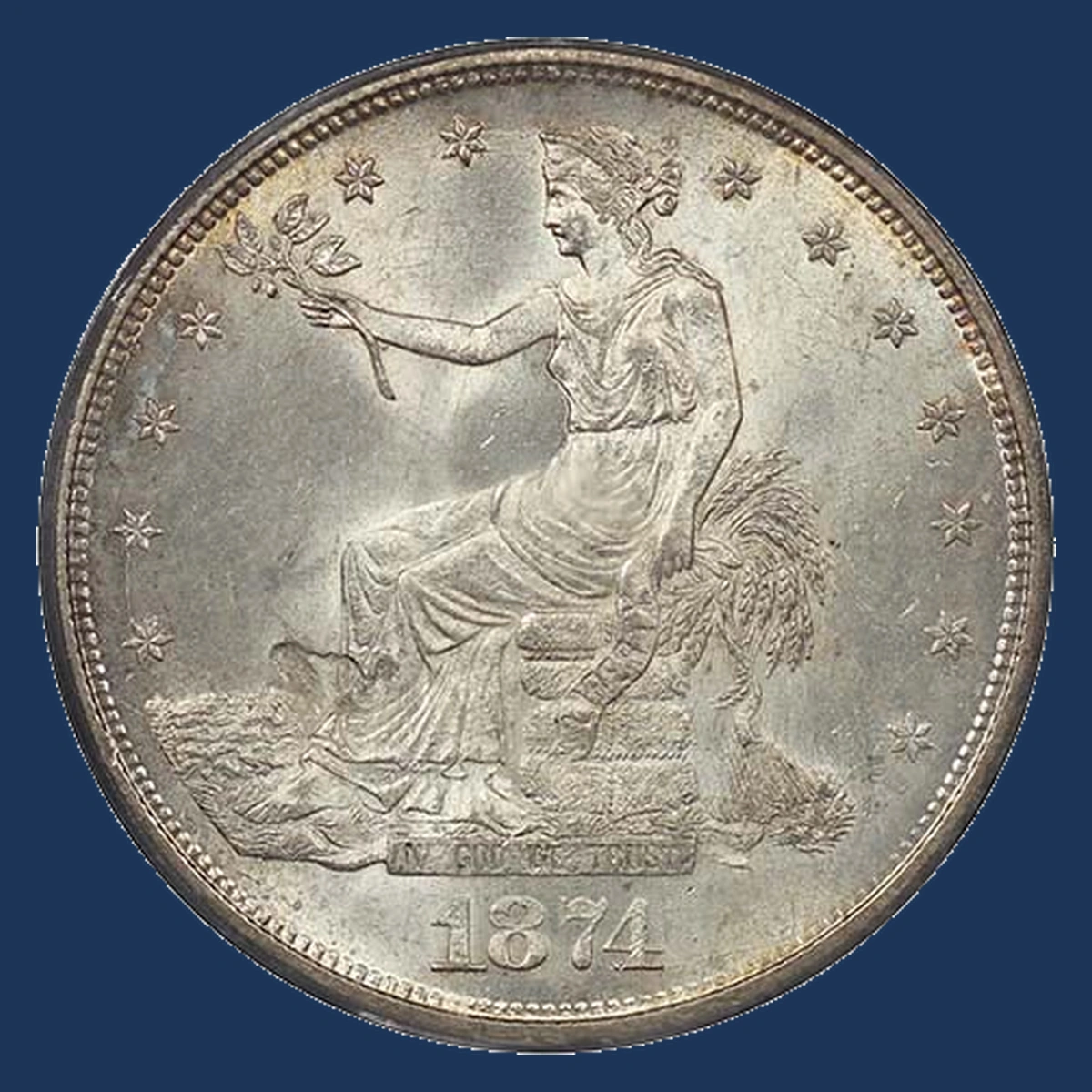
A small area on the front can show an impression left by material caught during striking. The object interrupted contact between the stamping tool and the coin, leaving an indentation or disturbed design.
An 1874-CC example graded PCGS MS64 is pictured in a Carson City error collection as a minor front strike-through. MS64 means an unworn coin with some marks.
The label does not identify the material. Its appearance should not be used to invent a story about grease, wire, or wood.
This original strike-through differs from a merchant’s stamp added after the coin entered circulation.
Estimated Value
Estimated whole-coin values of $500–$30,000 cover circulated examples through attractive unworn CC coins with a confirmed minor strike-through.
The photographed MS64 belongs to a collector’s display, not a stated public sale. For condition context, the separate normal MS64 sold for $9,600 in August 2025.
A small impression may add specialist interest while leaving overall condition as the main price driver. Larger surface damage or cleaning can reduce value even when an original strike-through is present.
How to Identify
Compare the suspected impression with the photographed 1874-CC strike-through, keeping the whole front visible. Do not assign its position from an unrelated Carson City coin.
Under angled light, study where normal detail meets the indentation. Material trapped during striking can block part of the intended design without producing the displaced metal of a later impact.
A merchant’s chopmark usually forms an added symbol pressed into the already finished surface. Corrosion can instead leave an irregular rough patch.
Look at the nearby surfaces for the same level of wear and signs of scraping.
The most useful comparison is the original impression’s outline and its meeting point with the struck design, not a guessed identity for the material.
Conclusion
The S coin’s slight rotation, doubled lettering, CC tool breaks, and front strike-through each have a different identifying feature. Keep the mint and the particular example in view throughout the comparison.
Working whole-coin estimates span $150–$30,000. Better preservation can matter more than a minor anomaly, so compare similar coins before adding an error premium or using an exceptional auction record as a price guide.