1869 Dollar Coin Error List with Pictures

One 1869 silver dollar can have several small features without becoming several separate errors to price. An unworn example with doubled designs and a repunched 1 sold for $37,820 in March 2026.
This 1869 Liberty Seated dollar error guide follows raised cracks, doubled details, and misplaced or repeated digits. Estimated whole-coin ranges run from $400–$50,000, including separately identified Proofs made for collectors.
See how the locations differ before choosing a matching example.
1. 1869 Liberty Seated Dollar Raised Crack across UNITED
A thin raised line between letters can come from a crack in the steel stamping tool, called a die. Silver entering the crack copies its shape onto the finished coin.
One 1869 dollar has this line between T and E near the top of UNITED. The same coin also has unusual date details.
A separate owner report describes another dollar with a back crack, without giving its precise route. It should not automatically receive the first coin’s T-to-E identification.
The distinction matters because scratches can occur anywhere. A matching raised route provides a stronger comparison than a generic cracked-coin label.
Estimated Value
Estimate $400–$30,000 for genuine examples across circulated through well-preserved unworn condition. This range describes the 1869 dollar, whose preservation can matter far more than a thin crack.
A small raised line may add little when the coin is heavily worn or cleaned. A scarce unworn example can be valuable even if its crack is hard to notice.
When the same dollar has misplaced digits, compare its combined appearance. Do not add another price merely because the back has a line.
How to Identify
Locate UNITED and keep T and E together in the close-up. Follow the thin line across the space between them, noting where it meets the normal lettering.
Change the light to determine whether the feature rises above the background. A cut with metal pushed along one side can resemble a bright raised line from a single angle.
Compare the route with the documented example rather than assuming all 1869 back cracks cross these letters. The separately reported owner’s coin needs its own photograph.
If you also examine date remnants, retain a full-front image beside this back view. That keeps the crack and date features tied to one physical coin without assuming every example carries both.
2. 1869 Liberty Seated Dollar Doubled Shield and Back Details
Repeated outlines can be built into a stamping tool before it touches a blank. Such a doubled die can copy the same details onto many coins.
An ordinary 1869 dollar shows doubling at the lower shield on the front and inside the motto ribbon on the back. Its date also has a repunched 1.
Other ordinary coins and Proofs, made with special preparation for collectors, have separately reported back doubling. Their exact patterns need their own comparisons.
The known shield-and-ribbon photographs should not stand in for every example. A whole coin struck twice would show a different repeated design.
Estimated Value
An NGC MS65 example with both doubled designs sold for $37,820 in March 2026 at Heritage. MS65 describes a well-preserved unworn coin.
Estimate $500–$50,000 for ordinary examples and $1,500–$40,000 for identified Proofs, depending on preservation. A reported cleaned, worn example brought $528 in June 2025, showing how condition changes the comparison.
The expensive dollar also has a repunched 1. Its sale prices the entire coin, not each small feature separately.
How to Identify
Begin at the lower shield when comparing the illustrated ordinary-strike variety. Follow repeated edges there before turning to the motto ribbon on the back.
Photograph the ribbon broadly enough to keep the doubled detail within its normal design context. One bright edge in a cropped image is less useful than several matching contours.
Inspect under another lighting angle to separate fixed raised outlines from shifting reflections. A low flat shelf left by movement during striking also needs comparison with the actual doubled-tool pattern.
For a Proof or another reported back variety, choose a specimen of that same kind first. Do not assume the shield or particular ribbon details belong to it simply because its date is 1869.
3. 1869 Liberty Seated Dollar Misplaced and Repunched Date Digits
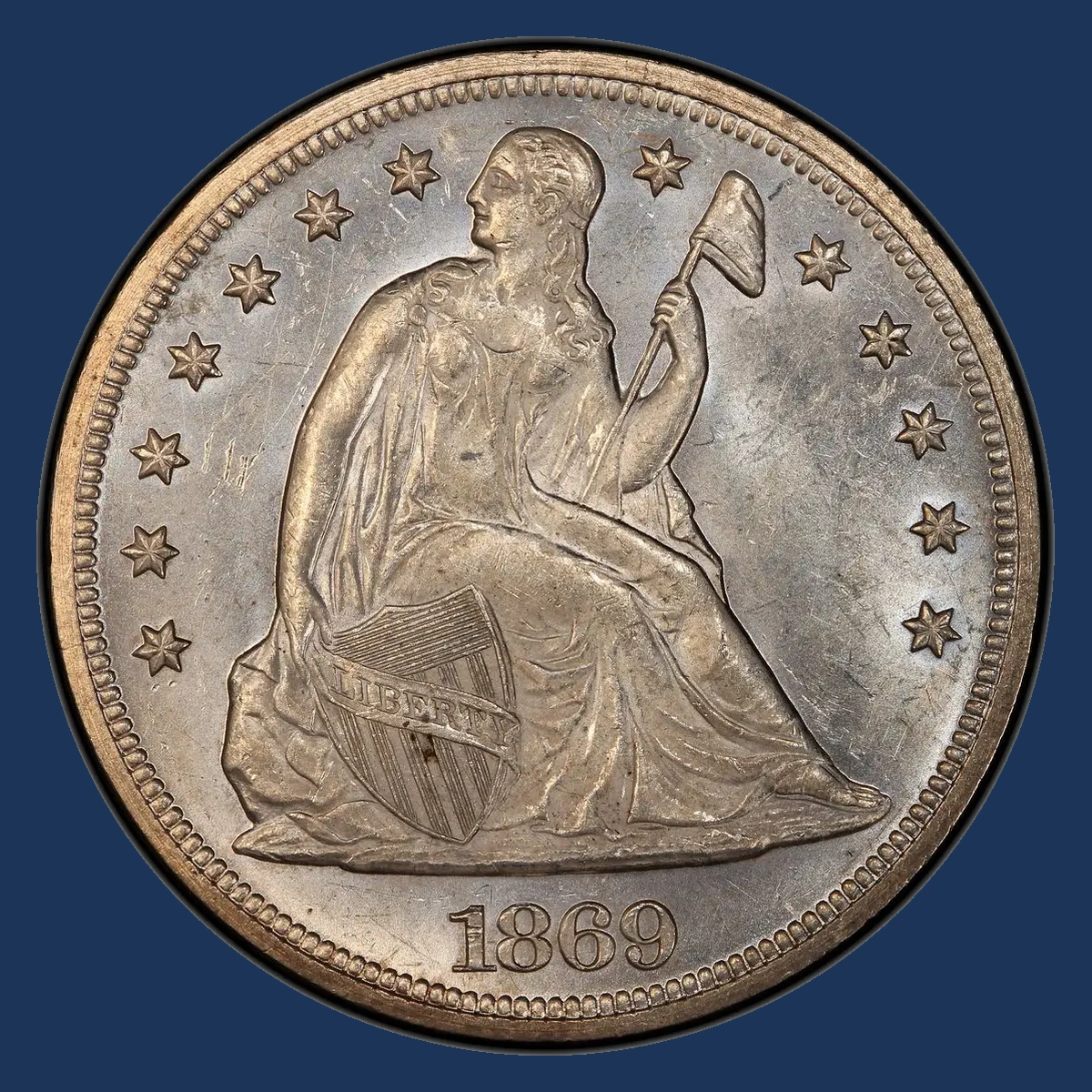
A stray digit can sit away from the date, while a repeated punch leaves extra strokes beside a normal numeral. Both begin when the date is put into the stamping tool.
One variety has part of 6 in the border teeth below the date. Another shows a loose foot of 1 between the normal 1 and 8.
Repunched examples have repeated detail at the top or base of 1. Some of these features accompany doubled designs or back cracks on the same dollar.
Proof catalogs also report date varieties, but their close-up details should not be borrowed from ordinary coins.
Estimated Value
A circulated example with the stray 1 between the date digits sold for $1,527.50 in July 2016. It was graded AU55, indicating slight wear and substantial surviving detail.
Estimate $500–$50,000 for identified ordinary examples and $1,500–$40,000 for corresponding Proof varieties. Preservation and the complete coin’s rarity explain much of the difference.
The repeated 1 on the $37,820 doubled-design dollar shares that whole-coin value. It is not a second sale or an extra amount to add.
How to Identify
Look below the date first if the candidate is described as having a misplaced 6. Keep the border teeth in focus and compare the extra curve with the normal 6 above.
A stray 1 calls for a different view: examine the open space between 1 and 8. Its small foot should be located there rather than beside an unrelated scratch lower down.
For repunching, inspect the top and base of the normal 1 itself. The position separates an adjacent repeated stroke from a detached numeral fragment.
Choose an ordinary-strike or Proof comparison that matches your coin’s manufacture. A catalog title alone cannot tell you which precise digit shape to expect on a Proof lacking a clear close-up.
Conclusion
For an 1869 dollar, inspect the lower shield, the motto ribbon, and the spaces around the date as separate locations. A faint raised crack tells a different story from a copied numeral.
Estimated whole-coin ranges span $400–$50,000. The $37,820 example combined several features with exceptional preservation, so its price should not be divided into individual premiums.
Keep ordinary strikes and specially prepared Proofs separate when comparing their details and prices.