1796 Dollar Coin Error List with Pictures

A thin peel near the rim and a deep line across the eagle tell very different stories. On 1796 Draped Bust Dollar errors, the first comes from the coin’s metal; the second can come from a broken stamping tool.
The year also includes a superb MS65 dollar that brought $1,175,000 at Heritage in April 2013. That was a condition rarity, not an error price.
The circulated examples discussed below have estimated whole-coin values of $3,500–$35,000. Read on to see where each feature appears.
1. 1796 Draped Bust Dollar Back Lamination
A small patch near the left edge of the back appears to peel away from the surrounding silver. This is a lamination, where a thin layer separates within the metal used to make the coin.
The documented 1796 BB-65 example has a short, shallow flaw at 9 o’clock. Most of its design remains clear.
Stack’s Bowers offered it in 2014 with an NGC EF45 label, indicating substantial detail despite circulation wear. Its Large Date and Small Letters identify the variety, rather than another error.
Estimated Value
For circulated examples with a modest lamination, estimate $3,500–$20,000 for the complete coin. The peel does not automatically increase its value.
A different BB-65 dollar, graded VG10 by PCGS, sold for $3,840 at Heritage in December 2022. That was a heavily worn variety comparison, not the 2014 laminated coin.
Stronger detail and attractive original surfaces support higher values. A large missing patch that spoils the eagle can instead reduce collector interest.
How to Identify
Inspect the left edge of the back without scraping or lifting anything. With a 10× magnifier, look for a thin layer boundary and a shallow patch beside the rim.
An impact often pushes metal into a ridge around a dent. Corrosion usually makes the surface rough or pitted, rather than leaving a clean layer edge.
Check the date and letter sizes against the BB-65 auction photographs. The specific 2014 coin has its flaw at 9 o’clock; a patch elsewhere would need a separate comparison.
Tilt the light to reveal the depth of the patch. Its thin, shallow boundary near the left rim is the useful starting check for this particular example.
2. 1796 Draped Bust Dollar Large Die Crack
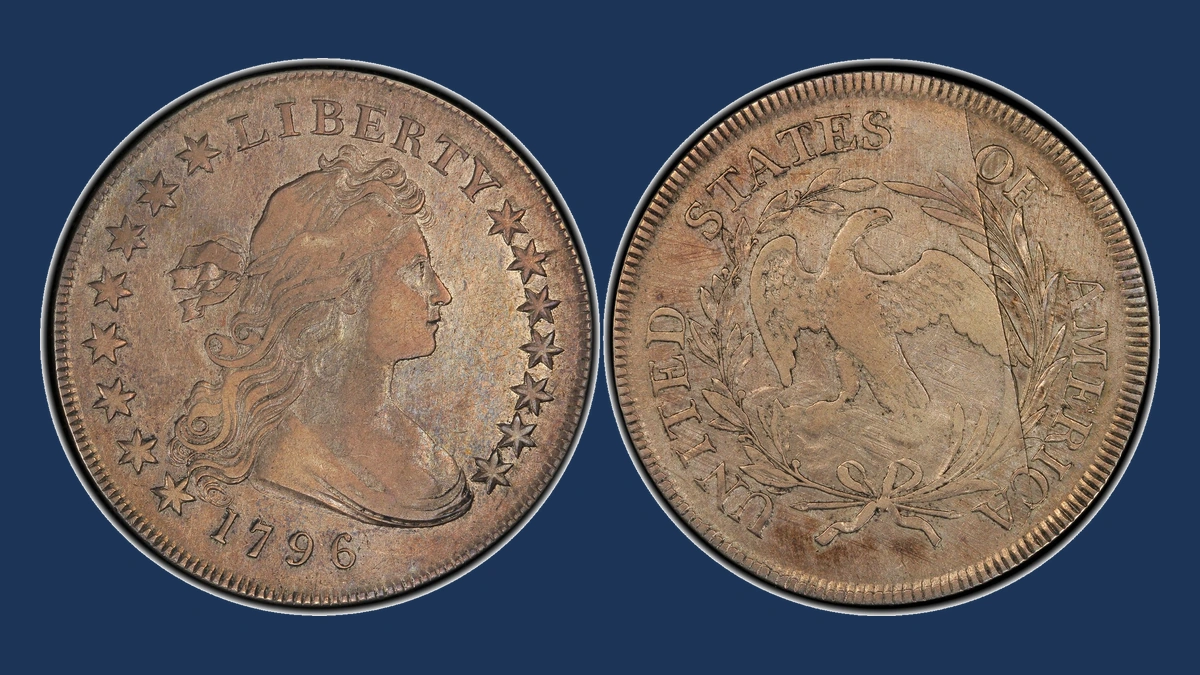
The design on the back can look much weaker on one side of a large raised line. On BB-64 dollars, this difference comes from a failed die, the steel tool that stamped the coin.
A major crack crosses the back from near 1 o’clock toward the lower edge. A smaller branch joins it from the wreath’s bow.
Metal entered the cracks during striking, leaving raised lines on the dollar. The damaged tool also failed to press some surrounding details fully.
That weakness belongs to the original strike. It should not be mistaken for uneven circulation wear.
Estimated Value
The BB-64 variety has an estimated whole-coin range of $8,000–$30,000, depending heavily on surface damage and remaining detail. Its scarcity matters alongside the striking failure.
PCGS records a BB-64 dollar labeled Genuine at $13,800 in a Heritage sale on October 5, 2025. Genuine confirms authenticity but does not provide a regular numerical condition grade here.
A cleaner example can attract more interest than one with scratches or repairs, even when both show the same dramatic crack.
How to Identify
Begin with the two sides of the crack, rather than grading the faint area in isolation. The left side can appear heavily worn while the right remains much sharper.
Follow the raised line from the upper border past the left side of O in OF. It continues through the wreath and wing tip, across C in AMERICA, then toward the lower rim.
The shorter branch runs from the bow through the foot of A and the bottom of C. Angled light helps separate these raised lines from sunken scratches.
Front scratches are a separate condition problem. They do not explain the back’s weak design.
Trace the connected main line and bow branch to distinguish this BB-64 break from an unrelated surface mark.
3. 1796 Draped Bust Dollar Uneven Centering
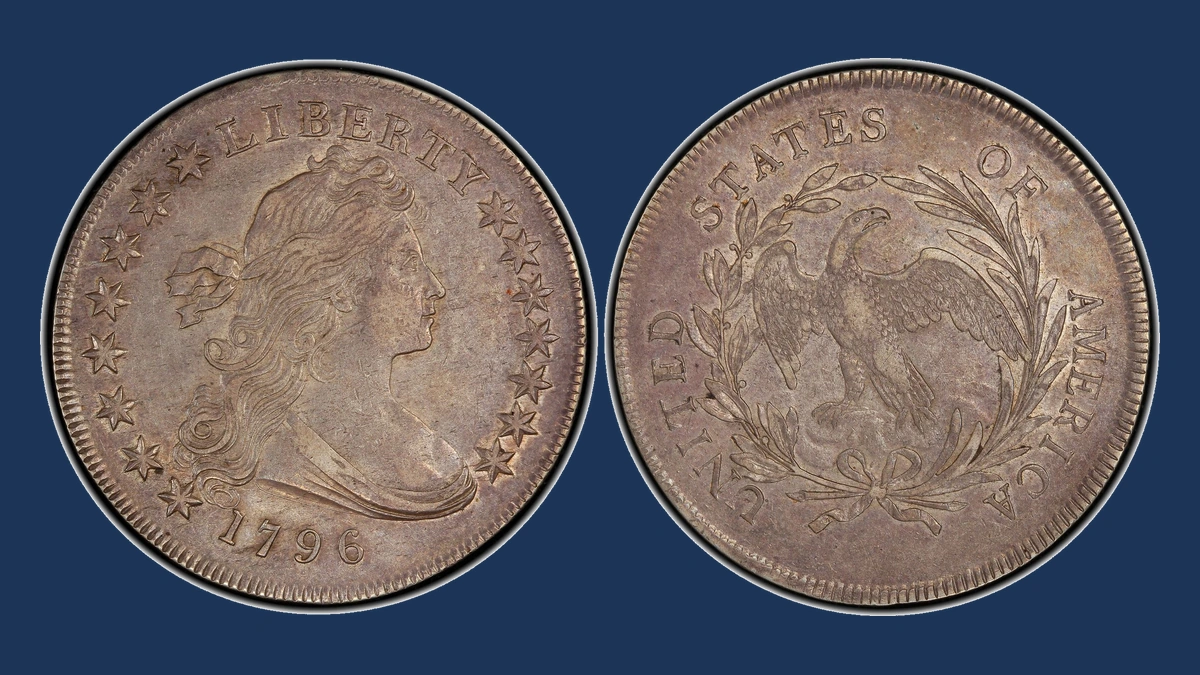
One face can have a narrow upper border and a wide lower border while the opposite face stays centered. Small shifts like this are described for the BB-63 variety.
The uneven placement can come from a misaligned die, meaning one stamping tool sits slightly out of position. The little tooth-shaped marks around the border then appear stronger at one end.
Historical descriptions also call individual examples slightly off-center. Comparing both faces helps separate a single shifted tool from movement of the metal disc, or blank, between the tools.
Estimated Value
Lightly off-center or unevenly centered circulated BB-63 dollars have an estimated whole-coin value of $4,000–$35,000. A slight border difference generally matters less than the coin’s condition.
For comparison, PCGS lists a BB-63 graded AU55, meaning light circulation wear, at $22,325 in an August 2013 Stack’s Bowers sale. That figure is for the variety, not a separately priced centering error.
A pleasing surface and clear eagle can outweigh a small shift in the border.
How to Identify
Photograph both faces straight on, with the complete edge visible. A tilted camera or a cropped photograph can make a centered design look displaced.
Compare the border teeth at the top and bottom of each face. A narrow upper border paired with a wider lower border shows where that design sits on the disc.
Now examine the opposite face. If it stays centered, the evidence points toward a single shifted tool rather than both designs moving together.
The BB-63 descriptions include several different coins, so do not apply one specimen’s direction to them all. The immediate test is whether the unequal border appears on one face or both.
Conclusion
These three features call for different checks: a thin layer near the edge, a raised branching crack, or uneven borders on one face. A faint eagle alone does not prove heavy wear.
Estimated whole-coin values run from $3,500–$35,000 for the circulated examples considered here. Preservation and the particular variety remain important, so have a specialist check the coin before treating every unusual mark as valuable.