2014 Dime Error List with Pictures

An extra edge on a tiny olive leaf can matter more than a generally blurry torch. That is one useful place to begin checking 2014 dime errors.
At the higher end, a year guide reports a $625 result in 2016 for a Denver dime missing a clad layer. That report is separate from the photographed Philadelphia example below.
The estimated ranges span $15–$800. Read on for checks that distinguish small design changes, misplaced strikes, and missing metal.
1. 2014 Roosevelt Dime Doubled Dies
A small extra outline appears along the right side of a central olive leaf on the back. The leaf is just above RIB in PLURIBUS, making it a specific place to inspect.
Wexler’s catalog describes this Philadelphia doubled-die feature. A die is the steel tool that stamps coins, and the repeated detail was already present in that tool.
A separate Denver doubled-die report does not identify the affected face. The Philadelphia leaf position should not be assigned to it, and ordinary torch-band detail is not a substitute for the leaf match.
Estimated Value
For genuine minor doubled varieties, estimate $20–$150. A sharply photographed extra leaf outline on an attractive dime is more useful than broad claims that the entire back looks doubled.
Condition matters because wear can soften this small feature. Strong remaining detail helps a buyer compare the coin with the identified Philadelphia example.
The Denver report needs its own design match before it receives a premium. The Philadelphia estimate does not establish a sale or matching variety for that coin.
How to Identify
Find PLURIBUS on the back and move upward from RIB to the central olive leaf. Use a 10× magnifier to inspect the leaf’s right-hand outline against the catalog photograph.
Check the mint letter near the front date before applying that comparison. The specific leaf description belongs to Philadelphia, not every 2014 dime.
For a loose ordinary clad coin, record about 2.268 grams and 17.91 mm as normal references for a scale and calipers. Inspect the edge grooves as part of the whole-coin check.
Flat shelves caused by movement during striking can imitate doubling. Judge the leaf’s actual extra shape rather than relying on thickness, equal height, or the normal appearance of the torch bands alone.
2. 2014 Roosevelt Dime Die Clash
A clash can leave faint parts of one face’s design on the other face. The two stamping tools hit each other when no blank was between them, transferring unwanted shapes.
Coins struck afterward can carry those fragments alongside the normal design. A 2014 Philadelphia clash is reported with an MS63 grade, meaning unworn with noticeable marks.
The exact outline of that specimen’s transferred design is not established by the report. The jaw and torch areas are useful places to examine, but a random line there does not automatically match the reported coin.
Estimated Value
An estimated $20–$200 covers modest through clearly recognizable clashes on ordinary 2014 dimes. Clear fragments that match the opposite design are more appealing than marks whose origin cannot be explained.
Good photographs and an undamaged surface help a collector make that connection. Wear or scratches can hide the transferred detail and reduce the whole coin’s value.
A claimed MS63 grade describes condition, not the size of the clash. It does not establish that every faint line deserves a premium.
How to Identify
Start with clear pictures of both normal designs and compare them with the unwanted marks. A clash should reproduce a recognizable fragment from the opposite tool rather than a random scratch pattern.
Use a 10× magnifier to follow the shape near the portrait or torch without assuming a fixed location from the year alone. The transferred fragment may be weak, so change the lighting instead of cleaning the surface.
For a loose ordinary clad dime, use a scale and calipers to check 2.268 grams and 17.91 mm, and inspect the grooved edge. Return to the design comparison: location alone, or a rule that every clash mark must have one surface height, cannot establish the cause.
3. 2014 Roosevelt Dime Struck Through Grease
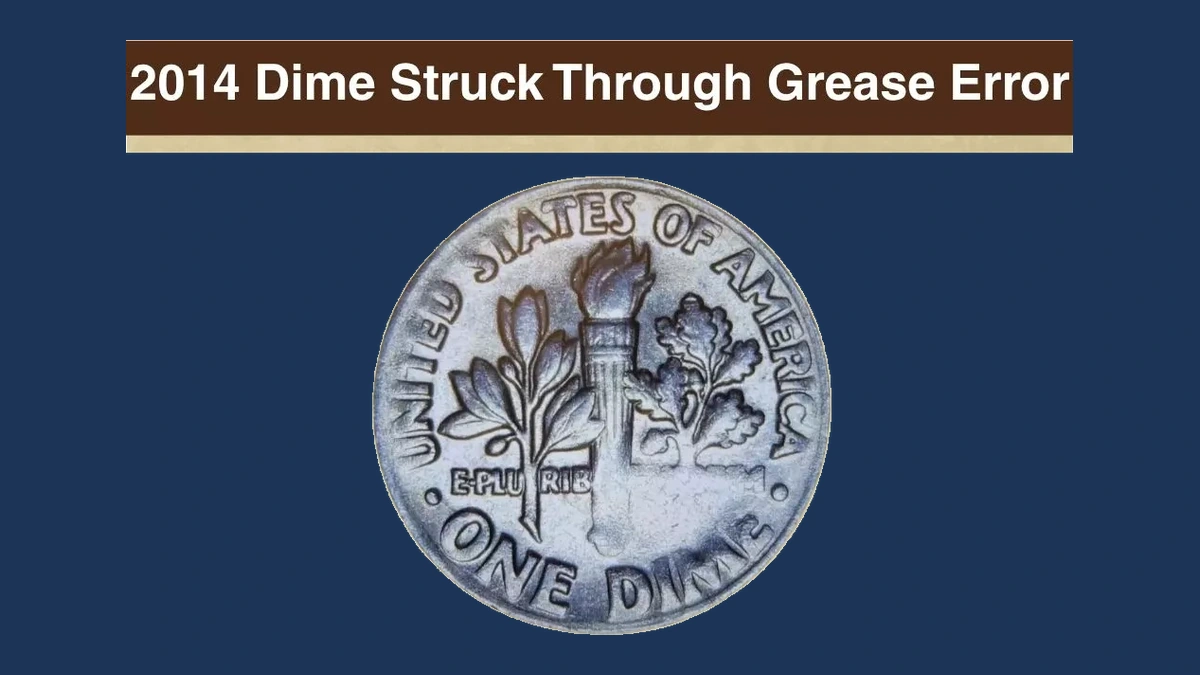
Part of the front can remain weak even while nearby details look sharp. Grease or similar material in the stamping tool can prevent that area from reaching the blank clearly.
A Philadelphia 2014 example is reported with a broad blocked area on the front and an MS60 grade. That grade describes an unworn coin with substantial marks or other appearance limits.
The affected area should be judged against the surrounding strike rather than described as ordinary circulation wear. Its weak outline does not establish a wire, cloth, or other specific solid object in the press.
Estimated Value
A faint small blocked area usually has less visual appeal than a broad clear interruption beside sharp detail. An estimated $20–$350 covers those differences on genuine ordinary-strike examples.
The coin should retain enough date and mint information to support the identification. Heavy marks or an unconvincing weak patch can keep the price near the low end.
MS60 alone does not make the error valuable. The affected area’s size, original surface, and contrast with nearby design guide the comparison.
How to Identify
Compare the weak patch with the strongest nearby details through a 10× magnifier. Grease blockage can affect a local area while leaving other features much clearer.
Check for wear on the high points outside that patch. Broad wear, sanding, or chemical attack can weaken the design without any obstruction during striking.
For a loose ordinary clad dime, compare scale and caliper readings with 2.268 grams and 17.91 mm. Inspect the edge grooves for related scraping or flattening.
Follow the transition into the weak area rather than trying to identify the grease itself. A gradual loss of detail with undisturbed surrounding metal is a better clue than a polished patch where the design has been rubbed away.
4. 2014 Roosevelt Dime Partial Collar Strike
The edge can show two levels rather than one evenly grooved band. A partial collar strike happens when only part of the blank sits inside the ring that normally controls the edge.
The portion inside the collar receives its normal restraint and grooves. The rest can spread outward, producing a shoulder or step between the two areas.
A 2014 Philadelphia example is reported with an MS64 grade, indicating an unworn coin with visible marks. Its exact step location is not specified, so an edge-on view is more useful than a front photograph alone.
Estimated Value
For genuine partial collar errors, estimate $40–$400 according to the clarity of the step and the coin’s preservation. A strong two-level edge is usually easier to appreciate than a slight unevenness.
A coin that merely rocks on a table does not earn the estimate. Bending or later rim damage can cause that behavior without a partial collar strike.
Compare the preserved groove pattern and the expanded portion together. Heavy edge damage can hide the original relationship and reduce buyer interest.
How to Identify
An edge-on photograph is the starting point, because the face alone may conceal the two-level band. Through a 10× magnifier, compare the grooved portion with the smoother expanded metal beside it.
For a loose dime, measure width in several directions with calipers against 17.91 mm and check mass against 2.268 grams with a scale. A partial collar moves metal outward without necessarily removing it.
Follow the step around the edge and compare its position with the nearby borders on both faces. Crushed grooves, a bent coin, or later rolling of the rim can create unevenness too, so wobbling on a table is not a sufficient test.
5. 2014 Roosevelt Dime Reported Die Misalignment or Rotation
An uneven border and an upside-down back are different problems. A tool shifted sideways can move one face’s design toward the edge, while a rotated tool changes its angle relative to the other face.
The 2014 Denver MS64 report uses alignment and rotation language together. It does not establish which movement occurred on the specific coin.
The distinction matters because the checks differ. Comparing the borders on both faces tests a sideways shift; keeping the coin on a fixed axis while flipping it tests the relationship between the designs’ directions.
Estimated Value
For an identified alignment error, allow an estimated $15–$450, from a slight one-face shift through a clearly demonstrated larger rotation. Those features should not be priced as if they were identical.
A small uneven border may add little to an otherwise ordinary dime. A conspicuous angle between the faces can be more interesting when photographs preserve their true relationship.
The reported MS64 grade describes an unworn coin with marks. It supplies neither an angle nor a rotation premium by itself.
How to Identify
Hold the front upright and flip the coin from top to bottom without twisting sideways. A normal back should finish upright; record a continuous view to show any angle difference.
Next, compare the border widths on the two faces. One shifted face with the other centered suggests a sideways tool problem, even if both designs remain upright.
Use a 10× magnifier on the edge grooves for crushing or a join. For a loose clad dime, a scale and calipers should be compared with 2.268 grams and 17.91 mm.
Keep the two observations separate when describing the coin. A border measurement cannot establish rotation, and two photographs individually turned upright cannot establish the angle between the faces.
6. 2014 Roosevelt Dime Off-Center Strike
An empty crescent can sit beside a design cut off at the opposite edge. The blank was not centered between the tools, so only part of the intended image reached it.
A 2014 Denver example is reported as roughly 25% off center and graded MS63. The grade describes an unworn coin with noticeable marks, while the percentage describes the reported size of the shift.
No fixed clock direction follows from those numbers. The surviving date, mint letter, and relationship between both faces are the useful details when comparing another coin with this report.
Estimated Value
An estimated $30–$500 covers genuine dated examples from modest through more obvious shifts. Clear remaining identification and attractive surfaces help the higher end.
For another-year comparison, a 1977 dime struck ten percent off center sold for $109 in June 2026. It was graded NGC MS64 Full Bands, meaning unworn with marks and clear separation in the torch bands.
That smaller shift does not directly price the reported Denver coin. Lost date detail or later damage can reduce either example’s appeal.
How to Identify
Check the year and Denver D while keeping the blank crescent in the same photograph. A close-up of the empty area alone cannot establish which coin you have.
Under a 10× magnifier, follow where the design ends on both faces. They should agree with the same blank lying out of position.
For a loose clad dime, use a scale against 2.268 grams and calipers against the normal 17.91-mm size. The strike can change the outline without removing metal.
Inspect the surviving edge grooves and the untouched area for filing or flattening. The reported 25% figure is a comparison, so judge another coin by its own missing design rather than forcing it into that percentage.
7. 2014 Roosevelt Dime Broadstrike
A broadstrike has a wider outline because the surrounding collar did not contain the blank normally. Metal spreads outward during the blow instead of staying within the intended diameter.
The complete main design remains on the coin, although the margin can become uneven. This differs from an off-center strike, which leaves part of the design beyond the available metal.
Denver broadstrikes appear in 2014 year lists, and a Philadelphia seller title also uses the name. That seller’s mixed off-center wording needs the coin’s full shape checked before deciding which description fits.
Estimated Value
A 2000-P dime combining broad spreading with multiple strikes sold for $159 in September 2025. That earlier combination gives a useful comparison, but includes more than a simple broadstrike.
For genuine 2014 examples, estimate $50–$550 based on condition and the amount of visible expansion. Clear complete design on naturally spread metal supports stronger interest.
An ordinary-size coin with a smooth edge does not automatically qualify. Later grinding or flattening can remove grooves without producing a genuine broadstrike.
How to Identify
Measure a loose coin in several directions with calipers and compare it with 17.91 mm. Check its weight on a scale against 2.268 grams, since spreading need not remove metal.
Trace the outer lettering on both faces with a 10× magnifier. A complete design within an expanded outline fits a broadstrike better than a cut-off design opposite bare blank surface.
The edge may lack normal grooves where the collar failed to engage. Compare that area with the rest of the expanded border.
Look for crushed letters or a hammered surface before accepting the shape. If a seller calls the coin both broadstruck and off center, the actual completeness of the design should guide your first classification.
8. 2014 Roosevelt Dime Rim Cud
A raised mound can join the rim and replace part of Roosevelt’s design or the back’s detail. It forms when a piece breaks away from the edge of a stamping tool.
Collectors call this a cud. Metal enters the missing-tool area, so the coin gains a smooth raised patch rather than the intended design there.
The 2014 reports describe an MS65 example but disagree about its mint. They do not establish two separate coins, and the raised patch must be examined without assigning an unsupported side, clock position, or crack path.
Estimated Value
A genuine rim-connected break can be estimated at $50–$600, depending on its size and the coin’s condition. A larger obvious patch is generally more appealing than a tiny borderline feature.
MS65 describes an unworn coin with relatively few marks, but that grade does not identify the patch’s cause. A dent with pushed-up metal still needs to be treated as damage.
Compare the raised area and remaining design. The conflicting mint reports should not create separate Denver and Philadelphia premiums.
How to Identify
Compare the raised patch with the same area on the opposite face. A genuine rim break can leave weaker detail opposite it, although that weakness alone does not prove the cause.
Under a 10× magnifier, trace the patch into the rim and inspect its boundary. Folded metal from an impact can imitate a mound but may retain damaged grooves or pushed-over surface detail.
For a loose clad dime, compare scale and caliper readings with 2.268 grams and 17.91 mm, then inspect the edge grooves. Look for a join or material added to the original coin.
Read the mint letter directly from the coin or its original photograph. The inconsistent year-list description cannot establish a separate example from each mint.
9. 2014 Roosevelt Dime Retained Lamination
A thin flap can lift from a coin’s surface while remaining attached along one side. Collectors call this retained lamination: a separation in the original metal with the loose portion still present.
A Philadelphia 2014 example is reported with an MS60 grade, an unworn grade with substantial marks or appearance limits. The report does not give the flap’s exact location.
That attached metal is the important feature. It differs from a complete missing clad layer and should not be described as a whole copper-colored face merely because both involve separation within the blank.
Estimated Value
For genuine attached flaps, estimate $50–$650 according to size, condition, and how clearly the separation can be seen. A larger intact flap can be more interesting than a small rough patch.
Keeping the lifted metal attached preserves evidence of the original flaw. Pulling it away can damage the coin and change what a buyer is evaluating.
The range covers the coin with its retained piece. It is not a separate price for the dime and another for the flap.
How to Identify
Leave the flap untouched and photograph it from a low angle.
Use a 10× magnifier to find where the thin layer lifts and where it still joins the coin. Rough texture beneath that opening can support a separation within the original metal.
A scrape may leave a ridge of pushed-up metal at its end instead. Check the boundary before treating every raised sliver as a retained layer.
For a loose clad dime, compare weight with 2.268 grams using a scale; attached metal can keep the reading near normal. Use calipers against 17.91 mm without touching the fragile flap.
Inspect the edge grooves for related damage. The attachment point should be shown clearly in photographs, rather than forced upward to make the flaw more obvious.
10. 2014 Roosevelt Dime Missing Clad Layer
An ordinary clad dime has a copper core between copper-nickel outer layers. Losing one outer layer can expose a copper-colored face and lower the coin’s weight.
A photographed Philadelphia example has its front layer missing and an NGC MS65 grade. That means an unworn coin with relatively few marks.
A separate Denver MS65 report does not specify the affected face. The two examples must remain distinct, and neither description should be extended to a 2014-S silver Proof, a specially prepared collector coin made from silver alloy.
Estimated Value
The year guide reports a $625 result in 2016 for the Denver coin. The photographed Philadelphia piece sold in January 2023, but its public auction page does not display the price.
For comparable genuine missing-layer dimes, estimate $100–$800 according to the extent of loss and condition. These are separate specimens and separate price records.
A large clear exposed face is more compelling than color alone. Staining or chemical stripping does not receive the same original-error premium.
How to Identify
Establish the metal before using a weight comparison. An ordinary clad dime should be about 2.268 grams, while a normal 2014 silver Proof is 2.50 grams.
For a loose clad candidate, use a scale to test whether the supposed layer loss makes it lighter. Calipers should be compared with the normal 17.91-mm diameter.
Inspect the exposed face and edge through a 10× magnifier, following the copper core and the boundary of the remaining outer layer. The edge normally has grooves.
Pitting, a coating, or chemical attack can explain a copper-colored surface without an original missing layer. Match the Philadelphia front-loss coin only to that specific feature; the Denver report does not establish which face lost its layer.
Conclusion
An extra leaf outline, a stepped edge, and a copper-colored face each call for a different check. The estimated $15–$800 range reflects those differences as well as condition.
Keep the Philadelphia and Denver reports separate when matching photographs. A missing outer layer should affect more than color, while a rotated design needs a fixed flip test; neither can be established by an unusual-looking front photograph alone.