2007 Dime Error List with Pictures

A piece of mint machinery can carry a dime design without ever having been a normal coin. A 2007-D aluminum feeder-finger fragment received three strikes, and its published auction result was $2,990.
Other 2007 dime errors are much easier to overlook, including a small extra leaf outline and a stepped edge. Estimated values across the types below run from $15 to $4,000.
Read on to compare these visible clues, their causes, and the prices attached to different examples.
1. 2007 Roosevelt Dime Doubled Dies
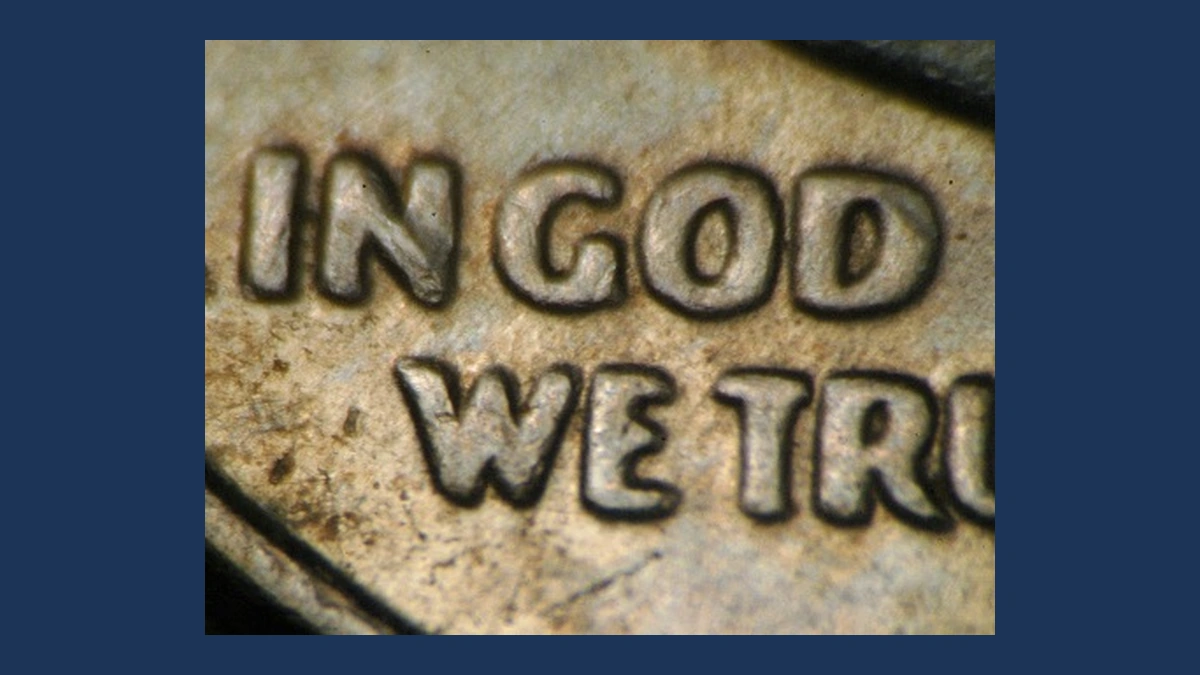
The extra detail on one Philadelphia dime is quite small: it sits beside an olive leaf. On another reported example, the front lettering looks unusually thick.
These features are described as doubled dies. A die is the steel tool that stamps coins, and doubling already present in that tool can repeat on many pieces.
Wexler’s 2007-P descriptions identify both appearances. The front report also notes that further examination would be useful, so thick letters alone do not establish a match.
Estimated Value
Estimate $20–$150 for a genuine minor doubled-die example. The upper end suits a clear match with sharp detail and little wear.
A vague thick letter is much less useful to a buyer than an identifiable extra leaf outline. Close photographs can therefore make a large difference when selling.
These are estimates for the varieties described here. They do not turn every thick-looking 2007 date into a valuable doubled die.
How to Identify
On the back, find RIB in PLURIBUS and look just above it. The reported extra detail follows the right side of the central olive leaf, not the torch bands.
Check the P beside the date before using the Philadelphia comparison. For a loose clad dime, a scale and calipers should give about 2.268 grams and 17.91 mm; inspect the edge grooves too.
For the front example, compare IN GOD WE TRUST, the initials JS, the date, and P with a normal dime. Use a 10× magnifier and steady light; glare can make ordinary lettering seem wider.
A flat ledge beside a letter can come from movement during striking rather than a doubled tool. Compare the actual shapes with the catalog photographs before paying a premium.
2. 2007 Roosevelt Dime Lamination and Layer Separation
A thin flap can lift from a dime when its metal separates. Collectors often call a separation within the metal a lamination error.
A modern dime also has outer layers bonded to a copper center. Failure along that bond is different from a crack within one metal layer, although both can leave peeling surfaces.
A 2007 lamination report does not identify a particular mint or side. Treat a possible example by its actual torn surface and attached metal, rather than expecting every coin to have a flap in one location.
Estimated Value
A modest genuine separation has an estimated value of $15–$200. A small patch on a worn coin belongs near the lower end.
A large, clearly visible flap can attract more interest when it remains attached and the design is readable. Heavy corrosion or scratches reduce that appeal.
The estimate covers mint-made metal separation. Artificial peeling does not receive the same premium, even when a damaged coin has lost a large piece.
How to Identify
Leave an attached flap alone. Lifting it can break the metal and remove useful clues about how it separated.
Under a 10× magnifier, follow the flap into the surrounding surface. Look for a natural split and rough exposed metal, then check whether the design continues onto the loose piece.
For a loose ordinary dime, use a scale against the normal 2.268 grams. Calipers can compare its width with 17.91 mm, while an edge view reveals the outer layers and copper center.
A normal-width dime can still have a missing patch, and a retained flap may leave the weight nearly unchanged. Scraped channels, tool marks, or corrosion around the opening point toward later damage rather than a clean mint-made separation.
3. 2007 Roosevelt Dime Partial Collar Strike
Turn a possible partial-collar dime sideways. Its most useful clue is a step around the edge, not simply a wide rim on one face.
The collar is the metal ring that controls a coin’s width during striking. If the blank sits only partly inside that ring, one edge band stays confined while the other expands.
A 2007-P example is reported with a grade of MS65, meaning unworn with some marks. Its reported error calls for an edge inspection; an uneven front border by itself describes something less specific.
Estimated Value
An estimated $40–$250 covers genuine partial-collar examples with a visible edge step. A slight step on a marked coin sits toward the lower end.
A clear band of grooves beside a strongly expanded band makes the error easier to show. Attractive unworn surfaces can also help the price.
The reported MS65 grade describes condition, not the size of the step. A buyer still needs an edge photograph to judge the strength of this error.
How to Identify
For a loose clad example, weigh it near the normal 2.268 grams and measure its width with calipers. Compare several points with the usual 17.91 mm diameter rather than measuring one narrow section.
Now turn to the edge. Support the coin without pressing or bending it and examine both edge levels with a 10× magnifier.
A confined grooved band should sit beside a less confined, expanded band. A single flattened patch instead calls for a check for impact damage.
Compare both faces with that edge view. A displaced design without the step suggests a different striking problem.
Inspect any suspicious smooth band for repeated filing or rolling marks before calling it a partial-collar strike.
4. 2007 Roosevelt Dime Clipped Planchet
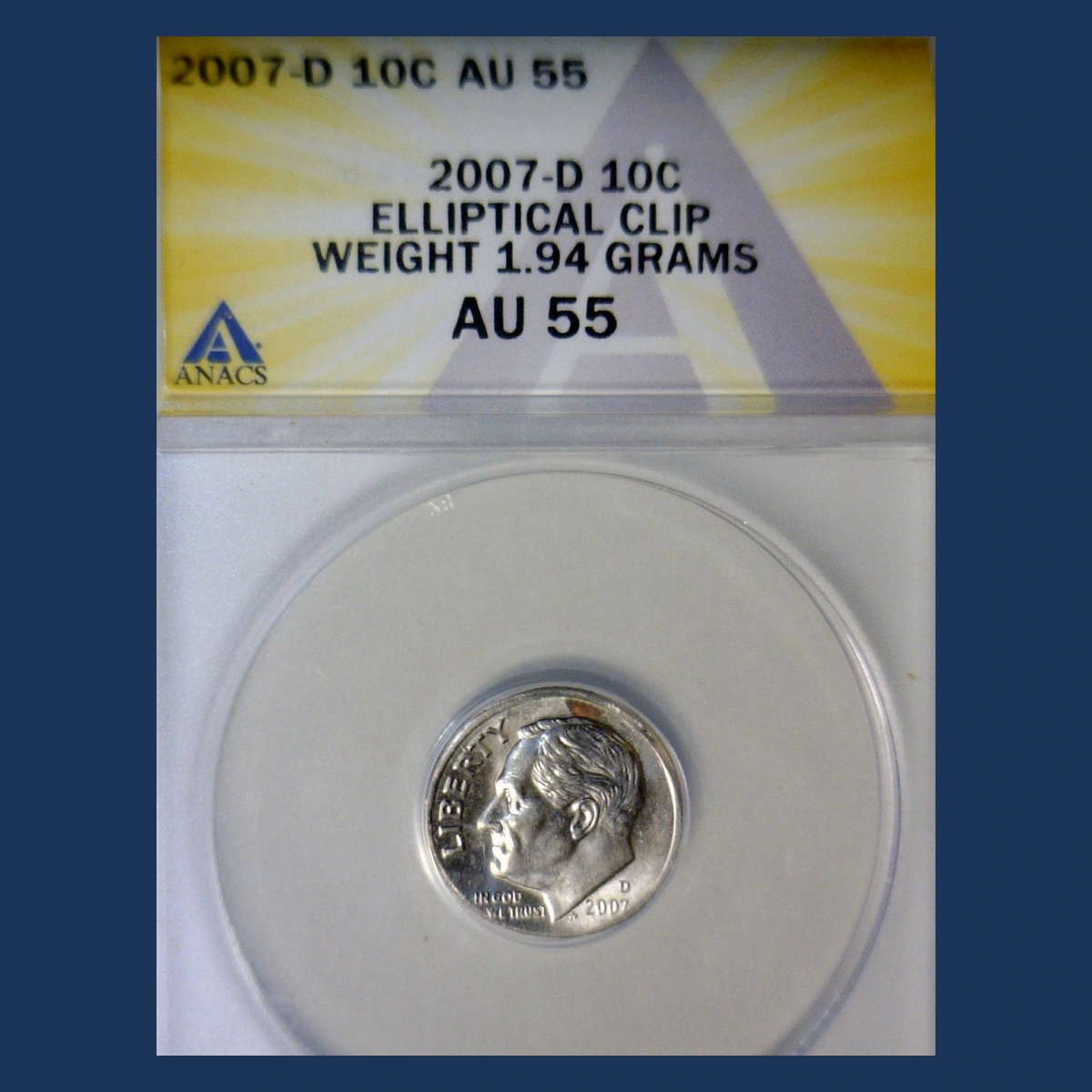
A blank is the metal disk prepared before striking. If it is cut from an incomplete area of the metal strip, the resulting coin can have a missing section.
The 2007 reports include a Philadelphia curved clip and a more unusual Denver shape. Error-Ref illustrates the Denver elliptical blank with a curved clip.
The curved gap interrupts the right side of that oval outline. It is a different appearance from a cup-shaped coin that splits after repeated strikes, even though both may seem to have a bite missing.
Estimated Value
Allow an estimated $20–$300 for genuine clipped examples. A small curved gap usually falls below a striking oval blank with a second curved missing area.
The size of the shortage, remaining date, and overall condition all affect the price. A clear whole-coin photograph helps show how the outline differs from a normal dime.
The Denver combination is one coin with two linked shape features. Its price should not be calculated by adding separate clip values.
How to Identify
Compare the complete outline before studying the gap. The Denver example combines an oval shape with a curved missing section on the right; the Philadelphia report does not establish that same shape.
Inspect the cut surface with a 10× magnifier. Filing scratches, a sharp fresh cut, or squeezed metal can expose a coin trimmed after it left the mint.
For a loose clad dime, use 2.268 grams as the normal weight and 17.91 mm as the normal diameter. Record both axes with calipers if the coin is oval.
Check the surviving edge grooves and the design beside the missing area. Metal flow toward a genuine shortage may soften nearby details, whereas a later cut simply removes already struck parts.
5. 2007 Roosevelt Dime Broadstrike
A broadstruck dime can look too wide while still retaining its design. The metal has spread because the restraining ring did not hold the blank during the strike.
This is called a broadstrike, and it differs from an off-center strike that leaves some design beyond the blank. The overall shape may be uneven without making the two errors interchangeable.
GreatCollections lists a 2007-P broadstrike graded NGC MS66 FT. MS66 describes an unworn coin with relatively few marks; FT describes strong torch detail, not a separate mint error.
Estimated Value
Estimate $40–$350 for a clear broadstrike, depending on expansion and condition. A modest spread is less dramatic than a wide border around a complete design.
For comparison, a different 2000-P dime with multiple strikes and a broadstrike sold for $159 in September 2025. That compound error is not the listed 2007-P coin.
The 2007 listing identifies a certified example but supplies no usable realized price here. Its grade alone does not set a sale value.
How to Identify
Use calipers on a loose coin to compare its widest dimension with 17.91 mm. A scale checks whether its weight remains near the standard clad 2.268 grams.
Lay a normal dime beside it and align their designs. Extra width should belong to metal spread around the design, not simply to different photograph sizes.
Follow the lettering around both faces with a 10× magnifier, then inspect the edge. A complete design with an expanded border supports broadstriking, while a missing part beside a blank arc points to off-center striking.
Look closely at disturbed edge grooves for signs of later flattening. If two distinct edge levels survive, photograph them sideways and compare partial-collar errors before deciding which explanation fits.
6. 2007 Roosevelt Dime Struck Through Cloth or Other Material
A piece of material between the tool and a coin can leave its shape pressed into the surface. This is a struck-through error.
A 2007-D cloth impression is reported in a year guide. A different auction description mentions a possible wire-like line inside the deep cap attributed to 2007-D.
The cloth report and the line on the cap are separate examples. A woven texture can support a cloth identification, but a narrow line alone cannot prove that the object was wire rather than another thin material.
Estimated Value
Genuine standalone impressions have an estimated range of $30–$500. A shallow, indistinct depression belongs below a large impression with a clear woven texture.
Collectors pay for recognizable detail as well as condition. A readable date and a clean surrounding surface make the error easier to display.
The deep cap’s $460 auction result covers that entire unusual coin. It is not a separate price for the possible line impression and should not be added to another cap value.
How to Identify
Change the light angle while watching the suspect area through a 10× magnifier. Cloth can leave a repeating weave rather than the single smooth groove expected from a narrow object.
Compare the impression with nearby letters and devices. A genuine obstruction can interrupt the design where it was trapped, while a later scratch often cuts across finished detail.
For a loose normal-shaped clad dime, a scale and calipers provide checks against 2.268 grams and 17.91 mm. Inspect the edge grooves for signs of broader damage.
The line on the deep cap requires a different comparison: inspect the protected inner surface and its auction images. Do not scratch, clean, or probe the mark to decide what made it; its material remains only a suggestion in that description.
7. 2007 Roosevelt Dime Off-Center Strike
An off-center strike leaves part of a coin blank while cutting off part of the design. The blank was not properly centered between the two stamping tools.
A 2007-P example is reported as MS66, an unworn grade with relatively few marks. The report does not establish a particular direction or percentage of displacement.
The visible relationship matters more than an attractive grade number. A wide margin on the front alone can come from a shifted tool, whereas a true off-center strike requires the blank and both designs to fit the same displacement.
Estimated Value
For genuine examples with a readable date, estimate $40–$600. Larger displacements usually draw more interest than small shifts, provided enough design remains to identify the coin.
A different 1977 dime struck about 10% off center sold for $109 in June 2026. It offers a modest-error comparison rather than a price for the reported 2007-P piece.
Clean surfaces and a strong blank arc help a buyer judge the error. Heavy damage can outweigh an impressive percentage.
How to Identify
Start with photographs of both faces taken straight on. The missing design and blank arc should belong to the same displaced strike.
If the front is shifted but the back is centered, consider a misaligned tool instead. A wide, complete design without a missing portion calls for a broadstrike comparison.
A 10× magnifier helps check the boundary between struck and unstruck metal. Look for a natural transition rather than ground-down details or an artificial smooth patch.
For a loose ordinary clad dime, record its weight against 2.268 grams. Use calipers to compare the original round blank with the normal 17.91 mm diameter, and inspect the edge grooves where they survive.
Keep the date and P visible in the same whole-coin photographs used to show the displacement.
8. 2007 Roosevelt Dime Cracked and Broken Dies
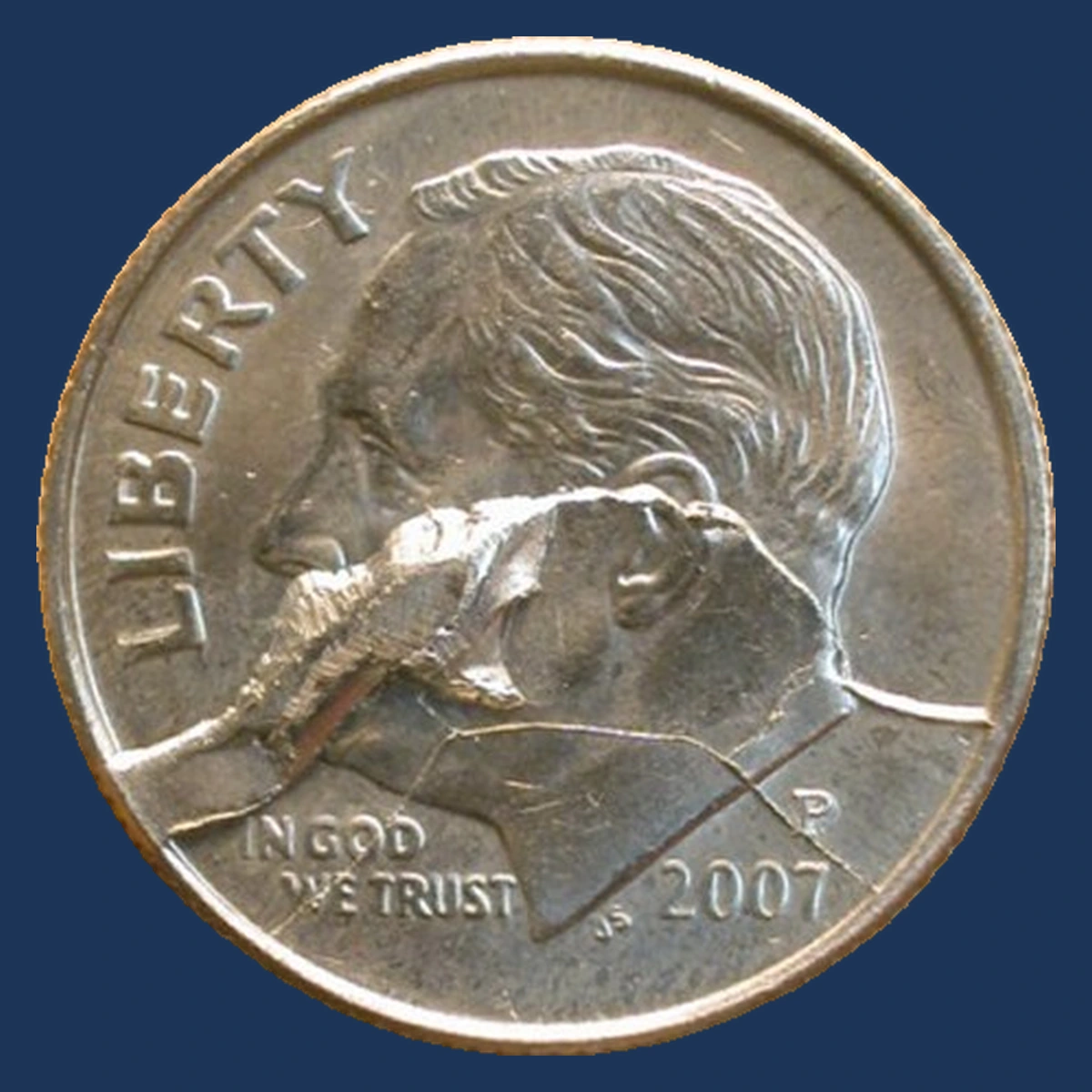
A cracked stamping tool can leave raised lines on a dime. When a piece breaks away, metal can fill the opening and form a raised lump.
Some 2007 examples show a retained break: the damaged piece of tool stayed in place but shifted. Parts of the design can remain visible across the affected area.
Historical listings describe Philadelphia shattered tools and retained breaks. A separate Denver report places a large interior break around the mouth and cheek; an interior lump does not have to connect to the rim like a cud.
Estimated Value
Estimate $20–$750 across small cracks and dramatic retained-break examples. Strong differences in the damaged area explain the wide spread.
Historical Philadelphia asking prices included $225 for a back break and $250–$275 for heavily shattered fronts. A two-coin set was offered at $750.
Those figures were dealer asking prices, not auction results. The $750 covered both coins together, and it should not be assigned to either coin individually or transferred to the separate Denver report.
How to Identify
Find the mint letter first. Philadelphia descriptions and the Denver mouth-and-cheek report should not be treated as photographs of the same coin.
With a 10× magnifier, trace the raised lines into any larger raised area. A retained break may preserve part of the portrait or lettering at a changed height.
Tilt the coin to compare those levels. A scratch cuts down into the surface, while attached dirt may have an unrelated texture or a distinct boundary.
For a loose clad dime, check approximately 2.268 grams and 17.91 mm using a scale and calipers. The edge grooves help complete that inspection, but ordinary measurements do not rule out damaged tools.
At the mouth and cheek, judge the raised metal and surviving portrait together rather than identifying the error from a nickname.
9. 2007 Roosevelt Dime Die Caps and a Mated Brockage Pair
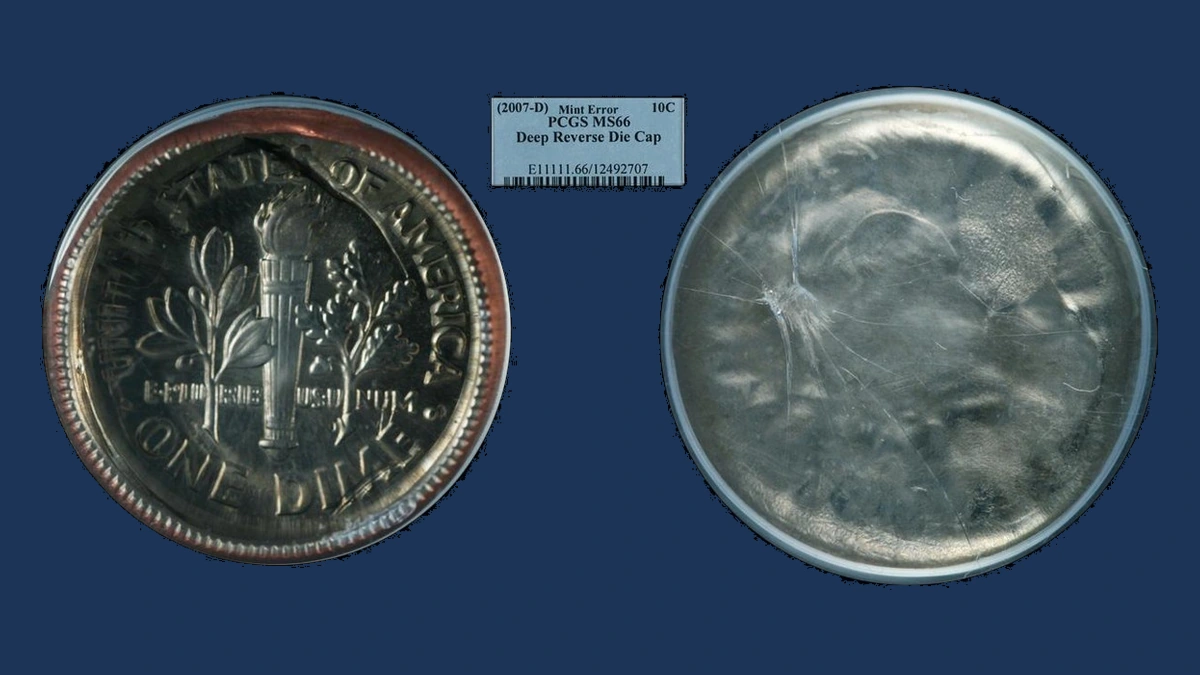
A dime that sticks to a stamping tool can grow into a cup-shaped cap after further blows. Reports include ordinary Denver front caps and a satin example with a split sidewall.
A deep back cap has an unreadable date and is attributed as (2007-D). A separate 2007-D satin pair shows how another trapped coin can make a sunken mirror image, called a brockage.
In that pair, one coin impressed its back into the other coin’s front. The second coin also developed a cap rim; the first acquired distorted borders during their encounter.
Estimated Value
Estimate $250–$1,500 for cap examples or an intact matched pair, depending on their shape and condition. Satin pieces have the special surface used for Mint Set coins.
The attributed deep back cap sold for $460 on May 1, 2009. The 2007-D satin pair brought $1,116.25 on November 1, 2016.
The latter price covers both coins. It is not a separate payment for each mirror image, cap rim, or distorted border.
How to Identify
For the satin pair, compare the first coin’s back with the second coin’s front. The second image should be sunken and reversed like mirror writing, rather than another normal raised back.
Inspect the steep rim around the second coin and the altered borders on the first. A 10× magnifier helps follow design details as they stretch toward a cap’s sidewall.
A split in a cap wall differs from a curved shortage in the original blank. Do not flatten a cap to measure it.
For a loose clad piece, record weight and dimensions with a scale and calipers against the normal 2.268 grams and 17.91 mm. Expansion alone does not mean lost weight; examine surviving edge grooves too.
The deep back cap’s date cannot be read, so its auction attribution remains in parentheses.
10. 2007 Roosevelt Dime Struck on a Cent Blank
A copper-colored dime needs more than a color check. A year guide reports a 2007 dime struck on a cent blank, meaning the wrong unstruck metal disk entered the dime press.
A modern cent blank is copper-plated zinc and is larger than a normal dime blank. Its different metal and size provide useful tests for this reported error.
This is not the reverse event of a cent design struck over a dime. The final design must be the Roosevelt dime design, and color alone cannot establish which blank was used.
Estimated Value
Use an estimated $300–$2,500 for an authenticated dime struck on a modern cent blank. A clear date, strong design, and convincing identification of the metal support the upper part of that range.
The 2007 year report does not supply a verified sale for this particular piece. The range is a guide for a correctly identified wrong-blank coin.
A copper-colored normal dime falls outside that estimate. Staining, added plating, and missing outer layers require different explanations.
How to Identify
Weigh a loose coin before deciding that its color identifies the metal. A normal clad dime weighs 2.268 grams, while a modern cent blank is nominally 2.50 grams.
Measure the outline with calipers. The normal dime diameter is 17.91 mm; a cent blank starts at 19.05 mm, although striking can alter its final shape.
Use a 10× magnifier to inspect the edge and design. Copper over a zinc interior differs from the copper center and outer layers of a normal clad dime.
Professional metal testing can separate a genuine wrong blank from added surface color. Check that the design is a 2007 Roosevelt dime, then look for any surviving earlier design that would instead indicate striking over an already finished coin.
11. 2007 Roosevelt Dime Struck on an Aluminum Feeder-Finger Fragment
This object started as part of the press machinery, not as a coin blank. A feeder finger moves blanks into position, and a broken aluminum tip can enter the striking area.
The reported 2007-D fragment received three strikes and carries overlapping dime designs. PCGS graded it MS64, indicating an unworn piece with visible marks.
Its irregular shape is central to the error. A normal dime struck through a feeder finger would carry an impression of that object; here, the machinery fragment itself carries the stamped coin designs.
Estimated Value
An estimated $2,000–$4,000 suits an authenticated example of this unusual machinery-fragment error. The published auction listing records $2,990 for the 2007-D triple-struck piece.
That figure concerns this identified fragment, not a normal dime with a small struck-through mark. The clear date and overlapping designs help connect the object to the press accident.
Condition, recognizable detail, and reliable identification of the aluminum all matter. A damaged or vaguely identified metal scrap does not merit the same estimate.
How to Identify
First establish what the object is made from. Its identity as aluminum machinery scrap requires more than an odd outline or a silver-gray color.
Compare the overlapping designs with the published 2007-D piece using a 10× magnifier. Follow repeated letters and portrait details to separate the three impressions from scratches.
A scale and calipers should record the fragment’s actual weight and dimensions. Published accounts use conflicting weight units, so a copied label number is not a substitute for measurement.
The normal dime standards of 2.268 grams and 17.91 mm are comparison points, not expected measurements for machinery scrap. Inspect the broken edges and remaining stamped detail rather than demanding a normal grooved coin edge.
Professional authentication should connect the metal, fracture surfaces, and overlapping strikes before the object is valued as a feeder-finger fragment.
Conclusion
Estimated 2007 dime error values run from $15 to $4,000, from modest metal separation to a struck machinery fragment. Small leaf details, edge steps, and large cup shapes call for different checks.
Keep ordinary coins, satin Mint Set pieces, and Proof collector coins separate. A matching pair also has one combined price, while a reported auction result carries a different meaning from a dealer’s asking price.