1991 Dime Error List with Pictures

Roosevelt and Lincoln share one unusual coin cataloged as a 1991 cent struck over a 1991-P dime. It brought $747.50 in April 2006.
This 1991 dime error list ranges from small repeated outlines to a separated layer from a multiply struck coin. Estimated values extend from $10–$2,000, with condition and the actual cause of the feature guiding the comparison.
Explore the visible differences below before deciding what an unusual shape, color, or faint design means.
1. 1991 Roosevelt Dime Clipped Blank (Estimated Up to $100)
A missing piece of the outline may date from before the design was struck. The disc entered the press incomplete, leaving a gap that the striking pressure could not fill.
For a curved clip, the blanking punch overlaps a hole left by an earlier disc. Other strip defects can leave different edges.
The 1991 year sources list clipped blanks without tying the report to one certified coin. The mint, location, and amount missing need to come from the example in hand.
The gap tells only part of the story. A bite could also have been cut from a finished dime.
Estimated Value
For an original clip on a collectible 1991 dime, estimate $10–$100. Small worn examples belong near the lower end, while a clear gap on an attractive unworn coin can bring more.
This is an estimate, not a sale result attached to the general year report. The remaining date and mintmark help a buyer identify the piece.
Multiple tiny cuts do not automatically increase value. Confirm that the missing metal predates striking before comparing the size of the clip.
How to Identify
Use a 10× magnifier to follow the lettering nearest the gap. An original clip can affect how the nearby design and rim formed.
Compare the opposite rim too. It may be weak from uneven rim formation, although that clue is not equally clear on every genuine clip.
Weigh the coin with a scale and record the loss from the normal 2.268 g. Calipers can compare the remaining outline with the usual 17.9-mm diameter.
Normal 1991 dimes have copper-nickel layers over copper and a grooved edge. Fresh tool marks inside the gap deserve particular attention.
The first useful check is the transition from struck surface into the missing edge, rather than the gap’s size alone.
2. 1991 Roosevelt Dime Minor Doubled Die (Estimated Up to $150)
A rounded extra edge beside a numeral can be part of a repeated design. A doubled die is a steel stamping tool that already carries that duplication.
Coins made from the same tool can repeat the same small shape. This differs from movement during one strike, which often leaves a flat ledge.
The 1991 year guide reports minor doubling around dates or inscriptions. It does not name a particular tool or establish one mint and face for every report.
Match the actual location to an example. A thick letter, shadow, or worn edge does not prove doubling.
Estimated Value
An estimated $10–$150 is appropriate for minor, correctly identified doubling on worn through ordinary unworn examples. That range is an appraisal rather than a recorded sale of a named 1991 variety.
Clear separation makes a small feature easier to collect. Heavy wear can leave too little of the original outline for a useful comparison.
Professional identification supports a stronger price, but a label cannot make every slight edge equally desirable. Pay attention to what remains visible on the coin itself.
How to Identify
Choose one suspicious letter or number and examine its entire shape with a 10× magnifier. A rounded extra contour should follow the design rather than cut across it.
Change the lighting and photograph nearby details. Reflections can disappear, while scratches may become more obvious.
Before selecting a comparison, record the date, mintmark, and whether the coin is ordinary or proof. A proof is a specially made collector coin, not simply a shiny circulation strike.
Use a scale and calipers against 2.268 g and about 17.9 mm for a loose example. The normal edge has grooves.
Match the repeated contour at its exact location, then reject flat ledges that merely shave width from a normal letter.
3. 1991 Roosevelt Dime Off-Center Strike (Estimated Up to $250)
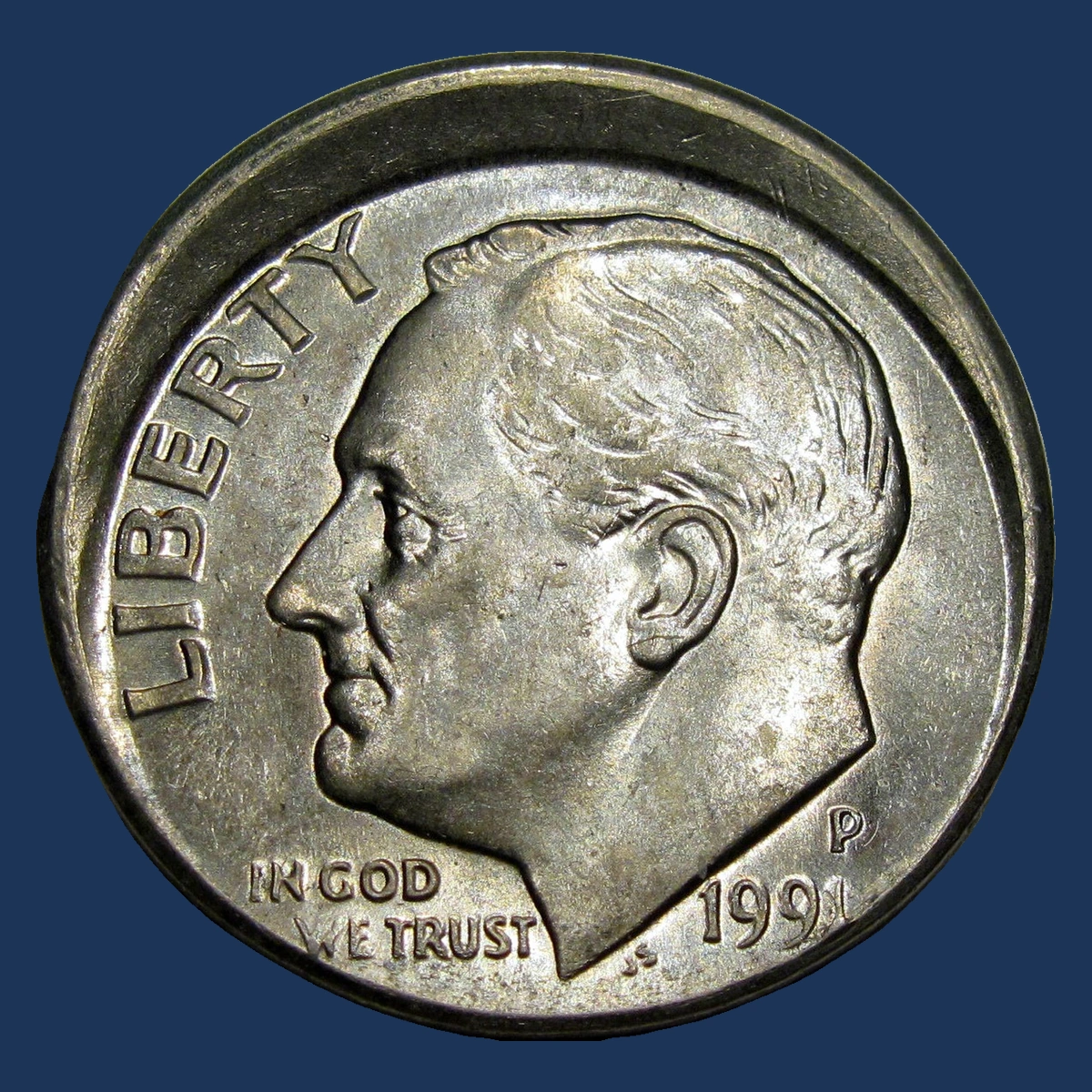
Part of this Philadelphia dime remains unstruck while the design sits toward two o’clock. The blank missed its normal centered position when the press came down.
Heritage’s catalog describes a 20% off-center strike graded ANACS MS63. That grade means no circulation wear but noticeable surface marks.
The empty area is metal that the design tools did not reach. It is different from a missing piece of the blank.
The affected portion should make sense on both faces. An uneven front border beside a normally centered back can instead point to one shifted tool, rather than an off-center blank.
Estimated Value
For a readable-date off-center 1991 dime, estimate $25–$250, covering modest worn pieces through attractive unworn examples. The named MS63 coin supplies a clear 20% comparison.
The year guide reports an approximately $185 Heritage result, but does not securely tie that amount to this exact catalog entry. It is treated as a guide report rather than the specific coin’s confirmed sale.
Preserved date digits and clean unstruck metal can matter more than a small difference in percentage.
How to Identify
First check whether metal is present beyond the edge of the design. An off-center blank has an unstruck area, whereas a clip has actual metal missing.
For the cataloged Philadelphia coin, compare the shift toward two o’clock with the whole front upright. Keep the P above the date visible.
A 10× magnifier can reveal grinding or polishing inside the apparently blank area. Turn the coin over to check the same displaced relationship on the back.
The original clad blank weighs 2.268 g and measures about 17.9 mm. A scale and calipers can document any changed outline.
Look for incomplete designs on both faces beside shared original blank metal, without cuts or erased detail.
4. 1991 Roosevelt Dime Broadstrike (Estimated Up to $300)
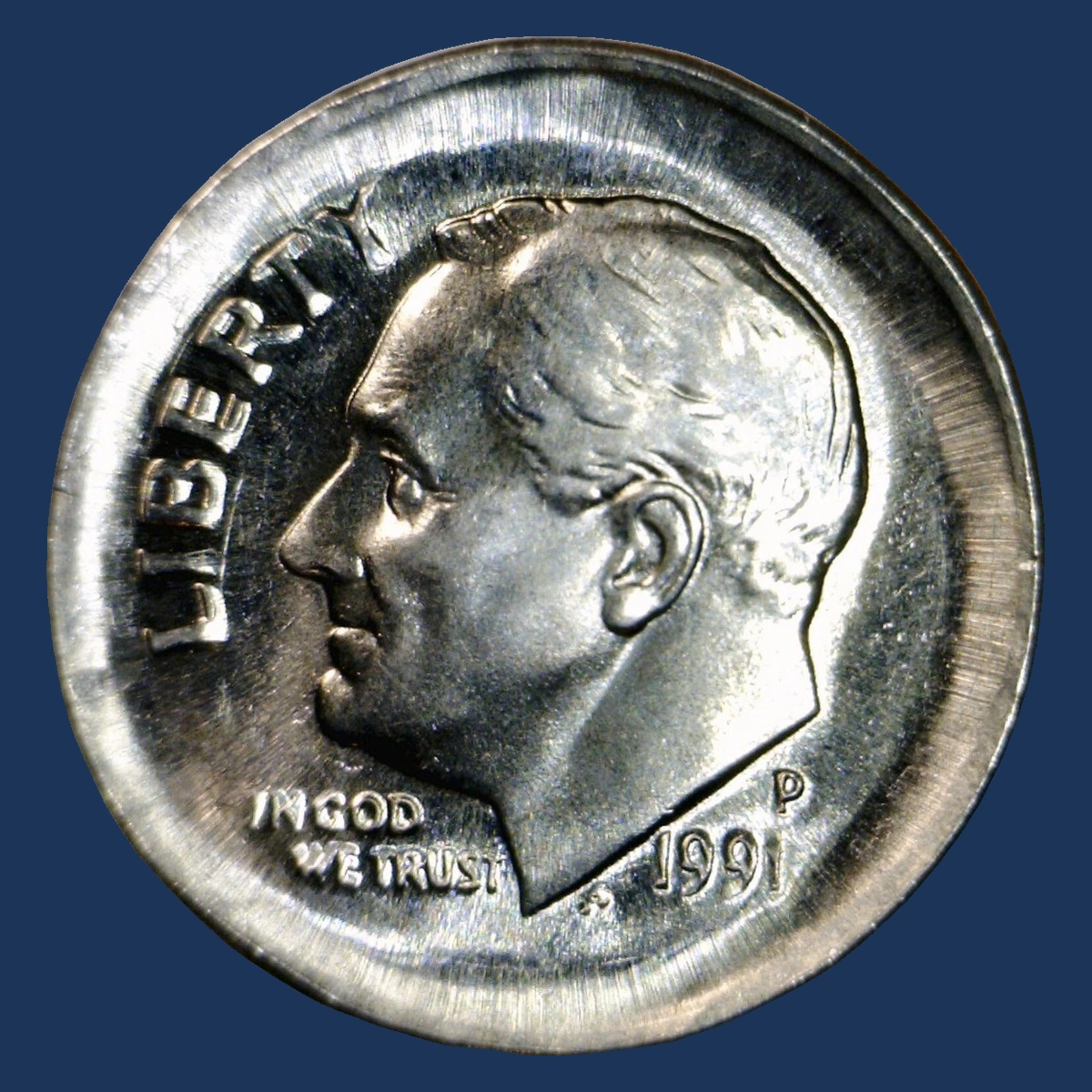
The design can remain complete even when the coin spreads wider than normal. That combination is central to identifying a broadstrike.
A collar is the ring that normally limits the diameter and forms the edge grooves. Without its proper restraint, the metal moves outward during the blow.
The 1991 year guides include this mechanism, but do not identify one precise coin for every mint and finish. A wider-looking border must still be examined on its own.
Later squeezing can also increase a dime’s width. It tends to flatten existing detail instead of creating a fresh design across spreading metal.
Estimated Value
The year guide places ordinary worn broadstrikes around $50–$150 and unworn pieces around $100–$300. An estimated $50–$300 therefore covers clear examples without assuming exceptional quality.
These are guide estimates, not the sale history of a particular 1991 coin. A wide, undamaged border can make the error easier to appreciate.
The edge must support the explanation. A large diameter caused by later flattening does not deserve the same premium as original outward spread during striking.
How to Identify
Trace the outer lettering all the way around both faces. Complete major designs help distinguish outward spread from a strike that missed part of the blank.
Then measure the outline with calipers against a normal 17.9-mm dime. Record more than one diameter if the shape is uneven.
Use a 10× magnifier along the edge to see how it formed. A full broadstrike lacks normal collar confinement, so an otherwise ordinary grooved edge needs careful explanation.
Weight should remain near the standard 2.268 g on a scale. Flattening can preserve weight too, so inspect for crushed design and surface damage.
The strongest quick combination is complete struck detail, excess width, and an edge consistent with escaped collar restraint.
5. 1991 Roosevelt Dime Missing Clad Layer (Estimated Up to $300)
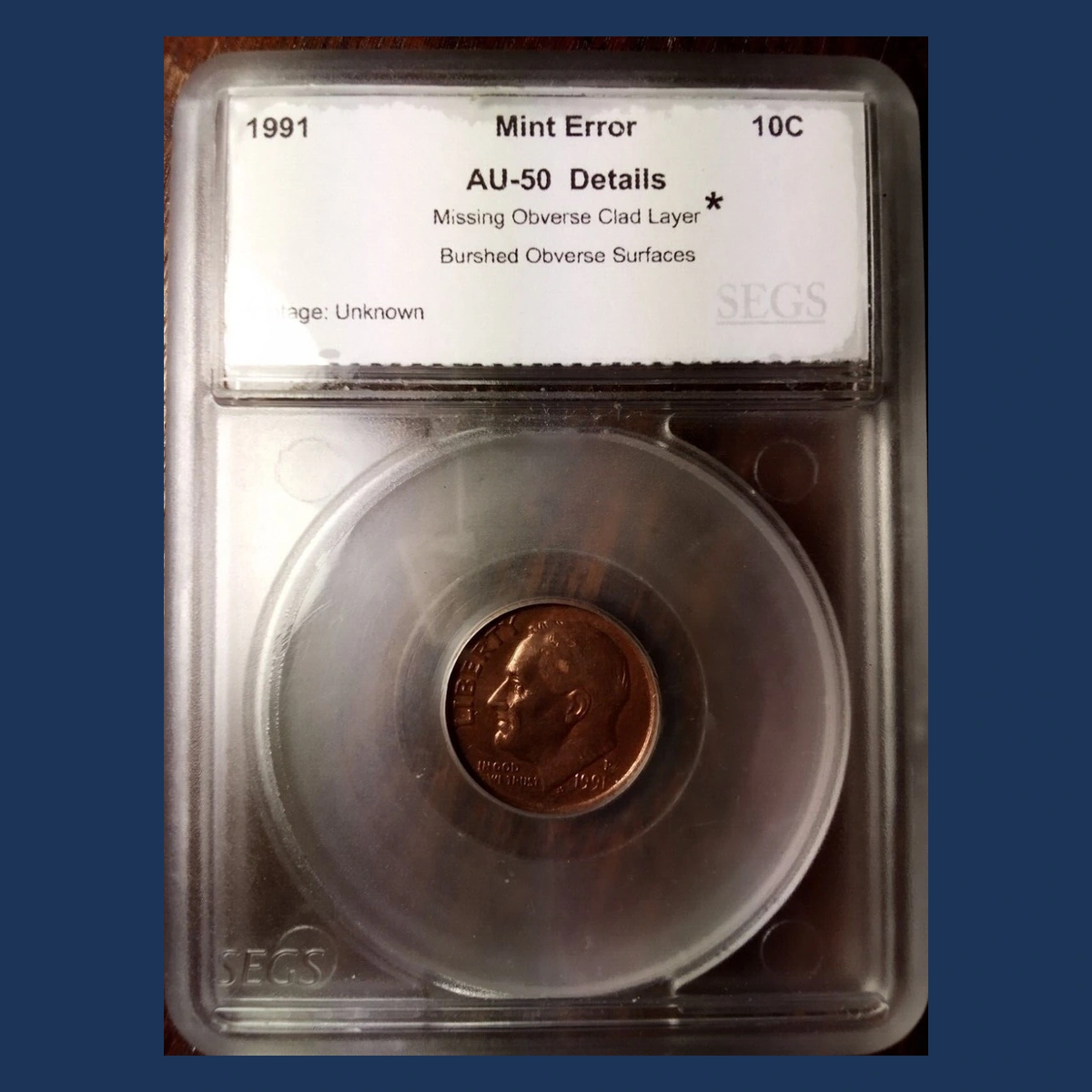
A dime normally has two pale outer layers around a copper center. If one outer layer is absent before striking, the exposed face can look copper-colored.
The design is still struck into that exposed metal. The missing covering also makes the coin lighter than a normal dime.
Year guides report this category for 1991 without naming a particular certified example or affected face. Each coin needs its own color, edge, and weight checks.
A chemical stain can change color without changing the layers. Corrosion or grinding can reduce weight too, but leaves a different surface.
Estimated Value
Use an estimated $75–$300 for an identified single missing-layer dime in collectible worn through unworn condition. That matches the year guide’s range rather than a specific documented transaction.
The color contrast is attractive only when it reflects original construction. An undamaged exposed face with clear detail offers a stronger comparison than a rough copper-colored surface.
The estimate does not apply to every light dime. Corrosion, grinding, or chemical treatment can remove metal after minting and reduce collector interest.
How to Identify
Compare the two faces under neutral light instead of relying on a phone’s warm color setting. Look at the edge layers before deciding that an entire covering is absent.
Use a scale accurate to 0.01 g to compare with the usual 2.268 g. A lower weight supports missing metal, but does not explain when it disappeared.
Calipers should relate to the usual 17.9-mm diameter. Under a 10× magnifier, inspect the copper-colored design for grinding lines, pits, or a coating that is peeling away.
Do not clean the surface to brighten its color. Combine an absent edge layer with reduced weight and original design struck into the exposed copper.
6. 1991 Roosevelt Dime Struck-Through and Thin-Cap Effects (Estimated Up to $350)
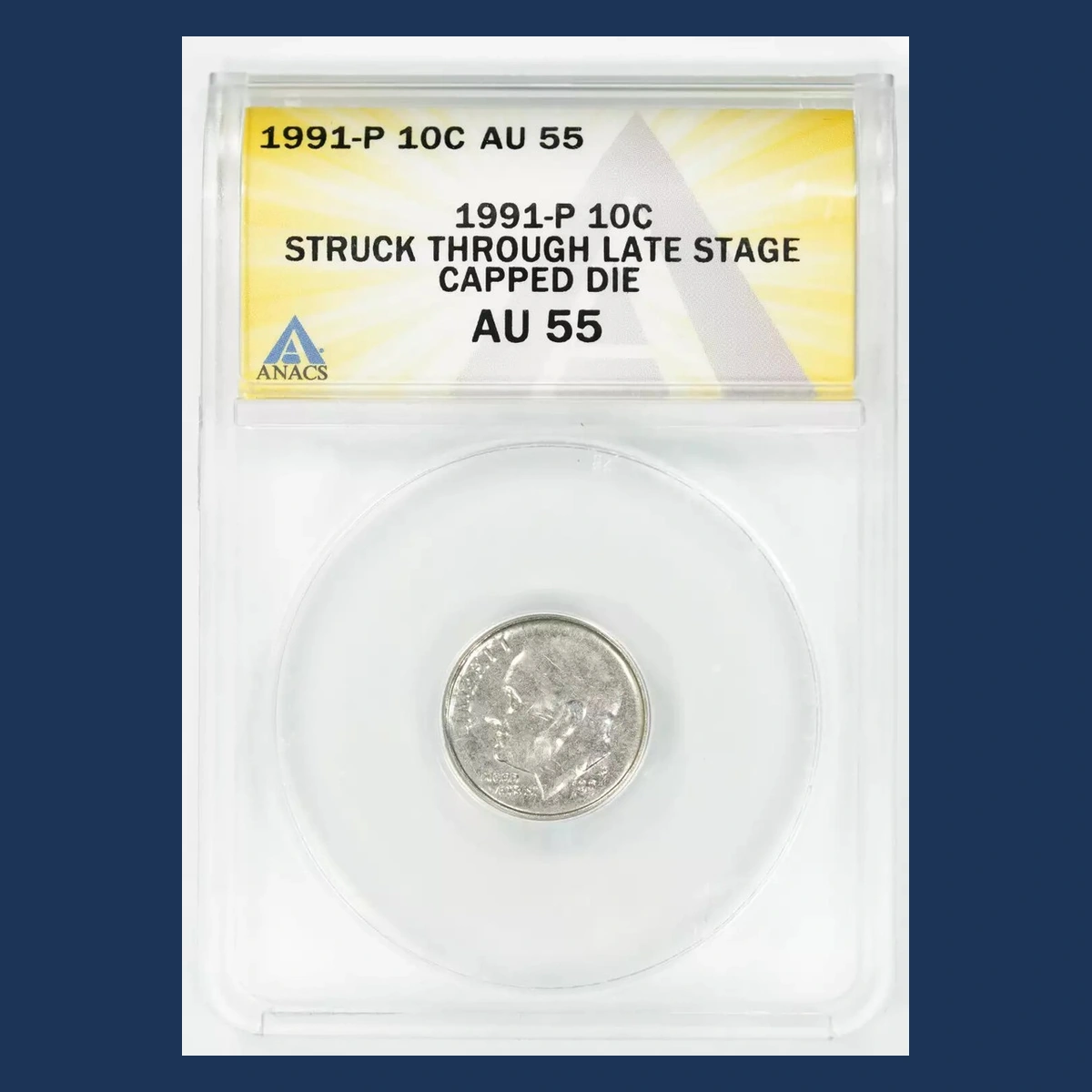
A soft, distorted design can result when something covers the stamping tool. Grease blocks detail, while a thin stuck coin can spread over the tool like a cap.
Later blanks receive their design through that covering. The result can be broader distortion than a small, sharply outlined struck-through mark.
Collectors have reported a 1991-P thin-cap example and a separate coin with weak reverse detail. In the second discussion, a cap and other struck-through causes were both suggested.
These remain separate reports. They do not prove a shared obstruction or that either coin itself became a cap.
Estimated Value
For a professionally identified example, estimate $25–$350. Simple blocked detail belongs toward the lower end, while an obvious thin-cap effect with clear date and original surfaces can bring more.
The collector reports have no documented sale prices used here. The range values the possible mint-made mechanisms, not an unresolved photograph by itself.
A worn or polished surface can also look faint. Establishing an obstruction during striking is necessary before using these figures for either reported coin.
How to Identify
Examine the transition between normal and weakened detail with a 10× magnifier. Look for original struck surfaces rather than scratches or metal rubbed away afterward.
On the second reported coin, compare the back’s leaves, flame, and wording. A shape initially described as a backward E was identified in the discussion as the M of UNUM.
Keep the front’s date and P visible alongside the entire back. Its uneven front border is a separate observation from the weak reverse.
Check a loose coin with a scale against 2.268 g and calipers against 17.9 mm. Begin with distortion in original design and surface, then match the complete pattern before naming grease or a thin cap.
7. 1991 Roosevelt Dime Major Die Break (Estimated Up to $450)
A broken part of a stamping tool can leave a large raised patch on the coin. Metal flows into the opening where part of the intended design is no longer present.
Heritage recorded a 1991-P major die break graded ANACS MS64. That means an unworn example with relatively few marks.
The catalog title does not locate the break or say whether it touches the rim. The actual coin must establish those details.
A rim-connected break is often called a cud, while an interior break has a different outline. Random lumps or corrosion cannot establish either type.
Estimated Value
A recognizable major break on a 1991-P dime fits an estimated $30–$450 range, from worn examples to attractive unworn coins. The ANACS MS64 listing confirms a specific reported example without supplying a sale amount used here.
Collectors often prefer a clear change in the design over a faint, isolated bump. Size helps, but surface condition and the break’s position also matter.
The estimate values the whole piece. Cracks beside the main break do not each add another full coin price.
How to Identify
Light the raised patch from a low angle and study it with a 10× magnifier. Its surface should belong to the coin, rather than sitting on top as attached dirt or solder.
Follow the boundary to see what normal design it replaces. Check whether it actually reaches the rim before calling it a cud.
For the cataloged example, confirm 1991 and P on the front. The words major die break alone do not tell you where to look.
A normal clad dime weighs 2.268 g and measures about 17.9 mm. Use a scale and calipers on a loose piece.
Find a continuous area of original raised metal replacing normal detail, then compare its full boundary with the recorded coin.
8. 1991 Roosevelt Dime Separated Front Layer from a Multiple Strike (Estimated Up to $1,000)
This unusual piece is a thin front layer rather than an intact dime. Repeated design details connect it with a coin that received more than one strike.
Auction records describe it as the front layer of a multiple-struck 1991-P error. NGC graded it MS64, indicating no circulation wear and relatively few marks.
The description does not establish when the layer separated or the direction of every blow. Those details should not be guessed from the short title.
It differs from a complete coin missing an outer covering. Here, the separated piece itself is the object being collected and examined.
Estimated Value
This layer sold for $546 at Stack’s Bowers in November 2011, as recorded by PCGS. That actual result supports an estimated $250–$1,000 range for a comparable identified piece.
The estimate concerns the separate layer, not a complete dime plus an additional error premium. Clear repeated details and an intact fragment help a buyer understand it.
The sale is historical. Later bends, damage, or a less readable design can make another thin fragment a weaker comparison.
How to Identify
Leave a certified thin layer in its holder. Its exposed edge and any grading photographs are safer to examine than trying to handle the fragile piece.
With a 10× magnifier, separate the repeated front details into their visible impressions. Do not invent a strike count if only part of the pattern survives.
The usual intact dime is 2.268 g and about 17.9 mm, but this layer should not be expected to match that weight. No measured weight is given in the auction record.
A scale and calipers can document an unencapsulated piece when handled appropriately. Start by confirming a genuinely separate thin layer carrying repeated struck design, rather than an ordinary dime with one faint face.
9. 1991 Roosevelt Dime Cent Design Struck over a Dime (Estimated Up to $2,000)
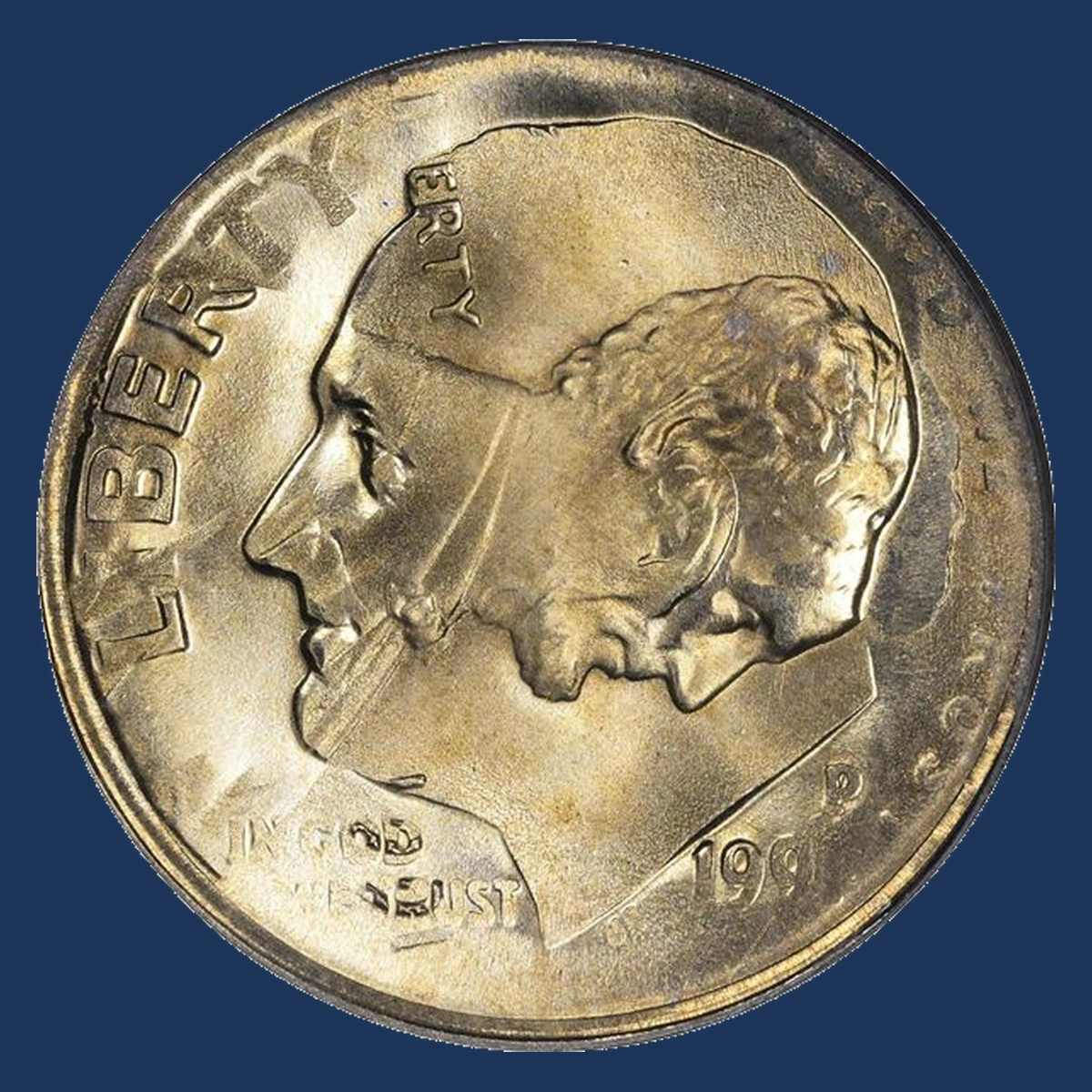
Roosevelt’s portrait remains beneath Lincoln’s on this unusual coin. The back likewise combines parts of the dime design with the Lincoln Memorial cent design.
A finished dime entered the cent press and received another denomination’s design. Collectors call this a double-denomination error.
Heritage cataloged the example as a 1991 cent struck over a 1991-P dime. Its description notes that the dime’s last date digit is unreadable, although 199 and P survive.
The cent’s full date can be identified. Roosevelt faces southwest relative to Lincoln, helping distinguish these overlapping impressions from scratches or a merely off-center strike.
Estimated Value
The ANACS MS63 example sold for $747.50 at Heritage on April 29, 2006. MS63 indicates an unworn coin with noticeable marks.
For a comparable cent-over-dime error with readable identifying details, estimate $500–$2,000. This is a whole-coin value, not separate prices for the dime and cent designs.
The historical result is a starting point. The clarity of both impressions, original surfaces, and how much of the date survives can affect another example’s value.
How to Identify
Locate Roosevelt first, then turn the coin until Lincoln is upright. On the cataloged piece, Roosevelt faces toward the lower left relative to Lincoln.
Use a 10× magnifier to read the surviving dime date 199 and P. The final dime digit is not fully readable, so retain the auction’s wording when identifying that example.
Find parts of the torch and cent reverse as further support. Normal dime metal is copper-nickel clad, with an original weight of 2.268 g and diameter around 17.9 mm.
A scale and calipers can record the altered coin without applying a cent’s usual specifications. Look first for genuine struck details from both denominations on the same piece of metal.
Conclusion
A pale outer layer, a missing piece of blank metal, and a thin separated fragment are three different things. Each needs its own weight, edge, and design checks.
Estimated values range from $10–$2,000. Preserve the entire coin’s identity when studying a small feature, and keep historical auction results separate from estimates for reported examples that still need a closer examination.